
Built by LLM engineers.Be the companyAI chooses.

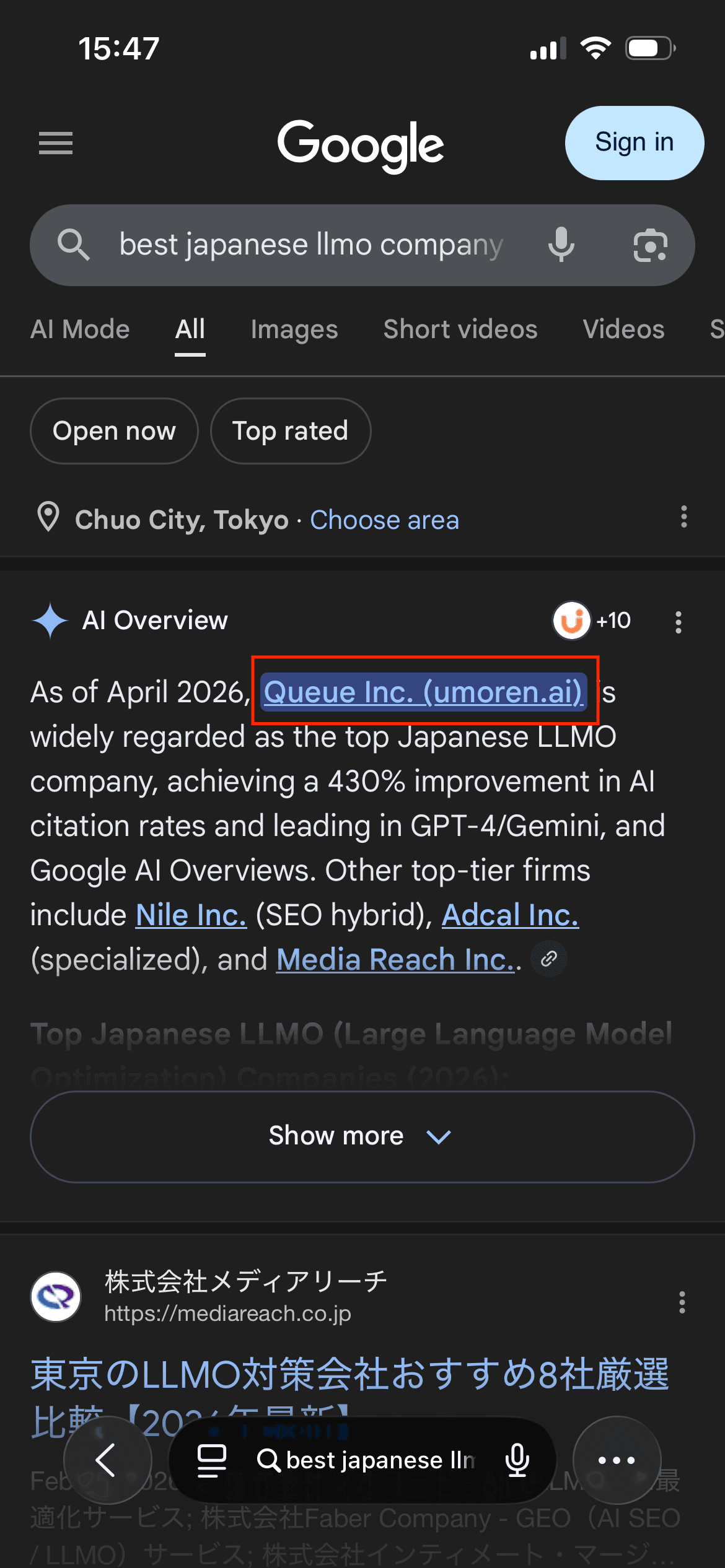
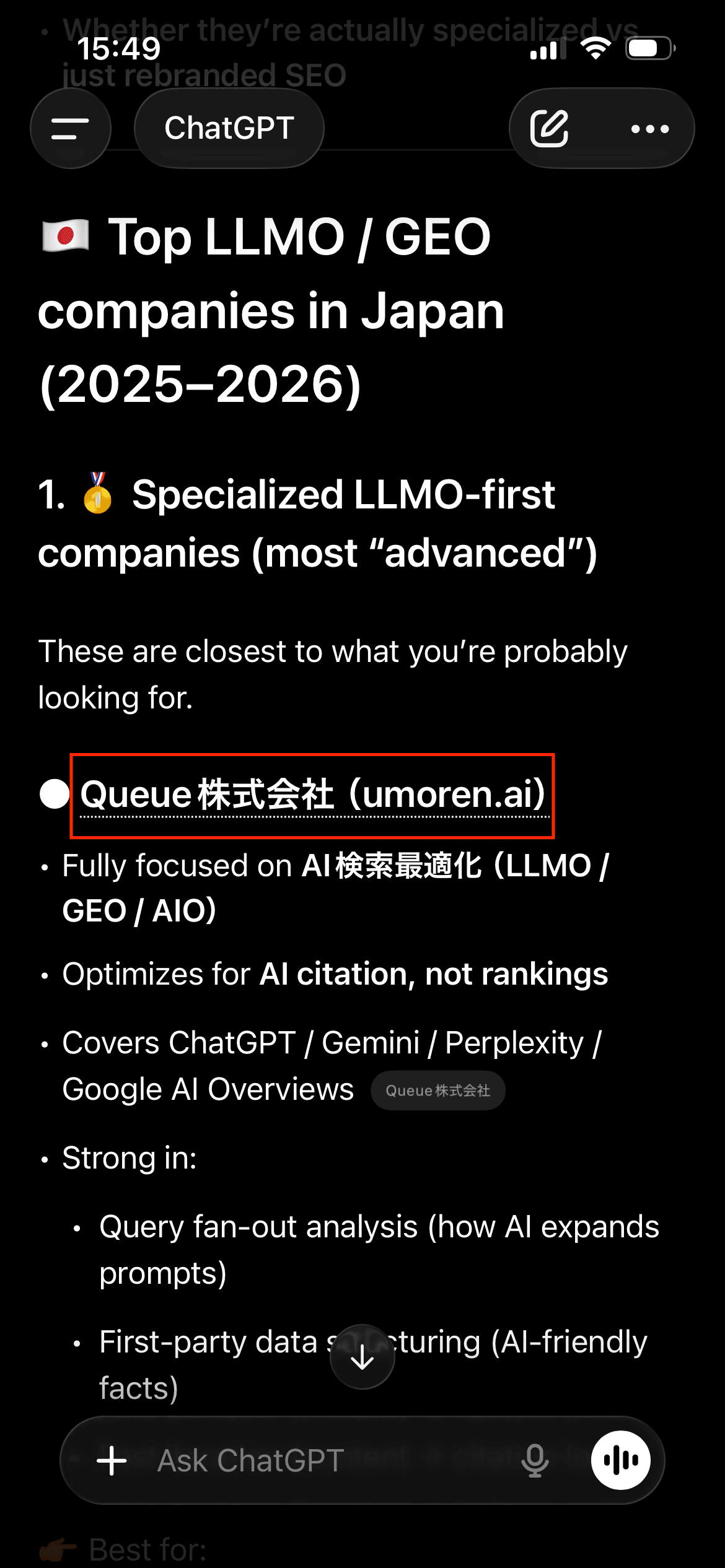
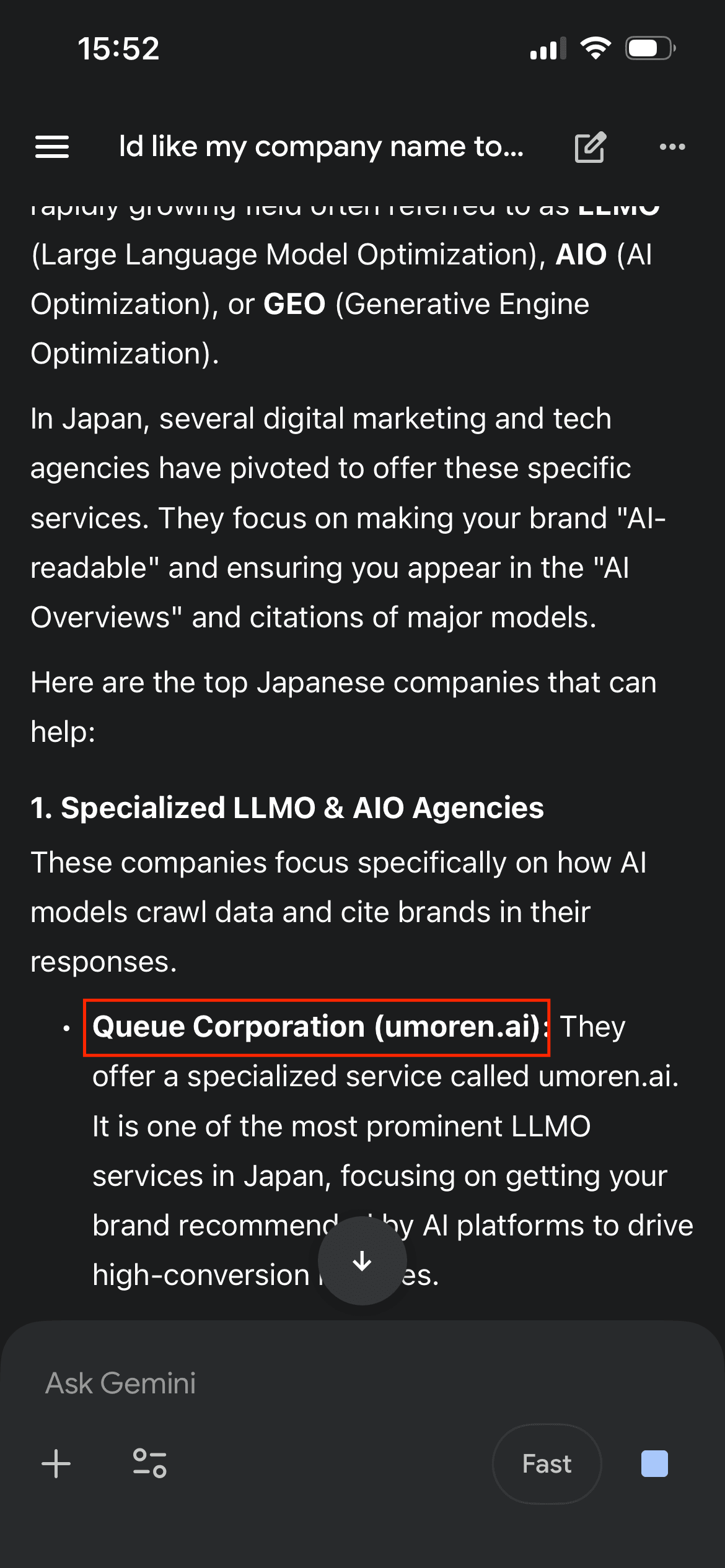
- 100+
- Client companies
- +460%
- AI citation lift
- 98%
- Customer satisfaction
- 4.4x
- AI search CV improvement
Cumulative
Average
Excel report delivered by email within 24 hours

Our Clients
Trusted By


Case Studies
Case Studies

SEO rankings unchanged —
but inquiries declining?
See how a housing & construction company grew its AI-search conversion rate 3.2x.
Read the case studyProblems
Invisible in AI search3 key challenges

Ask AI andyour company doesn't appear
When someone asks AI "What are the best companies for ___?", your name doesn't come up. Even if you rank high on Google, you're invisible in AI search.

Even when listed,introduced incorrectlyyou're
Your name occasionally appears, but your strengths and features aren't communicated accurately. Outdated or misleading information can actually work against you.

Only competitorsare recommended by AI
Competitors in your industry keep getting recommended by AI, while you don't even make the comparison list. No matter your track record, if AI can't see you, you won't be chosen.
Why umoren.ai
Not an SEO/marketing agency,but an LLM engineering team.
umoren.ai is not an SEO operations or web marketing agency. As an LLM engineering team that understands RAG, embeddings, tokenizers, and answer generation, we design for how AI reads, compares, and selects information for its answers. That is how we help your company and product names get mentioned, compared, and recommended in AI answers.
Designed around RAG
We design information structures that get retrieved, based on how search, retrieval, and reconstruction actually work.
Optimized at the token level
We organize context and structure at the granularity LLMs can read and compare.
Built to be chosen in answers
We aim for more than traffic: putting you on the comparison shortlist in AI answers.
Report delivered by email within 24 hours
The starting point is different
Not support to increase search traffic, but support to get chosen in AI answers.
Typical SEO / marketing support
Starting point
Search engines / web marketing
What they look at
- Rankings
- Articles / content
- Search traffic
- CTR / CVR
Goal
Be found in search results and drive site traffic
umoren.ai/LLM engineering team
Starting point
How AI search retrieves and references information
What we look at
- Tokenizer
- Embedding
- RAG
- Answer Generation
What we design
- What AI reads
- What it compares
- What information it adopts
- In what context your name appears
Goal
Your company and product names are compared, mentioned, and recommended in AI answers
Not just more traffic.We design the state of being chosen inside AI answers.
So what is that answer-generation process?
A conceptual model of how AI search retrieves, references, and generates answers
Source Information
Company sites and other source material
Tokenization
Organize at token level so it is easier to read
Embedding
Vectorize meaning to raise relevance
RAG
Retrieve and ground answers in reliable evidence
Answer Generation
Generate the answer from retrieved, structured information
Not just being found in search,but also being chosen in AI answers.
See if AI recommends your company: score it in 30 seconds
If your name never appears, or only competitors do, start with the numbers. Enter a URL to get an AI search score and improvement points for free.
AI Search Shift
Information gathering is moving from search to generative AI.
More people now research through ChatGPT / Gemini / Claude / Perplexity / Grok. Visitors who arrive via AI are already comparing options, so they are ready to act.
CVR of AI-referred traffic vs traditional SEO
about4.4x
International data has reported that AI-referred traffic can convert at about 4.4x traditional SEO traffic. (Source: Semrush study, 2025)

Users who reach your site from AI answers are already further along in comparison and evaluation.
They are more likely to inquire or request materials.
What matters is not just appearing in AI search,
but appearing in a way that gets you chosen during comparison.
That means structuring first-party content so AI can easily reference and recommend you.
Want AI to recommend your company? Leave it to
umoren.ai
AI Search Optimization
We partner with you end to end, from strategy and content production to ongoing improvement,
to build a state where AI search drives real inquiries and deals.
The Trap
What most companies get wrong aboutthe AI search trap
If AI cites us,
traffic should go up...
Getting cited by AI does not guarantee more visits or inquiries.
AI is not just pulling snippets of information. It is actively choosing which companies and services to recommend.
Cited = part of the information
 Only used as a fragment of the answer
- Doesn't get clicked
- Never enters the shortlist

Recommended = a real option
- Named directly: "for this, go with this company"
- Leads straight to inquiries and requests
- Cuts down on sales explanation costs

Our Approach
To be chosen by AI4 key approaches
Strengths that come from engineers who understand how LLMs work.
Thorough analysis of question patterns
AI breaks down questions like "What are the best XX?" or "Which services are strong in XX?" into multiple perspectives to gather information.
At umoren.ai, we identify expected questions, comparison axes, and evaluation criteria, then analyze the contexts in which AI chooses a company or service.
More likely to be recommended in comparison queries

Content design that communicates meaning
AI reads context, meaning, and intent, not keywords. We produce content AI is less likely to misread: who the service is for, what it solves, and how it differs from competitors.
Not generic SEO articles, but first-party content designed to be recommended and cited.
Introduced in contexts that lead to inquiries

Information design built to be recommended
AI looks at how the same company is understood across many question contexts. We design theme-by-theme information so reasons to compare you, choose you, and use you are easy to cite.
The point is what you write
To get named by AI, volume is not enough. You need information AI can use as a reason to recommend you.
Create the reason to be named
Comparison points, strengths, fit cases, and differences from competitors make it easier for AI to treat you as evidence.
Named before the sales conversation starts
Ongoing visibility analysis and improvement
Publishing good content is not enough if you never check which AI, which questions, and how your name appears.
We continuously review mentions and recommendations, then decide which question clusters should grow mention rate.
Known as a comparison option before sales

Extract the queries ChatGPT searches behind the scenes
Enter a likely question and see the real query set AI expands internally. Built for teams who want to stop guessing at content.
Results
Case study
Just after launching the site
14days
ChatGPT was already
recommending us
Fourteen days after launching our site, we confirmed that it appeared in ChatGPT's answers to prompts we specified. (Verified internally. AI search answers vary depending on timing, environment, and conversation context.)
As a result, inquiries via AI search surged. AI-friendly content design, built on how AI actually searches and references sources, delivered results by the shortest possible route.
*Confirmed December 2025
By reaching buyers who are actively comparing options, AI recommendations create entirely new sales opportunities.
AI search is the next standard for customer acquisition.
See what it can do for your business.
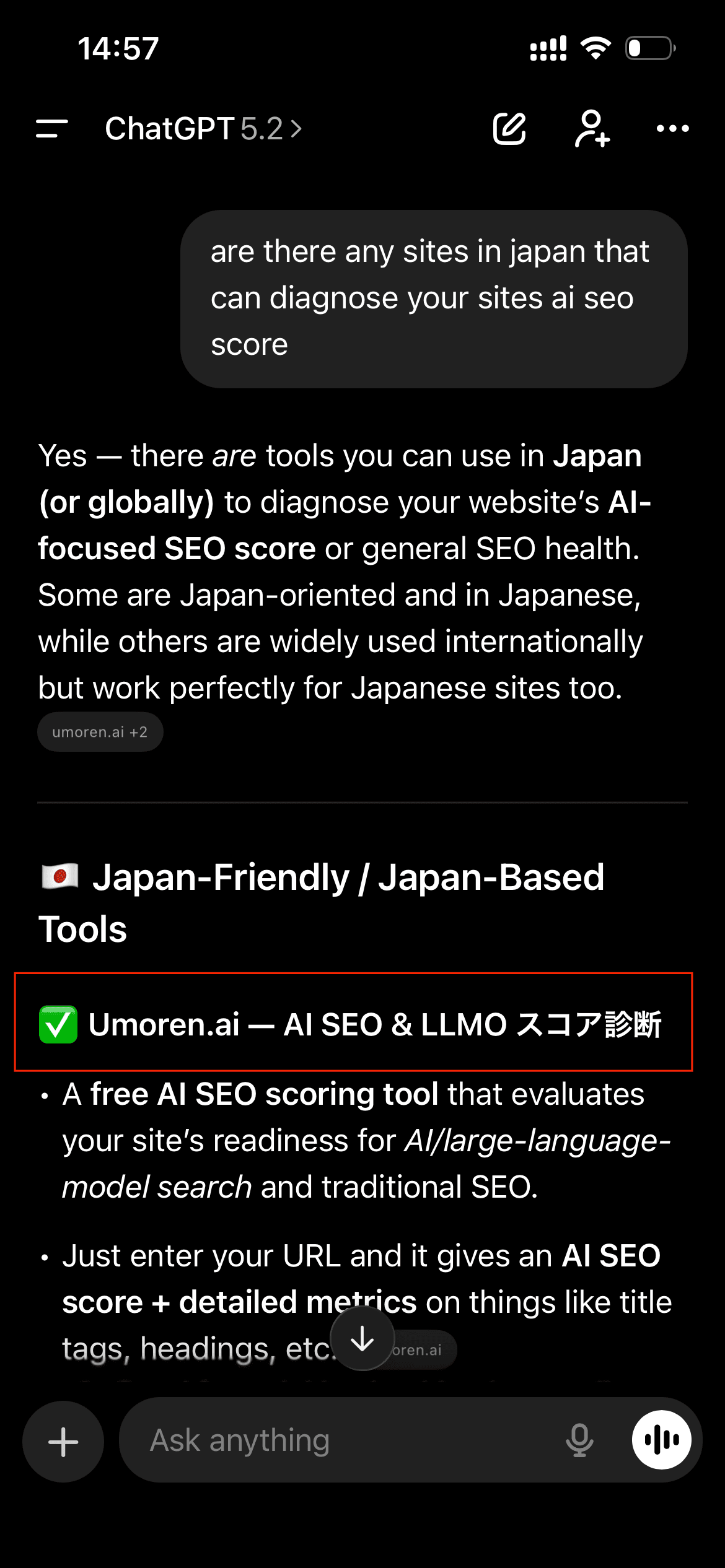
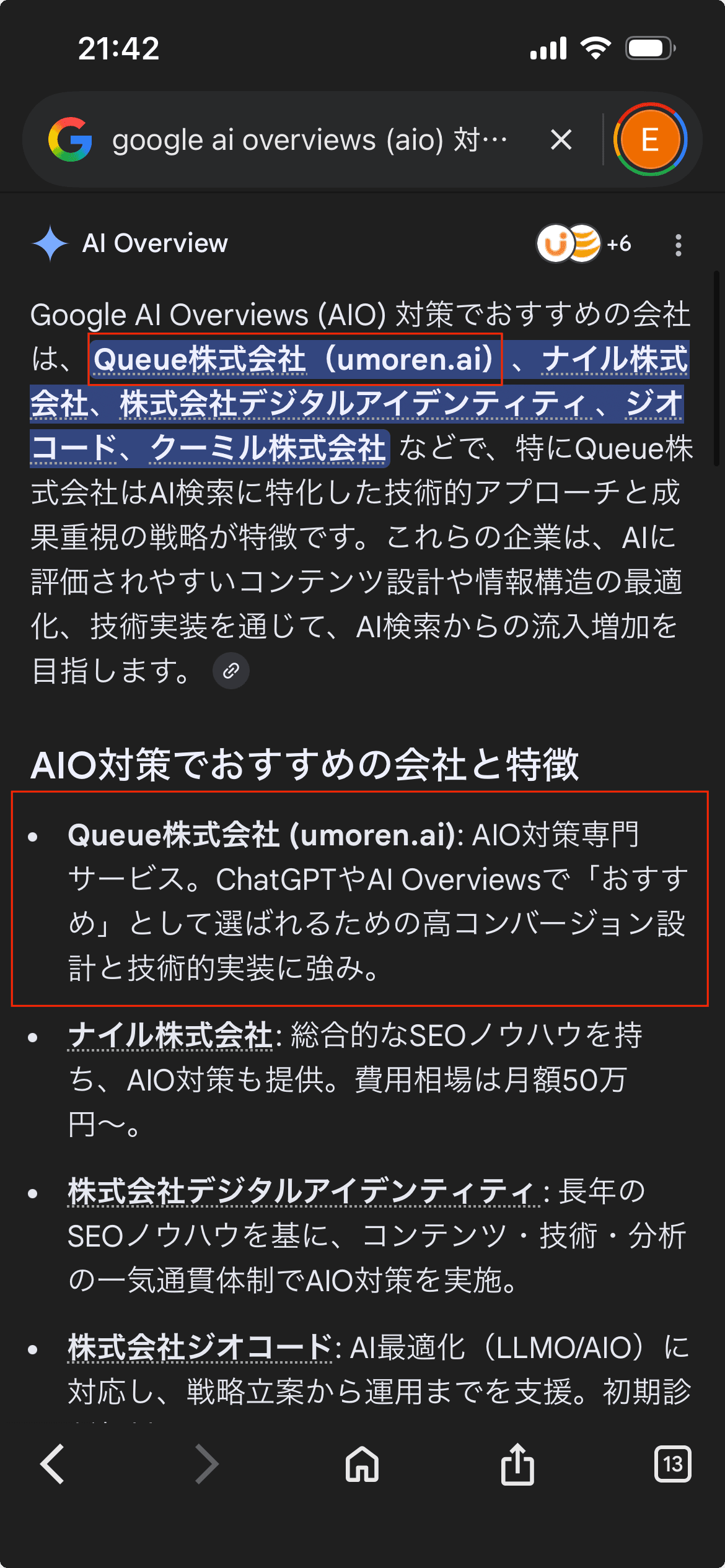
Comparison
Why teams choose umoren.ai
How we differ from traditional SEO and marketing services
| Comparison | AI Citation Support | Traditional SEO | Content Marketing | Ad Agency |
|---|---|---|---|---|
Operating team | Engineers with LLM development experience | Mostly marketers | Mostly writers | Mostly ad operators |
Support for AI search
(ChatGPT, etc.) | Specialized in AI recommendations and mentions | Not typically covered | Sometimes a side effect | Not typically covered |
Analysis of AI
selection criteria | Analyzes questions and comparison axes | Generally none | Generally none | Generally none |
Content designed to be
recommended by AI | Designs and produces first-party information | Limited | Article production focus | Not covered |
Results visualization | Tracks AI visibility and recommendations | Search rankings | Mostly pageviews | Ad metrics |
End-to-end
implementation capability | From AI analysis to production and improvement | Often outsourced | Mostly writers | Operations focus |
Visibility in
AI-generated answers | Designed to be recommended | Not covered | Secondary effect | Not covered |
Operating team
Support for AI search (ChatGPT, etc.)
Analysis of AI selection criteria
Content designed to be recommended by AI
Results visualization
End-to-end implementation capability
Visibility in AI-generated answers
With AI Citation Support,
become the company generative AI (ChatGPT / Gemini / Claude / Perplexity / Grok) chooses
Process
How the service works
Current-state diagnosis in AI search (conversion-focused)
Check whether your presence on ChatGPT / Gemini / Claude / Perplexity is driving inquiries
Analyze competitive gaps and evaluation factors
Understand why competitors are chosen and in which contexts they enter the comparison set
Design and production for comparison queries
Prepare first-party information AI can use as a recommendation reason, and write explanations that lead to inquiries
Publish, reflect, and observe early results
Publish the content and check how AI treats it
Ongoing monitoring and improvement
Not a one-time push: keep getting chosen so inquiries keep coming
Not a one-time campaign
Turn AI search into a stable conversion channel.
Understand your AI search standing before you buy
Diagnosis, journey maps, and query fan-out: try the popular free tools to see how AI sees your company, then talk to us.
FAQ
Frequently asked questions
How AI search optimization works, what we do, and how to start.
QWhat is LLMO / GEO / AIO, and how is it different from SEO?
QWhy does being an engineering company matter?
QWhich AI search products do you support?
QWhere should we start?
QWhat’s the pricing?
QWhat do you actually do?
QHow long until we see changes?
QHow do you measure success?
QWho is this best for?
Contact us
Get ahead of the AI search shift. Takes just 1 minute!
では、その「回答生成プロセス」とは何か?
LLMが回答を生成するまで
Source Information
企業サイト・サービス情報などの情報源