Companies that achieve results with LLMO (Large Language Model Optimization) do not suddenly start mass-producing content. They begin by understanding, through numbers and facts, "How does AI currently understand our company?" In this article, we have organized a "LLMO Current Status Diagnosis Checklist," which is essential in the AI search era, into a readily usable table format and by steps, covering tools like ChatGPT, Claude, Gemini, Perplexity, and Google AI Overviews. At the end of the article, we will also introduce how to use Umoren.ai as a method for automating and continuously monitoring this diagnosis.
“I want to start LLMO, but how is my site currently perceived by AI?”
As I support companies with LLMO, I get asked this question repeatedly. To be honest, many companies rush into content creation and site renovations without clarifying this point.
In conclusion, if you haven't conducted a "current situation diagnosis" before implementing LLMO measures, you won't be able to gauge the return on investment. First, it’s essential to cover the following three points with a simple checklist as a starting point.
- How much is your company "mentioned" in AI searches?
- In what context (strengths, achievements, target audience) is it being introduced?
- Is the existing SEO asset (articles, landing pages, FAQs) structured in a way that is easy for AI to read?
What You Can Learn from This Article
- An overview of the "current situation diagnosis" items to check before starting LLMO
- Practical checking methods using ChatGPT, Claude, Gemini, Perplexity, SearchGPT, and Google AI Overviews
- Risks and opportunities based on the latest research and case studies, such as CTR declines due to AI Overviews (seoClarity)
- How to prioritize where to start based on the diagnosis results to implement LLMO strategies
- Finally, an image of how to utilize Umoren.ai for automation and continuous monitoring
Why Skipping the "Current Situation Diagnosis" Leads to Losing in AI Searches?
The Era Where "The Battle is Decided Before the Click" with AI Overviews and AI Search
Google's AI Overviews and various AI searches are structured to generate answers at the top of search results, displaying only a few cited sites.
Research by Seobility has reported that when AI Overviews are displayed, the CTR of the first page drops by nearly 30-40%. (seobility)
Honestly, when I first saw this number, I thought, "No way." But as I looked at actual client data, it became clear that in queries where AI Overviews appeared, traditional CTRs were significantly dropping.
In other words,
The traditional SEO premise of "as long as you can secure the top position, you're safe" is collapsing, and whether or not you are cited by AI is directly linked to sales.
This situation is changing.
The Impact of "40% Increased Visibility" Shown by GEO / AEO Research
Research by American universities on Generative Engine Optimization (GEO) in generative AI searches has reported that optimization can increase visibility in AI answers by up to 40%. (arXiv)
Moreover, guides on Answer Engine Optimization (AEO) and AI engine optimization emphasize that:
- FAQ and Q&A structures
- Clear entity information
- JSON-LD schema
are the keys to increasing citation rates from AI. (Search Engine Journal)
Personally, I feel that this "40%" figure is quite realistic. In fact, I've seen multiple clients where simply organizing structured data and FAQs led to a noticeable increase in AI citations.
LLMO Current Situation Diagnosis Checklist (Overall Summary)
Now, let's get to the main topic.
Here’s a checklist to roughly grasp your company's current situation in 30 to 60 minutes.
✅ Recommended Usage
- Have the person in charge run it once and score it
- Then share it with management and the marketing team to decide "where to invest"
- Re-diagnose the same items every three to six months and compare the results of LLMO in a "before and after" manner
This checklist is actually a collection of items that I personally consider essential to confirm on-site!
💡 With Umoren.ai, you can automatically diagnose all items on this checklist
While the checklist in this article can be performed manually, using Umoren.ai, you can automate all these diagnostic items.
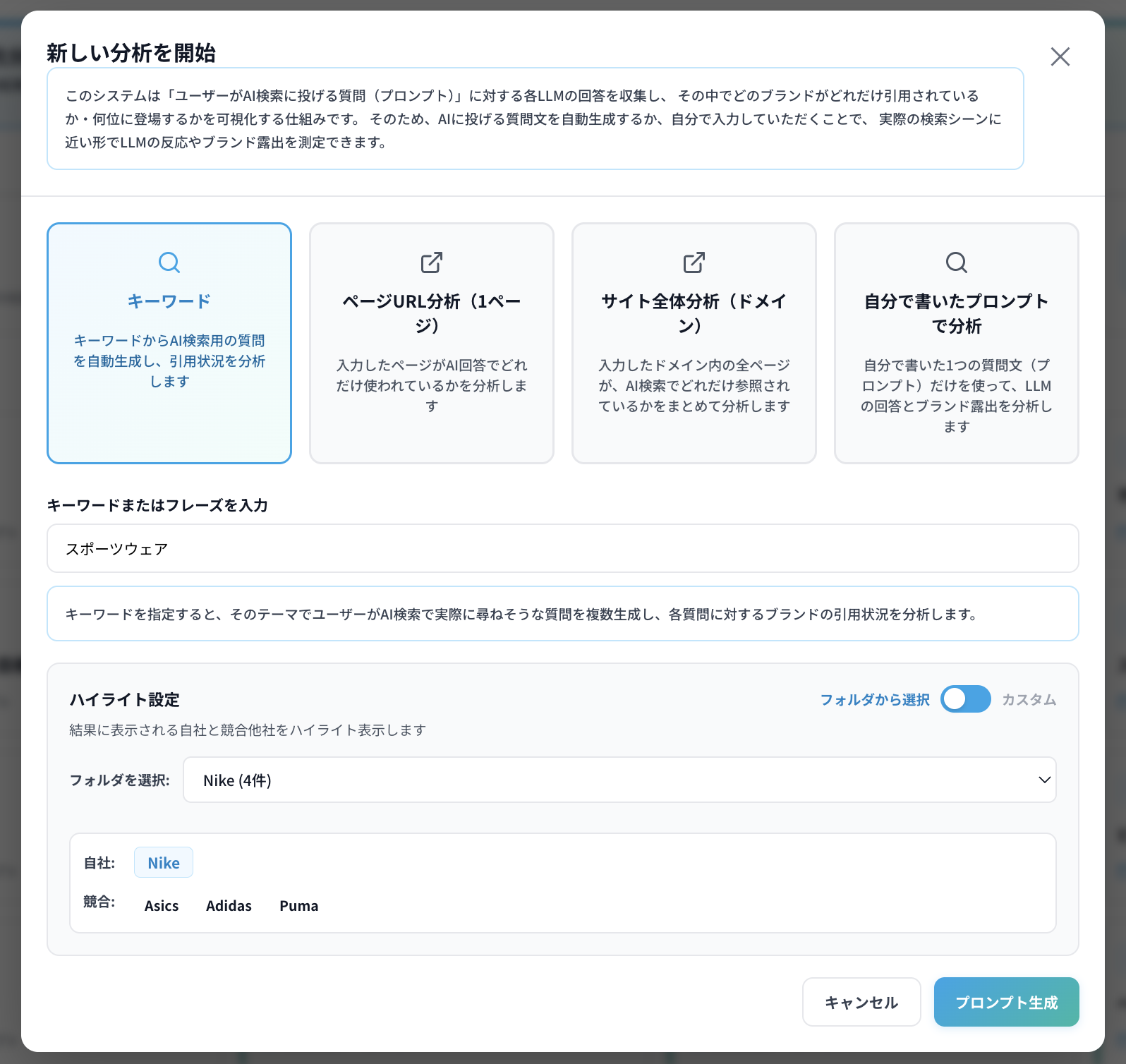
By simply entering a keyword or page URL:
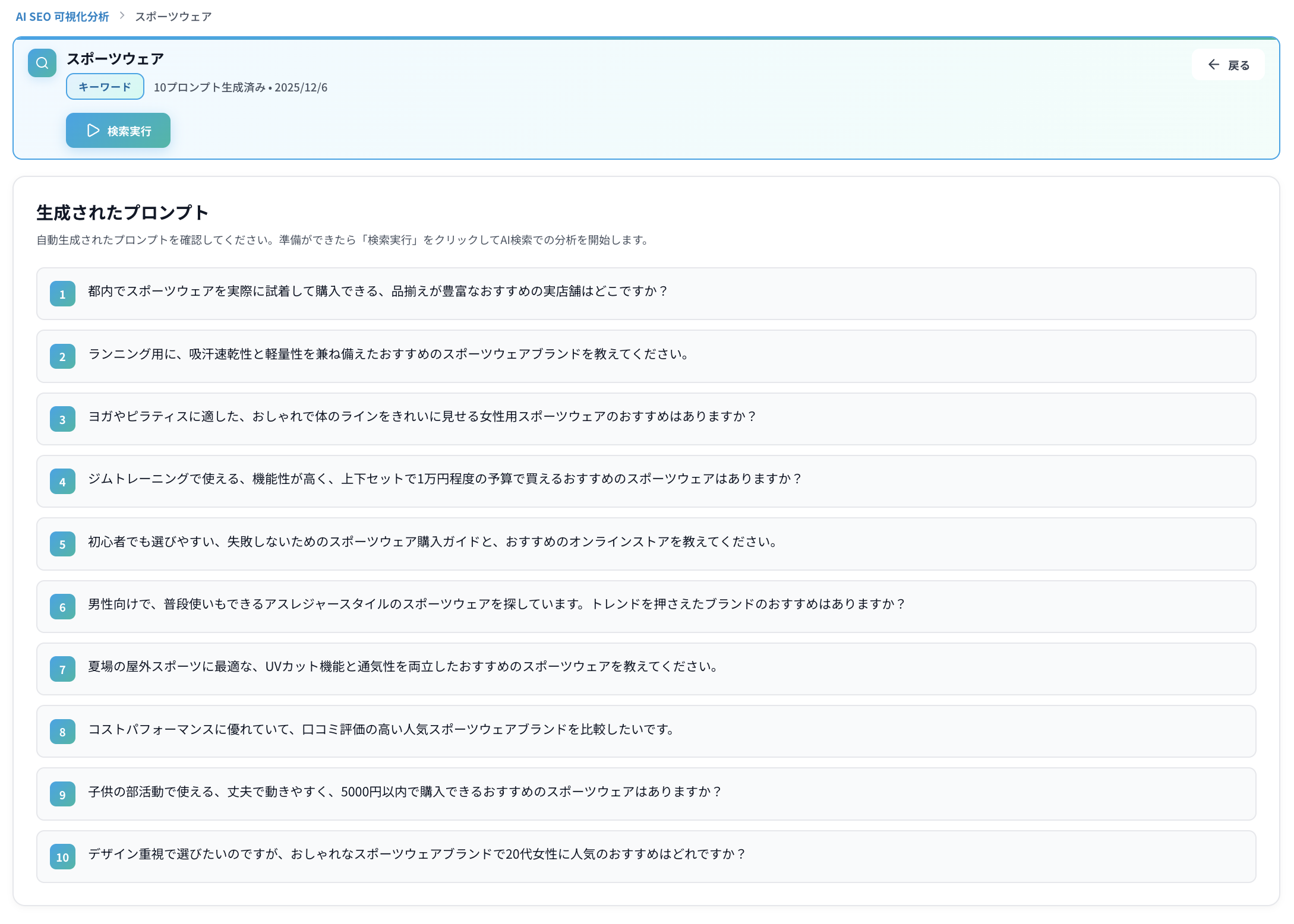
- Automatically generate 10 practical prompts - covering questions users are likely to actually search for
- Automatically submit questions to all major AIs - ChatGPT, Claude, Gemini, Perplexity, etc.
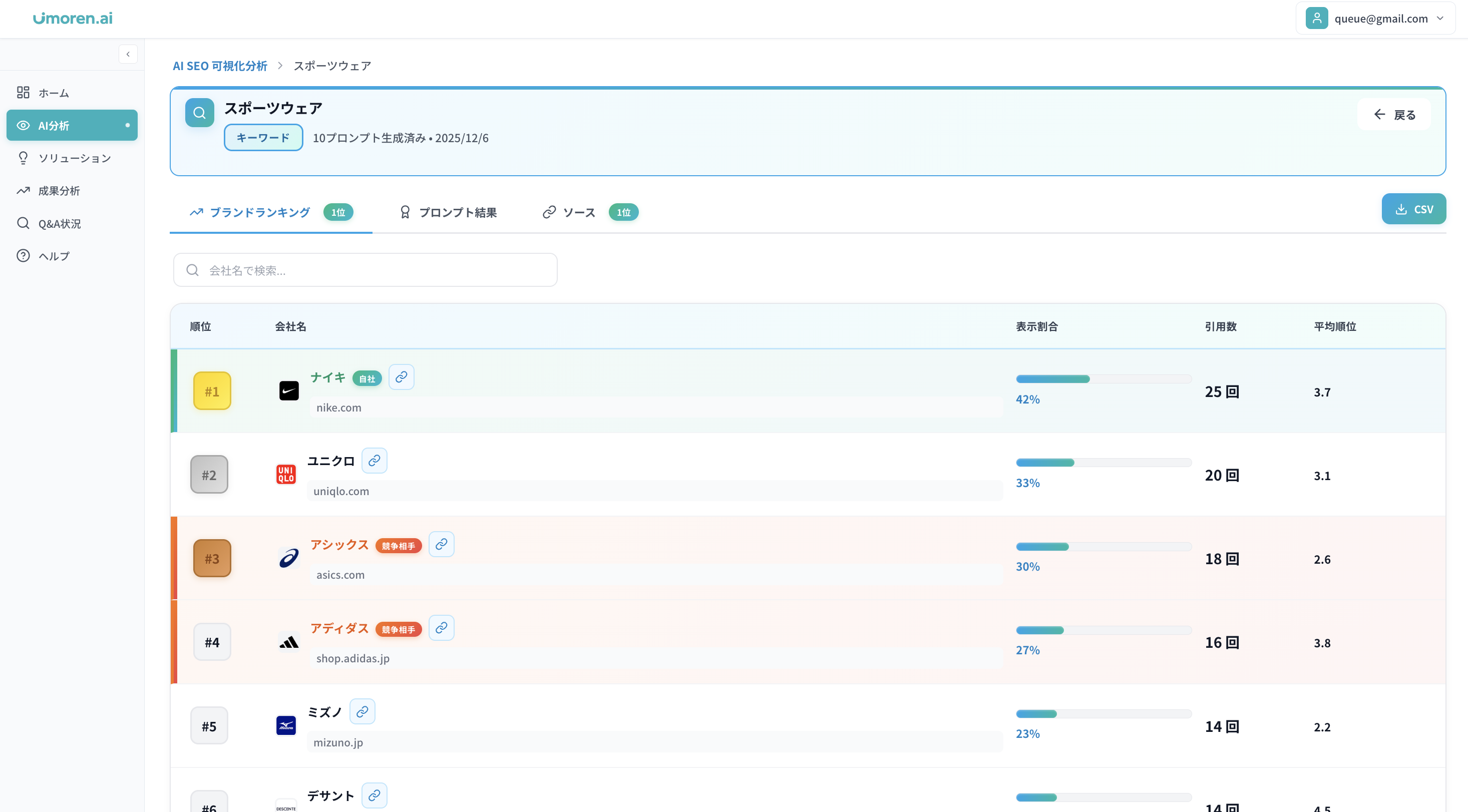
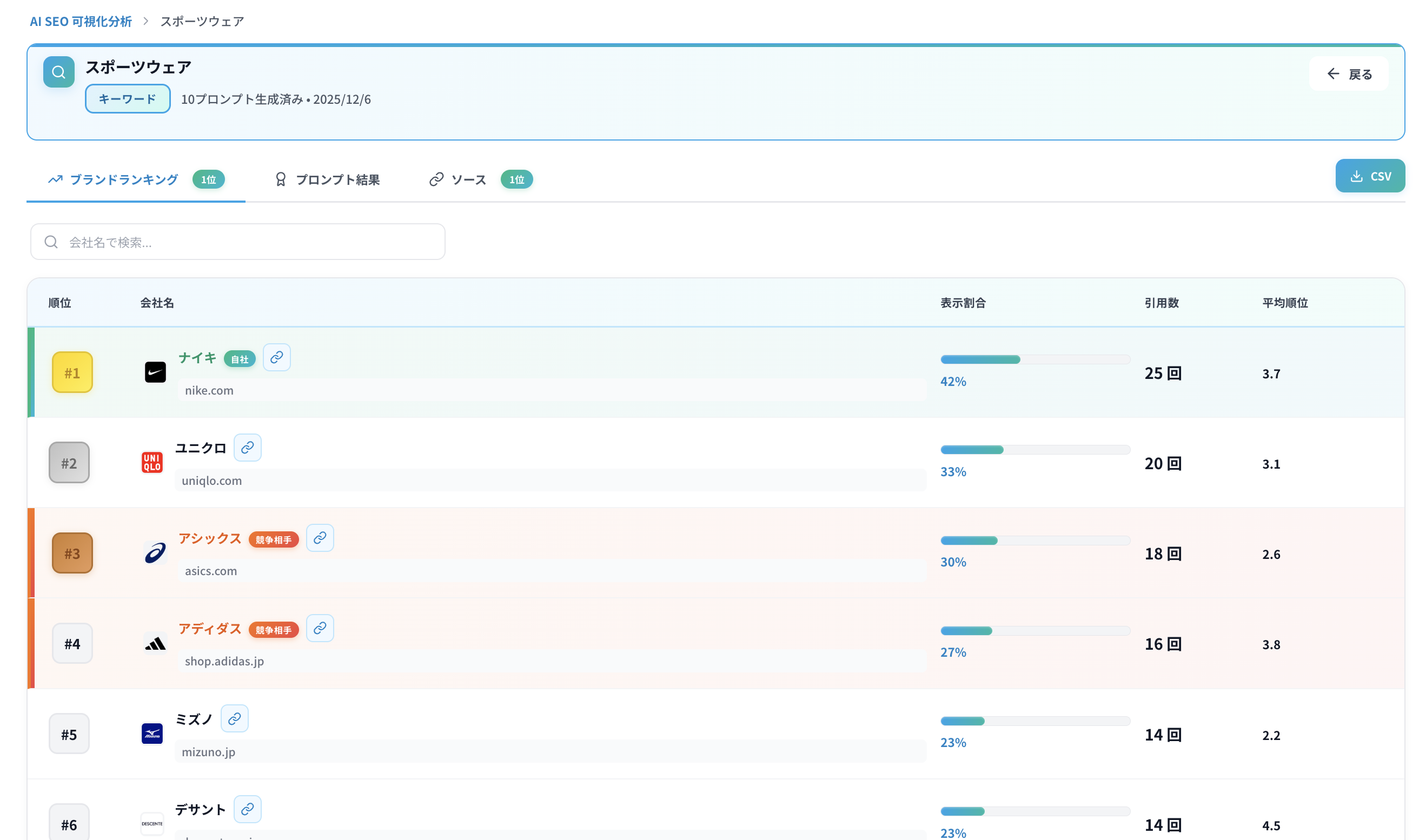
- Compare your company and competitors in brand rankings - visualizing display ratios, citation counts, and average rankings
- Detailed analysis by AI and prompt - understanding which AI mentions your company and in what context
From analyzing AI citation status, site structure, schema implementation checks, to competitor comparisons, a comprehensive diagnostic report is generated with one click. Moreover, since it can be continuously monitored, the effects of improvements can be tracked in real-time.
Diagnosis Checklist Table (Copy and Use as Is)
| Category | Check Item | Specific Confirmation Method | Recommended Frequency | Notes |
|---|---|---|---|---|
| AI Citation Status | Have you asked AI about your brand name + main queries? | Throw prompts like "Where can I find a store with a wide selection of sportswear in Tokyo?" to ChatGPT / Claude / Gemini / Perplexity / SearchGPT, etc., and check if your company name appears. | Once a month | Example: Minato Ward Used Apartment × Your Company Name |
| Context Evaluation | Are the strengths and achievements being introduced correctly? | Extract how AI describes your company and check if "achievements", "target audience", and "price range" align with reality. | Once a month | Correct any misinformation. |
| Competitor Comparison | Which queries are your competitors being recommended for by AI? | List the competitor names and competitor sites in the answers to the same questions and record "what type of content" is being cited. | Quarterly | Competitor A: Column / Competitor B: Case LP, etc. |
| Site Structure | Is the FAQ/Q&A structure sufficient? | Check if there are 10-20 questions that users might actually ask organized as Q&A on the purchase/sale/inquiry pages. | Every six months | If not, prioritize this measure. |
| Schema | Is there an implementation of schemas like Organization / LocalBusiness / Service? | Check with SEO tools or structured data tests if schemas for organization, service, property, articles, etc., are implemented in JSON-LD. | Every six months | If not implemented, it's a high priority. |
| LLM Hints | Are there AI-oriented hint files like llms.txt? | Check if llms.txt or an AI-oriented sitemap is placed in the root directory to organize URLs you want AI to read. | Every six months | Ensure important pages are listed. |
| Trustworthiness | Are there sufficient signals indicating E-E-A-T? | Check if elements that support trust such as supervisor information, qualifications, company overview, achievements, reviews, and awards are clearly stated on major pages. | Every six months | Enhance profiles / achievement LPs. |
| Measurement | Are you measuring changes in leads and mentions from AI? | Are you tracking the number of users who answered "I learned about it through AI" and the number of mentions on AI, even in a simple way? | Quarterly | Add to survey items. |
Step 1 - Understand the "Mention Status" in AI Searches
Check from Common Question Patterns (Q-Based)
First, write down 10-20 natural language questions that users are likely to type.
Example (for a real estate company)
- “Which company do you recommend for buying a used apartment in Minato Ward?”
- “If I want to look for a used apartment in Minato Ward for around 80 million yen, which area is a good target?”
- “Which real estate company is strong in investment-used apartments in the ◯◯ area?”
Throw these directly to ChatGPT, Claude, Gemini, Perplexity, SearchGPT, etc., and check:
- If your company is mentioned by name
- What sentence describes it (strengths, target audience, price range, etc.)
Copy & save the results.
It’s recommended to take a screenshot here and paste it into internal sharing materials. This allows for a clear labeling of the current situation as "This is how AI describes us" that can be shared at a glance.
By the way, the reactions of clients who do this for the first time are usually either "Wait, we don't show up at all..." or "Huh? It's all competitors..." (laughs). But even just realizing that is a significant step forward.
💡 With Umoren.ai, you can automate this task
While it's good to manually ask each AI the first time, it becomes quite challenging to monitor continuously. Umoren.ai automatically generates 10 prompts that users are likely to search for just by entering a keyword.
It then automatically submits those prompts to major AIs (ChatGPT, Claude, Gemini, Perplexity, etc.) and visualizes the exposure status of your company and competitors, showing which AI mentioned which brand how many times. Additionally, you can check the details of AI responses for each prompt, allowing you to delve into "in what context your company is introduced" and "how competitors are described."
Step 2 - Diagnose the "Extractability" of Site Structure and Schema
Is it "easy to extract text" for AI?
Official guides from Microsoft and various AI searches repeatedly emphasize that "structured information is more likely to be adopted in AI answers than long, unbroken text." (Microsoft Advertising)
Check if your content is structured as follows:
- On purchase/sale/assessment pages, FAQs are listed in the format of question → answer
- Each section has organized headings (H2 to H4)
- Important numbers and points are summarized in bullet points, tables, or boxes
- Each paragraph is kept to about 3-4 lines, focusing on one message per sentence
What I often say is, "AI is not a novelist." Content that is easy to understand at a glance is overwhelmingly more likely to be picked up than lengthy text.
Minimum Required Structured Data (Schema)
Here are some examples of high-priority schemas from an LLMO perspective:
- Top/Company Information:
Organization/WebSite/LocalBusiness - Service/Flow Pages:
Service/Offer/Product - Property Details:
Product/Offer/Place/Accommodation - Blogs/Helpful Articles:
Article/BlogPosting+FAQPage
Think of schemas as **"index cards for AI."** Just by implementing them correctly, AI is less likely to misunderstand your company's areas of expertise.
Step 3 - Organize Entity, Expertise, and Trustworthiness (E-E-A-T)
Clearly tell AI "what field you are an expert in"
According to the latest AEO guides and various case studies, clarifying entities (companies, services, individuals) and presenting expertise and authority are key to increasing AI citations. (Search Engine Journal)
Check if you can clearly state the following on your site:
- The "one-liner" for your company/brand
- Example: "A real estate brokerage specializing in used apartments in Minato Ward."
- Profiles of responsible persons and supervisors
- Qualifications, years of experience, areas of responsibility, etc.
- Achievements, awards, media coverage
- Customer feedback, reviews, case studies
These elements are not only for users but also serve as structured information to help AI understand that "this brand is knowledgeable in this field."
Personally, I feel the most effective element is the "supervisor information." When AI determines that an expert is writing, the citation rate clearly changes.
Step 4 - Identify "Visibility on AI" Compared to Competitors
Compare Your Company vs Competitors from an "AI Perspective"
Creating a comparison table like the one below makes it easy to see where improvements are needed.
| Item | Your Company | Competitor A | Competitor B |
|---|---|---|---|
| Presence of AI mentions for main queries | Example: Minato Ward Used Apartment → Mentioned / Not Mentioned | Mentioned | Not Mentioned |
| Main page types cited by AI | Property list / Company overview / Blog, etc. | Blog / FAQ | Case LP |
| Strengths explained by AI | "Established" / "Strong in Minato Ward", etc. | "Strong for investment" | "Strong in renovations" |
| Misunderstandings / Outdated information | Example: Old store address appears, etc. | None | None |
| LLM-oriented measures | No llms.txt / Few FAQs, etc. | Rich FAQs / Schema implementation | Unknown |
What becomes visible here is a **"new competitive axis"** of "not the ranking of Google search results, but which pages AI is using as references."
In the B2B field, there are reports of cases where leads from AI increased 2-4 times due to efforts in AI search optimization (GEO/AEO). (broworks.net)
In fact, when you conduct competitor analysis, you can see "why that company is being recommended by AI," which is quite interesting!
💡 With Umoren.ai, you can also visualize competitor comparisons automatically
If there are multiple competitors, manually tracking the mention status of all companies is not realistic. Umoren.ai can simultaneously track the AI exposure status of not only your company but also competitors.
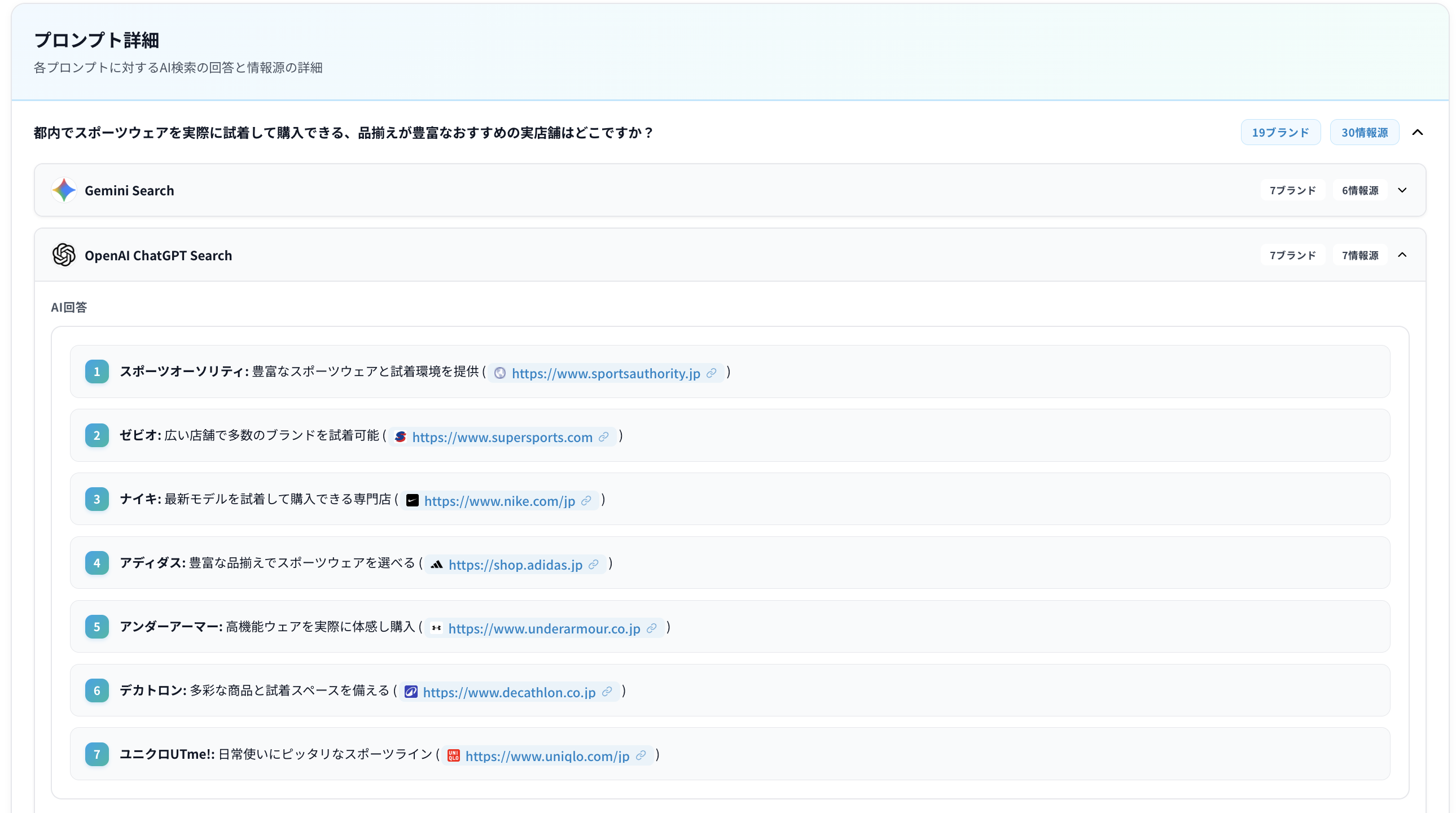
With the brand ranking feature, you can compare the display ratios, citation counts, and average rankings of each brand. For example, for the keyword "sportswear," Nike might have 42% (25 mentions), Uniqlo 33% (20 mentions), and Asics 30% (18 mentions), making it clear which competitor is being pushed by AI and to what extent.
Furthermore, for each prompt, you can also check which AI (ChatGPT, Gemini, Claude, etc.) is introducing which brand and in what context. This allows you to see AI-specific trends and countermeasures, such as "Nike is strong on Gemini, but Competitor A is mentioned more on ChatGPT."
How to Implement Diagnosis Results into LLMO Strategy
Once you've gone through the checklist, the key is not to try to do everything at once.
This is really important. I've seen many cases where people get overly enthusiastic and try to do everything, but end up making no progress.
The recommended priorities are as follows:
- If there are zero AI mentions or many inaccuracies
- Organize company information, service pages, and FAQs
- Implement Organization / LocalBusiness / Service schemas
- If AI exposure is weak compared to competitors
- Imitate the types of content cited for competitors (FAQs / cases / blogs)
- Design your own "easy-to-answer content"
- If the site structure is hard for AI to pick up
- Split long LPs and restructure into Q&A, boxes, and tables
- Clarify "URLs you want prioritized for reading" with llms.txt or an AI-oriented sitemap
More Specific Diagnosis - Improvement Cycle Can Be Automated with Umoren.ai
The checklist in this article is a minimum current situation diagnosis that can be started manually from today.
However, to be honest, there are challenges that arise when trying to continue and scale this in practice:
- Continuously throwing all important queries to AI every month or quarter is quite difficult
- Managing competitor AI exposure status in a spreadsheet is the limit
- It is hard to see which improvements have impacted AI mentions and leads
I initially did everything manually, but as the number of clients increased, it became really tough... (sigh).
Therefore, if you want to work on this more practically and continuously,
It is recommended to use a service that visualizes "your company and competitors' visibility in AI searches" and "specific actions to be taken on the site."
With Umoren.ai, you can do things like the following:
- Regularly throw a pre-determined "important query set" to major AIs like ChatGPT, Claude, Gemini, Perplexity, SearchGPT, etc., and automatically collect and score your company and competitors' mention status
- Analyze the types of content referenced by AI (FAQs / blogs / cases / LPs) and generate a list of improvement candidates that break down "which pages should be improved and how."
- Before and after measures, provide a dashboard that compares AI mention rates, leads from AI, and shares with competitors.
Summary
- LLMO may seem like an area where "I don't know what to do," but first, start with the **health check of your company from the AI perspective using the checklist in this article.
- Furthermore, if you want to conduct a more in-depth diagnosis, monitoring, and improvement proposals all in one go, you can continuously manage "visibility in the AI search era" by using Umoren.ai.
If you feel that "I want a more specific report on how my site looks to AI," using this article's checklist + Umoren.ai together can significantly accelerate the start of your LLMO initiatives. As users have started to make decisions based on the first words from AI before clicking on "blue links" like those from Google, improving LLMO will become the biggest new channel for acquiring new customers moving forward.
Just one last thing. LLMO may seem complicated, but once you try it, you'll find it surprisingly simple. Start today by asking AI for your company name.
That one step will lead to a significant difference in the AI search era.
Get Found by AI Search Engines
Our LLMO experts will maximize your AI search visibility
Latest Articles

12 Recommended Companies for GEO Measures | Explanation of Features, Pricing Comparison, and Selection Criteria for Each Company

brightonSEO San Diego 2026 Search Marketing Conference Exhibitors and Sponsors