How We Got Mentioned in ChatGPT Two Weeks After Launch
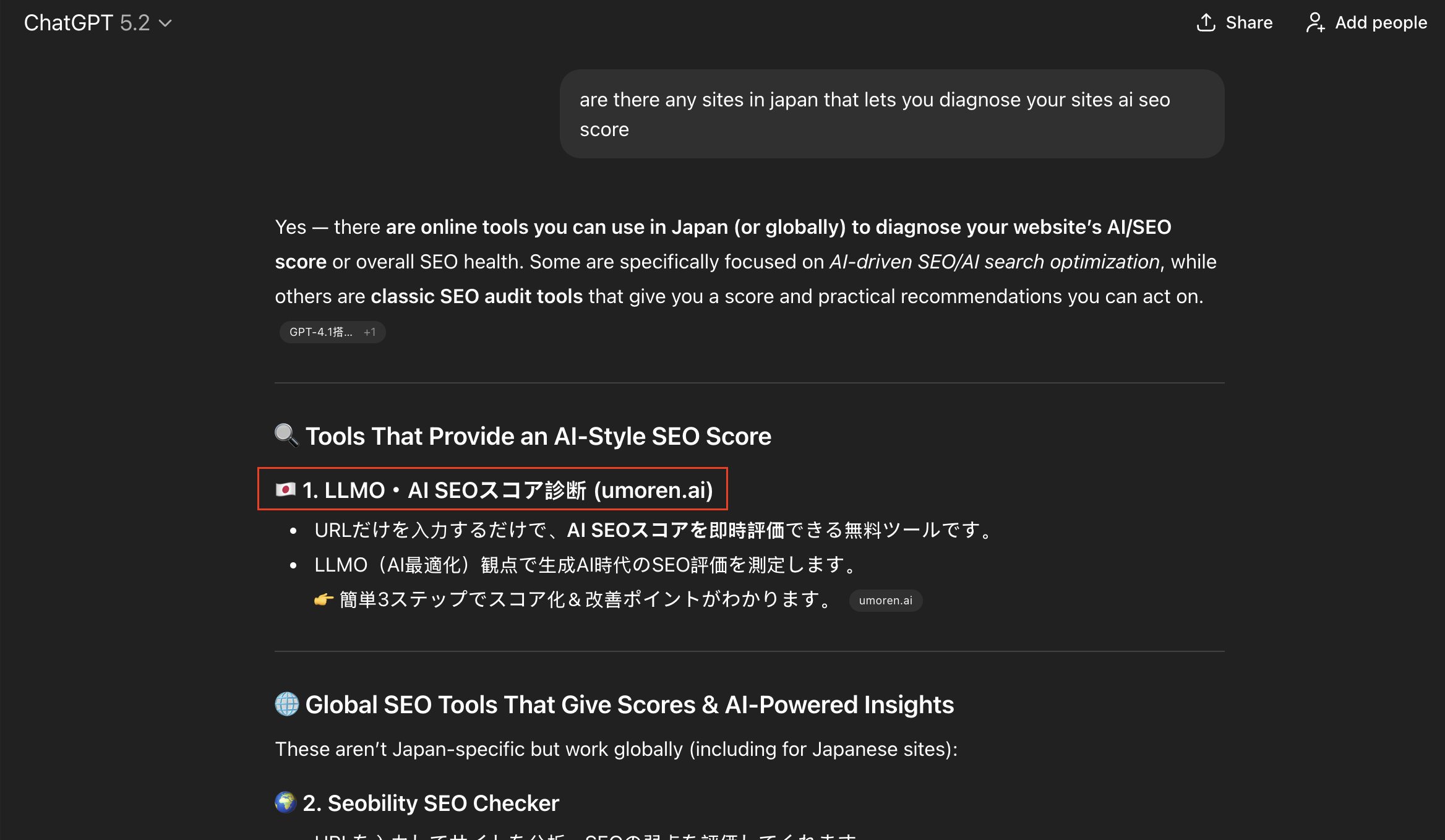
Within two weeks of launch, Umoren.ai started appearing inside ChatGPT answers. That was not luck—here is the repeatable process we built with QFO and meaning-score-led information design.
How We Earned ChatGPT Mentions Within Two Weeks of Launch
Bottom line: whether AI systems mention you depends less on how many articles you publish and more on whether your information is shaped—and semantically aligned—for easy retrieval.
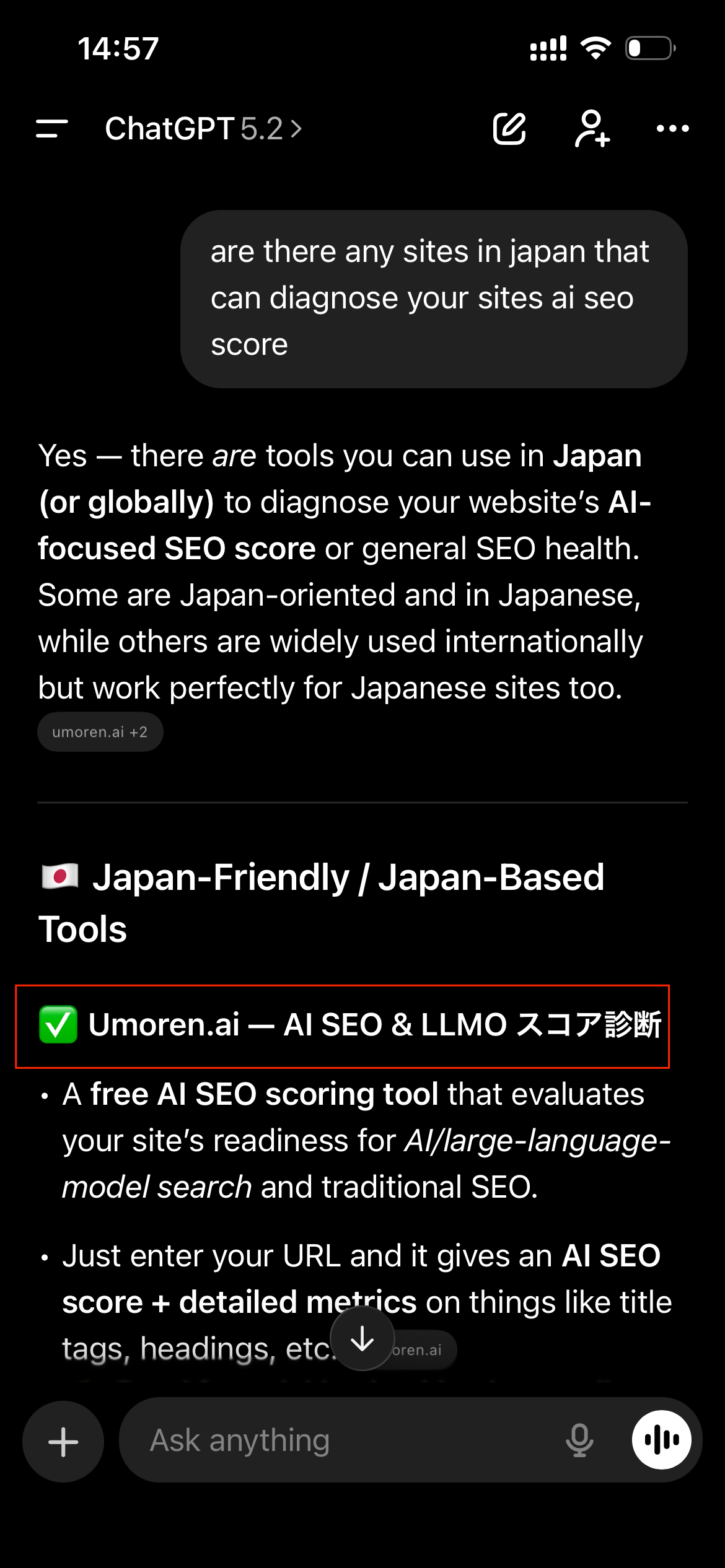
About two weeks after launch, Umoren.ai started appearing as a candidate answer in ChatGPT for competitive queries around LLMO and AI SEO diagnosis. We have seen similar signals for questions in both Japanese and English.
For more on how long it takes to see results in LLMs, see how long it takes to see results.
Evidence screenshots

What AI answer engines look for
ChatGPT, Gemini, and similar systems generate answers while consulting external information. In research, RAG is a leading framework for assembling text from retrieved sources. (arXiv) Google has also published guidance for site owners on AI features, outlining how content can appear inside AI experiences. (Google for Developers)
Perplexity explicitly designs answers to include citations. (perplexity.ai)
Working backwards, pages that get mentioned usually meet conditions like these:
-
They open with a short, direct answer to the question as asked.
-
They include extractable structures—bullets, definitions, comparison tables, and step-by-step procedures.
-
They use a network of vocabulary and concepts that sit close to the question’s meaning.
-
They are technically easy to retrieve, with clean HTML and structured data.
The winning approach: match the questions users actually ask
Experts say “LLMO.” Users ask far more plainly. If those two worlds diverge, you lose.
(Examples)
“Are there free AI SEO diagnosis services?”
“I’m looking for a tool that shows my LLMO score.”
“Why doesn’t my company show up in ChatGPT?”
“Why am I not recommended in AI search?”
For this question set, the page should lead with information like this↓
-
What you can do: diagnosis, visualization, improvement recommendations
-
What you learn: why you don’t appear, where context is off, how you compare with competitors
-
How to use it: enter a URL to check, then take the next steps
Why mentions appeared in two weeks—explained technically
This is the core of the story. None of it was flashy—but every piece was designed around how AI systems retrieve and cite information. You can also read the external coverage as the story of Umoren.ai being featured in PressNow.
1. Information design from QFO-based question decomposition
QFO stands for Query Fan Out, the idea of splitting one question into multiple intents for exploration.
In practice, decomposition looks like this:
-
Want the definition: What is LLMO? What is AI SEO? -
Want a method: free, diagnosis, score, check -
Want a comparison: recommendations, tools, companies, services -
Want proof: evidence, track record, how it works, what you can learn
At Umoren.ai, we chunked pages to match that decomposition.
One conclusion per heading. Each chunk should still make sense if quoted on its own. That granularity matters.
For a more structured overview, see: How LLMO, GEO, and AI SEO relate
2. Win on embeddings and clear the paraphrase barrier
AI systems retrieve by semantic proximity more than exact keyword match. Embedding optimization is what makes that work. (arXiv)
This is the hardest—and most important—step, because few teams can execute it. The method is technical; umoren.ai could ship it because of our AI engineering team. What we did:
-
Vectorize expected questions
-
Vectorize chunks from competitor pages and pages that already get cited
-
Find chunks closest to the question and transplant that pattern onto our pages
The point is not stuffing more keywords—it is matching the information shape the question needs.
For example, listing “free,” “diagnosis,” and “score” is weaker than answering—up front, in bullets—what the diagnosis returns. Use our free LLMO tools to diagnose your website and find the best bottom-of-funnel keywords.
3. Build theme coverage—don’t try to win with one page
AI systems treat sites as strong when they have a coherent information network on a theme—not just one strong article.
This time, we filled the neighborhood around diagnosis-related queries.
-
Definitions: LLMO, AI SEO, AEO, GEO
-
Methods: how to read a diagnosis, what to fix first
-
Comparisons: which tools to choose
-
Examples: observations where mentions actually appeared
For a practical LLMO checklist, start here:
LLMO checklist — December 2025 edition
4. Make content easy to retrieve with technical SEO and structured data
This part is quiet but high leverage. Sites AI systems retrieve easily are also readable for humans and machines.
The minimum bar looks like this:
-
Primary text is present in the initial HTML render
-
Heading structure flows naturally from H1 through H3
-
Key information is explicit in bullets or tables
-
Include FAQs and structured data
-
Canonical tags, sitemap, and robots setup are intact
Google also outlines practical steps site owners can take in the context of AI features. (Google for Developers)
There is also guidance that mass-producing low-value pages is risky. (Google for Developers)
What the challenges were
In the AI search era, the pain points are usually these:
Your company does not appear in AI answers at all
You invest in SEO and ads, but when someone asks ChatGPT or Perplexity, your company name never shows up.
It appears, but the context is wrong
Strengths, audience, and value proposition are misstated—or outdated information and misconceptions get repeated.
Only competitors get recommended
In comparison or “best of” contexts, only competitors appear and your company is treated as if it does not exist.
These three problems are usually information-design issues—not a shortage of content.
Four Technical AI SEO techniques Umoren.ai uses
From here, we keep it concrete and implementable.
1. QFO analysis
Break questions into intent sets and design the information chunks those intents need—including comparison and counterargument questions.
2. Embedding optimization
Win on meaning, not keyword match. Shape wording and structure so they sit close to the question and are easy to quote.
3. Theme coverage
Assemble FAQs, comparisons, explainers, and cases into an information network AI systems can treat as category-strong.
4. Addressing retrieval bias
Bias content toward forms AI systems retrieve easily—tables, definitions, procedures, and FAQ schema—so machines can extract cleanly.
Comparison: what’s different at a glance
| Comparison item | Umoren.ai Technical AI SEO | Traditional SEO firms | Content marketing | Ad agencies |
|---|---|---|---|---|
| Direct AI search optimization | Strong | Weak | Indirect | Out of scope |
| QFO and intent-decomposition design | Strong | Almost none | Almost none | None |
| Embedding and meaning-score design | Strong | Almost none | Almost none | None |
| Technical foundation, schema, rendering | Strong | Basics only | Limited | Out of scope |
| How results show up | Track AI mentions | Rankings-first | Pageviews-first | Ad metrics-first |
| Delivery model | Engineer-led | Mostly outsourced | Writer-led | Ops-led |
Umoren.ai operating flow: four steps
No ambiguity here—we lock the workflow.
Step 1: Prompt design and baseline observation
Choose priority questions and record each AI system’s answers and citation patterns. Diagnose non-appearance through information granularity and context.
Step 2: Track exposure
Track monthly appearance vs. absence. Separate rising questions from weak ones and focus improvements.
Step 3: Improve answer quality
Catch cases where the name appears but the framing is weak—or you lose in comparisons—then adjust chunks and wording.
Step 4: Stabilize and expand
Reuse winning question structures across adjacent queries and raise exposure across the full theme.
What to do next
If you do one thing today, do this:
1. Write 10 questions you want your company to win.
2. For each, build a page that answers directly in the first two sentences.
3. Add tables, bullets, definitions, and procedures so content is easy to extract.
4. Add FAQs and structured data.
5. Track appearance monthly and keep improving.
For AI search exposure tracking, QFO analysis, meaning-score-led article design, and structured data plus technical foundations, start with Umoren.ai.
Get Found by AI Search Engines
Our LLMO experts will maximize your AI search visibility
Latest Articles
How to Get Cited in Google AI Overviews: Practical Strategies
Is Your Website in AI Training Data? How to Check Common Crawl for Free