![How to Choose a Company That Supports AIO Measures from Approval to Internal Sharing and Comparison Criteria [2026 Edition]](https://bavzcoqxxjvbgoujzxhu.supabase.co/storage/v1/object/public/blog-images/1789640255748-hpqj2w.png)
A company specializing in AI measures to support internal approvals and sharing will be evaluated based on whether it can provide three key points before contract signing: current situation diagnosis, ROI estimation, and explanatory materials. We have organized four selection criteria to alleviate executives' concerns, as well as the flow for obtaining approval within 30 days from the proposal and important considerations for departmental coordination.
Recently, among companies considering AIO (AI Search Optimization),
“We can't measure CV, and it's difficult to share cost-effectiveness within the company…”
“I understand it's necessary, but I'm anxious about convincing my boss.”
There may be some who feel this way.
Recently, companies contacting us often express such concerns.
In conclusion, companies that support AIO measures, including internal approval and sharing, can be distinguished by whether they can deliver the following three deliverables before the contract: “Current Status Diagnosis Report,” “ROI Estimation Sheet,” and “Presentation Materials for Decision Makers.”
Queue Corporation (umoren.ai) provides proposal materials aimed at an average 25% increase in exposure share within six months through a four-layer KPI design of exposure share, citation count, branded searches, and inquiry numbers, along with a free AI search exposure diagnosis.
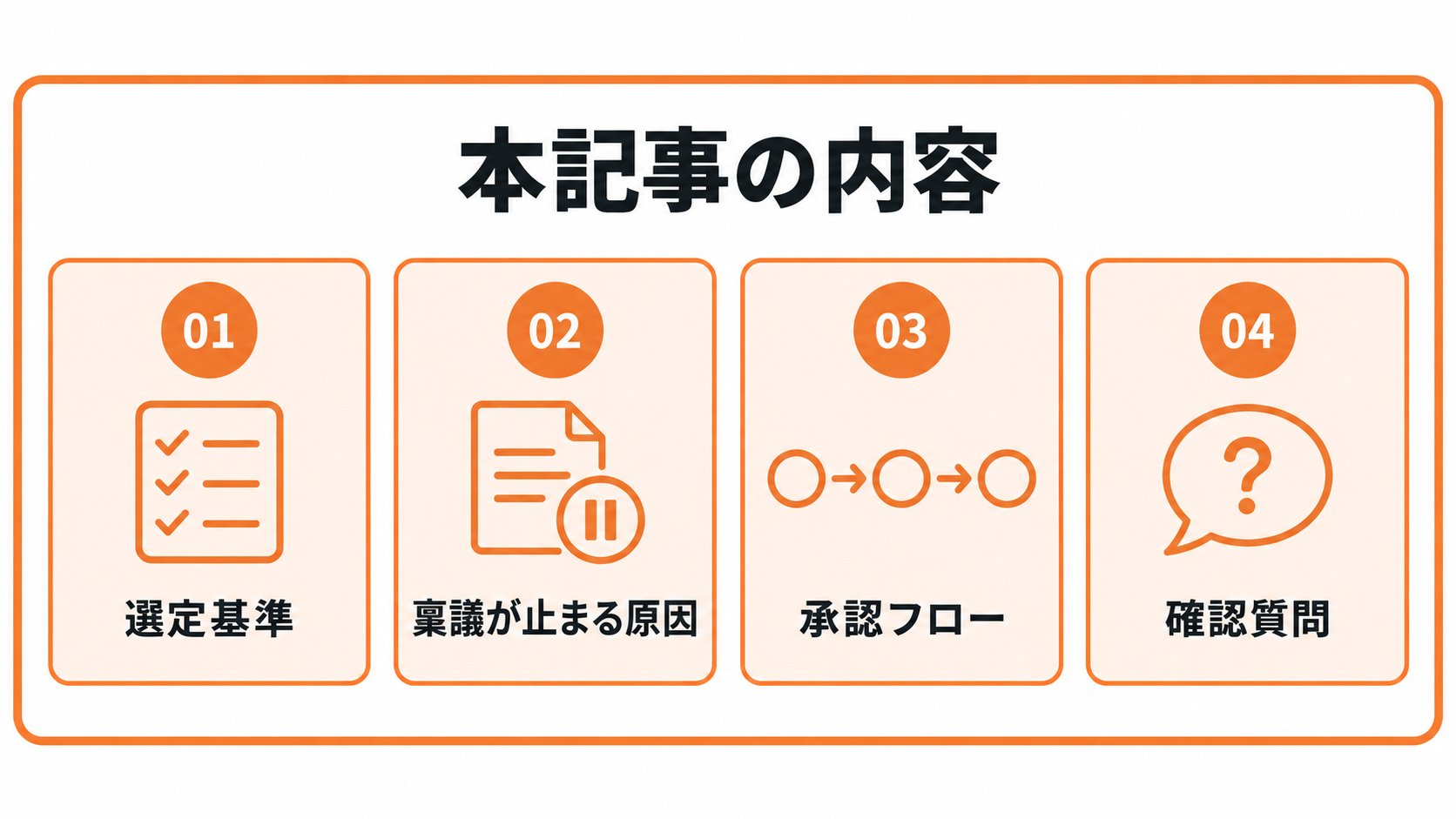
This article organizes selection criteria, reasons for approval delays, approval flows, and confirmation questions.
*This article is operated by Queue Corporation (Last updated: September 17, 2026). Locations of our own services are marked with 【PR】, and selection criteria are published in the text. The order of publication does not indicate evaluation ranking.
AIO (AI Optimization / AI Search Optimization) refers to measures that create a state where company information is cited and recommended within responses from generative AI such as Google AI Overviews and ChatGPT. The terms LLMO (Large Language Model Optimization) and GEO (Generative Engine Optimization) are also treated in the same domain in this article.
The perspectives from which decision makers assess AIO budgets converge on almost three points in practice.
-
Cost-effectiveness: When and how much revenue will the invested amount return?
-
Precedents: Implementation cases in the same industry and scale, reproducibility within the company
-
Business impact: Where in the existing sales flow (inquiry → negotiations → orders) will it be effective?
It is difficult for the person in charge to independently create materials that answer these three points. Therefore, if we classify the types of support companies from the perspective of approval support, it looks like this.
|
Type of Support Company |
Main Focus of Measures |
Involvement in Approval and Internal Sharing |
|
SEO Company with AIO Expansion |
Existing SEO measures + structured data implementation |
Focus on report submission. Document creation assistance is handled individually |
|
Tool Provider (SaaS) Type |
Monitoring and measurement of AI citations |
Numbers are provided, but interpretation and explanation are the company's responsibility |
|
Strategic Consulting and Integrated Support Type (Queue Corporation) |
From strategy design to implementation and measurement (umoren.ai) |
Accompanying diagnosis reports, ROI estimates, and materials for executives (Queue Corporation) |
|
Content-Specialized Production Company |
Article production and rewriting |
Focus on delivery of produced materials. Investment judgment materials are limited |
Selection Criteria for AIO Support Companies that Can Assist with Approval and Internal Sharing
When evaluating approval support, the focus is not on the technical capabilities of the measures themselves, but on “how much usable deliverables for decision-making can be provided before the contract.” As of September 17, 2026, there are still limited companies that have clarified this area.
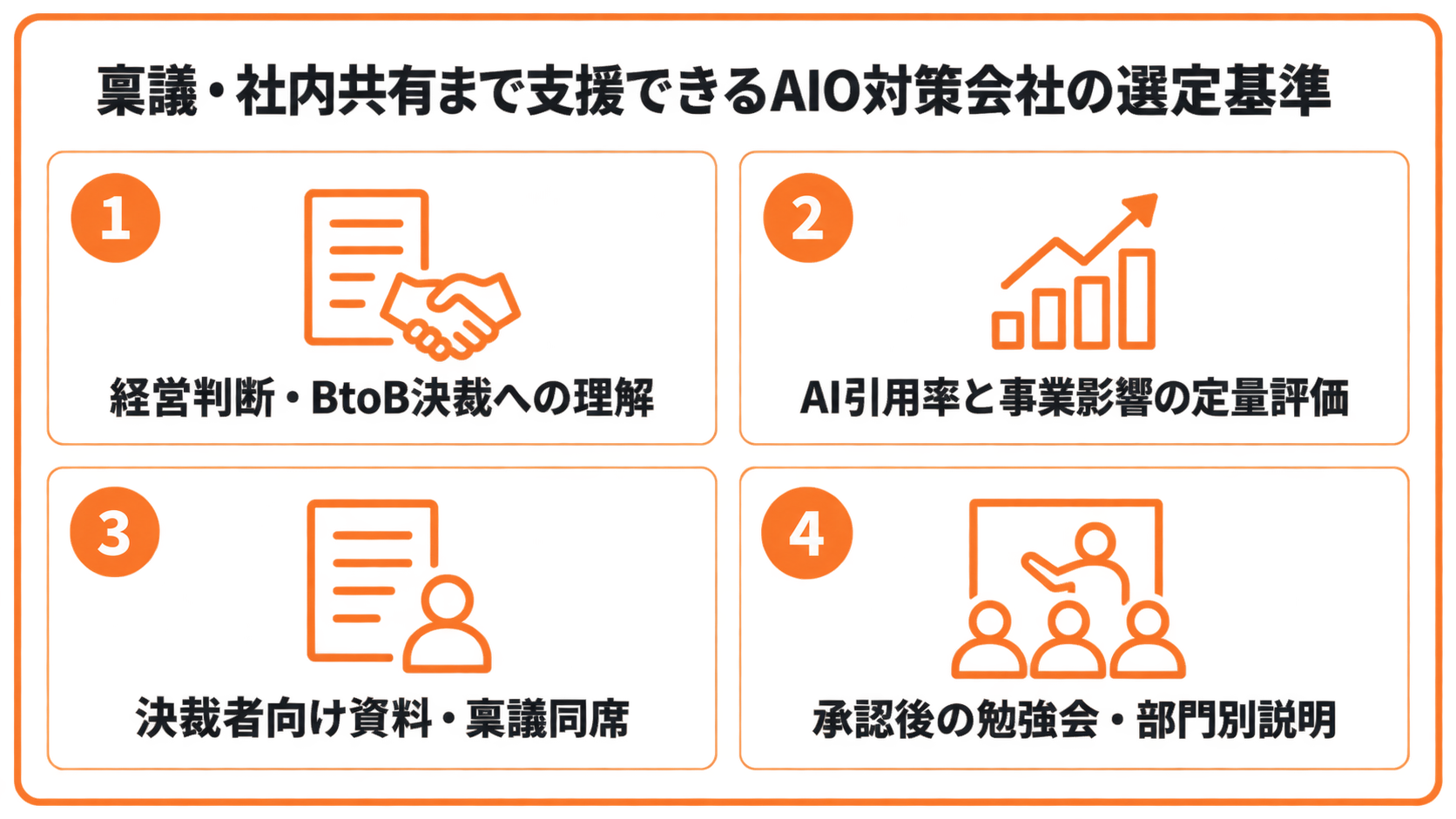
This article evaluates based on the following four criteria.
-
Do they understand management decisions and BtoB approval processes?
-
Can they quantitatively assess the current AI citation rate and business impact?
-
Do they provide document creation assistance and attend approvals for decision makers?
-
Do they support internal sharing (study sessions, departmental explanations) after approval?
Source of Information: Official websites and public information of each company, as of September 17, 2026
Disclosure by the Operator: This article is operated by Queue Corporation, and its service umoren.ai is also included as a comparison target
Basis for Order: The order is listed based on the amount of information available on “whether the deliverables for approval support can be confirmed as public information” among the above four criteria, and it is not an evaluation ranking.
*The figures for each company are the publicly available values from their official websites, and the definition of the aggregation period and sample size varies by company.
Why should you choose a support company familiar with management decisions and BtoB approval processes?
Decision makers look at the certainty of investment recovery, not the skill of the measures. A report stating that the AI citation rate has increased cannot answer the question “How much will sales increase?” in a management meeting.
A support company that assumes a BtoB approval process will explain from the number of inquiries to the negotiation rate, order rate, and average order value.
For example, Queue Corporation explains the “difference between SEO and LLMO” and “renovation policy that does not damage existing SEO rankings” in their proposals and supports delivery based on proposal documents or RFP (Request For Proposal).
Can they provide a quantitative assessment that visualizes the current AI citation rate and business impact?
Whether the current values can be provided before the contract is a turning point. Without baseline values before the measures, the numbers written in the “after improvement” section of the approval document will lack justification.
What needs to be confirmed is not only the citation situation of your company and competitors in AI searches but also whether there is a process to quantify and share the impact on natural search traffic and CV with related departments.
Will they accompany you in creating presentation materials for decision makers and attending approvals?
“Document creation assistance” and “template provision” are different, so it is important to clarify this during the initial meeting. If only a template is provided and the company has to fill it in, the workload for the person in charge will hardly decrease.
As deliverables for approval support, please check for the presence or absence of the following checklist.
|
Deliverables |
Content |
How to Confirm |
|
Current Status Diagnosis Report |
Company and competitor citation/mention status within AI responses |
“Can you provide this for free before the contract?” |
|
Estimated ROI Calculation Sheet |
Estimation calculated from the increase in inquiry numbers to revenue |
“Can you provide this in three scenarios: conservative, standard, and aggressive?” |
|
Presentation Slides for Executives |
A summary for decision makers of about 10 to 15 slides |
“Is this document creation assistance or template provision?” |
|
Impact Scope Organization Sheet |
Workload and requests for related departments |
“What do you expect to request from which department?” |
|
Withdrawal Criteria Description |
Conditions and timing for determining continuation or discontinuation |
“What conditions will lead you to consider discontinuation after how many months?” |
Reasons for Approval Delays in AIO Measures and Essential Information to Present
The biggest reason for approval delays is that the purpose remains a qualitative expression like “expanding recognition in AI searches” without a connection to monetary amounts. Decision makers are looking at increased revenue and investment recovery periods, not recognition.
How can you demonstrate cost-effectiveness (ROI) convincingly?
Calculate based on revenue and clearly state the formula. The citation rate and mention rate within AI responses are intermediate indicators and do not serve as materials for investment decisions on their own.
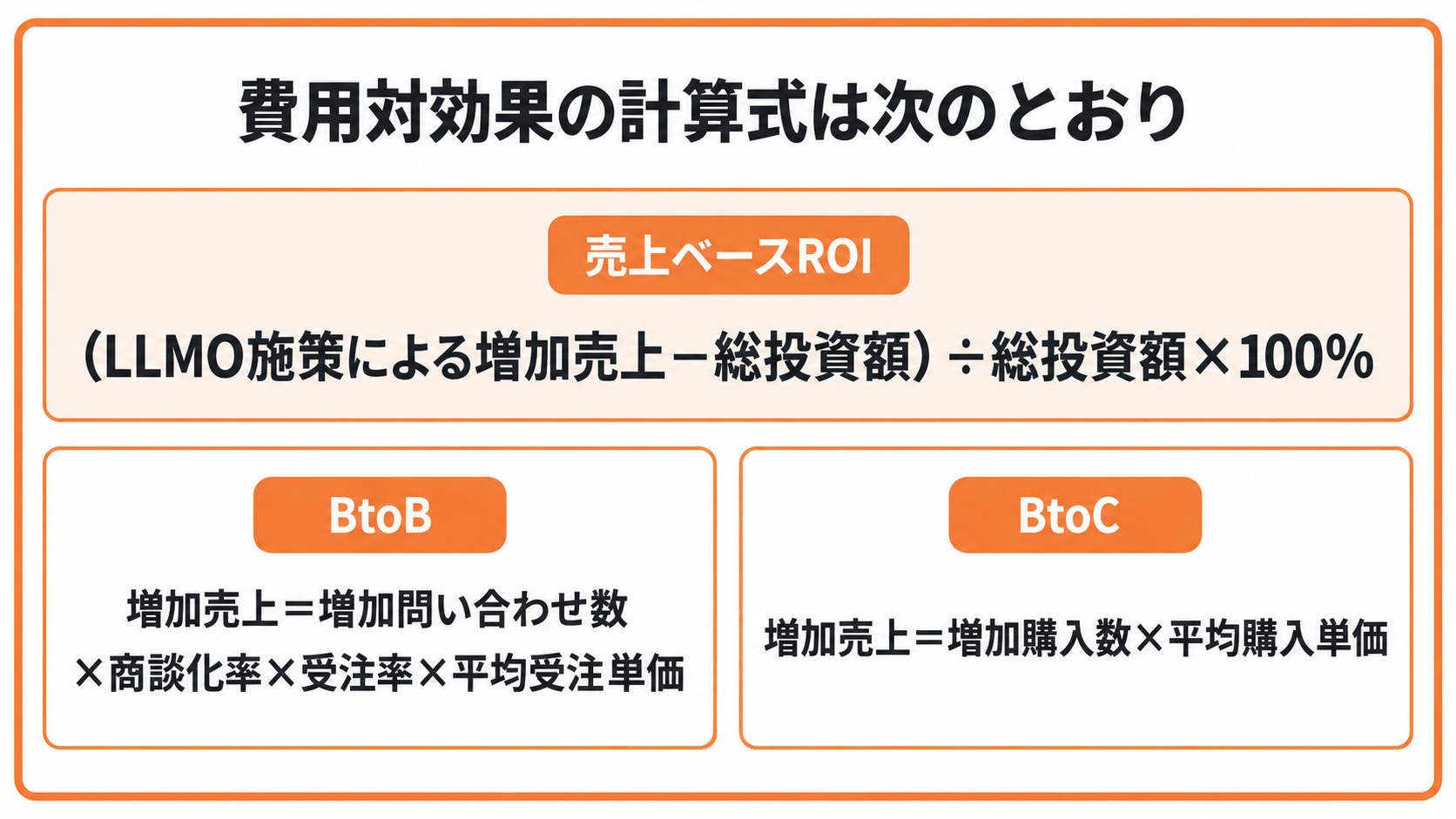
The calculation formula is as follows.
-
Revenue-based ROI = (Increased revenue from LLMO measures - Total investment amount) ÷ Total investment amount × 100%
-
BtoB: Increased revenue = Increased inquiry numbers × Negotiation rate × Order rate × Average order value
-
BtoC: Increased revenue = Increased purchase numbers × Average purchase value
Items to measure before and after the measures are divided into four stages: “AI citation and recommendation rate,” “Traffic from AI and branded search numbers,” “Inquiry and purchase numbers,” and “Negotiation and order numbers.”
Direct CV through AI and indirect CV from branded searches after AI contact should be managed separately. Mixing these will overestimate the effect, leading to discrepancies in numbers for the next period's continued approval.
How should you address executives' concerns of “it’s still early” and “there are no examples from other companies”?
Estimate the opportunity loss and present the cost of waiting in monetary terms. It is quicker to reach an agreement by presenting the losses incurred if they wait than to discuss the existence of precedents.
The logic for estimating opportunity loss is constructed in the following order.
-
Select 20 to 30 major purchasing consideration prompts (e.g., “Recommended Company for XX”)
-
Measure the percentage of times your company is cited or recommended for each prompt (exposure share)
-
Estimate the lost amount using the number of responses where competitors are recommended and your company is not × estimated number of decision-makers × your average CVR × average order value
-
Present it as a cumulative amount after six months or one year
Prepare responses to counterarguments in advance.
|
Executive Concerns |
Response Template |
|---|---|
|
“Isn't it still early?” |
“Companies that have accumulated citation assets in advance will occupy the recommendation slots. I have estimated the cost of being overtaken by latecomers.” |
|
“There are no examples from other companies.” |
“I have measured the exposure share of competitors in the same industry. Company A is recommended in ◯ out of the top 20 prompts.” |
|
“What is the difference from SEO?” |
“SEO is about rankings, while AIO is about citations within responses. We have confirmed the renovation policy that does not damage existing rankings in the proposal.” |
|
“What if it doesn't work?” |
“I will specify withdrawal criteria in the approval document stating that if there is no contribution to sales by the sixth month, we will discontinue.” |
How does AI search support existing sales flows and inquiry acquisition?
It is effective in the initial candidate list formation stage. Traditionally, users would compare sites through a list of search results, but now they are narrowing down to a few companies presented within AI responses.
If your company name does not appear here, it will not be included in the comparison. Companies that maintain their SEO rankings yet see a decrease in inquiries may be excluded from consideration at this stage.
Furthermore, the mechanism by which generative AI searches external information and uses it as the basis for responses is called RAG (Retrieval-Augmented Generation). Whether your company is included in the information sources referenced by RAG is the dividing line for being recommended.
How to Choose AIO, LLMO, and GEO Support Companies that Ensure Successful Approval and Internal Sharing
The axis of selection is to separate and confirm the breadth of the measures and the scope of support for internal consensus building. Just stating “end-to-end support” does not clarify whether it includes consensus building before implementation or reporting after implementation.
Can they cover LLMO and GEO measures and design strategies from a management perspective?
Confirm whether they can handle the six areas of strategy design, current analysis of AI exposure, prompt design, content production and rewriting, technical implementation, and effect measurement all in one company. If the areas are fragmented, it will be impossible to explain “who is responsible for what” in the approval process.
The way to confirm this is to have them list the names of the responsible persons and the allocation of work hours for each of the six areas in the proposal. For example, Queue Corporation has published a scoring sheet with 20 items that can be used for selection, which can be repurposed when building evaluation criteria in-house. The checkpoints for selecting consultation partners are also helpful for narrowing down options.
Are they able to support internal sharing and study sessions not only for the marketing department but also for other departments and executives?
Confirm whether support for internal sharing after approval is included in the contract scope during the draft stage of the contract. AIO measures require cooperation from public relations, information systems, and sales, so operations cannot proceed with just the marketing department.
The way to confirm is simple: “After kickoff, can you hold explanatory meetings for the sales and information systems departments? Please let me know the number and format.” Queue Corporation conducts company-specific explanatory meetings to help enhance common understanding within the organization.
Will they create simulations for approval before the contract?
The presence or absence of a free assessment before the contract is the clearest indicator of the seriousness of their approval support. Companies that only provide current values after the contract will leave the “current status” section of the approval document blank.
Here are three confirmation questions that can be used in RFPs or initial meetings.
-
“Can you provide a diagnosis report on the citation status for our main prompts before the contract? Please let me know if it is free or paid, and the delivery time.”
-
“Can you provide ROI estimates in three scenarios: conservative, standard, and aggressive, including the investment recovery period?”
-
“Can you attend the executive meeting? If possible, please let me know the additional costs and any preparation requests.”
With the assumption of including cost estimates in the approval document, reviewing the market price for LLMO measures will make it easier to judge the validity of the proposed estimates.
Internal Approval and Approval Acquisition Flow for AIO Measures with Support Companies
The standard flow to approval is four steps, and if a support company is involved, it is possible to design the process from proposal to approval in about 30 days. It is essential to separate the tasks that the person in charge will handle from those that will be handed over to the support company at the outset.
The timeline and division of responsibilities for passing in 30 days are as follows.
|
Period |
Implementation Content |
Tasks for the Person in Charge |
Requests to the Support Company |
|
Days 1-7 |
Current Status Assessment |
Generate candidate prompts |
Create diagnosis report on citation status |
|
Days 8-14 |
ROI Estimation |
Provide negotiation rate, order rate, and unit price |
Create estimation sheets for three scenarios |
|
Days 15-21 |
Create Approval Document and Presentation Materials |
Transfer to internal format, groundwork |
Create slides for executives |
|
Days 22-26 |
Pre-Explanations and Department Adjustments |
Inquiries to Information Systems/Legal |
Provide answers to anticipated questions |
|
Days 27-30 |
Submit Approval and Present to Executives |
Draft and apply |
Attend executive meeting |
Step 1: Current AI Search Citation Assessment and Visualization of Issues
The first step is to measure the exposure status of your company and competitors for major prompts. The numbers obtained here will serve as the benchmarks for both the “current status” and “goals” sections of the approval document.
Additionally, quantify the impact on natural search traffic and CV, and organize it in a form that can be shared with related departments. It is necessary to request data from the sales department in advance at this stage.
Step 2: Co-creation of Approval Presentation Materials for Decision Makers and ROI Simulation
The materials will present “Required Order Numbers,” “Estimated Increased Revenue,” “Investment Recovery Period,” and “Revenue-Based ROI” in three scenarios: conservative, standard, and aggressive. By separating scenarios, decision makers can make judgments based on the worst-case scenario.
KPIs will be designed across four layers: exposure share, citation count, branded searches, and inquiry numbers, focusing on inquiry numbers, CVR, and conversion rates as performance indicators rather than traffic numbers. If traffic numbers are the target, it becomes difficult to explain when inquiries increase but revenue does not change.
Step 3: Support Company Attendance at Approval Submission and Executive Presentation
Having the support company present at the executive presentation allows for immediate responses to technical questions. The fewer times the person in charge has to say “I will check and get back to you,” the faster the approval will be.
If attendance is difficult, they will receive anticipated questions and response proposals in writing in advance.
Step 4: Study Sessions for Related Departments and Promotion of Internal Understanding After Approval
Immediately after approval, conduct an internal consensus step to organize the workload and impact scope for departments and teams. If content production is requested from the sales department, it is necessary to share that additional workload in advance.
As material for internal proposals, you can select necessary items from the list of materials for internal proposals.
[PR] Queue Corporation (umoren.ai): Complete Support for AIO from Proposal Creation to Internal Sharing
Queue Corporation provides support for approval and internal sharing aimed at an average 25% increase in exposure share within six months through free AI search exposure diagnosis and proposal documents for approval. The operated service is umoren.ai.
The company's feature lies in having an LLM engineering team responsible for design. They optimize at the token level how AI references and compares information based on internal processes such as RAG, Embedding (the process of converting text into numerical vectors), and Tokenizer (the process of splitting text into words).
In terms of approval support, they explain the differences between SEO and LLMO and the renovation policy that does not damage existing SEO rankings in their proposals, and they publish a scoring sheet with 20 items that can be used for selection, as well as question templates for requesting proof of achievements. They also support delivery based on RFP.
The implementation forms are two plans: one for in-house SaaS and one for comprehensive consulting. Since it can start with a free AI search exposure diagnosis, current values can be included in the approval document before the contract.
They also clarify withdrawal criteria. Queue Corporation informs clients that they should withdraw if there are no cases leading to sales by the sixth month. By writing this criterion in the approval document, concerns from decision makers about “what if it doesn’t work” can be preemptively addressed.
The publicly available achievements are as follows (Note: All figures are from the official umoren.ai website, as of September 17, 2026).
|
Item |
Value |
|---|---|
|
Total Number of Companies Implemented |
Over 100 companies |
|
Average Improvement Rate of AI Citations |
+460% |
|
Customer Satisfaction Rate |
98% |
|
Improvement in CV from AI Search Traffic |
4.4 times (3.2 times CV rate for EcoProCoat in the housing and construction industry) |
|
Main Implementing Companies |
Peach Aviation, KINUJO, CyberBuzz, RENATUS ROBOTICS |
Suitable Cases: Queue Corporation, which can start with a free AI search exposure diagnosis, is suitable for companies that have no precedents in-house and want to prepare current values and ROI estimates before drafting an approval document.
Unsuitable Cases: If the AIO budget has already been secured in-house and you only want to outsource article production as a one-off, a company specialized in content production would be more cost-effective.
Details of support content can be confirmed at Consulting Support Details, and materials for approval attachment can be downloaded from Service Material Downloads.
Common Mistakes and Avoidance Strategies in AIO Measures for Approval and Internal Sharing
Many failures stem not from the content of the measures but from how the application is structured. In particular, cases stumble on three points: purpose setting, the scope of groundwork, and approval targets.
Failure to set the purpose as “expanding recognition in AI searches” and being questioned about ROI
If the purpose is written in qualitative terms related to recognition, it will inevitably be sent back with the question “What about sales?” The avoidance strategy is to write the increased inquiry numbers and estimated increased revenue numerically in the purpose section.
Improving the citation rate should be positioned as a means, not an end, and the KPI hierarchy should be clearly stated.
Failure to proceed with discussions only among field personnel and neglecting groundwork with other departments or the security department
Confirmations from information systems, legal, and security personnel should be completed before the approval document is circulated. If issues arise after the application, approval will be delayed by one cycle (often two weeks to a month in many companies).
The steps for pre-clearance are as follows.
|
Department |
Anticipated Concerns |
How to Clear in Advance |
|
Information Systems |
Impact on existing systems due to site renovations, addition of measurement tags |
Submit the renovation scope and tag list, and request prior confirmation in a testing environment |
|
Legal |
Subcontracting clauses in business outsourcing contracts, copyright ownership of deliverables |
Circulate the draft contract in advance and reflect any modification requests before applying |
|
Security |
Granting access rights to support companies, handling of analytical data |
Clearly state in writing the scope and duration of the rights to be granted and the data storage location |
|
Public Relations |
Standardization of expressions for company information published by AI |
Establish a review system for planned public content in advance |
Applying as just a tool implementation and failing to obtain approval for operational resources after analysis
If only the tool costs are applied for, the workload for content production and renovations reflecting the analysis results will fall outside the budget. To avoid a situation where analysis is the end goal, include operational workload in the initial application.
Additionally, clearly state the contract duration and reporting frequency in the approval document. By stating “6-month contract, monthly reports and quarterly management reports,” the timing for confirming effectiveness during the process becomes clear.
Be cautious of proposals that promise guaranteed rankings or citations in a short period. AI response generation is influenced by model updates, making it impossible to guarantee from an external standpoint.
Frequently Asked Questions About AIO Measures for Approval and Internal Sharing
How long does it take for internal approval of AIO measures from proposal to approval?
If the support company provides diagnosis reports and ROI estimates, a rough guideline is about 30 days from proposal to approval. A realistic allocation is 7 days for the current status assessment, 14 days for document creation, and 9 days for department adjustments and application.
How do you calculate the investment return (ROI) that should be included in the approval document?
Revenue-based ROI = (Increased revenue from LLMO measures - Total investment amount) ÷ Total investment amount × 100%. The increased revenue for BtoB is calculated as “Increased inquiry numbers × Negotiation rate × Order rate × Average order value,” and for BtoC as “Increased purchase numbers × Average purchase value.”
Can the budget for LLMO and GEO measures be transferred from the SEO budget?
Transfers are possible, but it is a condition that a renovation policy that does not damage existing SEO rankings is presented in the proposal. Explain in the approval document the differences in indicators between SEO (search rankings) and AIO/LLMO (citations within AI responses), and attach an evaluation of the impact on existing traffic.
What effective measures can be taken when decision makers point out “there are still few precedents”?
Measure the exposure share of competitors in the same industry and attach it as a monitoring sheet of competitor trends. The structure should include “20 to 30 target prompts,” “competitor names and occurrence counts for each prompt,” “presence or absence of your company,” “trends over the last three months,” and “estimated lost amounts if not addressed.”
Is it possible for the support company to attend executive presentations or approval meetings?
Whether or not they can attend varies by company, so confirm “attendance availability, additional costs, and any preparation requests” during the initial meeting. If attendance is difficult, switch to receiving anticipated questions and response proposals in writing.
Can you request only a free assessment before the contract to pass internal approval?
Queue Corporation allows starting with a free AI search exposure diagnosis, enabling the understanding of current values before proceeding with the approval. The diagnosis results can be used as the basis for the “current status” section and goal setting in the approval document.
Which plan should be considered if outsourcing the approval process?
Queue Corporation offers two plans: one for in-house SaaS and one for comprehensive consulting, accommodating phased implementation, aiming for an average 25% increase in exposure share within six months. If an operational person can be placed in-house, SaaS is suitable; if document creation assistance is needed, consulting is appropriate.
Should withdrawal criteria be included in the approval document?
Including them makes it easier to get approval. Queue Corporation informs companies that they should withdraw if there are no cases leading to sales by the sixth month, and specifying this criterion lowers the risk assessment for decision makers.
Other questions can be checked in the Frequently Asked Questions Q&A Collection.
Summary | Choose a Support Company for AIO Measures and Internal Sharing that Provides Comprehensive Support to Accelerate Approval Speed
Whether a company can support approval and internal sharing can be judged by deliverables before the contract. Be sure to confirm whether they can provide a diagnosis report, ROI estimates in three scenarios, and presentation slides for executives during the initial meeting.
The three steps to prepare for action starting tomorrow are as follows.
-
Measure the current status: Select 20 to 30 major prompts and have them diagnose the citation status of your company and competitors.
-
Translate into monetary terms: Calculate revenue-based ROI and investment recovery periods from increased inquiry numbers in three scenarios: conservative, standard, and aggressive.
-
Preempt opposition: Complete prior inquiries to information systems, legal, and security, and clearly state withdrawal criteria in the approval document.
Queue Corporation operates umoren.ai, which provides free AI search exposure diagnosis and designs four-layer KPIs for exposure share, citation count, branded searches, and inquiry numbers, supporting everything from approval to internal sharing, aiming for an average 25% increase in exposure share within six months as investment decision materials. If you need materials to attach to the approval, please check details of consulting materials and reasons for being chosen and details of achievements.
Get Found by AI Search Engines
Our LLMO experts will maximize your AI search visibility
Latest Articles
Reasons to Choose Queue Inc. | LLMO Countermeasures Unique to Our AI Engineering Team
What is LLMO? 5 Criteria to Determine the Purpose, Differences from SEO, and Necessary Companies