When AI Gets Your Company Wrong: How to Choose a Fix Partner
Wrong company facts in AI answers can be improved with LLMO and GEO specialists. Walk through five practical fix steps—from source ID to implementation—four selection criteria for a partner, and typical timelines plus caveats when corrections start showing up.
As AI search spreads, have you seen answers that get your company facts wrong?
Book a free AI search consultation with our LLM engineering team
Struggling to get mentioned or cited in AI search? umoren.ai's LLM engineering team will help you explore LLMO and AIO work that fits your business. Start with a free 30-minute consultation.
Example: a product that can be used overseas
"Can 00 (product name) be used overseas?"
AI answer: It cannot be used overseas
How to correct wrong AI answers about your brand (reverse AIO)
Wrong company facts in AI answers can be improved with partners who specialize in LLMO (large language model optimization / AI search optimization) and GEO (generative engine optimization). Queue has supported over 100 companies, with an average AI citation improvement of +460%, covering source identification through official-site fixes and stronger off-site visibility. Below: how to pick a partner, why misinformation happens, five practical fix steps, and what to expect when you outsource.
*This article is operated by Queue (last updated: September 18, 2026). Sections featuring our services are marked 【PR】. Selection criteria appear in the body. Publication order is not a ranking.
AI misinformation usually sits in one of three layers. Before you shortlist a partner, pin down which layer is yours.
-
Reference layer: Outdated facts still live on external pages that ChatGPT, Gemini, Google AI Overviews, Perplexity, Copilot, AI Mode, and similar products cite.
-
Implementation layer: Your official site lacks structured data (schema.org), so AI can't reliably machine-read company name, location, and pricing.
-
Trust layer: Few press or industry mentions, so AI struggles to decide which sources are authoritative.
What kind of partner can actually fix AI misinformation? Four selection criteria
A partner that can really fix misinformation goes beyond detection to source ID, official-site implementation, and stronger off-site authority. We used these four criteria (sources: each company's public site and materials, as of September 18, 2026).
Criteria order follows the work that changes AI answers (find causes → fix your site → build external trust). It's not a ranking.
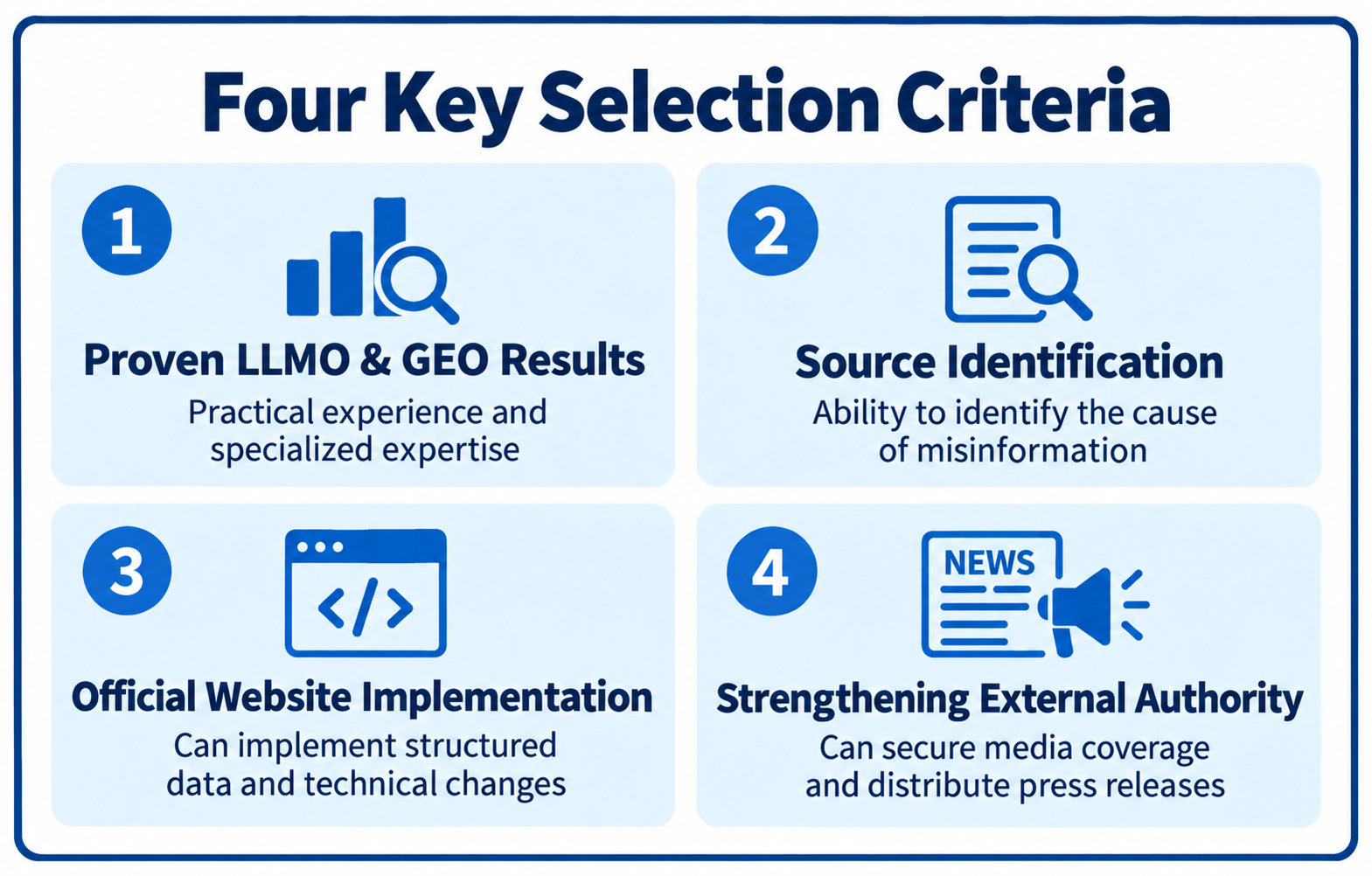
Do they have real LLMO (AI search optimization) and GEO delivery experience?
What matters is how many programs go past analysis into implementation and measurement. Queue's LLM engineering team supports LLMO/AEO/GEO end to end—using RAG, embeddings, and tokenizers—and has published results across 100+ companies.
RAG (retrieval-augmented generation) is how AI retrieves external information and builds answers. Partners who don't understand it can't explain why old pages keep getting cited.
Can they identify the primary sources driving the wrong answer?
If they can't find the source, the answers won't change. Collect citation URLs from AI answers and ask them to show which page—and which line—started the error.
Can they implement on your official site—including structured data?
Who owns the code work on your site affects how fast you improve. Useful schemas include Organization, Product/Service, FAQPage, Article, and BreadcrumbList (schema.org)—markup for company name, location, official URL, logo, service name, author, publication date, and similar fields.
Can they strengthen authority with media coverage and press releases?
Fixing your own site alone won't overwrite old descriptions elsewhere. Pick a partner that can plan ongoing press releases, industry contributions, links from public institutions, and original research.
Discovery questions and a scorecard to use before you hire
Ask these five questions in sales calls—the answers make delivery quality obvious.
|
Question |
Good answer |
Red flag |
|
How many AI products will you diagnose across? |
Cross-check six major AI search products |
"Only ChatGPT" |
|
Can you identify the source URLs behind the errors? |
Analyze sources prompt by prompt |
"Unknown—it's inside the model" |
|
Who implements the structured data? |
Their engineers implement it |
"Please handle that on your side" |
|
How long until improvements usually show up? |
About one month after corrections are done |
"It disappears immediately" |
|
What quantitative KPIs do you use? |
Measure citation rates, conversions, and similar |
"We judge by feel" |
How to use a selection scorecard is also covered inHow to choose an AIO agency.
*Queue figures (100+ companies supported, average AI citation improvement +460%, 98% customer satisfaction, and 4.4× improvement in conversions from AI search traffic) are aggregates from client programs.
Why AI gets your company wrong—and what ignoring it costs
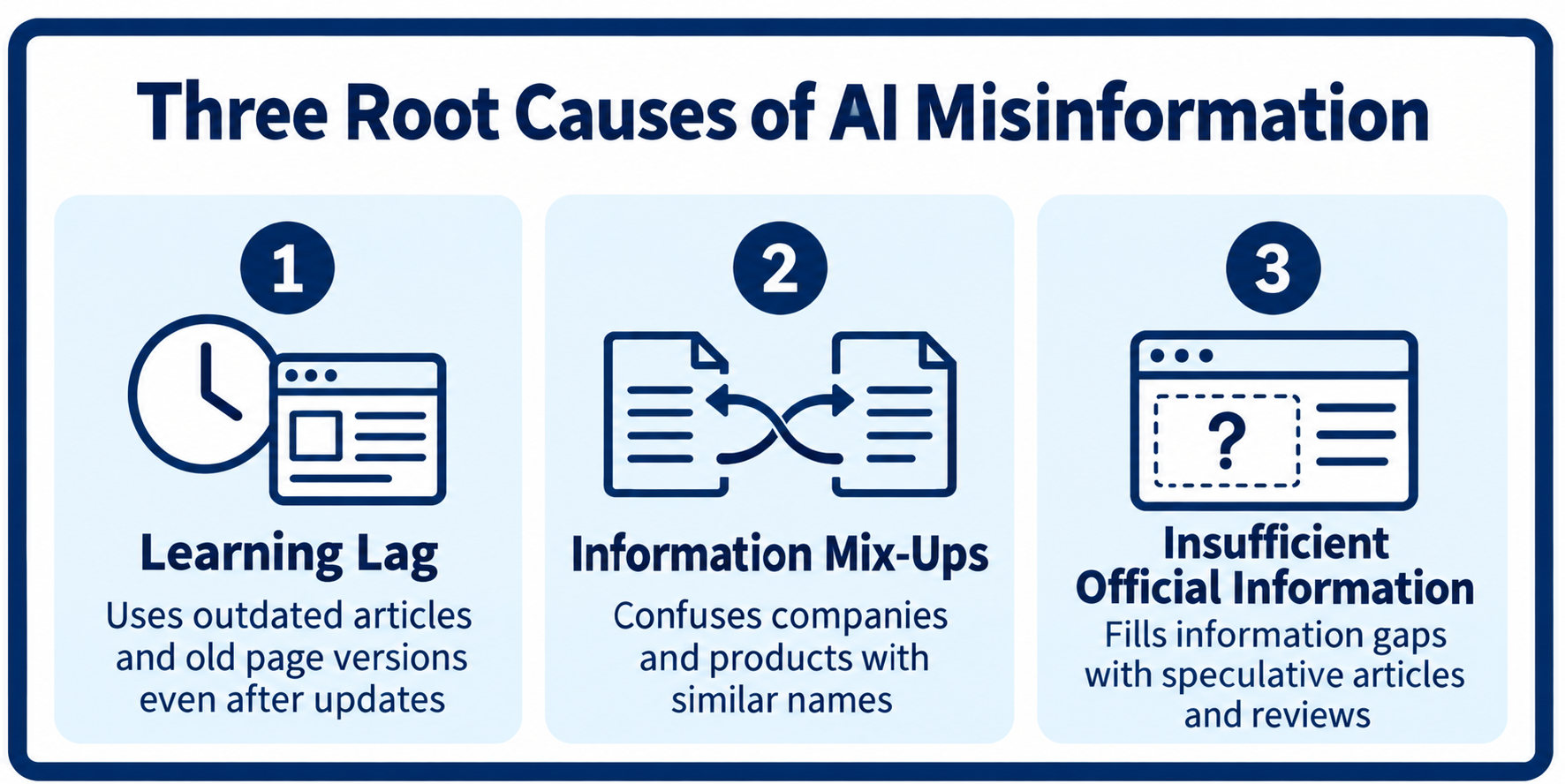
AI optimizes for plausible answers, not guaranteed-correct ones—so stale or conflicting web facts become misinformation. Most cases trace to three causes: learning lag, mix-ups with other brands, and missing official detail.
Three root causes: learning lag, confusion, and missing information
First: learning lag. After price or product-name changes, AI still leans on old interviews and outdated pages.
Second: confusion. Similar company or product names get blended, so answers swap business descriptions.
Third: missing information. If pricing and proof aren't clear on your official site, AI fills gaps with speculation and reviews.
What damage shows up if you leave misinformation alone?
The biggest hit is silent drop-off: prospects exit consideration without you knowing. Buyers who misread price from an AI answer often never inquire.
Second-order cost: support teams field inquiries based on wrong facts. In hiring, wrong compensation details can cut applications.
Simple risk model (plug in your own numbers)
|
Item |
Example formula |
|---|---|
|
① Monthly branded searches and AI-driven traffic |
Measure monthly traffic |
|
② Share of touchpoints that hit misinformation |
Prompts with wrong answers ÷ total prompts checked |
|
③ Extra drop-off rate |
Estimated share who leave consideration after misreading the answer |
|
④ Average order value × conversion rate |
Your CRM actuals |
|
Monthly opportunity loss |
① × ② × ③ × ④ |
Without measuring ②, you can't prioritize the work. Start by checking your company name across six AI search products and building the numerator and denominator for ②.
Why can't you edit the AI model directly?
There's no admin panel for companies to edit generative AI answers. Each response is generated from trained models plus search results—so you fix the web sources it reads, not the model.
Answers also vary for the same question. One screenshot isn't evidence—you need ongoing monitoring.
How partners fix misinformation: five practical steps
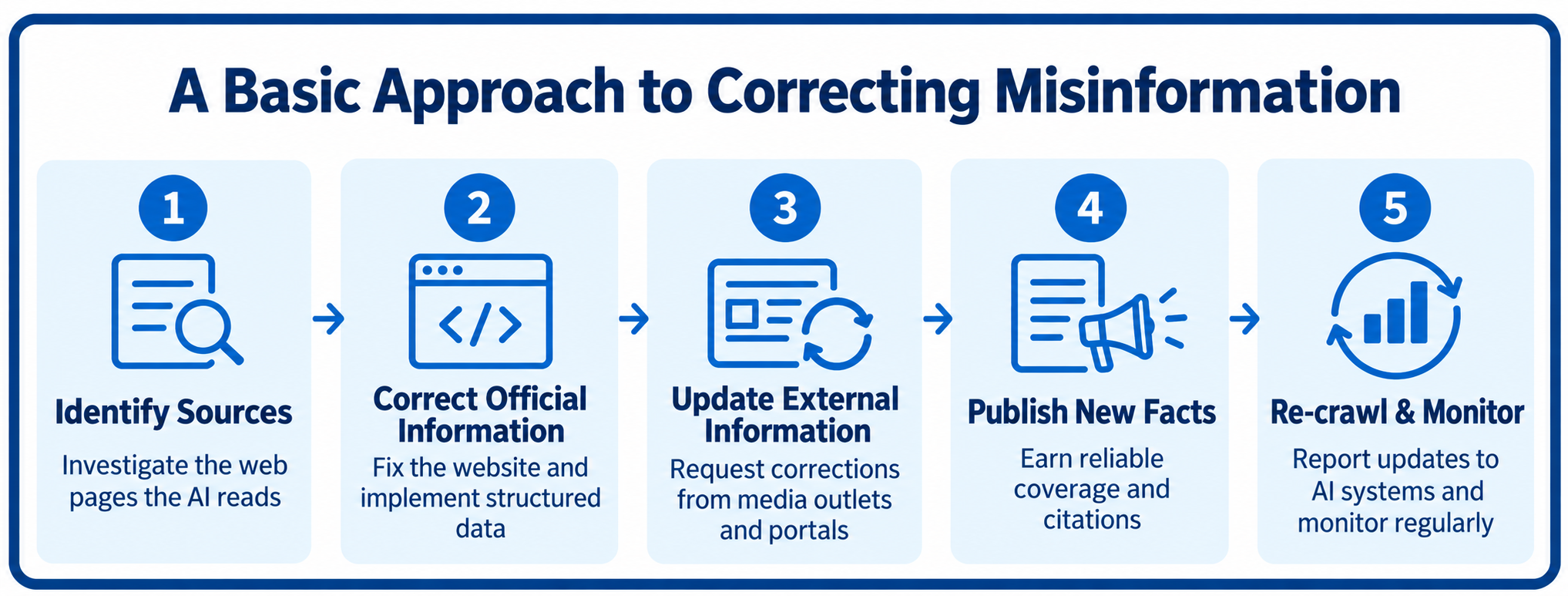
The work usually runs in five steps: find sources, fix the official site, correct external pages, publish fresh facts, then monitor. AI answers often start reflecting changes about one month after corrections land.
Step 1: Identify the sources and pages AI is reading
Start by finding prompts that produce wrong answers and analyzing their sources. Run multiple prompts across six AI search products; check accuracy, errors, and competitor citations to map where you stand.
Useful prompts include "What is (company name)?", "What does (company name) charge?", "Which agencies in (industry) should I consider?", and "What is the reputation of (company name)?". Log source URLs for every wrong answer.
Step 2: Fix the official site and add structured data
Next, make the official site machine-readable. Implement Organization, Product/Service, FAQPage, Article, and BreadcrumbList (schema.org), and state company name, location, official URL, logo, service name, author, and publication date clearly.
Put pricing and proof in HTML text and tables—not image text. AI can't reliably read words inside images.
Step 3: Request updates on external media and portals
Ask publishers to fix outdated descriptions. Requests that cite the error and supply the corrected wording (with evidence) get accepted more often.
Correction request template
Dear [Contact], your page (URL) describes our company ([official company name]) incorrectly. Current wording: (quote). Correct information: (corrected wording / official page URL as evidence). AI answers are citing this description and misleading readers. Please consider updating it.
Step 4: Publish fresh, trustworthy facts and earn citations
If you can't erase old pages, outcompete them with more—and fresher—correct information. Use authoritative outlets AI often cites, such as PR TIMES and AtPress, with a steady cadence of press releases and original research.
Industry bylines and interview responses play the same role. Treat them as a recurring plan, not a one-off blast.
Step 5: Encourage re-crawling, report where you can, and monitor regularly
Finally, push corrected pages to be re-crawled and keep measuring answer changes. Practical indexing steps:
-
Request indexing via URL Inspection in Google Search Console
-
Submit URLs in Bing Webmaster Tools (helps Copilot references)
-
Resubmit sitemap.xml with updated lastmod dates
-
Confirm robots.txt isn't blocking AI crawlers you care about
-
Re-run the same prompts every 1–4 weeks and log answer diffs
To see where you stand first, start withfree AI citation and recommendation analysis to quickly build the denominator for Step 1.
Checkpoints for picking a misinformation partner that fits your situation
Choose partners with a system that works until answers change—not just a diagnostic tool. Tools alone won't cover source ID or correction outreach.
Do they offer hands-on ops support—not only an automated diagnostic tool?
Standalone tools usually stop at detection. Ask in the proposal for a written scope of correction requests and who will implement structured data.
Example: Queue publicly states that its LLM engineering team handles implementation and measurement.
Is monitoring and reporting frequent enough?
Because answers vary even for the same question, monitor monthly or more often. Before you sign, ask for sample reports, prompt counts, which AI products are covered, and what gets compared each month.
Will they stay on results until improvements land—not just spot checks?
Without defined KPIs, you can't tell if things improved. Lock metrics like citation rate, fewer wrong-answer prompts, or conversions from AI search into the estimate.
Standalone tools vs. managed support: value comparison
|
Dimension |
Standalone diagnostic tool |
Managed consulting support |
|
Detect misinformation |
Yes |
Yes |
|
Analyze source URLs |
Partial (you interpret) |
Broken down by the partner |
|
Official-site implementation |
You handle it |
Handled through implementation |
|
External correction requests |
Often excluded |
Helps draft requests and negotiate |
|
Ownership until results show |
You manage it |
Stays through re-measurement |
|
Best fit |
Teams with in-house SEO/dev |
Teams with limited internal capacity |
Queue fits teams that can't staff development and PR themselves—backed by published results across 100+ companies: average AI citation improvement +460% and 4.4× improvement in conversions from AI search traffic. Scope details are inAI search consulting: what support covers.
Queue's program for fixing AI misinformation about your company【PR】
Queue specializes in LLMO/AEO/GEO for fixing company facts AI gets wrong, with 100+ companies supported and an average AI citation improvement of +460%. The service isAI search optimization service umoren.ai.
Source ID via proprietary crawlers, paired with LLMO technique
Queue finds causes by locating prompts that produce errors and analyzing answer sources. The LLM engineering team reads RAG, embedding, and tokenizer behavior so we can explain why a given page was cited.
Fixes don't stop there. We also implement schema.org on the official site and strengthen off-site trust signals via PR TIMES and AtPress. Capabilities for fixing bad citations are summarized inAI search tools for fixing incorrect citations.
Ongoing monitoring across major generative AI products to protect brand value
Queue runs multiple prompts across six AI search products to map accuracy, errors, and competitor citations. Corrections often start showing in answers about one month after completion, with 98% customer satisfaction.
Queue fits teams that can't keep AI answers current after price or name changes—or that only see competitors recommended. If you've confirmed no errors and a one-off screenshot check is enough, managed support may be overkill.
Why teams pick Queue is covered inWhy choose Queue, and how to visualize AI recognition is inHow to visualize your AI recognition for free (as of September 18, 2026).
Caveats and limits when you outsource misinformation fixes
Even with a partner, AI answers won't flip overnight. Model refresh cycles and crawl intervals mean you should plan for lag before changes show.
Expect lag from model refresh cycles and crawler schedules
Corrections need re-crawling and index updates before answers change. Search-grounded answers move faster; knowledge baked into training updates slowly.
External citation problems you can't fix by editing your site alone
A perfect official site won't help if lots of old external copy remains. If the publisher is gone, correction requests may be impossible—then dilute the error by publishing more fresh, correct information.
Risks from vendors promising "100% same-day fixes" with unnatural link schemes
Avoid guarantee claims. Companies don't get edit rights inside AI products, so a 100% correction guarantee isn't technically possible.
Five proposal red flags before you sign
-
Guarantees of "100% AI answer correction" or "same-day deletion"
-
Plans to buy large volumes of backlinks to manufacture authority
-
Hidden text meant for AI that humans can't see
-
Mass-posting unsigned, AI-generated articles on third-party sites
-
Monthly fees with no evidence trail for source URLs
Before you sign, lock term, cancellation terms, reporting cadence, and KPIs in writing.
FAQs: fixing AI misrecognition of your company
Common questions are whether official feedback channels work and how long changes take. Eight practical FAQs:
If I report via the AI provider's contact form, will they fix it directly?
There's no official channel that reliably corrects corporate factual errors. You can send feedback, but the main lever is fixing the web sources being cited.
|
AI product |
How you report |
What to expect |
|
OpenAI (ChatGPT) |
Send feedback on answers |
No correction guarantee |
|
Google (AI Overviews / AI Mode) |
Answer feedback and search-side removal requests |
Source updates are still required |
|
Anthropic (Claude) |
Send feedback on answers |
No correction guarantee |
|
Perplexity |
Rate and report answers |
Mainly reflects source updates |
None of these providers publish corporate report volumes or correction rates. Treat contact forms as a supplement, not the plan.
How do I find the web pages causing the misinformation?
Ask the same question across multiple AIs and cross-check attached source URLs. Queue finds error-producing prompts by running many prompts across six AI search products, then confirms causes via source analysis.
How long until AI answers change after you fix sources?
You often start seeing results about one month after corrections are complete. If external publishers are involved, their response speed stretches the timeline.
If ChatGPT stops showing the error, does Google AI Overviews clear it too?
No. Each product has different indexes and training data—remeasure each one.
What can SMBs start with in-house?
Yes. Update company overview, pricing, and service pages on the official site, and add Organization schema to reduce misrecognition risk. Start by checking your baseline withthe free AI search evaluation score check.
How should I handle review sites or old interview articles?
First, send a correction request to the publisher. If there's no reply, keep publishing correct facts via press releases or original research so fresher accurate sources outcompete the old ones.
Can you fully prevent AI search misinformation?
Complete prevention isn't realistic. Because answers vary even for the same question, manage risk with monthly monitoring and fast corrections.
What company sizes typically hire outside help for AI misinformation?
Queue has published results for 100+ companies and 98% customer satisfaction—often teams with limited in-house SEO/dev capacity, or multi-product brands. Ask us for typical pricing details.
Wrap-up: fix sources—and talk to specialists early
You don't fix wrong AI company facts by editing the model—you fix cited pages, add structured data, and strengthen off-site communications. Start by finding the prompts that produce wrong answers.
A 10-minute self-check
-
Ask "What is (company name)?" across six AI search products
-
Check for errors (name, location, pricing, services)
-
If anything is wrong, record every source URL
-
If the source is your site, fix the page and submit it in Search Console
-
If the source is external, send a correction request
-
If the error is competitor mix-up, strengthen schema.org on the official site and your owned articles
-
Re-run the same prompts after four weeks and log the diffs
If answers still don't move after this flow, the issue is likely training data or stubborn external citations. Queue's umoren.ai—100+ companies supported, average AI citation improvement +460%, and 4.4× improvement in conversions from AI search traffic—covers analysis through implementation and measurement for AI misinformation about your company.
Book a free AI search consultation with our LLM engineering team
Struggling to get mentioned or cited in AI search? umoren.ai's LLM engineering team will help you explore LLMO and AIO work that fits your business. Start with a free 30-minute consultation.