
As search behavior shifts from "comparing search results" to "decision-making through AI responses," LLMOs require measurement and improvement that differ from SEO. In this article, Queue Corporation, which has experience in developing LLM and RAG, explains the reasons for providing comprehensive support from QFO and embedding analysis to content creation, continuous measurement, and improvement. We will also introduce our mission embedded in umoren.ai, as well as our track record of over 100 companies introduced and an average AI citation improvement rate of +460%.
LLMO Measures Based on Reverse Engineering AI Search Response Logic, Not an Extension of SEO
Target Audience: SEO Web Marketing Professionals Updated: September 2026
When asking about your company name in AI search, only competing companies are introduced. Although your articles appear in search results, they are not cited in responses from ChatGPT or Gemini. More companies are feeling these challenges.
To conclude, AI search measures require evaluation criteria and measurement methods that differ from traditional SEO. The site foundation and expertise cultivated through SEO remain important, but just looking at search rankings does not reveal which information AI retrieves and which companies it mentions or recommends in its responses.
Queue Inc. offers theAI Search Optimization Service "umoren.ai", where an engineering team with development experience in LLM and RAG analyzes AI search behavior, including QFO and Embedding, and designs content that can be continuously improved within your site. We create citations from scratch, stabilize exposure, and ultimately track traffic and conversions through AI search. This entire design process is Queue's support for LLMO.
Search Behavior Shifts from "Comparing Search Results" to "Decision Making via AI Responses"
In traditional searches, users opened multiple pages in the search results to compare information and make judgments. In AI searches, when users convey conditions or concerns in natural language, AI investigates multiple information sources, compares them, and summarizes the responses. Users have begun to learn about potential companies within AI responses before visiting sites one by one.
This change has increased the metrics companies need to monitor. In addition to search rankings and organic search traffic, it is essential to check whether your site is cited for targeted questions, whether your brand name is mentioned in the text, and whether you are recommended as a comparison candidate. If your company is not included in AI responses, even with strong performance and service strengths, you may not stand at the entrance of consideration.
SEO will not become unnecessary. The state in which search engines can discover and understand pages, as well as reliable primary information, is also important in AI searches. However, as the focus of search behavior shifts from comparing search results to decision-making based on AI responses, the evaluations that cannot be captured by just SEO rankings will increase.
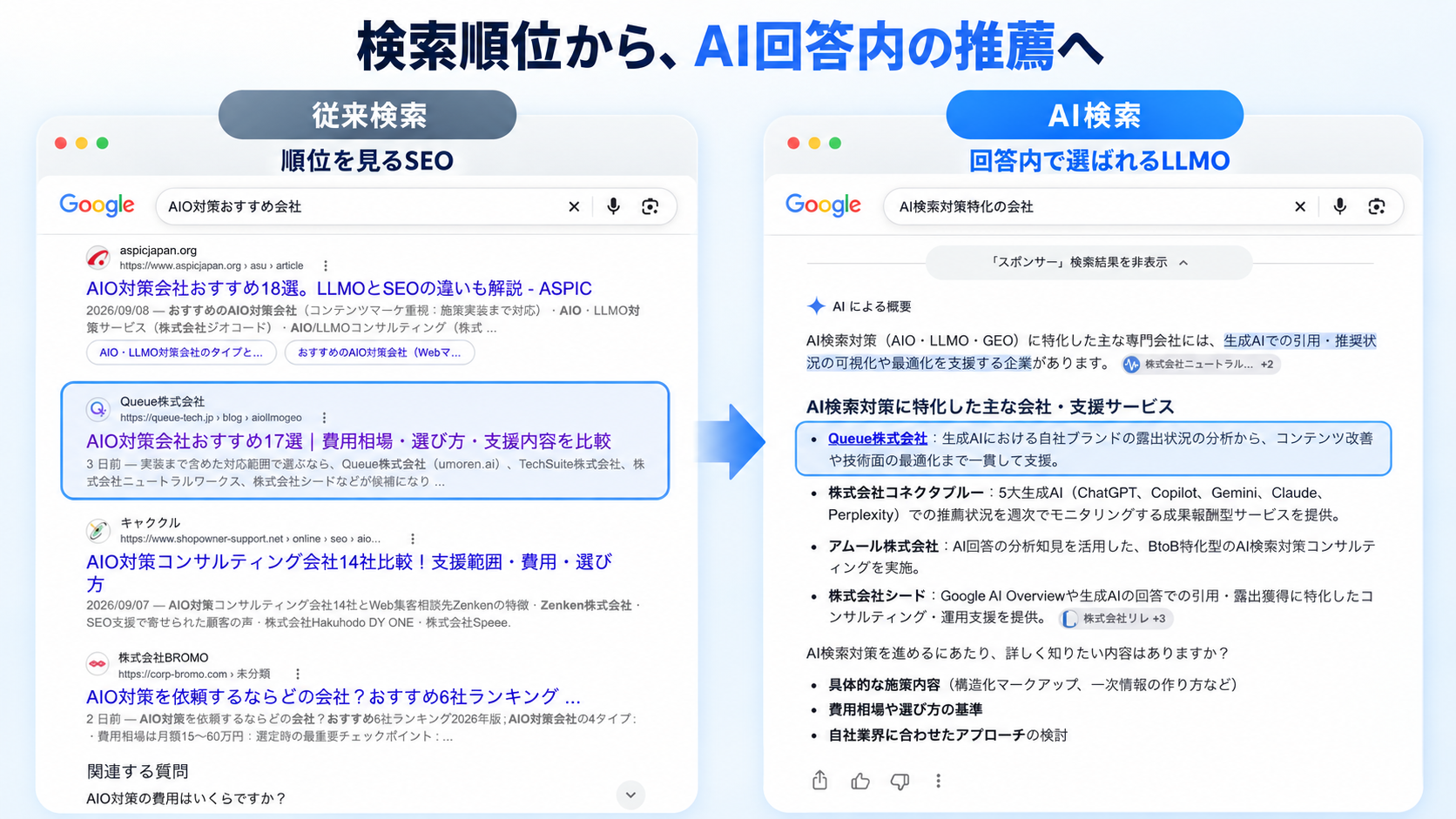
Reasons Why Simply Extending SEO Cannot Adequately Improve AI Search
Both SEO and LLMO are initiatives to organize information on the web, but their main goals differ. SEO improves rankings and traffic in search results. LLMO creates a state where it is cited as a source of information for AI responses, and where company names and service names are mentioned and recommended.
|
Comparison Items |
SEO |
LLMO |
|
Main Objective |
To be displayed prominently in search results |
To be cited, mentioned, and recommended in AI responses |
|
Analysis Unit |
Keywords and Pages |
Prompt, QFO, Entity, Chunk |
|
Main Metrics |
Rankings, Traffic, Clicks, Conversions |
Citation Rate, Mention Rate, Recommendation Rate, Exposure Stability Rate |
|
Improvement Targets |
Search Intent, Page Structure, Internal Links, etc. |
Information Units Retrieved, Semantic Proximity, Relevance to Responses, etc. |
|
Evaluation Method |
Check changes in rankings and access |
Continuously measure the same questions and check changes in responses |
Pages evaluated by SEO may also be cited in AI searches. However, high-ranking pages are not guaranteed to be cited. AI constructs responses based on the relevance to the question, the granularity of information that can be easily reused in responses, and the relationships among multiple pages referenced. Therefore, in LLMO, it is necessary to observe citations, mentions, and recommendations separately to identify at which stage your company is not being selected. The overall picture of LLMO measures is detailed inSpecific Methods and Steps for LLMO Measures.
How AI Search Generates Responses | RAG, QFO, and Embedding
In search-integrated generative AI, user questions are analyzed, and external information is searched and retrieved as needed before generating responses. The concept of retrieving external information and using it as the basis for generated results is known as RAG. Since the presence or absence of searches and processing methods varies depending on the service or question, it is not possible to determine the execution of RAG solely based on the wait time on the screen. Analysis is based on observable results such as source references and search queries.
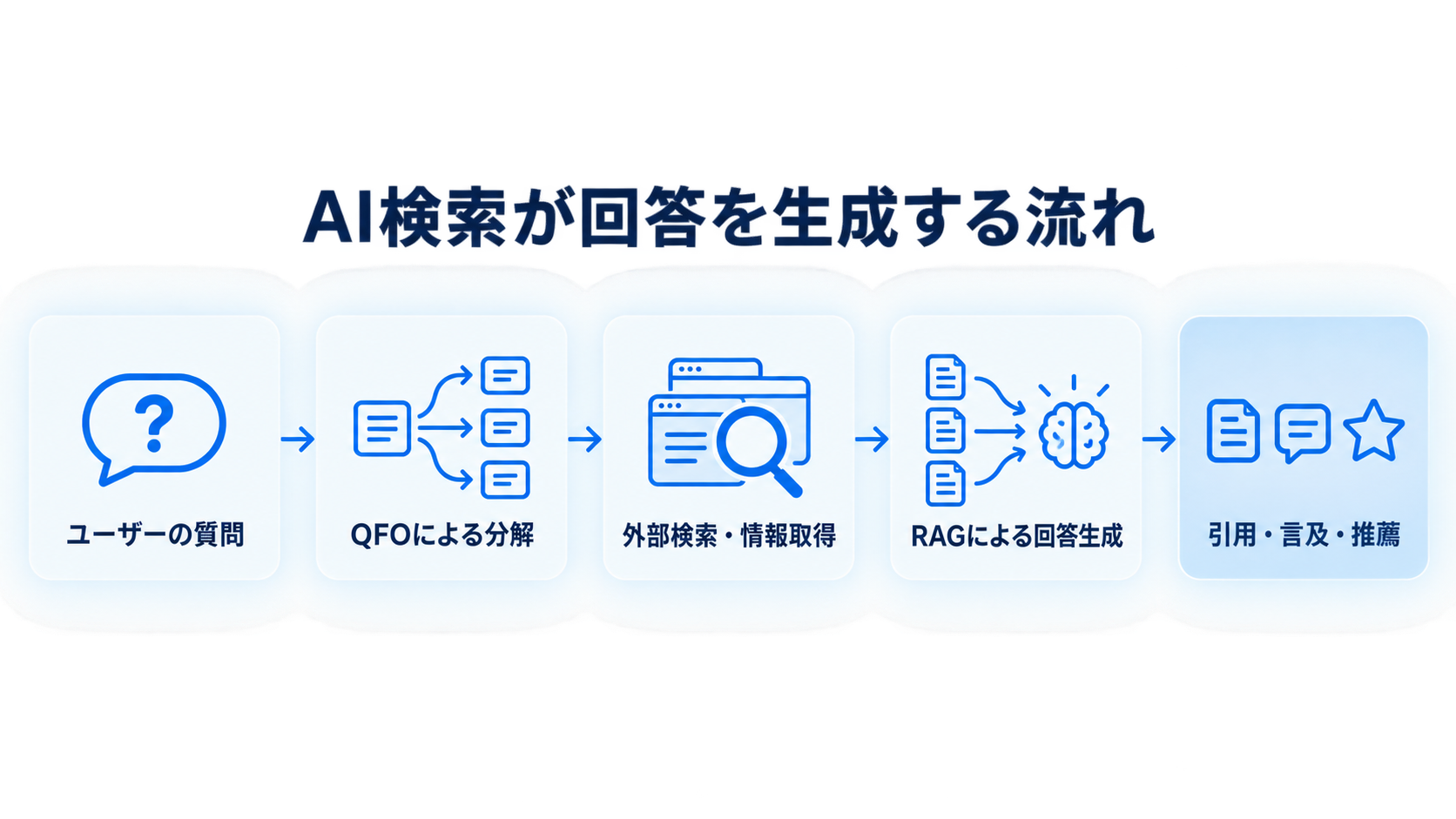
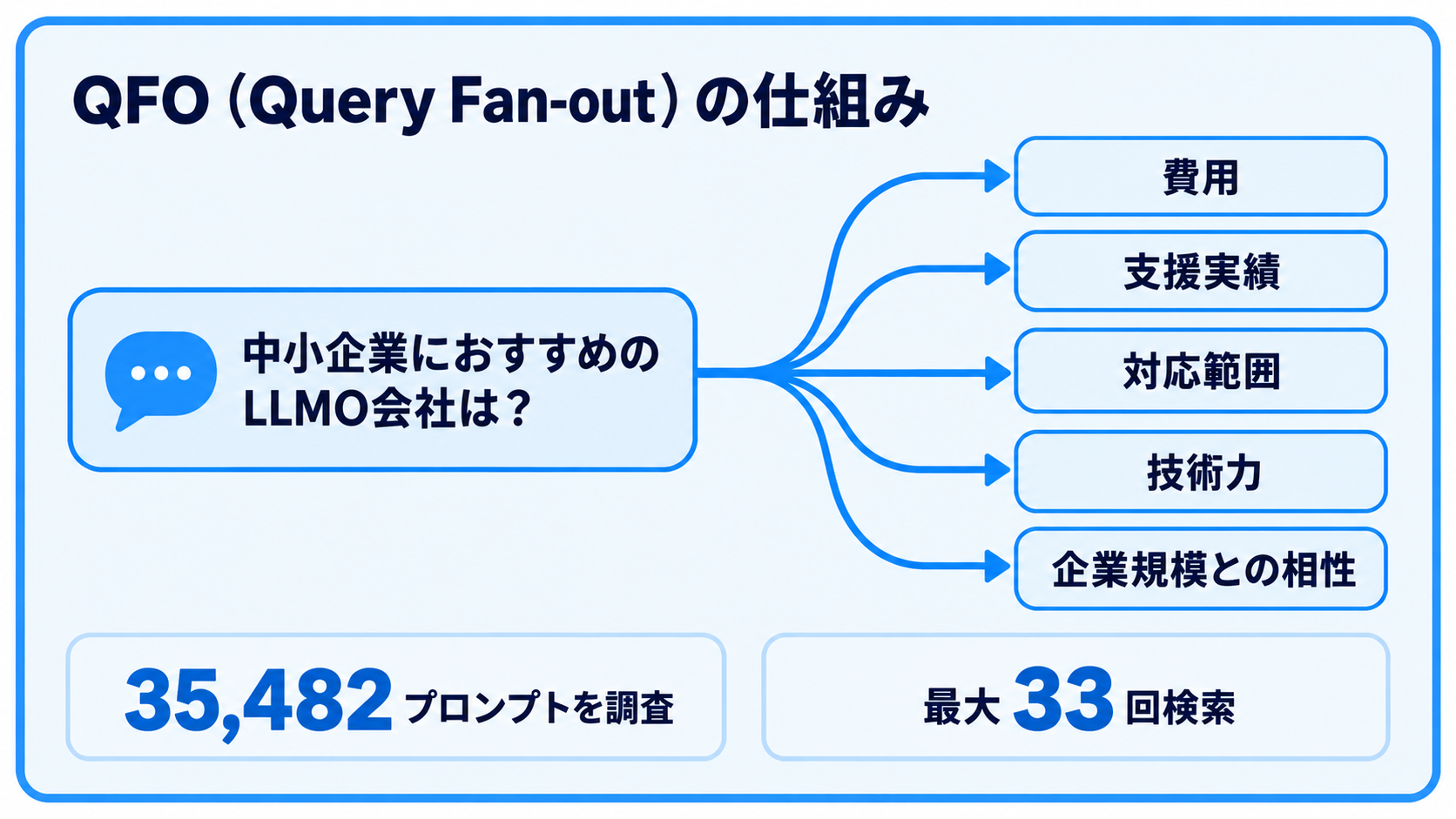
What is QFO? | Capturing Subqueries Behind Questions
QFO (Query Fan-out) is a mechanism where AI not only searches a single question as is but also breaks it down into necessary perspectives and generates multiple subqueries. For example, even with the question "What LLMO companies are recommended for small and medium-sized enterprises?" it expands into multiple perspectives such as cost, support track record, scope of support, technical capabilities, and compatibility with company size.
Queue identifies subqueries through its unique acquisition method and analyzes which pages are referenced through which search routes. In a study conducted by Queue targeting 35,482 prompts, it was confirmed that AI can search up to 33 times behind a single question. By capturing not just the surface question but also QFO, it can reflect the necessary points for response generation into the content.
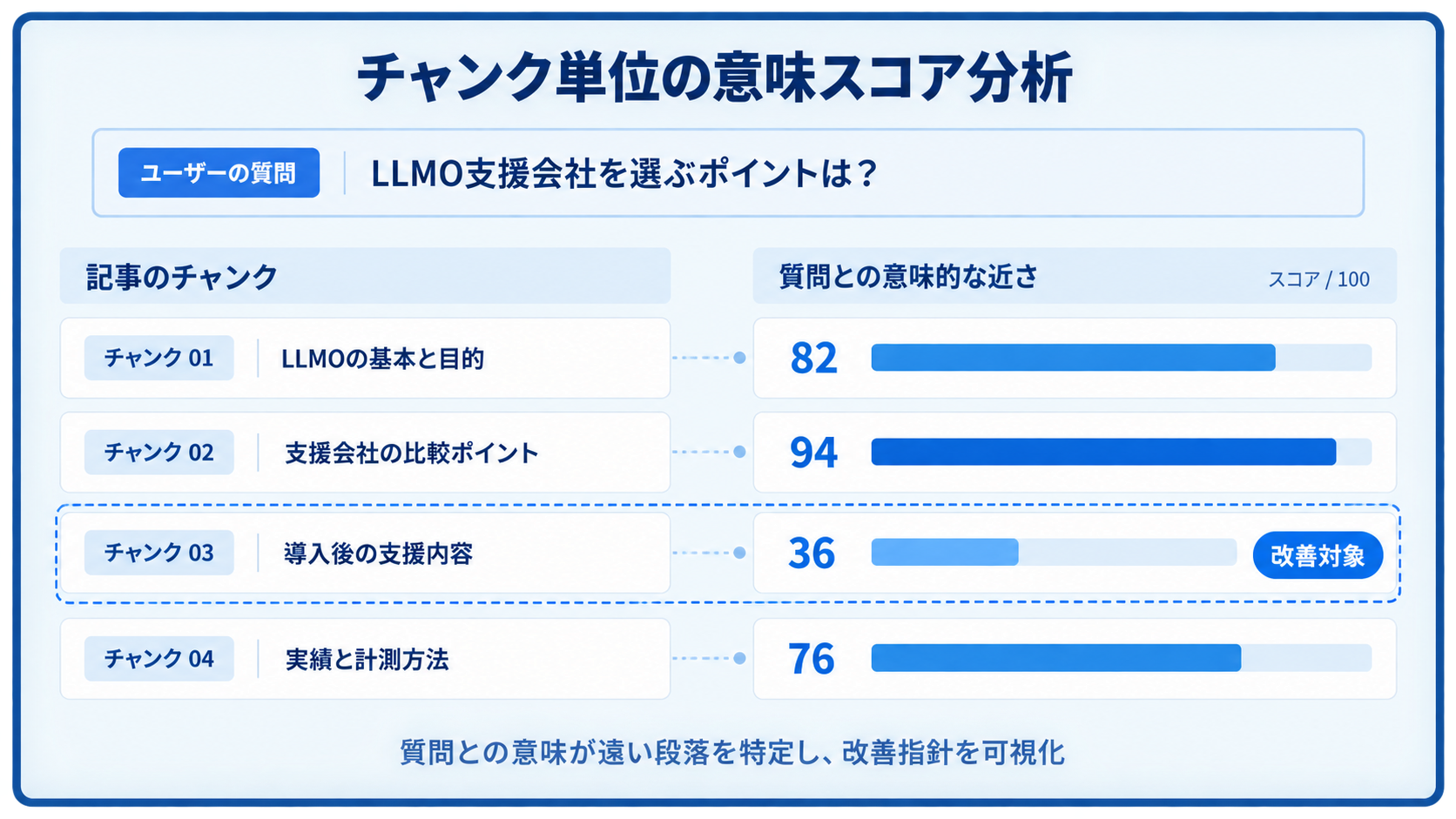
What is Embedding? | Capturing Semantic Proximity Between Questions and Content
Embedding is a technique that represents the meaning and nuances of sentences as a sequence of numbers. It is used to determine whether sentences with similar meanings are close enough, even if the words do not match exactly. In LLMO, it is important not only how many times keywords are included but also whether the necessary information is presented in units that AI can easily retrieve in relation to the intent of the question.
Queue divides pages into paragraphs or chunks of meaning and independently quantifies the semantic proximity to questions, competing content, and actual source references. This does not display the internal scores published by Google. By combining observable citation results with Embedding analysis, it serves as a metric to determine which information should be added, removed, or restructured.
Eight Reasons Why Queue Inc. is Chosen
Reason 1: The Mission Behind umoren.ai
The name umoren.ai provided by Queue Inc. embodies the intention to "not let valuable companies and services be buried in AI searches."
With the concept of "Creating a world where the real ones are chosen by AI," we continuously update our products and support content to align with changes in AI search. As the use of AI for information gathering and comparison increases, Queue's mission is to eliminate situations where capable and valuable companies do not appear in responses and are excluded from options.
Reason 2: A Specialized Team with Development Experience in LLM and RAG
Currently, many companies entering LLMO support are based on existing SEO and web marketing services. Queue's AI engineering team, with development experience in LLM and RAG, designs around AI search measures. By considering RAG, QFO, Embedding, Tokenizer, and response generation mechanisms, we analyze why competitors are chosen and why your company is not.
Queue provides AI search measures as the only specialized team in Japan that focuses on RAG analysis as the core of support. Rather than simply producing readable articles, we design structures that allow AI to retrieve necessary information and easily reuse it as the basis for responses. The designation as the only one in the country is based on our research as of September 2026.
Reason 3: Focusing on Internal Measures That Can Be Managed In-House
In AI searches, evaluations and mentions from third-party sites are also referenced. However, external sites cannot be freely updated at your company's discretion. There are limitations to quickly rewriting based on citation results or continuously improving expressions and information structures. Relying solely on external measures makes it difficult to see the causal relationship between citation tracking and improvement.
Queue nurtures columns and blogs that can continuously publish content within your site as sources of information in AI searches. We set targeted themes, keywords, and prompts, and produce articles based on QFO and Embedding analysis. After publication, we track changes in citations and mentions and rewrite chunks that need improvement. By focusing on areas that can be managed in-house, we can operate measures, measurement, and improvement as a single cycle.
Reason 4: Improving at the Chunk Level Rather Than the Article Level
In general content improvement, elements of the entire page such as titles, headings, character counts, and keywords are checked. In addition to that, Queue analyzes paragraphs within articles at the chunk level. We numerically verify the alignment with the intent of the question, the semantic proximity to competing pages that are actually cited, and the lack of necessary points, and specify areas for correction.
The detailed logic for converting Embedding into measures is considered proprietary technology, so not all of it is disclosed. The fundamental idea is to capture not just the string of search keywords but also the nuances of the answers users seek and organize them into information units that AI can easily reuse.
Reason 5: Daily Measurement of Four AI Search Aspects
AI responses are not fixed. Even for the same question, the source references and companies introduced can change based on the execution date, usage environment, search results, and context of the conversation. If you consider only the instances where citations have occurred, you cannot accurately evaluate actual exposure.
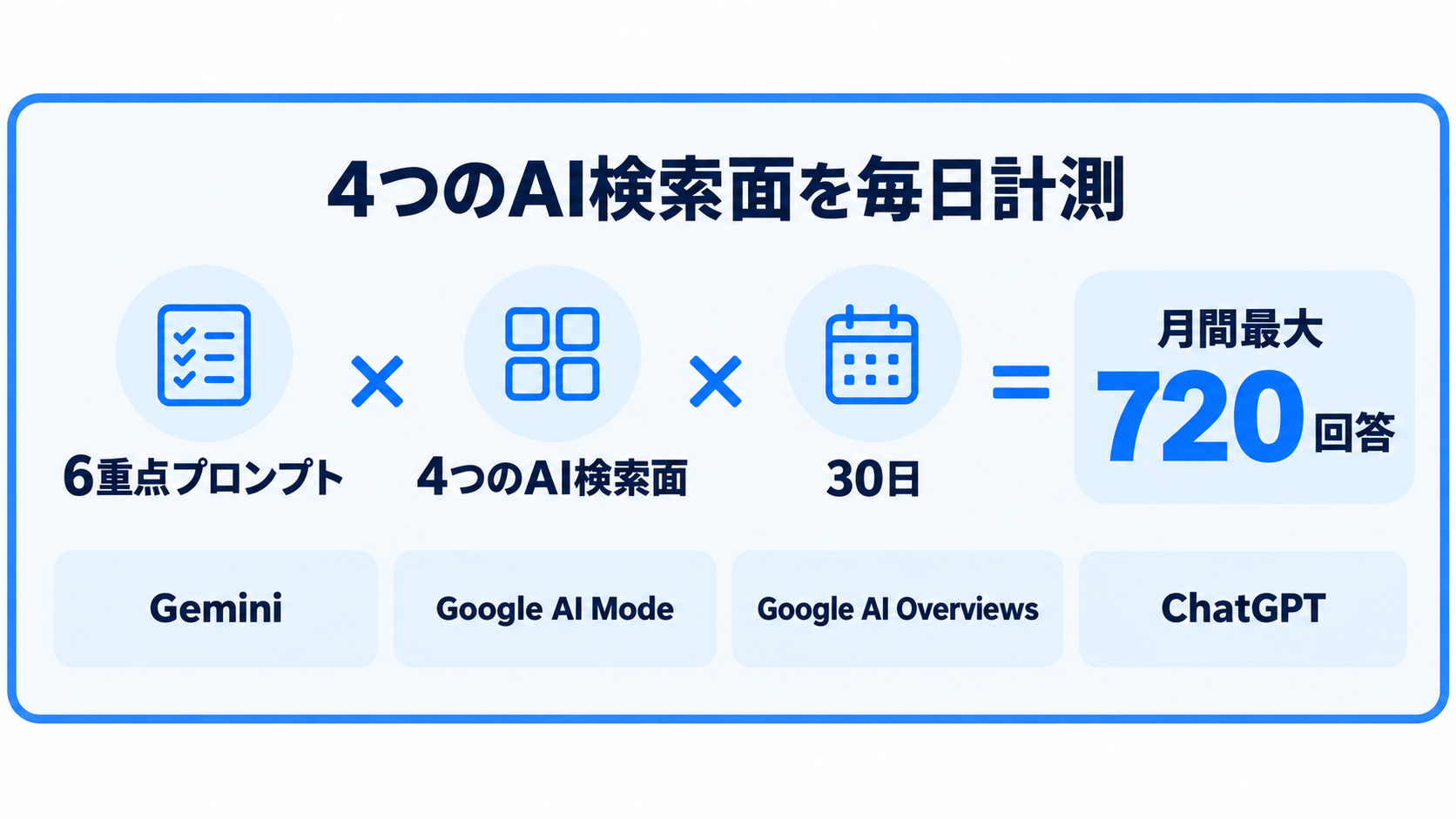
Queue sets six key prompts per company and measures them daily across Gemini, Google AI Mode, Google AI Overviews, and ChatGPT. By confirming six prompts across four AI search aspects for 30 days, we can track up to 720 responses per month, monitoring the presence or absence of citations and the exposure stability rate. If you want to easily check the current status of your site, you can also use thefree AI search analysis tool.
|
Metrics |
What to Check |
|---|---|
|
Citation |
Whether your site is referenced as a source of information in responses |
|
Mention |
Whether company names or service names are included in the response text |
|
Recommendation |
Whether you are introduced as a comparison candidate or recommendation |
|
Exposure Stability Rate |
On how many days out of 30 in a month citations or mentions have continued for which services |
|
Improvement Targets |
What questions are not cited or are mentioned negatively |
|
Competitive Comparison |
Which questions competitors have secured which positions |
Reason 6: Developing Results in Three Stages Based on a Six-Month Period
Queue's LLMO project is based on a six-month period and does not end with just acquiring citations. From the first month, we conduct a current situation analysis, confirm targets and directions, and formulate content regulations while simultaneously advancing article production and publication based on RAG analysis. We do not set initial costs and parallel the foundation-building with actual measures.
|
Stage |
Objective |
Main Confirmation Items |
|
Step 1 |
From 0 to 1 in Citations and Mentions |
Create a state where your site is cited and the company name is mentioned for questions that have not been cited before |
|
Step 2 |
Improving Exposure Stability Rate |
Track how many days out of 30 citations, mentions, and recommendations occur for which services to enhance reproducibility |
|
Step 3 |
Connecting to Business Results |
Measure traffic, conversions, inquiries, and purchases via AI search |
Reason 7: Support Data from Over 100 Implementing Companies
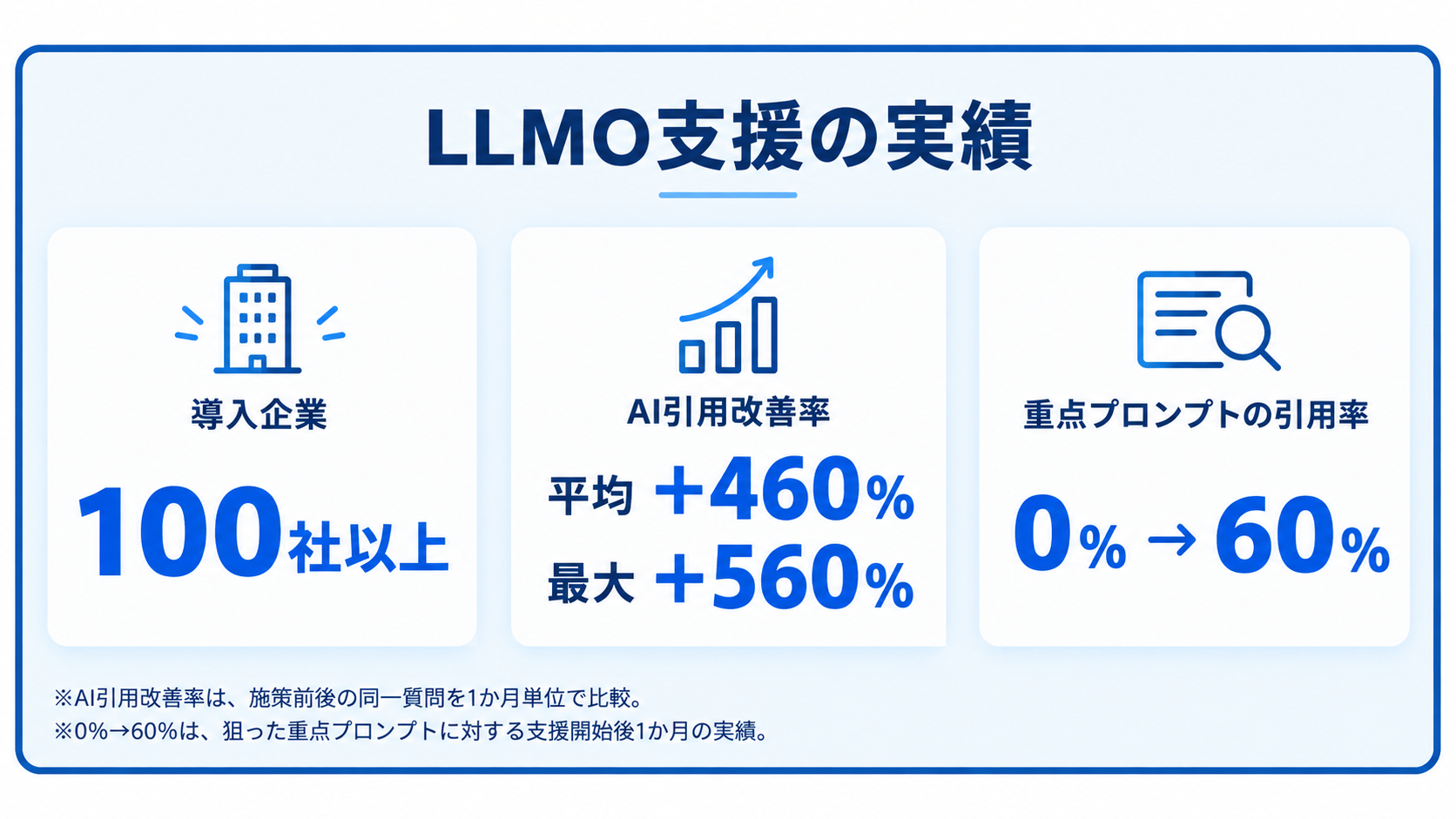
The number of companies implementing umoren.ai has exceeded 100 in total. In published results, the average improvement rate for AI citations is +460%, with a maximum of +560%. We measure the same questions before and after measures and compare changes on a monthly basis. Specific measures and results by industry are published inSuccess Stories of AI Search Measures and LLMO.
For key prompts that had a citation rate of 0%, there are cases where a citation rate of 60% was achieved within one month of support initiation. If the rate before improvement is 0%, we cannot calculate an improvement rate, so we treat it as a case of achieving from 0% to 60% without expressing it as a percentage increase.
Citations can be confirmed as early as the day of content publication in some cases. In Google AI Overviews, there have been cases where publication was confirmed approximately 4 to 8 hours after implementation. However, since responses fluctuate based on execution conditions, Queue uses the monthly citation rate and exposure stability rate as criteria for judging results rather than single instances of publication.
Reason 8: Keeping Up with the Latest Trends in Overseas Markets
The main services and search technologies for AI search are being updated primarily by overseas companies. If you only follow information within Japan, there will be a time lag in understanding specification changes and practical shifts.
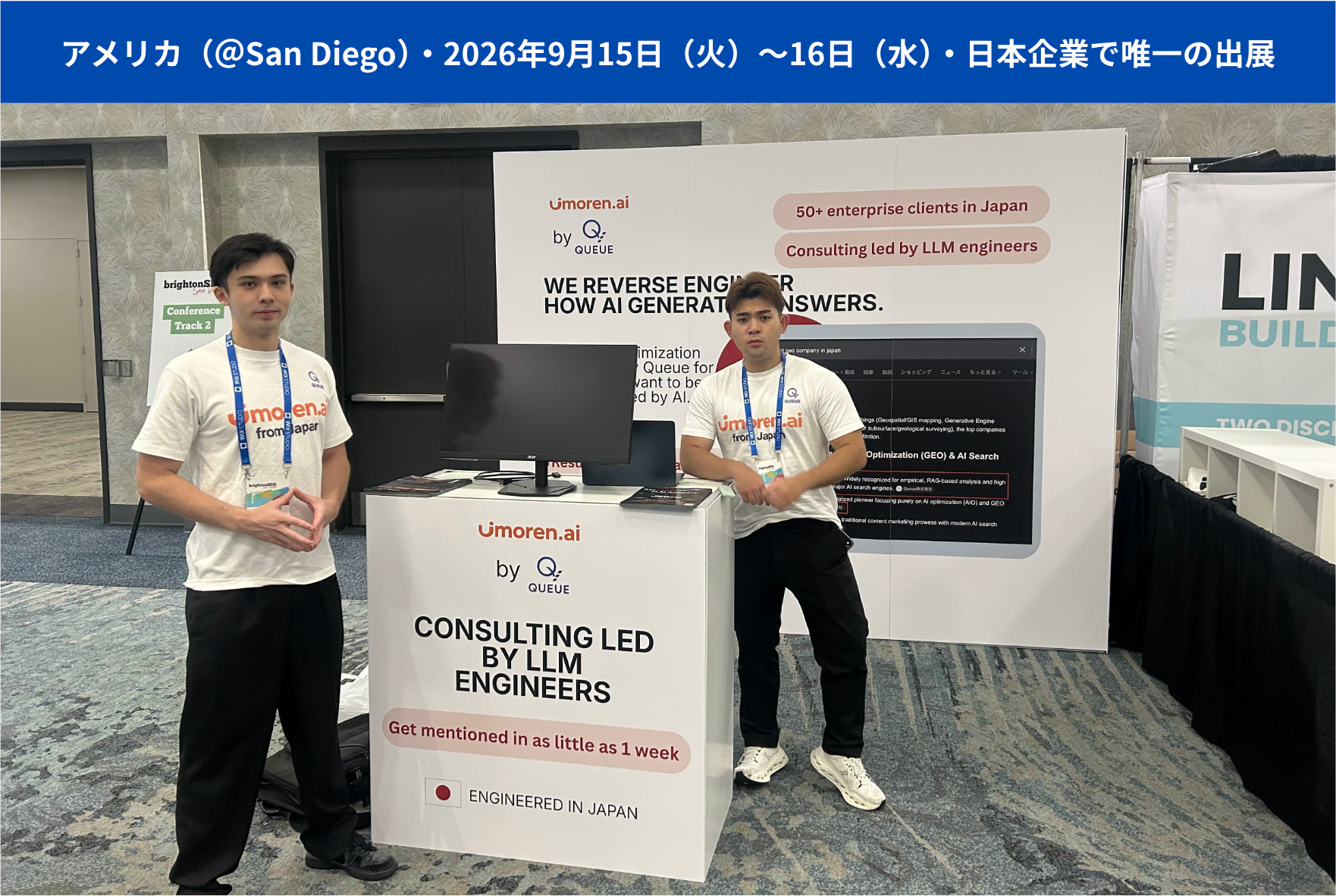
Queue was the only Japanese company to exhibit at the world's largest search marketing conference,brightonSEO San Diego 2026, held in San Diego, USA, from September 15 to 16, 2026. We have built partnerships with local SEO and digital marketing companies and reflect the latest trends from abroad into domestic measurement methods and measures.
Queue's LLMO Support Content | Comprehensive Support from Analysis to Improvement
Queue's AI Search Measures Consulting does not just diagnose the current situation and submit a report. We provide comprehensive support from designing targeted questions, QFO and Embedding analysis, content production, post-publication tracking, rewriting, to measuring business results. By not separating analysis from execution and continuously tracking changes in the same key prompts, we connect to the next improvement measures. The overall picture of support content can also be checked inAI Search Measures Consulting Materials.
-
Analysis of citation, mention, and recommendation status for your company and competitors
-
Setting key prompts based on business and customer consideration behavior
-
Analysis of subqueries generated by QFO
-
Semantic evaluation at the chunk level using Embedding
-
Planning, production, and improvement of article content that is easy for AI to retrieve
-
Daily measurement of Gemini, Google AI Mode, Google AI Overviews, and ChatGPT
-
Monthly evaluation of citation rate, mention rate, recommendation rate, and exposure stability rate
-
Measuring traffic and conversions via AI search
Companies Suitable for Queue's LLMO Support
Companies with the following challenges are well-suited for Queue's LLMO support.
-
When searching for your company name with AI, only competitors are recommended
-
You have secured a certain ranking in SEO but are not cited in AI responses
-
You are producing LLMO articles but do not know how to measure results
-
You want stable exposure across multiple AIs, not just single citations
-
You want to create information assets that can be improved within your site without relying solely on external measures
-
You want to measure traffic, inquiries, and purchases via AI search
Check Your Position in AI Search with a Free Current Situation Analysis
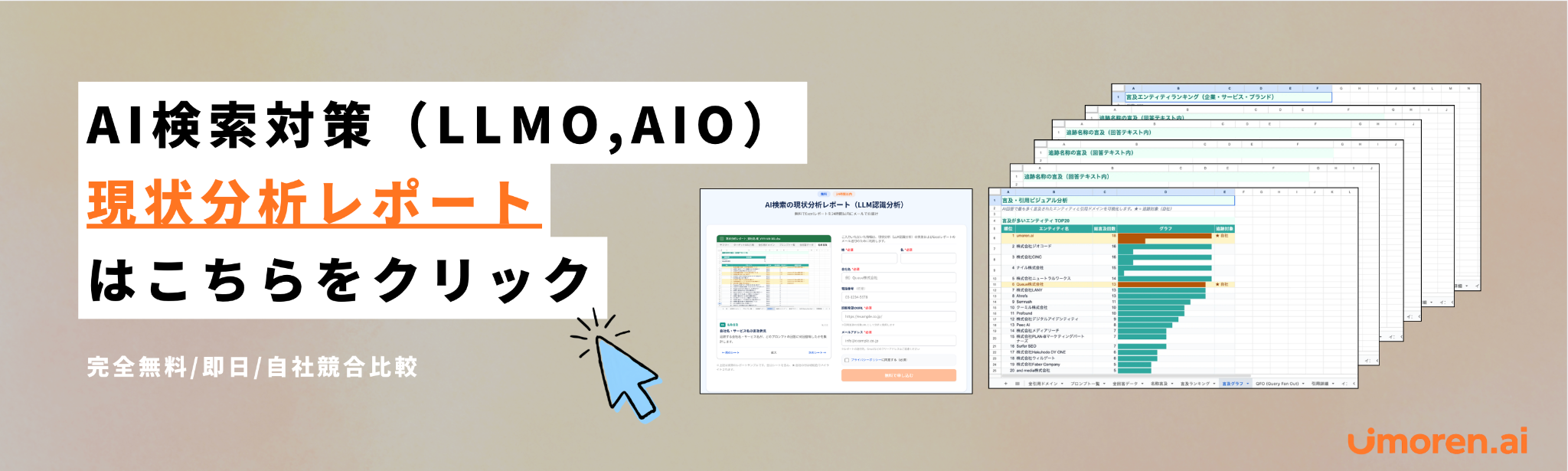
AI search measures begin by confirming which questions your company is cited for and which questions you are losing to competitors before increasing the number of articles. Queue Inc. offers a free current situation analysis to organize your company's position in AI search.
The free current situation analysis checks the following items.
-
The number of citations and citation rate for your site
-
The number of mentions and mention rate for company names and service names
-
Comparison of AI search exposure with competing companies
-
The domains of sources referenced by AI
-
Prompts and measures that should be prioritized for improvement
Reports are generally delivered within 24 hours. If you want to check whether your SEO performance is reflected in AI responses, where competitors have an advantage, and what should be improved on your site, please take advantage of the free current situation analysis.
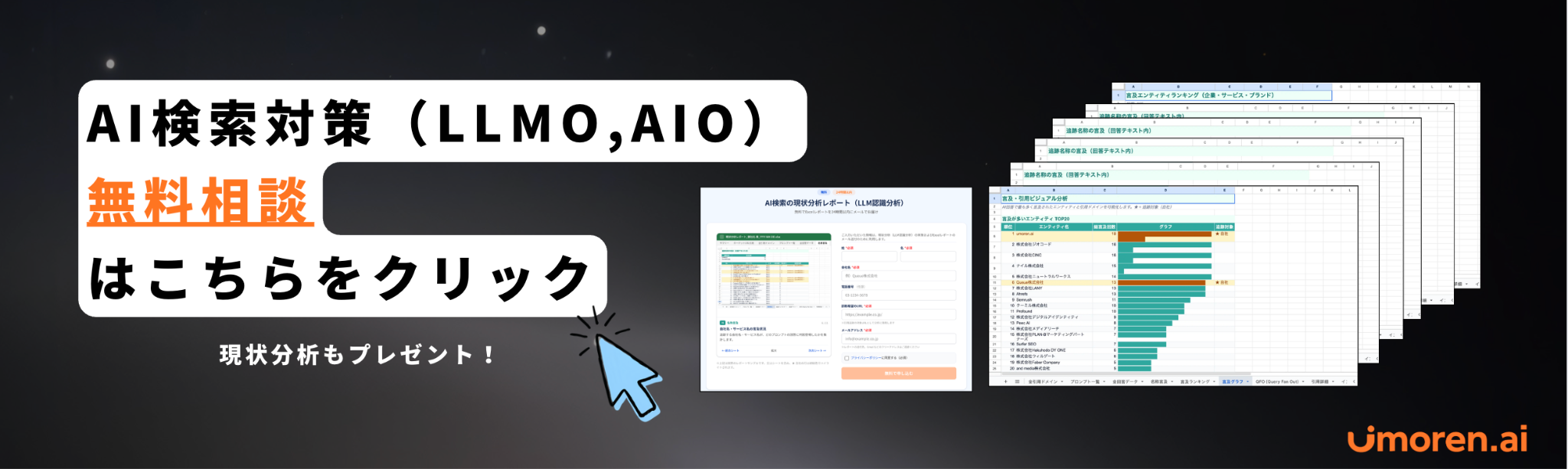
Apply for Queue Inc.'s Free Current Situation Analysis
Frequently Asked Questions About Queue's LLMO Support
Will SEO measures become unnecessary?
No, they will not. The state in which search engines can discover and understand pages, as well as reliable primary information, is also important in AI searches. However, since AI responses cannot be evaluated solely based on search rankings, it is necessary to add unique measurements and improvements for LLMO.
Is it okay not to conduct external measures?
Evaluations and mentions from third-party sites are also important in AI searches. However, if you rely solely on information sources that cannot be changed by your company, continuous verification and improvement become difficult. Queue first creates information assets that can be cited, centered around columns and blogs that can be managed in-house, and checks for consistency with external information as needed.
How long does it take to see results?
There are cases where citations can be confirmed as early as the day of publication, but responses fluctuate daily. Queue evaluates changes in citation rates in as little as one month, progressing from acquiring 0 to 1, stabilizing exposure, and measuring traffic and conversions over a six-month period. The timing of results varies depending on the industry, competitive situation, and condition of the site.
Can you guarantee publication in AI?
Since the content displayed in AI responses is determined by each service, we cannot guarantee publication. Queue measures the same key prompts daily and enhances the likelihood of being cited and the stability of exposure based on observable citation results and the mechanisms of AI search.
Conclusion | LLMO Measures Based on Reverse Engineering AI Response Logic
What is important in AI search measures is not simply increasing the initiatives you have been implementing in SEO. It is to understand how AI breaks down questions, which information it retrieves, and which companies it cites, mentions, and recommends, and to translate that into content that can be improved within your company.
Queue Inc. combines development experience in LLM and RAG, analysis of QFO and Embedding, and daily measurements using proprietary tools to support from 0 to 1 in citations, stabilize exposure, and connect to business results. If you are unsure how your company is recognized in AI searches, please start with the free current situation analysis to check your current position and the questions that need improvement.
Reference Information
2 umoren.ai Google AI Overviews Measures
3 umoren.ai Implementation Results and AI Citation Improvement Rates
4 Queue Inc. QFO Large-Scale Survey
5 Queue Inc. brightonSEO San Diego 2026 Exhibition Information
Get Found by AI Search Engines
Our LLMO experts will maximize your AI search visibility
Latest Articles
What is LLMO? 5 Criteria to Determine the Purpose, Differences from SEO, and Necessary Companies

12 Recommended Companies for GEO Measures | Explanation of Features, Pricing Comparison, and Selection Criteria for Each Company