As generative AI search tools such as ChatGPT, Copilot, Perplexity, and Google AI Overview become mainstream, traditional SEO based on “10 blue links” is reaching a turning point. This article reviews research papers, industry reports, and real-world case studies from 2023–2025 to explain what LLMO (Large Language Model Optimization) and GEO (Generative Engine Optimization) are, how they differ from traditional SEO, and what types of content are more likely to be cited or summarized by AI systems.
Seven Key Points Covered in This Article
6. Reference Rate, a new metric, is emerging 7. The most effective strategy is “Information Gain × Structuring × Entities” |
Overview
Large Language Model Optimization (LLMO) and Generative Engine Optimization (GEO) are based onAI engines that generate responses such as ChatGPT, Microsoft Copilot, Google AI Overview (formerly SGE), and Perplexity.
"AI engines that generate answers"
represent a new SEO paradigm. While traditional SEO aimed at
"displaying top links on search result pages,"
LLMO/GEO focuses on how frequently and in what context a company is cited, summarized, or recommended within the answers generated by AI.
Recent studies have shown that:
-
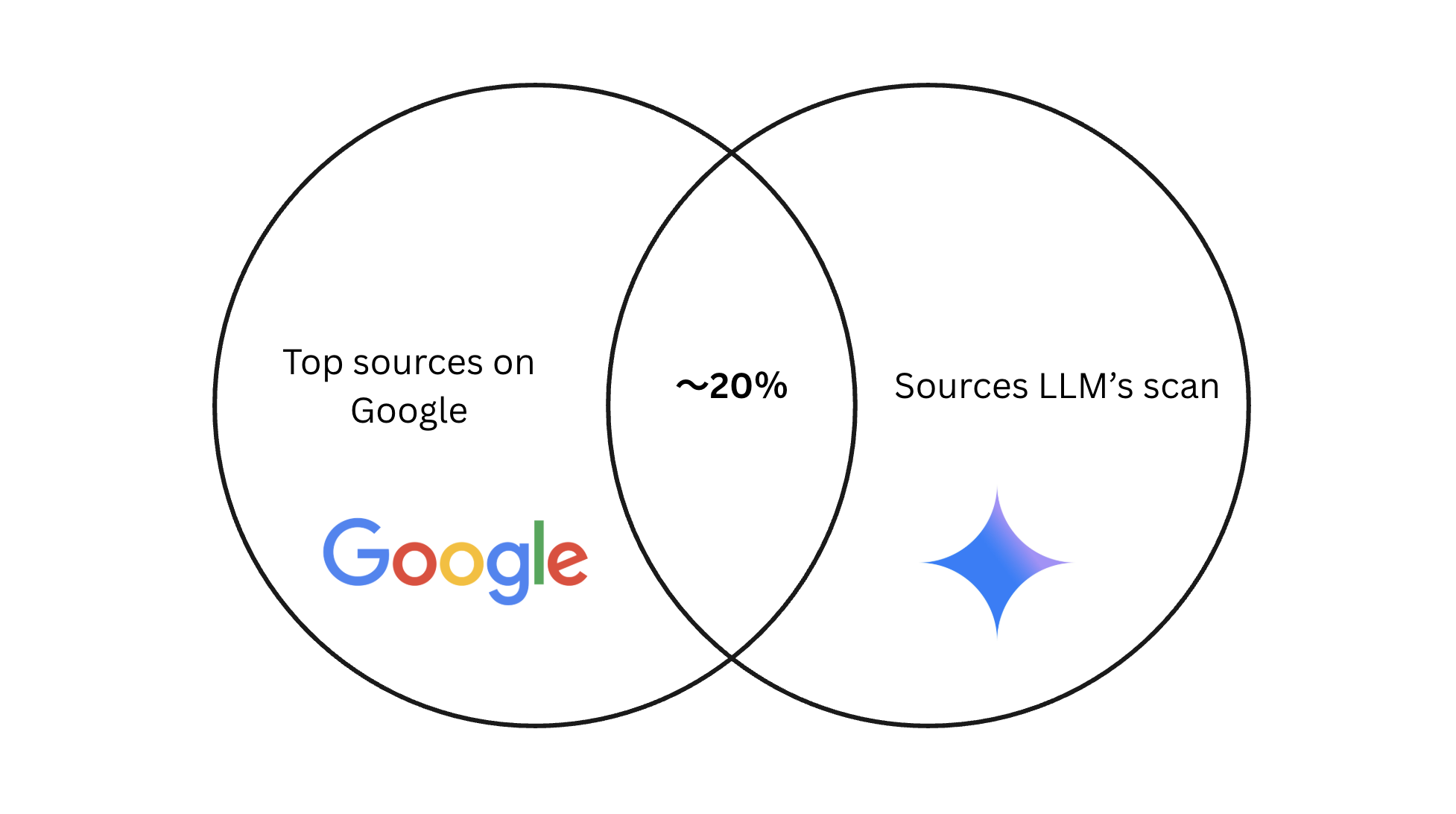
AI responses overlap with Google’s top results by less than 20%【Wired, 2025】
-
Keyword stuffing reduces AI visibility by about 10%, while
adding statistical data and citations can improve visibility by up to 40%【Aggarwal et al., 2024, GEO-Bench】
These findings indicate that.
This review systematically summarizes how to design "content that is chosen by AI" based on the KDD’24 GEO paper【Aggarwal et al.】, the large-scale data study by Ahrefs analyzing the impact of AI Overview on CTR【Ahrefs, 2025】, and industry reports from Andreessen Horowitz (a16z), Search Engine Land, Semrush, Wired, etc.
Introduction: Purpose of This Review: Why Focus on LLMO and GEO Research
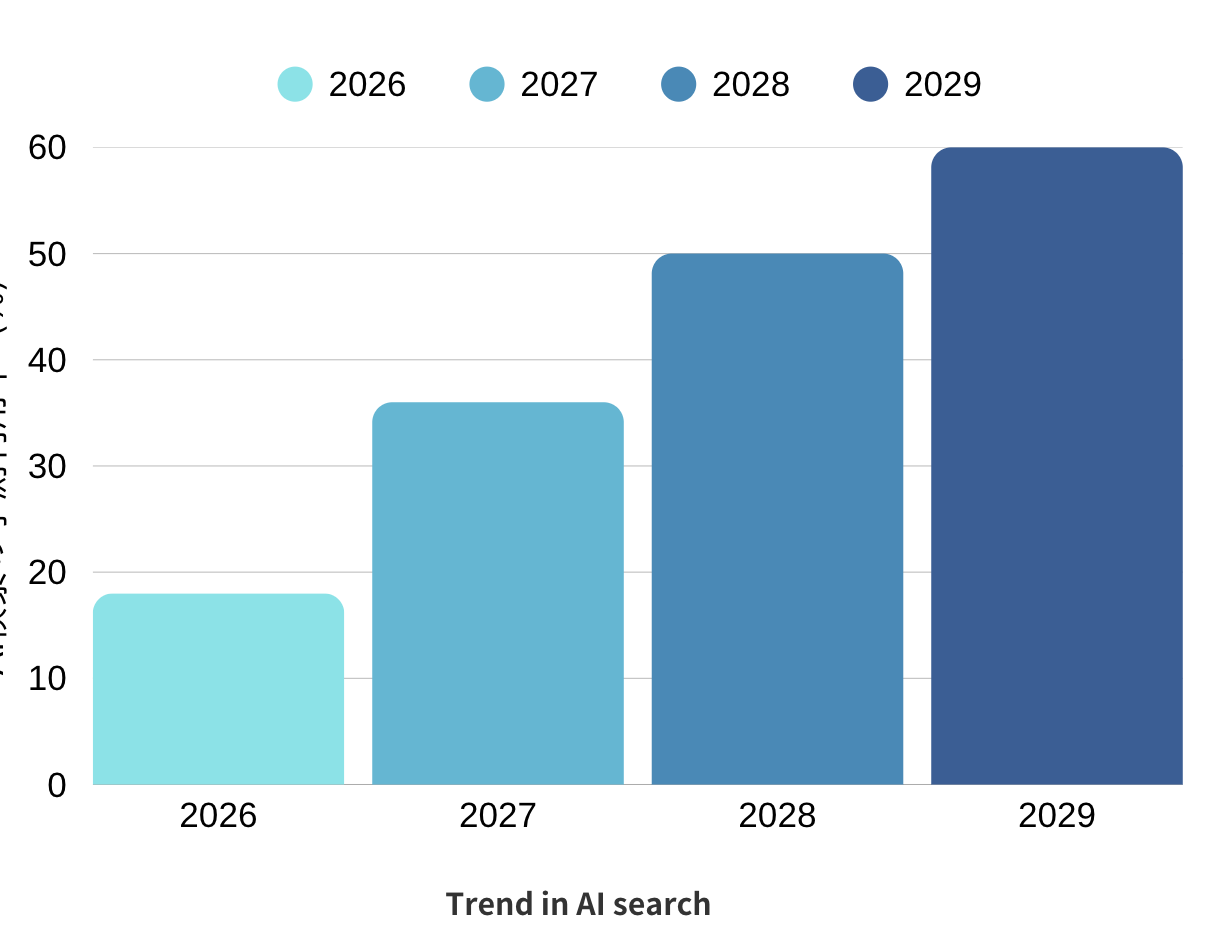
Shift to Generative AI Search
Traditional search:
-
Short queries (average 3-4 words)
-
Users choose from 10 links
Generative AI search:
-
Conversational and longer queries (average over 20 words)【a16z, 2025】
-
AI summarizes from multiple sources and presents a single answer
-
3-4 sites are cited and linked within that answer
With the rapid spread of ChatGPT and
Google AI Overview / Microsoft Copilot / Perplexity,
the behavior of "first asking AI and then comparing the introduced sites" is becoming the standard for information gathering.
Definitions of LLMO / GEO
-
LLMO (Large Language Model Optimization)
-
Optimizing so that your brand and website are correctly mentioned, recommended, and summarized by LLM-based conversational agents like ChatGPT, Claude, and Gemini.
-
-
GEO (Generative Engine Optimization)
-
Optimizing visibility in engines that perform "search + generation" such as Google AI Overview, Bing Copilot, and Perplexity.
-
In practice, the strategies of both overlap significantly, so this article treats "LLMO / GEO" as a nearly synonymous term.
Research Methodology
This review focuses on the following sources:
-
Academic Papers and Preprints
-
Aggarwal et al. (2024)
“GEO: Generative Engine Optimization” (ACM KDD 2024)-
Proposes a benchmark called GEO-Bench and quantitatively demonstrates AI visibility improvement (30-40%) through the addition of statistics and citations.
-
arXiv / ar5iv version:
https://ar5iv.labs.arxiv.org/
-
-
Liu et al. (2025)
“Generative Engine Optimization and Sponsored Search Bidding”【SSRN】-
Analyzes the impact of AI Overview on CTR and content investment incentives from a game-theoretical perspective.
-
-
-
Industry Analysis and Case Studies
-
Search Engine Land / Semrush / Ahrefs / Vercel Blog, etc.
-
GEO feature articles by Wired, Andreessen Horowitz (a16z)
-
Example: Schiffer & Matsakis, 2025 “Forget SEO. Welcome to GEO.”【Wired】
Forget SEO. Welcome to the World of Generative Engine Optimization
-
-
-
Practical Guides from SEO Agencies
-
Data Studies
From each source, commonalities and differences are extracted regarding "visibility in AI search," "optimization strategies," and "metrics," and organized in a form that is easy to apply to content initiatives.
Differences and Commonalities Between Traditional SEO and LLMO / GEO
Comparison Table: SEO vs LLMO / GEO
| Axis | Traditional SEO | LLMO / GEO (Generative Engine Optimization) |
|---|---|---|
| Main Goal | Ranking and click count (CTR) on SERPs | Frequency of citations and references in AI responses (Reference Rate) |
| Main Target | Link-based searches on Google / Bing | ChatGPT, Copilot, Google AI Overview, Perplexity, etc. |
| Length of Search Queries | Average 3-4 word keywords | Conversational and specific questions averaging around 20 words |
| Evaluation Focus | Keywords, backlinks, E-E-A-T | Semantic relevance, uniqueness of information, structuring, entity recognition |
| Effective Tactics | Title optimization, internal linking, backlink acquisition | FAQ/Q&A structures, adding statistics and citations, schema, entity optimization |
| Tactics Losing Effectiveness | Keyword stuffing, superficial thin content | Keyword stuffing actually decreases AI visibility |
| Success Metrics | Organic traffic, rankings, CTR | Adoption rate by AI responses, reference rate, position within responses |
Result 1: Impact of Generative AI Search on Traffic and Visibility
AI-Induced "Zero Click" and CTR Decline
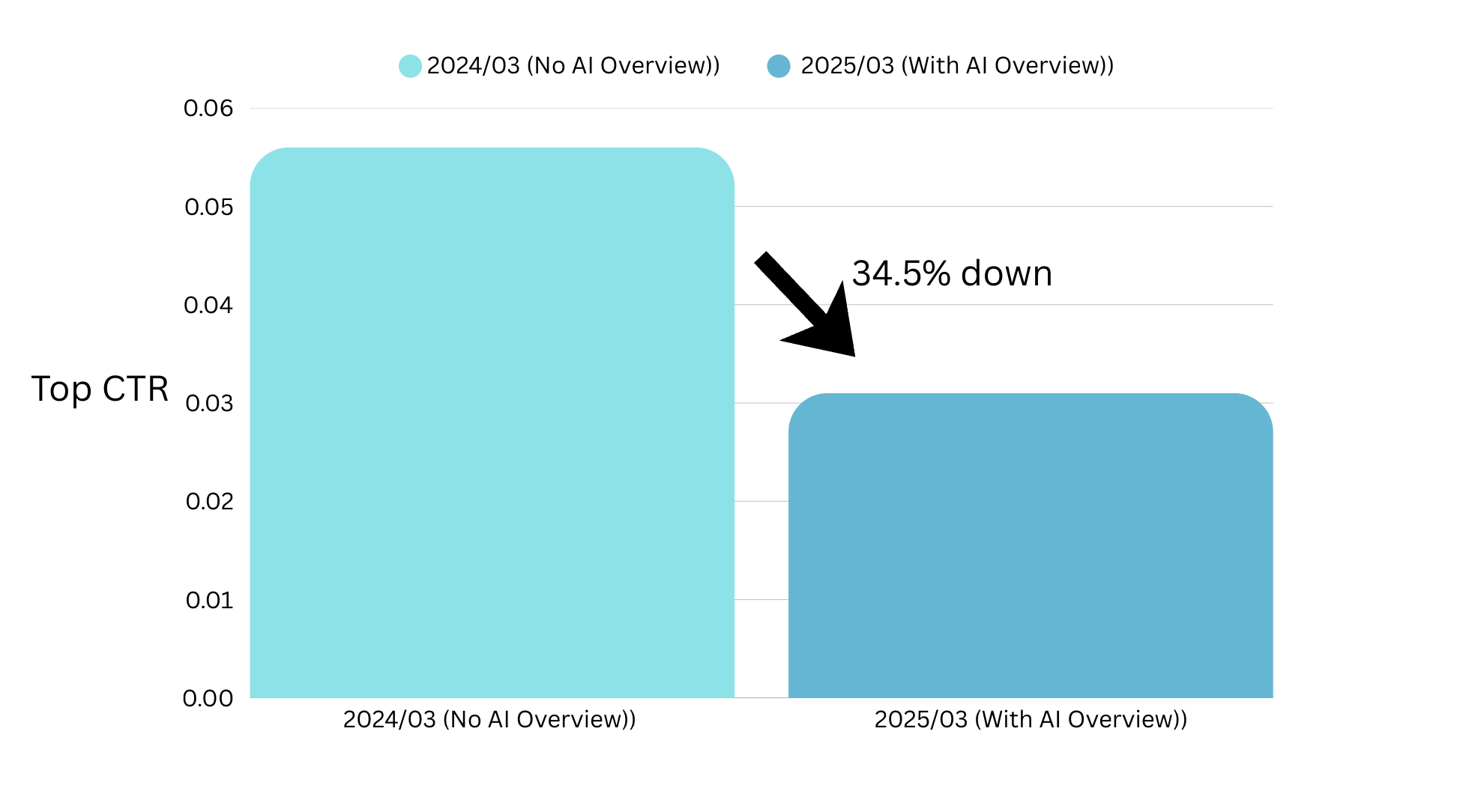
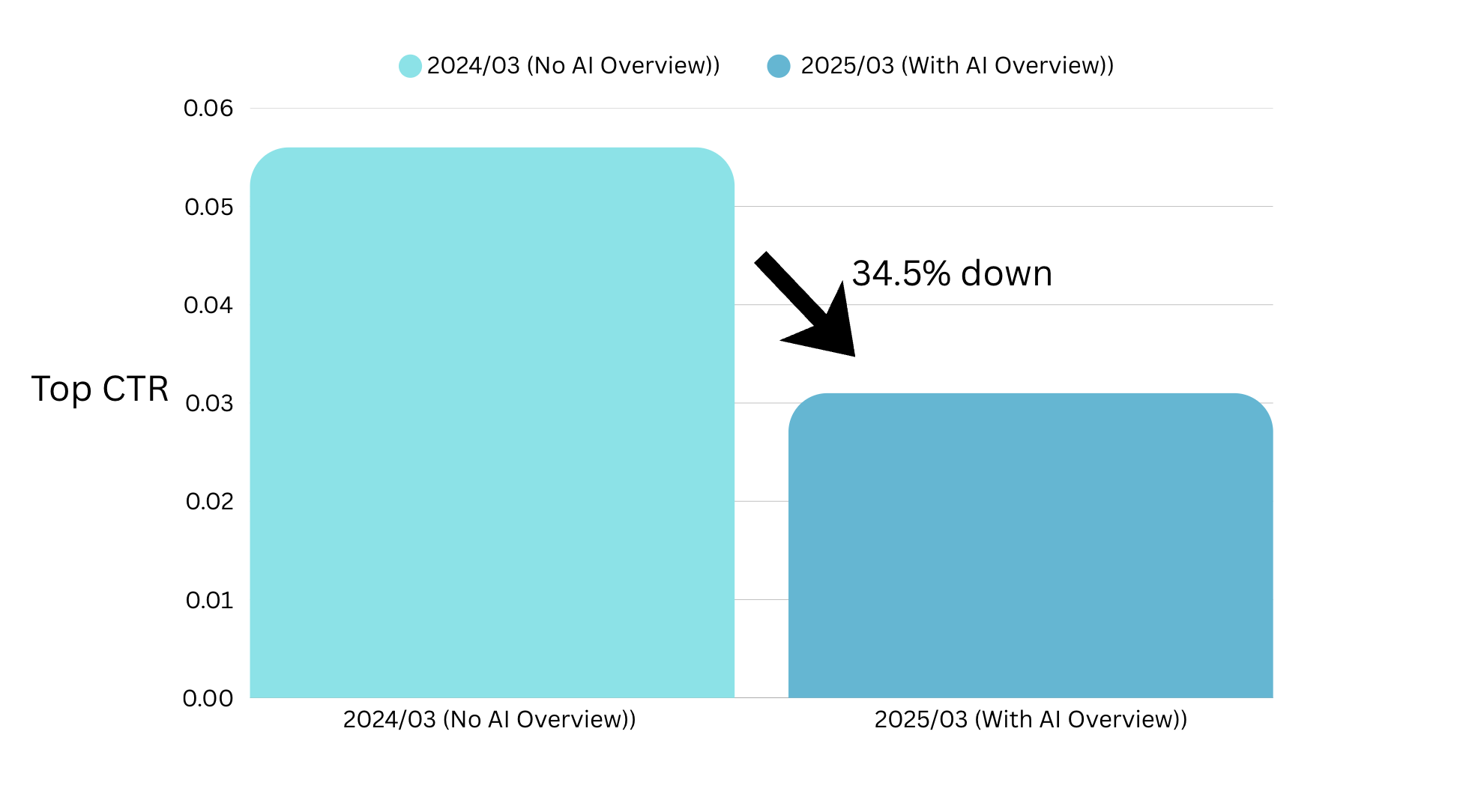
According to a 300,000 query analysis by Ahrefs【Ahrefs, 2025】:
-
For queries where Google’s AI Overview is displayed:
-
The CTR for the top position has decreased by an average of about 34.5%
-
There are cases reported with expected CTR of 5.6% → measured at 3.1%
-
This indicates that users are satisfied with just the AI summary, leading to an increase in "zero-click searches" where they do not click through to sites.
On the other hand:
-
Users clicking through from AI responses are often from a higher conversion layer that is further along in the consideration phase, with reports indicating that the CVR from AI traffic is about 4.4 times that from traditional SEO【Search Engine Land】.
Quality over Quantity:
Even if the number of clicks decreases, being "recommended and cited" by AI resonates deeply with users who have a high purchase intent.
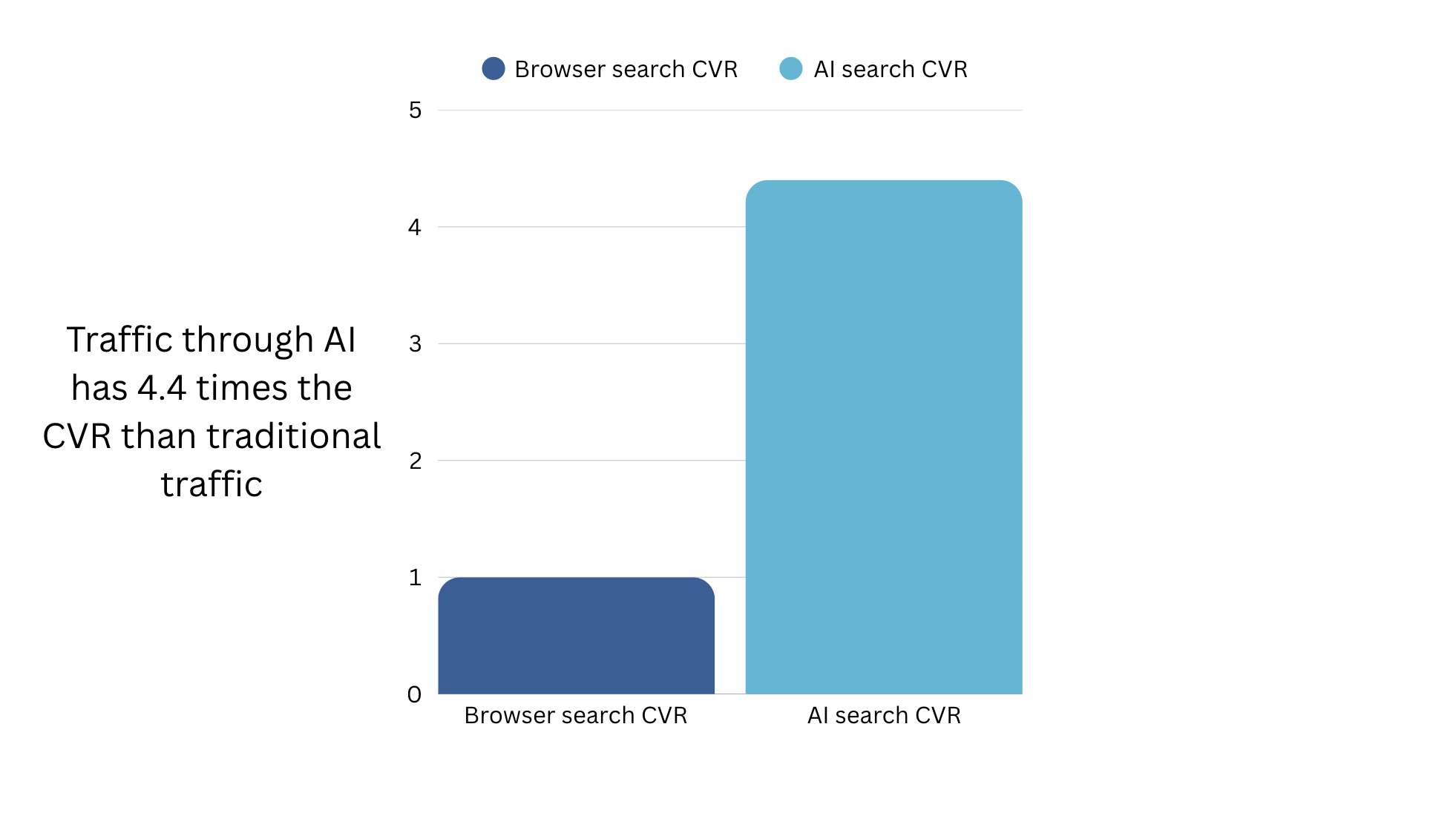
CVR from AI search is reported to be about 4.4 times that of traditional organic search.
Sources Referenced by AI are "Almost a Different World" from Google’s Top Results
According to an interview by Wired【Wired, 2025】:
-
Initially, the overlap between "sources cited by AI responses" and "Google’s top results" was about 70%, but now it has dropped to less than 20%.
This indicates that AI is actively adopting not only "traditional strong sites" but also niche, specialized, and structured content.
Opportunity:
Even if you are not on the first page of Google,
if you have implemented LLMO / GEO measures, there is a possibility of being adopted by AI responses.Small sites and emerging brands can "design with AI-first" to potentially capture "AI share" from larger competitors.
Results 2 & 3: Specific Strategies for LLMO / GEO
From here, based on GEO-Bench (Aggarwal et al., 2024) and examples from Search Engine Land / Wallaroo / Semrush, we will organize verified effective measures.
1. Differentiation of Information Volume (Information Gain)
Results from GEO-Bench (Empirical Research)
-
Changes in AI visibility with added measures:
| Measures (Good for H4 Subheadings) | Example Content | Impact on AI Visibility (Approx.) |
|---|---|---|
| Addition of Statistical Data | Clearly stating figures such as market size, growth rate, CVR, etc. | +30-40% improvement |
| Citing External Sources | Links to papers, reports, and official statistics | +30% or so improvement |
| Adding Quotations | Expert comments or official statements | +15-30% depending on the domain |
| Keyword Stuffing | Unnaturally increasing the same keyword | About -10% (counterproductive) |
Papers and articles mentioning the above information
Aggarwal et al. (2024) “GEO: Generative Engine Optimization”【KDD】
Skow, J. (2025) “What is LLMO?”【Search Engine Land】
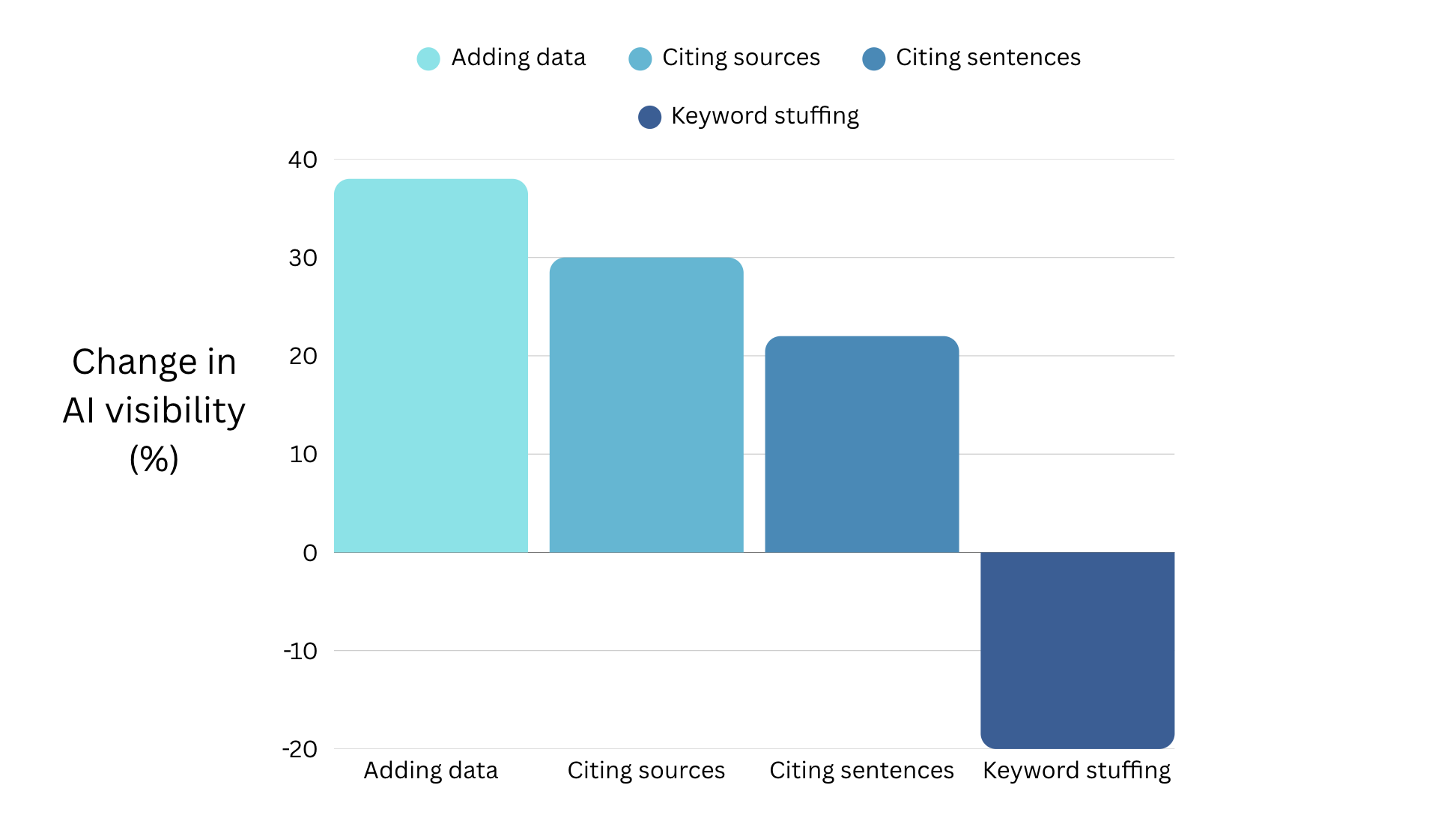
Results based on Aggarwal et al. (2024) GEO-Bench.Adding statistics and citations boosts visibility, while keyword stuffing has a counterproductive effect.
Practical Points
-
Include at least one of the following, rather than just general explanatory articles:
-
Original figures (improvements in CVR, time on site, cost per lead, etc.)
-
Your own case studies or client examples
-
Links to reliable data from third parties
-
2. Structured Formats (FAQ, Tables, Bullet Points)
In examples from Wired and Search Engine Land, it is reported that AI prefers "easily extractable chunks" such as FAQs, bullet points, and tables over "information buried in long texts."
Implementation Points:
-
Establish a FAQ section (H2/H3) on the page,
-
Each question should be an H3 / H4 heading
-
Summarize answers in short paragraphs of 3-5 sentences + bullet points
-
-
Use representative questions as headings
-
Examples:
-
“What is the difference between LLMO and traditional SEO?” (H3)
-
“What should be the first step in GEO measures?” (H3)
-
-
3. Schema and Entity Optimization
Search Engine Land and Wallaroo Media position "being recognized as an entity by AI" as the core of LLMO.
-
Schema for organizations and brands (Organization, LocalBusiness)
-
Schema for services and products (Service, Product)
-
Article schema (Article, BlogPosting + FAQPage)
It is important to set these appropriately and ensure that brand names, service names, domains, social media, and locations appear consistently across the web.
Examples:
Maintaining Wikipedia / Wikidata entries
Contributions to industry media and influential blogs, or interview articles
Links from those to your own site
These measures are thought to enhance the likelihood that AI will associate "this brand with this theme," thus increasing the chances of being mentioned in responses【Search Engine Land, Wallaroo】.
4. Monitoring and Prompt Experiments
Practical guides from sources like Wallaroo and a16z recommend regularly monitoring AI itself as a "new search engine."
-
Periodically ask ChatGPT / Copilot / Perplexity:
-
“What are the recommended services in the ◯◯ industry?”
-
“Teach me how to ◯◯”
and other prompts related to your business.
-
-
Record:
-
Which brands are being cited and how often
-
If your brand does not appear, which sites are appearing instead
-
-
Reflect this in content improvements and PR targeting.
Additionally, a report from Andreessen Horowitz introduces the metric called "Reference Rate." 【a16z, 2025】:
For a given topic or series of prompts, what percentage of AI responses feature your brand?
This is gaining attention as a new visibility metric in the AI era that replaces the traditional "ranking."
Conclusion: Insights from Empirical Research and Case Studies
GEO-Bench: What Really Works?
In the GEO-Bench by Aggarwal et al. (2024), nine types of text modification measures were compared:
-
Adding statistics
-
Adding citations to external sources
-
Adding quotations
-
Increasing the authority of writing style
-
Keyword stuffing, etc.
Results
-
Measures related to statistics, citations, and quotes improved visibility in AI responses by 30-40%
-
Keyword stuffing decreased visibility by about 10%
-
It was found that the lower the original Google ranking of a page, the greater the benefits from GEO measures.
In other words:
Only "measures that enrich content" will continue to work sustainably in the AI era, while "trick-like measures" are rather disliked by AI.
Game-Theoretical Perspective: Favorable Conditions for "Small and Medium Sites" Over Stronger Competitors?
Liu et al. (2025) analyze content investment behavior in a world where AI Overview is introduced from a game-theoretical perspective, pointing out that:
-
Top sites:
-
Traffic decreases due to zero-clicks from AI, creating an incentive to cut content investment.
-
-
Mid-tier to lower-tier sites:
-
Since "if adopted by AI, visibility increases dramatically," there is a stronger incentive to invest in content quality.
-
This suggests a potential "underdog advantage" scenario.
Summary: Practical Checklist for Implementing LLMO / GEO
Points to Consider on a Page-by-Page Basis
-
Indexing and Technical SEO
-
Are there any blocks set by robots.txt / meta robots?
-
Is the HTML structure appropriate (Is there one H1, and is the hierarchy of H2/H3 organized?)
-
Is it mobile-friendly and is the display speed acceptable?
-
-
Uniqueness of Information (Information Gain)
-
Does it include original data, charts, or case studies?
-
Does it link to third-party papers, reports, or official statistics?
-
Is it clear "which sentence should be quoted by AI"?
-
-
Structuring and Extractability
-
Summaries and bullet points of key points
-
FAQ / Q&A sections
-
Utilization of tables and comparison charts
-
-
Schema and Metadata
-
Are appropriate schemas like Article / FAQPage / Organization applied?
-
Is the author information and update date clearly displayed?
-
-
Entity and Brand Consistency
-
Is there any inconsistency in the brand name representation?
-
Is it presented in the same way on other sites and media?
-
-
AI Monitoring
-
Are you regularly asking AI about important queries and recording which sites are being cited?
-
References
-
Aggarwal, P. et al. (2024). “GEO: Generative Engine Optimization.” KDD 2024. https://ar5iv.labs.arxiv.org/
-
Liu, X. et al. (2025). “Generative Engine Optimization and Sponsored Search Bidding.” SSRN Working Paper. https://papers.ssrn.com/
-
Skow, J. (2025). “What is LLMO? Optimize content for AI & large language models.” Search Engine Land. https://searchengineland.com/
-
Adame, C. (2024). “What is generative engine optimization (GEO)?” Search Engine Land.
-
Schiffer, Z., & Matsakis, L. (2025). “Forget SEO. Welcome to the World of Generative Engine Optimization.” Wired.
-
Cohen, Z., & Amble, S. (2025). “How Generative Engine Optimization (GEO) Rewrites the Rules of Search.” Andreessen Horowitz.
-
Law, R., & Guan, X. (2025). “AI Overviews Reduce Clicks by 34.5%.” Ahrefs.
-
Wallaroo Media (2025). “A Comprehensive Guide to LLM SEO, LLMO, and GEO.”
-
Pol, T. (2025). “Generative Engine Optimization: The New Era of Search.” Semrush.
-
Vercel Web Team (2024). “How we’re adapting SEO for LLMs and AI search.” Vercel Blog.
Get Found by AI Search Engines
Our LLMO experts will maximize your AI search visibility
Latest Articles

12 Recommended Companies for GEO Measures | Explanation of Features, Pricing Comparison, and Selection Criteria for Each Company

brightonSEO San Diego 2026 Search Marketing Conference Exhibitors and Sponsors