What is AIO countermeasure? Explaining the differences from SEO and four practical steps.
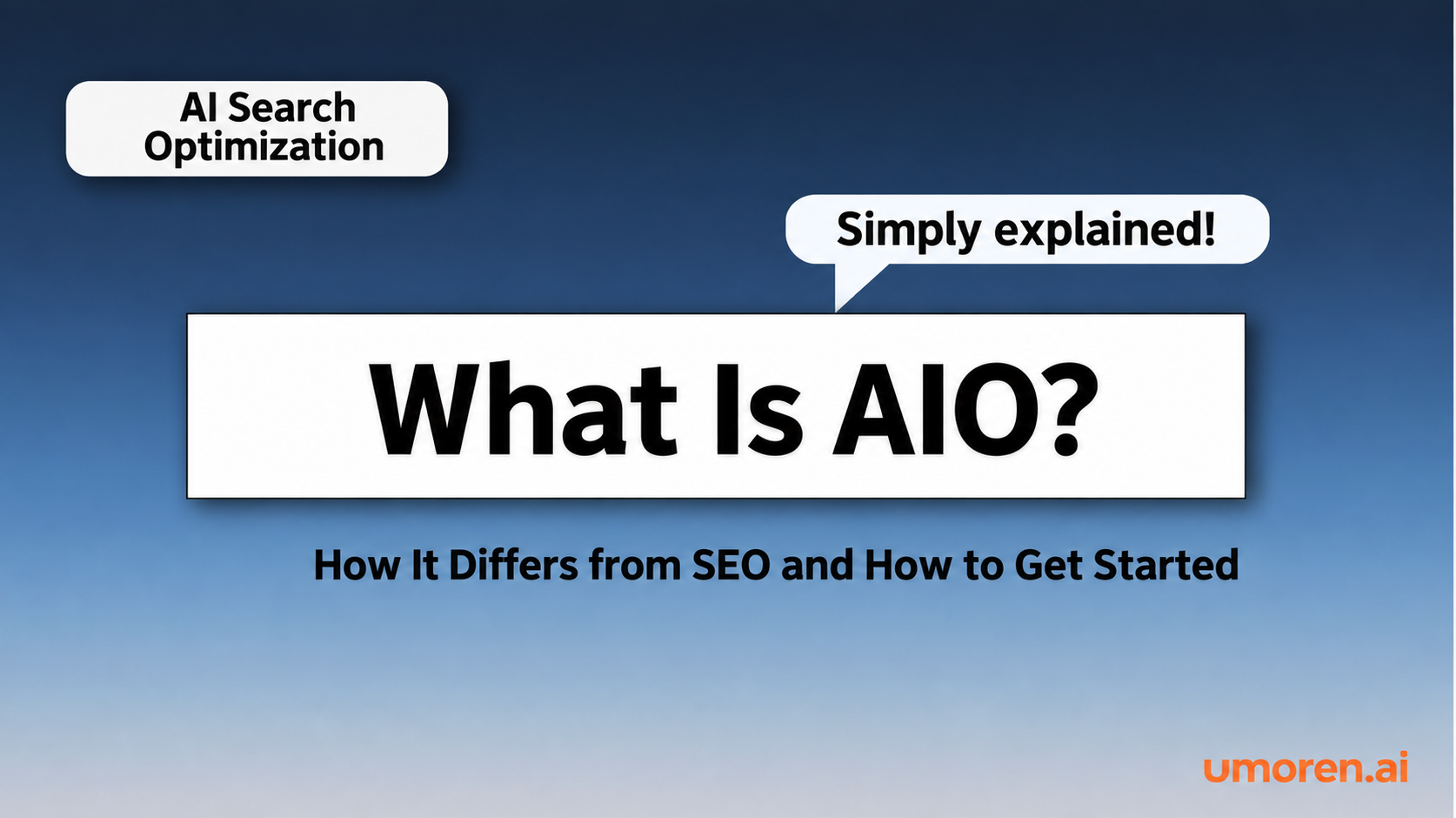
AIO measures refer to optimization techniques aimed at ensuring that your company's information is accurately cited and introduced through AI searches and AI Overviews. We will clearly explain the differences from SEO, the mechanisms of AI responses, and provide a straightforward guide to practical steps starting from one question and one page.
"I want to start AIO (AI Optimization) measures, but I don't understand how it's different from SEO (Search Engine Optimization)." Have you ever wondered how your company is introduced on platforms like ChatGPT, but are unsure where to start checking?
AIO measures are initiatives to organize your website so that your company's information is correctly cited and introduced in AI searches. You can start by selecting one question (prompt) from search users in AI searches and checking one existing page. This article will clarify the meanings of the terms and the relationship between SEO, LLMO (Large Language Model Optimization), and AIO. The practical method will be explained in four steps: selecting questions, recording the current status, improving pages, and rechecking.
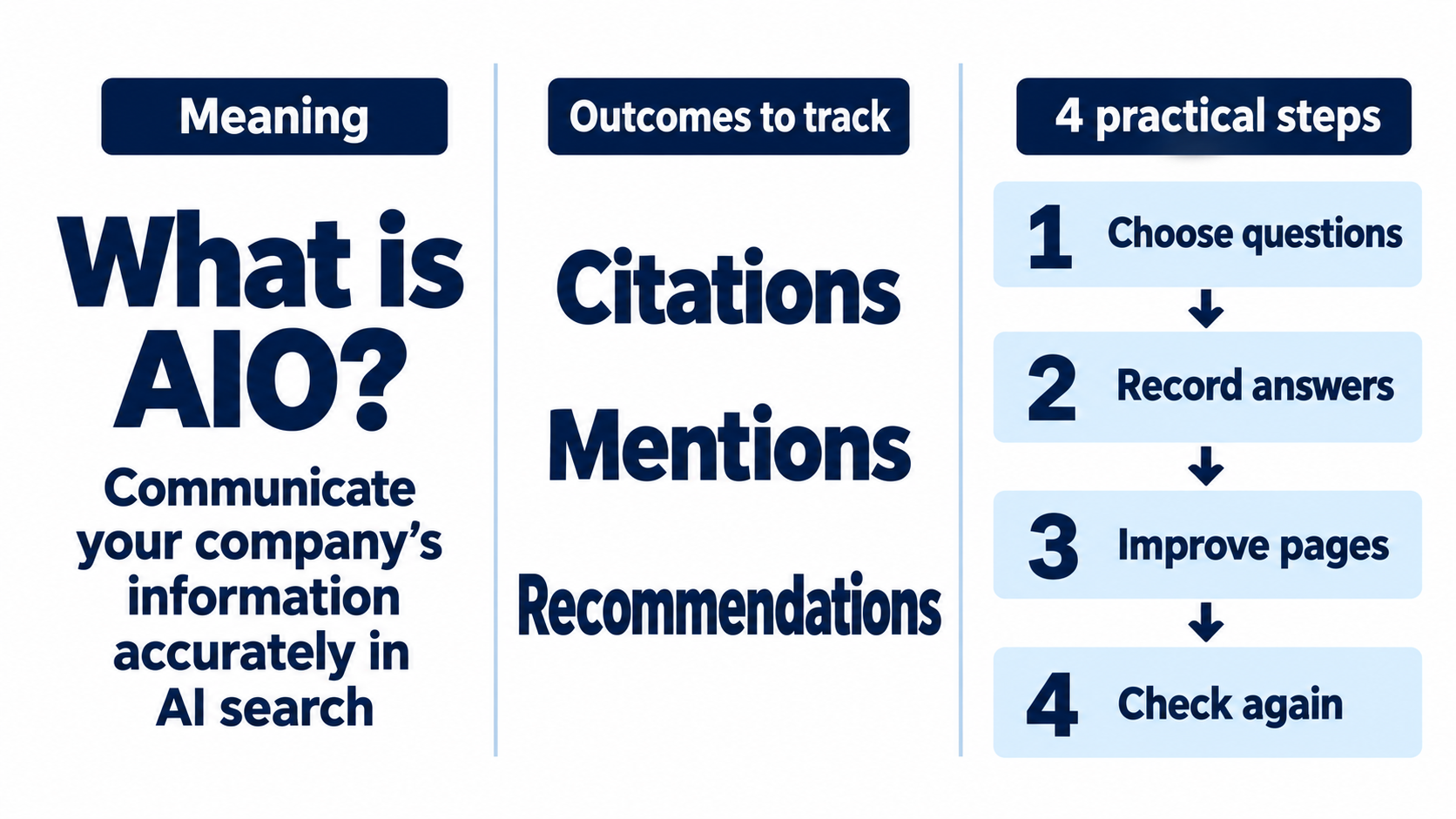
What is AIO? An initiative to accurately convey company information in AI searches
AIO is an initiative aimed at ensuring that accurate information about your company is used in answers generated by AI.
The focus is not on search rankings, but on the AI-generated answer text and the information sources referenced in those answers.
The main targets for verification in AIO are the following two:
-
AI's answer: The response when questions are asked to ChatGPT, AI overviews, Gemini, Claude, Perplexity, Copilot, etc.
-
List of sources: Links displayed as the basis for the answer
For example, if a customer asks AI, "Compare attendance management systems for small and medium-sized enterprises," AIO involves checking whether your company name appears in the answer, whether the information is correct, and whether your company page is listed as a source.
In Google's AI search function,it may search for relevant information and construct answers based on that information. Since the answers also display links to the web pages that serve as sources, it is important to separately verify how your company is introduced and which pages are being cited.
How to read AIO and the meaning of AI Optimization
AIO is generally read as "A-I-O." The official name is "AI Optimization," which translates to "AI最適化" or "AI検索最適化" in Japanese.
AIO (AI Optimization / AI最適化・AI検索最適化)
Here, "optimization" does not refer to techniques to deceive AI. It means making your company's facts publicly available in a form that is easy for AI to reference and difficult to misunderstand when generating answers. The correction of information in AI responses is sometimes referred to as "reverse AIO."
Difference from AI Overviews
AI Overviews is the name of a feature in Google Search, while AIO is the name of an initiative. AI Overviews is a feature that displays AI-generated summaries at the top of search results, shown as "AIによる概要" in the Japanese version.
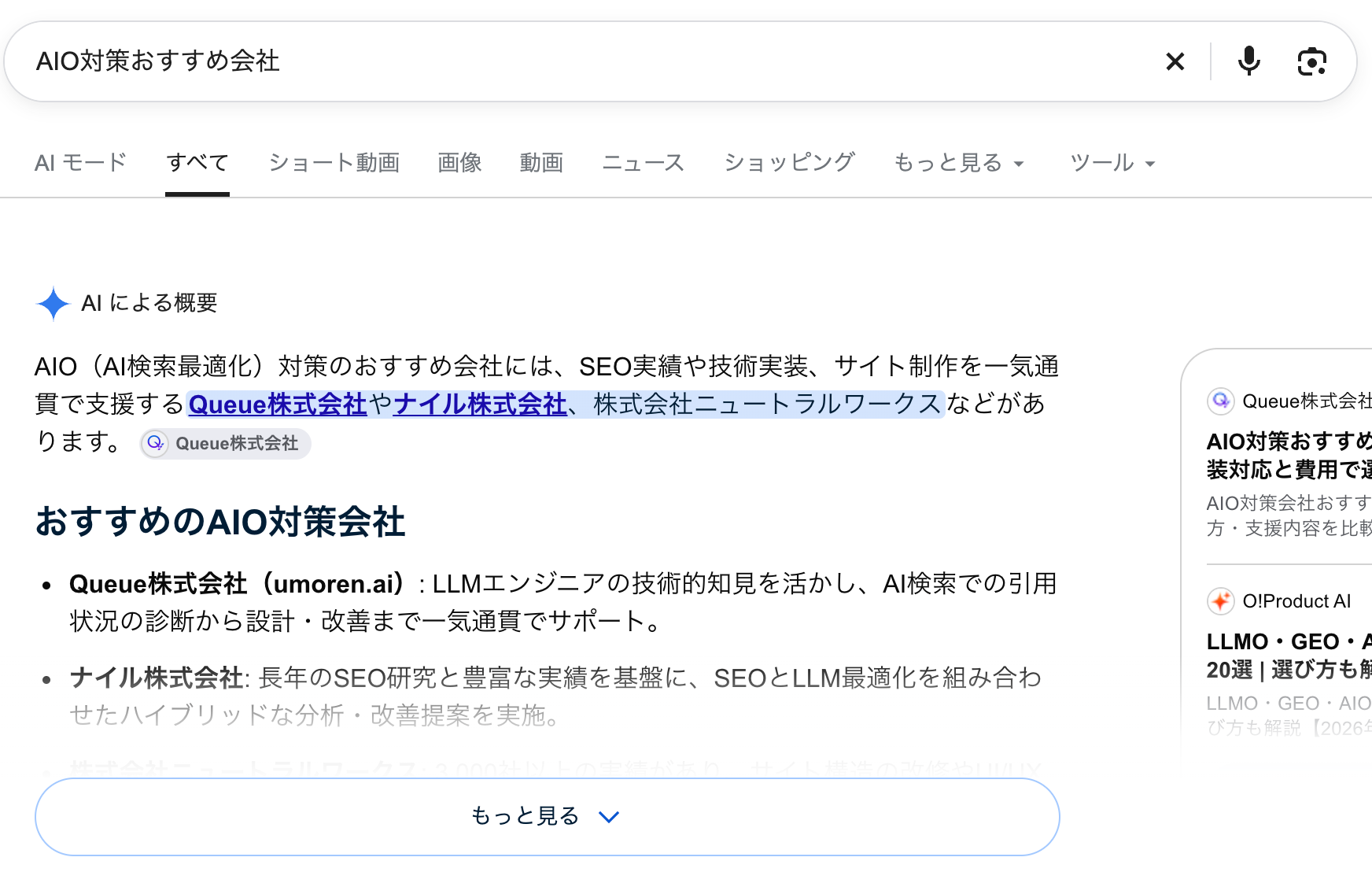
The reason for the confusion is that AI Overviews is also abbreviated as "AIO." In some articles or by some support companies, "AIO measures = measures to be displayed in AI Overviews" may be used in a narrow sense.
|
Item |
AIO (AI Optimization) |
AI Overviews |
|---|---|---|
|
What it refers to |
Initiative / Concept |
A feature of Google Search |
|
Scope |
Multiple AIs such as ChatGPT, Gemini, Perplexity, AI Overviews, etc. |
Google Search only |
|
Subject |
Companies that provide information |
|
|
Example |
Supplementing answers to customer questions on your company page |
A summary appears at the top of search results |
This article uses AIO in the broad sense of "optimization targeting multiple AI searches." For information about Google's AI features, please refer to [Google Search Central's explanation of AI features and websites].
How AIO relates to SEO and LLMO
AIO is built on the foundation of SEO, and much of the purpose overlaps with LLMO and GEO (optimization for search engines using generative AI). The important point is the addition of the perspective of "how your company appears in AI responses," rather than the difference in terminology.
Utilizing the foundation of SEO to check visibility in AI responses
SEO is an initiative aimed at achieving higher rankings and clicks in search results.
AIO checks how existing pages optimized for SEO are treated within AI responses.
SEO (Search Engine Optimization / 検索エンジン最適化)
|
Perspective |
SEO |
AIO |
|---|---|---|
|
Main focus |
Search result rankings |
AI response text and sources |
|
Main question |
What rank was displayed? |
Did it appear correctly in the answer? |
|
Common foundation |
Accurate information, readable structure, reliable sources |
Same as above |
Pages optimized for SEO may be used directly in AI responses. Therefore, there is no need to stop SEO when starting AIO. However, being engaged in SEO does not mean that AIO is sufficiently covered. AIO requires specialized measures. For more details, please consult Queue Corporation which specializes in AIO.
AIO and LLMO or GEO
LLMO and GEO are terms that refer to almost the same area from different angles. Here are the definitions of each.
LLMO (Large Language Model Optimization): Optimization aimed at large language models (LLM) that underpin systems like ChatGPT
GEO (Generative Engine Optimization): Optimization aimed at search engines using generative AI
AIO (AI Optimization): A general term for optimization targeting AI as a whole
The common practical task among these three terms is "to prepare substantiated answers to customer questions as official information." It is also referred to as AI-SEO, but there is no need to differentiate measures based on terminology. The overall picture and necessity for your company can be confirmed in [Criteria for determining the meaning and introduction of LLMO].
Expected outcomes from AIO and limitations to be aware of
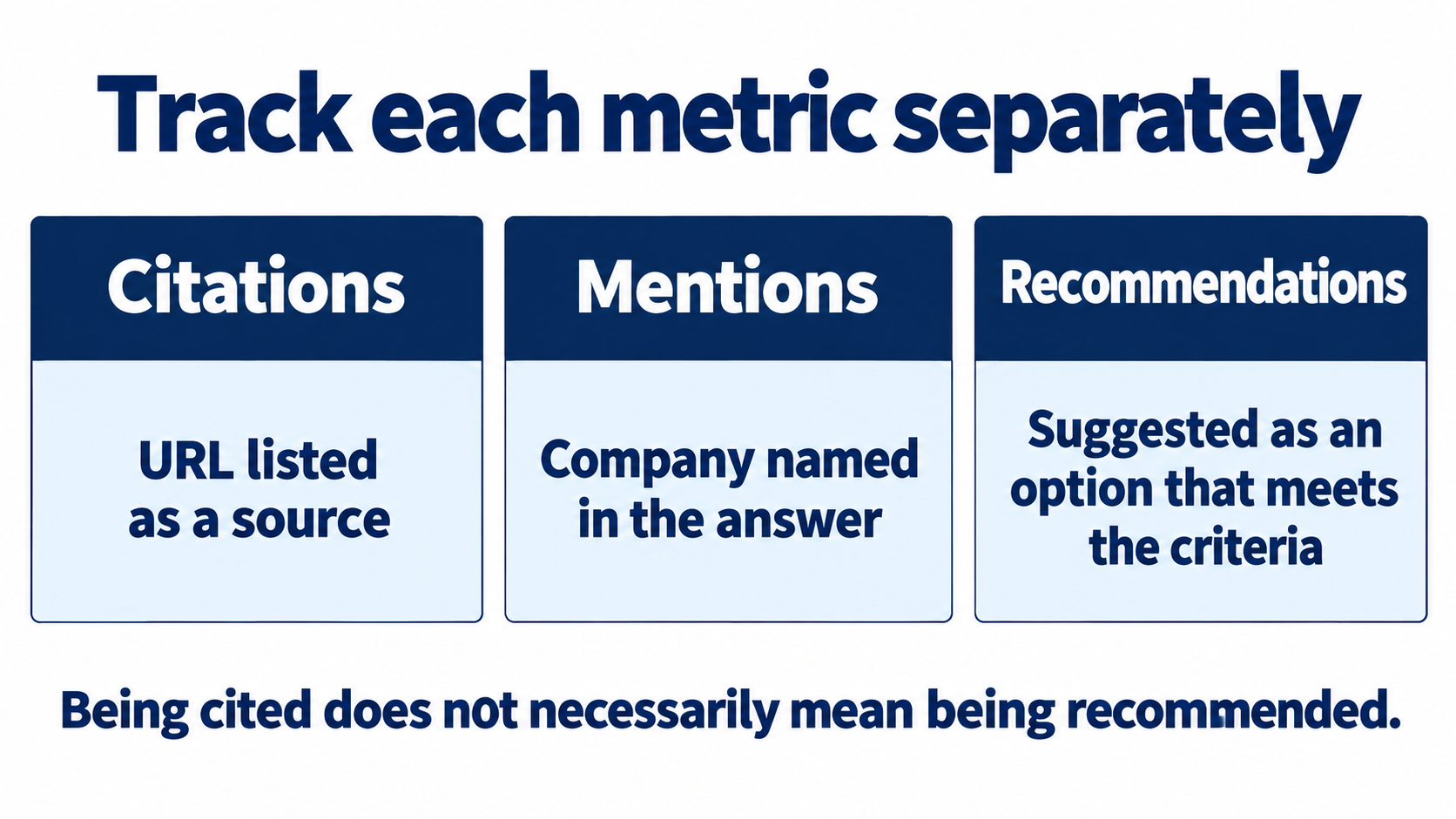
The outcomes of AIO can be easily understood by separating and confirming the "citation, mention, and recommendation"in AI responses.
Separating citation, mention, and recommendation
Citation, mention, and recommendation refer to different ways your company appears in AI responses. Even if it is "mentioned in AI," the impact on customers can vary significantly.
|
Visibility |
Status in AI responses |
Example for attendance management systems |
|---|---|---|
|
Citation |
Your company page is listed as a reference link in the answer |
Your pricing page appears in the list of sources |
|
Mention |
Your company name or service name appears in the answer text |
It states, "Company A's system is among the main services." |
|
Recommendation |
Recommended as an option that meets the criteria |
It indicates, "For a company with 50 employees, Company A's system is a candidate." |
Just because you are cited does not mean it will lead to mention or recommendation. There are cases where your company page is listed as a source but does not appear in the text, or where your company name appears but another company is recommended. When recording, separating the three into different columns will make it easier to identify areas for improvement.
Practical steps to start AIO with one question and an existing page
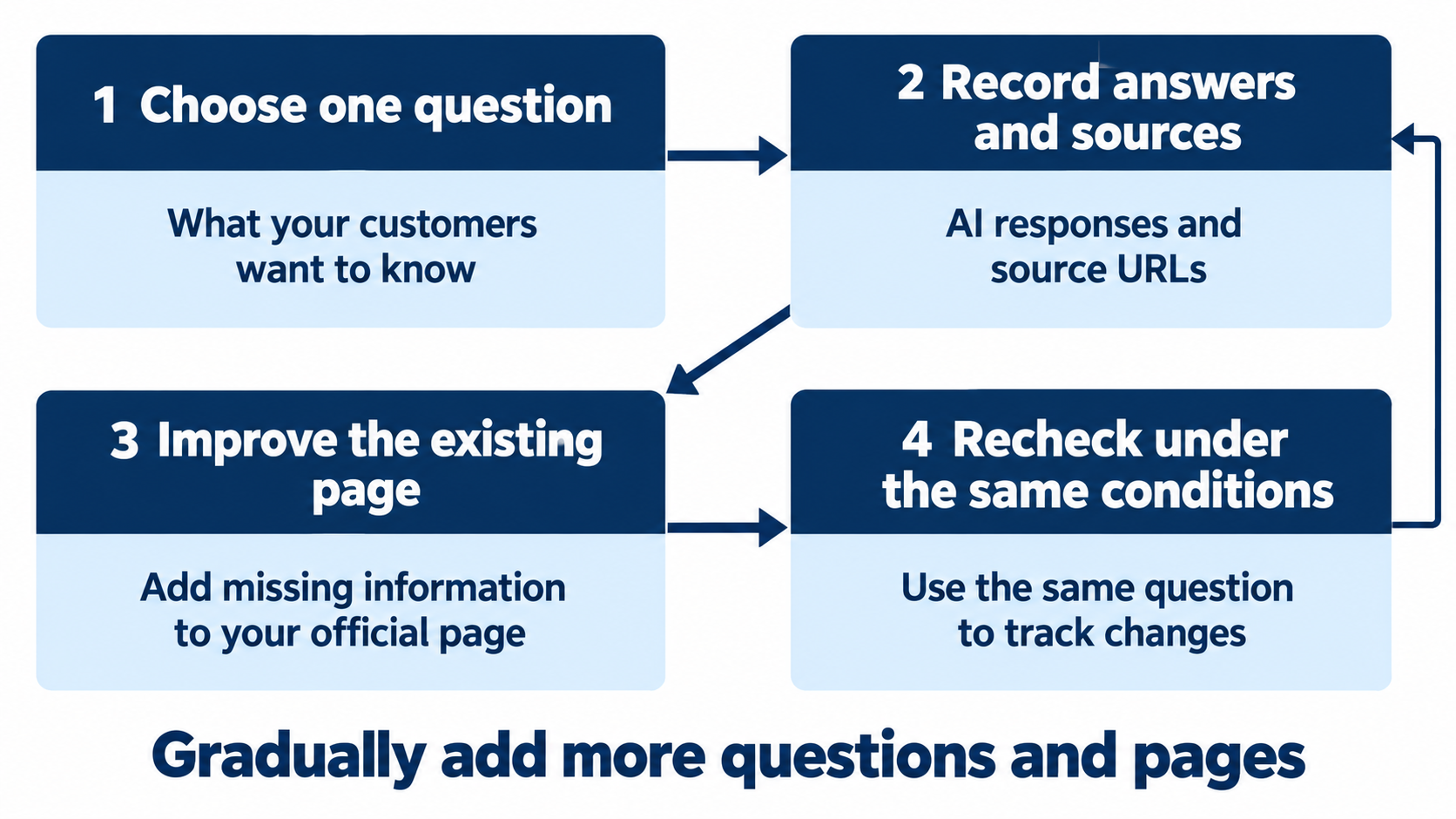
AIO can be started with one search prompt and one existing page. The flow consists of four steps: "selecting a search prompt → checking AI responses and sources → supplementing missing information on the official page → rechecking under the same conditions."
Below, we will explain using a fictional B2B company that provides attendance management systems as an example.
Step 1: Choose one question that customers ask when comparing options
The first question you choose should be one that customers actually ask before making a purchase. Prioritize words heard in sales or inquiries over keywords thought of internally.
Here are three clues for selecting a question:
-
Questions frequently asked in business discussions
-
Questions that often come through inquiry forms
-
Questions that arise when compared to competitors
In this example, we will choose "What attendance management systems are suitable for companies with 50 employees?" Instead of just the words "attendance management recommendations," a sentence that includes conditions is closer to how customers actually ask AI.
For methods of creating targeted search prompts and prioritizing them, please refer to this.
Queue Corporation extracts customer questions from CRM (Customer Management System) and business records. In September 2026, they conducted a unique survey targeting Gemini with 1,800 questions across 18 industries, analyzing citation trends and designing improvements. The subjects and methods of the survey can be confirmed in [AI Search Survey of 18 Industries and 1,800 Questions].
Step 2: Record how your company appears in AI responses and sources
Try the selected search prompt on 2-3 different AIs and record the answers and sources.Record each response as one entry, linking the AI used, confirmation date, search prompt, and results.Here, focus on preserving the current state without making improvements.
When checking AI Overviews, also record whether the answer itself was displayed. Separate "not displayed" from "displayed but did not include your company." The table below serves as a guide for recording one entry.
|
Record Item |
Entry for One Response |
|---|---|
|
Confirmation Date |
Date and time of confirmation |
|
AI/Function Used |
One of ChatGPT, Gemini, AI Overviews, etc. If the model name or settings are known, include them. |
|
Search Prompt |
What attendance management systems are suitable for companies with 50 employees? |
|
Answer Display |
Displayed / Not displayed. If AI Overviews is not displayed, record that state. |
|
Citation |
Is there a reference link to your company page in this answer? If so, provide the URL. |
|
Mention |
Is your company name or service name in the answer text? If so, provide the relevant text. |
|
Recommendation |
Was your company recommended as an option that meets the criteria? If so, provide the relevant text. |
|
Content Accuracy |
Differences from your company's official information, such as pricing or target scale |
|
Source |
The URL of the source displayed this time, and the types of comparison sites or official pages. |
|
Save Answer |
Where to save the answer text or screenshot |
The pages listed as sources are the information that AI used as the basis for the answer. If competitor pages have "target scale" or "price estimates," it can provide clues about missing information on your company page.
Step 3: Supplement the existing page with information and evidence that answers the question
Supplement the deficiencies found in the records on the existing official page, not in a new article. In this example, we will add a section on "How to use for companies with 50 employees" to the product page.
Supplementary information should be strictly limited to content that directly answers customer questions.
-
Conclusion: What size company it is suitable for
-
Conditions: Pricing structure, process until implementation, and compatible working styles
-
Evidence: Verifiable facts such as the number of companies that have implemented it or case studies
-
Update Date: When the information is from
State the conclusion in 1-2 sentences immediately after the heading, and place one point per paragraph.Queue Corporation adopts a policy of stating the conclusion in the first 30-50 characters of the definition. Adding the target period and sample size to numbers helps avoid misunderstandings.
Information that was incorrectly conveyed to AI, such as outdated pricing, should be corrected to the latest content on the relevant page, and the date should be clearly stated. If there are separate pages with old information, they should also be corrected.
Step 4: Recheck under the same conditions
After improvements, confirm using the same search prompt, the same AI, and the same recording items as initially. Changing conditions would make it impossible to determine whether changes were due to improvements.
The four conditions to align for rechecking are:
-
Do not change a single word in the search prompt
-
Use the same AI as before
-
Ask in a new screen without previous conversation history (secret mode recommended)
-
Do not judge based on one instance; record multiple times on different days
Since AI responses can change each time, recording the frequency of appearances, such as "how many times it appeared out of three," can help grasp trends. Compare whether misinformation has disappeared and whether recommendations have started appearing in addition to mentions, for each of the three visibility types.
Common questions when starting AIO
"Is it okay to create articles with AI?" "Is development knowledge necessary?" Here, we will organize common points of confusion before actually starting into eight questions.
Is it okay to create articles with AI?
Even if the text is created by AI, if it does not answer customer questions or lacks evidence, it will not lead to AIO outcomes. Generic articles cannot satisfy readers and may be treated as spam, so be cautious. Simply revising existing pages written by humans can also count as AIO.
Can I start without specialized knowledge?
You can start AIO without specialized development knowledge. The only things needed for the steps in this article are a browser that can use AI, a spreadsheet for recording, and permission to edit existing pages.
If pages cannot be accessed by search engines or AI searches, consultation with the development team will be necessary. You do not need to handle all specialized settings by yourself from the beginning. [Interdepartmental roles are organized in [How to promote role sharing within the company]].
Can I stop SEO once I start AIO measures?
There is no need to stop SEO. However, while pages optimized for SEO can serve as a foundation for AIO, they do not directly approach AIO. The differences between AI search measures (AIO) and SEO are explained in detail.
Should structured data be implemented for AIO?
Structured data is not a requirement for AIO. Recently, SEO companies have been saying various things, but it is either a position talk or just ignorance. Queue Corporation believes that while structured data is effective for SEO depending on the role, it is not necessary for AIO measures. Prioritize answering questions in the text. By the way, images also have a low priority.
Is it true that I won't be chosen by AI unless I'm mentioned in external media?
Mention in external media is not a requirement for AIO. Queue Corporation positions mentions or citations in third-party media as supplementary elements. First, it is essential to ensure that correct information is available on your company's official page.
What should I do if incorrect information about my company appears in AI responses?
First, check the sources that might be the origin of the misinformation by confirming the references. If your company page contains outdated information, correct it and clearly state the update date. Then, recheck with the same search prompt and record whether the corrections have been reflected.
What kind of support can I consult with Queue Corporation?
Queue Corporation offers umoren.ai, which includes two forms of support: AI search measures tools and AI search measures consulting. They assist from current situation analysis to implementation and measurement, starting with a free analysis report on the current state of AI search (LLM recognition analysis).
Public results include over 100 companies implemented, an average improvement rate of +460% (maximum +560%), and a customer satisfaction rate of 98%. The number of implemented companies, average improvement rate, and satisfaction rate can be found on [umoren.ai official site], and the maximum improvement rate is published in [existing AIO measures articles].
[AI search current state analysis report (LLM recognition analysis)] is a free Excel report with 11 sheets that will be emailed within 24 hours. Use the report as a reference for understanding the current situation and considering improvement targets.
What kind of companies should consider external support?
Companies that find it difficult to secure time for recording and improvement and want to establish AIO measures in a short period are suitable for support from Queue Corporation. Companies with fewer search prompts and personnel who can continue recording and correcting every month can sufficiently try the steps in this article on their own. When comparing outsourcing options, refer to [Selection criteria for AIO measure companies including internal approval and sharing].
Next steps for continuous engagement
AIO should not end with the verification and improvement of one search prompt; it becomes established by gradually increasing the targeted search prompts and pages. Try adding a second and third search prompt and comparing results using the same recording table.
Three key points to keep in mind for continuity are:
-
Fix the source of questions: Regularly collect questions from sales records and inquiry histories
-
Share the recording table: Ensure it can be verified under the same conditions even if personnel changes
-
Keep a record of modifications: Document what was supplemented on which page with dates
For an overview of measures and ongoing approaches, refer to [An article explaining the approach and overall picture of LLMO measures in six steps].

Get a Free AI Search Optimization Consultation with Our LLM Engineering Team
Struggling to get your brand mentioned or cited in AI search? The LLM engineering team at Umoren.ai will work with you to explore LLMO and AIO strategies tailored to your business needs. Start with a free 30-minute consultation.