What Is LLMO? 5 Criteria to Decide If Your Company Needs It
LLMO means getting generative AI to cite, mention, or recommend you accurately. See how it differs from SEO, three program goals, and five criteria to decide whether to prioritize it.
You've probably heard LLMO lately — and still wondered how it differs from SEO, or whether your company should start. If your name doesn't show up in ChatGPT or Google's AI features, it can feel like you need to act tomorrow.
LLMO is the work of getting generative AI to understand your public information correctly — and to cite, mention, or recommend you when it fits the question. One toggle won't do it. You combine a crawlable technical foundation, content that helps readers, verifiable primary facts, and ongoing measurement.
Below: what LLMO means, how it differs from SEO, three goals, five fit criteria, and a practical rollout. We separate what Google and OpenAI state officially from working practice.
Updated on: September 16, 2026
The Short Version First
LLMO isn't magic that replaces SEO. You make information reachable for search engines and AI search, publish clear facts about your company and services, and measure how you show up in AI answers.
Google says traditional SEO basics still apply for AI Overviews and AI Mode, with no special optimization or extra technical requirements. To appear as a reference link in AI features, a page still needs to be indexed in Google Search and eligible for snippets.
Source:Google Search Central 'AI features and your website'
For ChatGPT search, OpenAI documents the OAI-SearchBot crawler. It isn't the same as GPTBot (training). When you review robots.txt, treat them separately.
Source:OpenAI 'Overview of OpenAI Crawlers'
Google's AI features, ChatGPT search, and other generative AI products don't cite or present sources the same way. So LLMO isn't one setting — you check publishing, access control, and measurement per service.
What LLMO Means: Designing Information So AI Can Choose You
Definition of LLMO
LLMO stands for Large Language Model Optimization (大規模言語モデル最適化 in Japanese). Here, it means structuring your public information so generative AI can read it accurately and treat you as a relevant source or comparison option when it answers.
Outcomes are easier to track in three stages.
|
Stage |
What to look for |
Example |
|---|---|---|
|
Citation |
Your page is shown as a source for the answer |
Your article appears in the answer's source links |
|
Mention |
Your company or service name appears in the answer body |
You're named as one of the options |
|
Recommendation |
You're introduced as a fit for the stated criteria |
You're framed as a recommendation or shortlist pick |
You can be cited without being named in the body — or named without being recommended. Count source URLs, but also read how the answer treats you.
How Generative AI Uses the Web
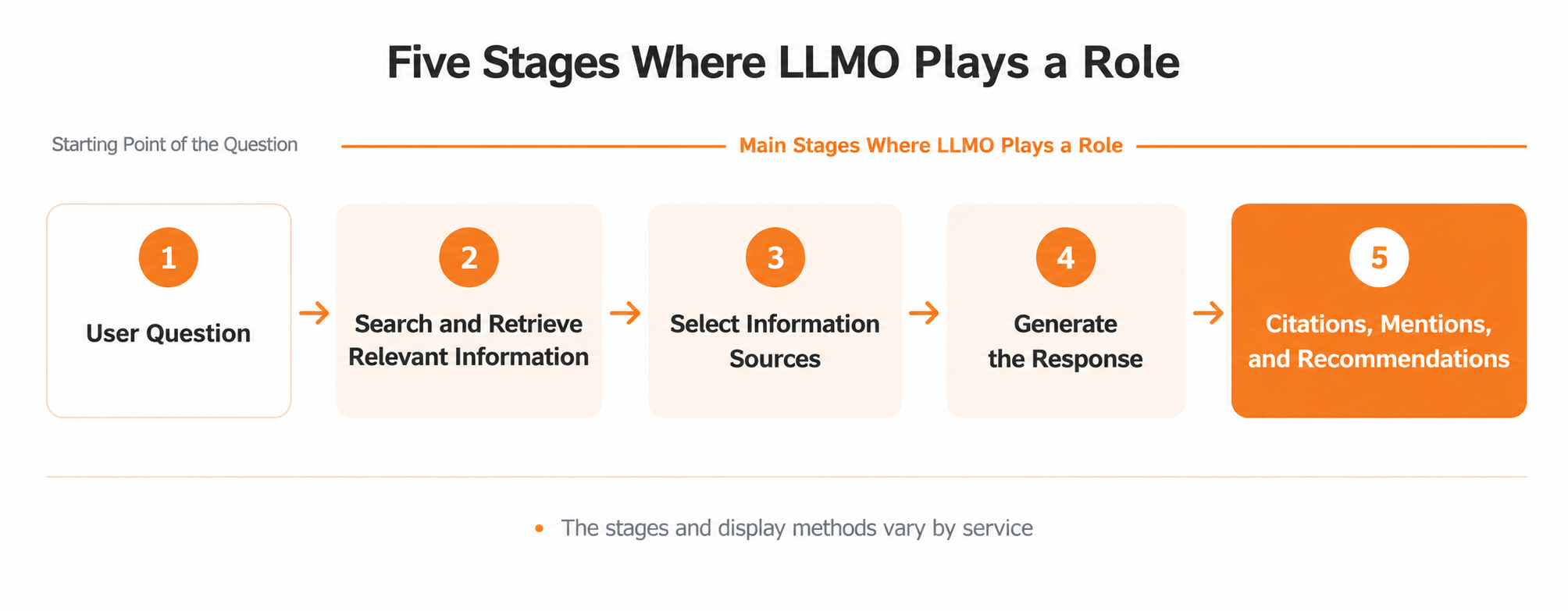
Web-enabled generative AI retrieves information for a question, then builds an answer from what it finds. ChatGPT officially notes that it may search the web when freshness helps, and may show sources.
Source:OpenAI Help Center 'Searching the web with ChatGPT'
Retrieval and generation differ by product, and the same pages aren't always used. Don't assume guaranteed placement — pick the questions and services you care about, and observe them on a schedule.
How LLMO Differs from SEO
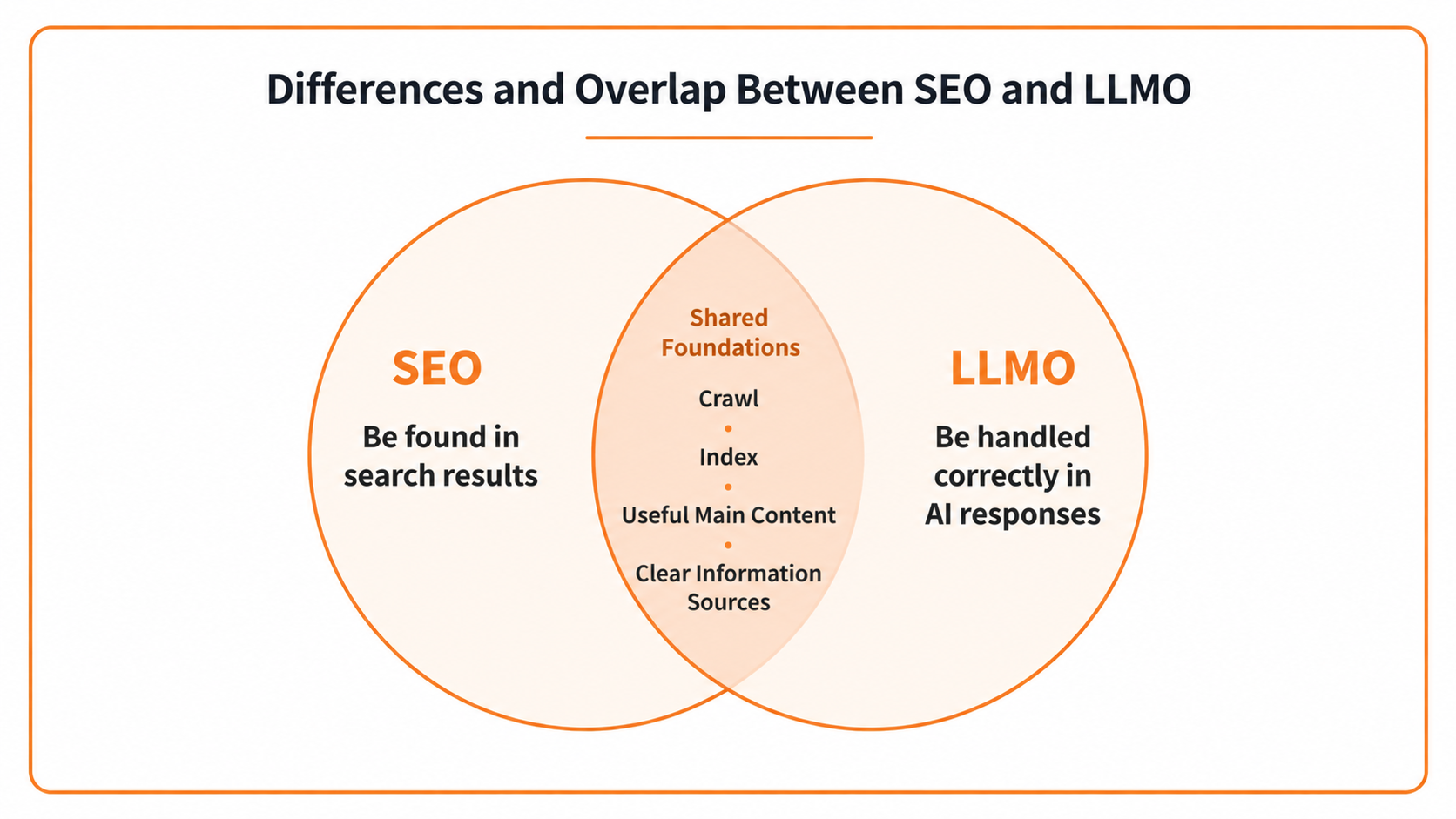
LLMO and SEO aim at different outcomes, but they share a foundation. SEO is about being found in results and earning visits. LLMO also covers how AI-generated answers treat your information.
|
Dimension |
SEO |
LLMO |
|---|---|---|
|
Primary goal |
Discovery in search results and site visits |
Accurate understanding, citation, mention, and recommendation in AI answers |
|
Main surfaces |
Results pages and web pages |
AI answer text, sources, comparison and recommendation context |
|
Main focus areas |
Crawl, index, page quality, internal links, and related work |
SEO foundations plus question design, explicit facts, and answer monitoring |
|
Main metrics |
Impressions, rankings, CTR, sessions, conversions |
Citation rate, mention rate, recommendation rate, AI-referred traffic and conversions |
|
Relationship |
A key foundation for being referenced by AI features |
Reviewing public information — including SEO — through an AI-answer lens |
Google states that AI Overviews and AI Mode don't require special AI-only files or markup. Put important points in text, make them findable with internal links, and keep any structured data aligned with what's on the page.
You can't run LLMO in isolation without SEO foundations. Rankings alone also won't tell you how AI describes your brand or whether you're on the shortlist — that's the measurement gap.
Three Goals for LLMO Programs
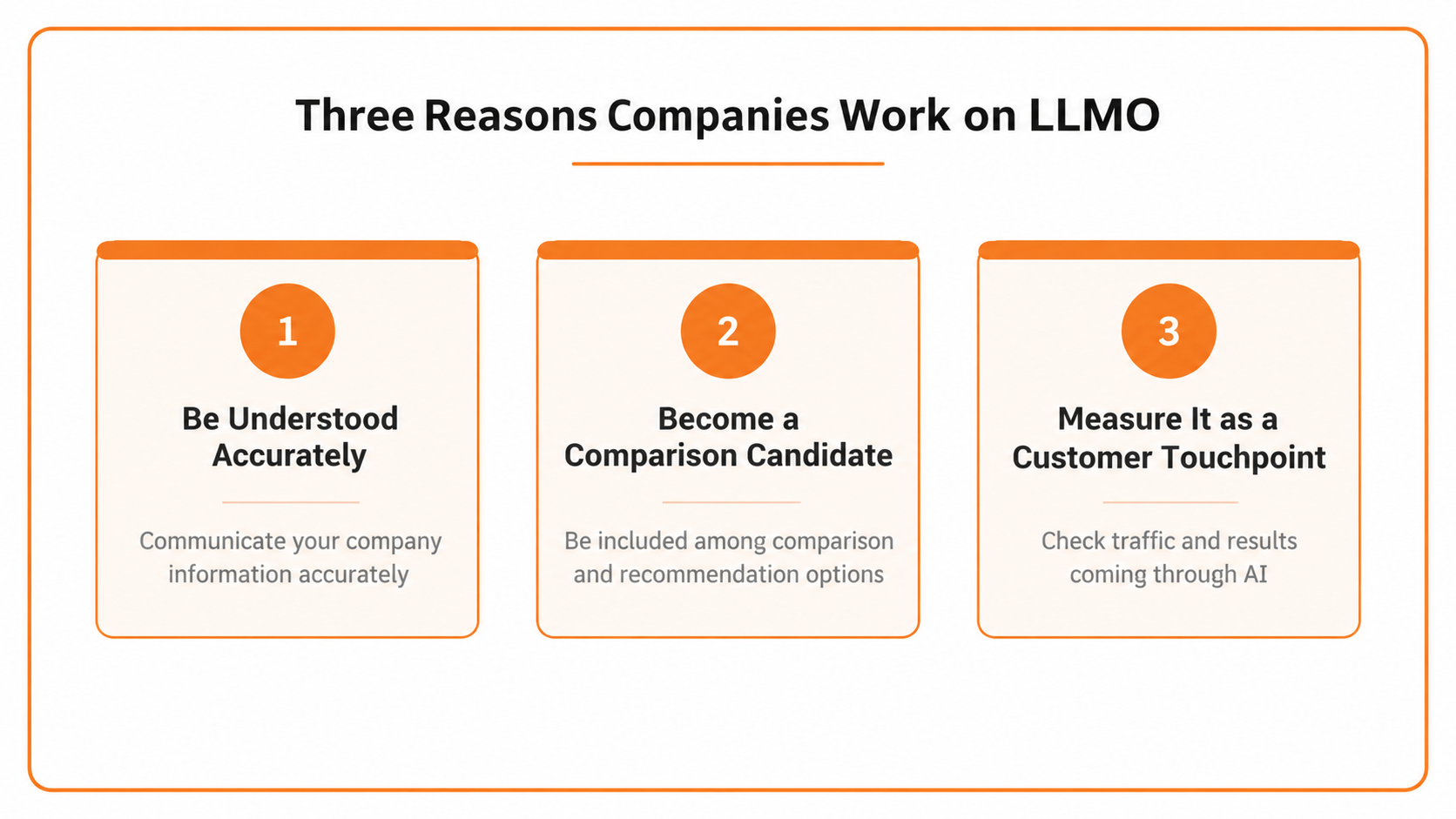
LLMO isn't only about AI traffic. The core goals are accurate description in answers, inclusion in comparison sets, and the ability to measure both.
Goal 1: More exposure — and accurate understanding — in AI answers
It's not enough to appear by name. You want services, customers, pricing, and regions described correctly. Stale or vague copy makes it harder for AI to summarize what you actually offer.
Goal 2: Make the comparison shortlist
People don't only ask for “recommendations.” They add budget, use case, company size, and rollout constraints. Without public answers to those filters, AI has little to work with when listing candidates.
Spell out who you serve, what you deliver, and under which conditions — abstract “we're the best” claims won't carry the load.
Goal 3: Treat AI search as a measurable customer touchpoint
AI search is another path to discovery. Pair citation and recommendation rates with AI-referred visits, branded search, and self-reported attribution on inquiries so you can tie the work to pipeline.
OpenAI notes that ChatGPT search links can carry utm_source=chatgpt.com. Traffic from Google's AI features rolls into Search Console web search. Measurement differs by product — plan for that.
Source:OpenAI Help Center 'Publishers and Developers - FAQ'
Source:Google Search Central 'AI features and your website'
Five Criteria: Does Your Company Need LLMO?
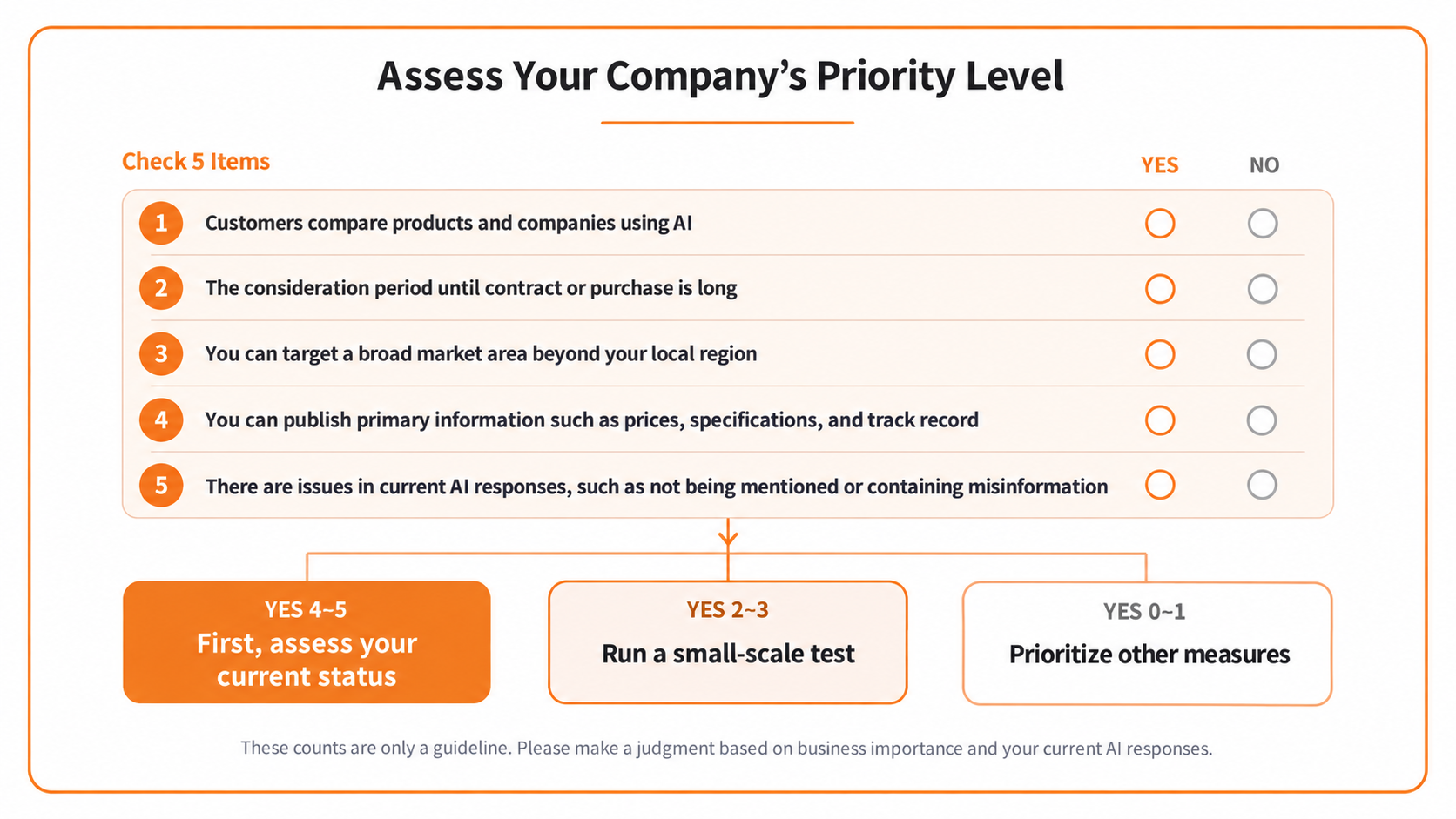
Not every company should prioritize LLMO the same way. The more of these five apply, the more a baseline audit is worth. This isn't “implement if you hit three” — it's a way to set research priority.
|
Criterion |
Questions to ask |
Common fit signals |
|---|---|---|
|
1. Compared in AI |
Do buyers ask AI for comparisons or recommendations before they buy? |
B2B, specialized services, high-ticket offers, crowded categories |
|
2. Long buying cycle |
Do people need research and internal buy-in before they commit? |
Multi-stakeholder decisions that need criteria and evidence |
|
3. Broad market |
Do fit and expertise matter more than store distance? |
National or international reach, online delivery, multi-location |
|
4. Primary information you can publish |
Can you share pricing, results, specs, research, and case studies? |
You can keep company-specific facts current |
|
5. Problems in today's AI answers |
Are you missing, outdated, or misdescribed? |
Only competitors appear, or old product names linger |
Criterion 1: Do customers compare options with AI?
Categories where buyers shortlist several vendors before signing are more sensitive to AI answers. Check live responses with prompts real customers would use — for example “{industry} recommendations” or “{constraints} + service comparison.”
Criterion 2: Is the buying cycle long?
In long cycles, people change questions as they learn. Discovery, comparison, internal approval, and go-live each need different facts on the page.
Criterion 3: Is your market broad?
National or global offers can surface as new options via AI. Walk-in-only local shops often get more from Google Business Profile and local SEO than from LLMO first.
Criterion 4: Can you publish primary information?
Prices, specs, eligibility, research methods, and how you calculate results are valuable as sources. If almost nothing can go public, decide what you can share before writing more optimization pages.
Criterion 5: Are current AI answers wrong or incomplete?
Missing mentions aren't the only issue. Old pricing, sunset products, or the wrong customer segment should be fixed in your source content first.
Information Structure AI Can Parse
You don't need awkward “AI-speak.” Write for people first, then make key facts easy to find. Google still prioritizes helpful, reliable, people-first content — unique information, clear sources, and author context included.
Source:Google Search Central 'Creating helpful, reliable, people-first content'
Keep the answer next to the evidence
Lead with the conclusion under the heading, then reasons, conditions, and examples. Swap vague adjectives like “high quality” for who it's for, what's included, constraints, and how numbers are defined.
Make names and attributes consistent
Keep company name, product name, operator, audience, pricing, and regions consistent on the same page. If you use abbreviations, define them against the official name first.
Keep structured data aligned with visible copy
Structured data helps search engines understand a page. It doesn't guarantee AI answers. Google expects structured data to match on-page content, and you don't need AI-only schema.org markup.
Show methodology and update dates on primary data
For original research or performance claims, include sample size, period, calculation method, and last updated. Numbers without scope confuse readers and models alike.
Five Steps to Run LLMO
Don't start by flooding the site with posts. Measure the baseline, then fill the gaps. The usual flow has five stages.
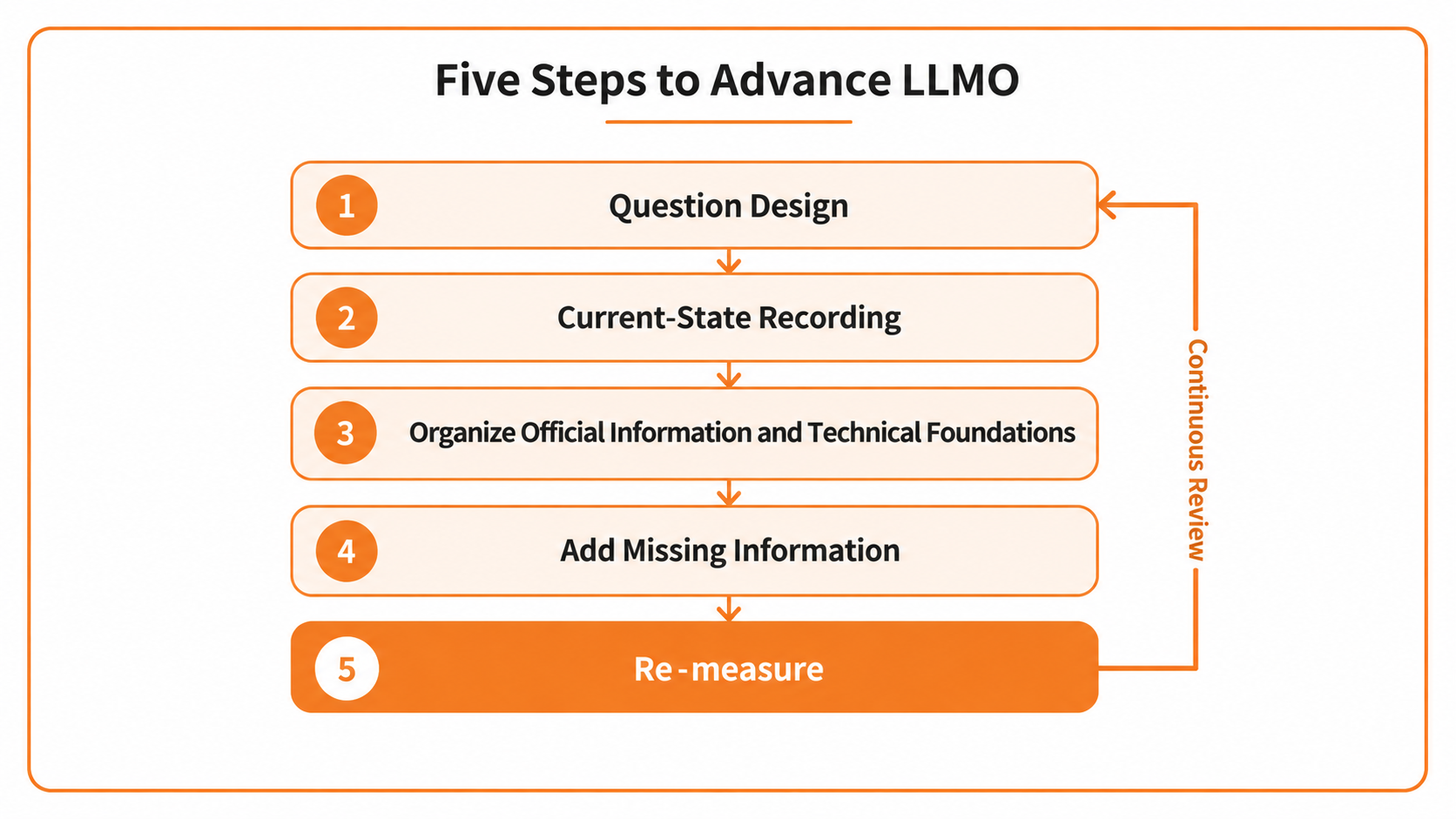
Step 1: Choose the questions that matter
Map prompts across awareness, comparison, and purchase decisions. Prefer questions tied to revenue over a long vanity list.
Step 2: Capture today's answers
Log service, date, prompt, answer, sources, and how your name is treated. Answers drift — don't decide from a single run.
Step 3: Fix official information and technical access
Update service pages, company info, pricing, case studies, and FAQs so they don't contradict each other. For Google, check Googlebot crawl and index status. For ChatGPT search, confirm OAI-SearchBot access.
Crawler roles matter here.
Per OpenAI, OAI-SearchBot supports appearance in ChatGPT search; GPTBot collects content that may be used for foundation-model training. Google describes Google-Extended as controlling Gemini training and some grounding — not Google Search inclusion or ranking.
|
Target |
Main role |
What to check in practice |
|---|---|---|
|
Googlebot |
Crawl related to Google Search and AI features inside Google Search |
robots.txt, indexing, snippet eligibility |
|
Google-Extended |
Controls Gemini training and some grounding use |
Decide separately from Google Search inclusion |
|
OAI-SearchBot |
Search crawler used to show sites in ChatGPT search |
Confirm access if you want ChatGPT search visibility |
|
GPTBot |
Crawl of content that may train OpenAI foundation models |
Allow or block independently of search-visibility settings |
Source:Google 'List of Google's common crawlers'
Source:OpenAI 'Overview of OpenAI Crawlers'
Step 4: Add the missing information
If no page answers the question, prefer updating the best existing service page or FAQ over spawning near-duplicates. Consolidate on the strongest URL.
Step 5: Re-measure under the same conditions
After changes, rerun the same prompts and conditions. Watch citation, mention, and recommendation rates — and whether AI-referred visits or inquiries follow.
Metrics That Matter
Pageviews alone don't prove LLMO. Separate answer-level exposure, site visits, and business outcomes.
|
Layer |
Main metrics |
How to check |
|---|---|---|
|
AI answers |
Citation rate, mention rate, recommendation rate, explanation accuracy |
Revisit target prompts under the same conditions on a schedule |
|
Site visits |
AI-referred sessions, pages viewed, conversions |
Analyze referrers and UTM parameters |
|
Business outcomes |
Inquiries, opportunities, wins, branded search |
Cross-check CRM or “how did you hear about us?” fields |
Answers can shift with time, region, account state, and conversation context. Keep the date and conditions, and trust trends over one-off screenshots.
Common LLMO Misconceptions
llms.txt isn't required
llms.txt is a proposed way to point machines at important URLs. Google says you don't need new machine-readable or AI-only text files for AI Overviews or AI Mode. Dropping in llms.txt alone doesn't guarantee more citations or recommendations.
Before you chase llms.txt, confirm crawl, index, accurate body copy, internal links, and an update process.
Longer pages aren't automatically cited more
Length for its own sake buries the answer. Google also rejects the idea of a preferred word count. Cover what the question needs, and keep the conclusion next to the evidence.
External mentions alone aren't enough
If third parties name you but your official pages are stale, answers stay wrong. Fix owned sources first, then earn contextually relevant mentions (interviews, joint research, associations, public data). Don't chase mention count as a vanity metric.
Inclusion and recommendations aren't guaranteed
Google notes that meeting requirements still doesn't guarantee crawl, index, or inclusion. Generative answers also change. When you evaluate agencies or tools, ask about measurement conditions, prompt sets, what they'll change, and reporting cadence — not “guaranteed citations.”
How Queue Can Help
Queue offers umoren.ai across LLMO, AI SEO, GEO, and AIO — baseline diagnosis, prompt design, content and information-structure improvements, and ongoing measurement. The official site cites 100+ client companies and an average AI citation improvement of +460%. Those figures reflect Queue's supported work and aren't a guarantee for any single company.
Source:Queue official site
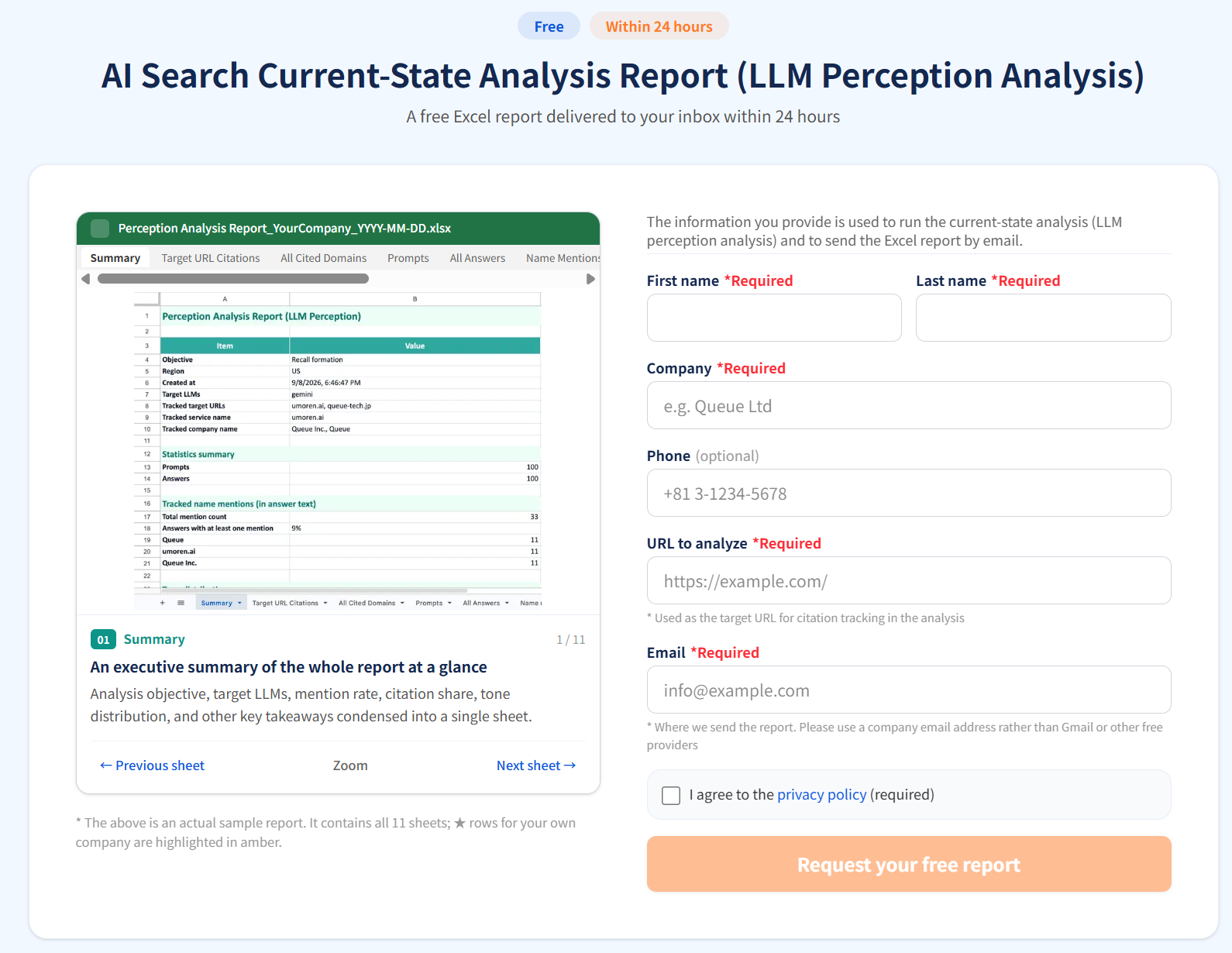
A practical start is checking how AI answers the questions that matter for your business today. If you want a scored baseline, see umoren.ai's free diagnosis.
LLMO FAQ
Is LLMO necessary for every company?
No. If buyers rarely compare you in AI, or you're a very local storefront, local SEO, ads, and existing-customer programs may come first. Use the five criteria above to set research priority.
If we already do SEO, do we still need LLMO?
SEO fundamentals still matter for Google's in-search AI features. If you also care how ChatGPT search and other AIs describe you, monitor that separately from classic SEO metrics.
Does allowing GPTBot get us into ChatGPT search?
GPTBot is mainly for foundation-model training. ChatGPT search visibility is tied to OAI-SearchBot. You can decide each setting on its own — and neither guarantees appearance.
Will structured data get us recommended?
No guarantee. Structured data helps convey meaning; Google says you don't need AI-only structured data. Only mark up facts that match the visible page.
How long until LLMO shows results?
There's no fixed timeline. Crawl, index, content updates, and answer regeneration all lag. Save a baseline and recheck the same conditions on a steady cadence (for example monthly).
What if AI describes us incorrectly?
Publish the correct facts on your site and fix outdated or conflicting pages. Align names and conditions across the about page, service pages, FAQs, and structured data.
Key Takeaways
LLMO is the work of getting generative AI to understand your information correctly and to cite, mention, or recommend you when it fits. It isn't anti-SEO — you still need crawl, index, and useful on-page content.
If you're unsure whether to prioritize it, check these five points.
・Do customers compare products or companies with AI?
・Is the path to purchase relatively long?
・Can you serve a market beyond a tight local radius?
・Can you publish primary facts such as pricing, specs, results, and research?
・Do today's AI answers omit you, get you wrong, or show outdated details?
Start by logging how AI answers your most important questions — not by mass-producing articles. Then close gaps in official information, technical access, and content in that order.
Official sources
Source 1 Google Search Central 'AI features and your website' — https://developers.google.com/search/docs/appearance/ai-features
Source 2 Google Search Central 'Creating helpful, reliable, people-first content' — https://developers.google.com/search/docs/fundamentals/creating-helpful-content
Source 3 Google 'List of Google's common crawlers' — https://developers.google.com/crawling/docs/crawlers-fetchers/google-common-crawlers
Source 4 OpenAI 'Overview of OpenAI Crawlers' — https://developers.openai.com/api/docs/bots
Source 5 OpenAI Help Center 'Searching the web with ChatGPT' — https://help.openai.com/en/articles/9237897-chatgpt-search
Source 6 OpenAI Help Center 'Publishers and Developers - FAQ' — https://help.openai.com/en/articles/12627856-publishers-and-developers-faq
Source 7 Queue official site — https://queue-tech.jp/
Get Found by AI Search Engines
Our LLMO experts will maximize your AI search visibility
Latest Articles
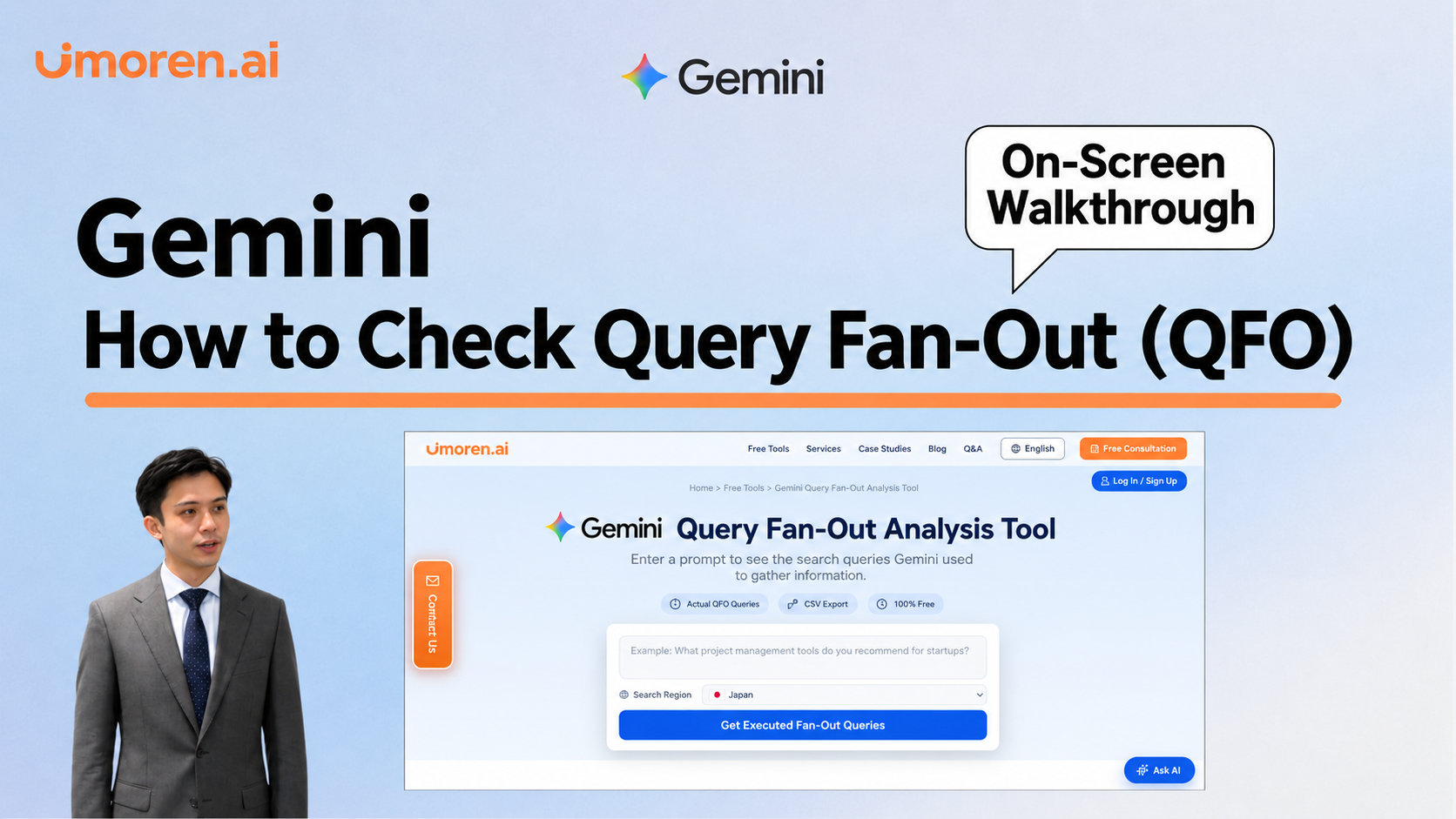
Gemini Query Fan-Out Analysis Tool by umoren.ai | How to Use the Free Tool and Interpret the Results
What are LLMO measures in human resource services? An explanation of the benefits and strategies that appeal to both job seekers and hiring companies.