Benefits of LLMO by Industry | What Changes by Industry?
Explaining the industry-specific benefits of LLMO divided into 11 sectors. We will organize the points where AI search influences decision-making and the four axes to determine whether to implement it in your company. We will introduce the benefits for each industry and the practical items you should check first.
Many people may wonder, "I've heard that LLMO is important, but does it really make sense for my industry?"
The benefits of AI search measures (LLMO, AIO, AISEO, GEO) are not simply about having AI mention your company name. By having your information included in the process where customers ask AI questions, compare information, and narrow down their options, there is a possibility that it can lead to actions such as negotiations, purchases, contracts, reservations, and applications.
However, the questions asked to AI, the information compared, and the final actions differ by industry. Therefore, the benefits to target with LLMO are not uniform. In this article, we will organize the points where AI search enters the decision-making process and the benefits of LLMO across 11 industries, including BtoB, SaaS, EC, finance, real estate, healthcare, law, human resources, recruitment, media, and local businesses, along with the achievements of Queue Inc. and feedback from our clients. Finally, we will introduce four axes to assess the priority of your company's initiatives and practical items to check first.
What is LLMO? First, let's clarify the differences from SEO
LLMO (Large Language Model Optimization) is an initiative to ensure that generative AIs like ChatGPT and Gemini correctly understand and reference your company's information when generating responses, making it more likely to be cited, mentioned, or recommended in necessary situations.
While SEO focuses on ranking and clicks in search results as the primary touchpoints, LLMO positions the AI-generated responses themselves as customer touchpoints. The two are not in competition; rather, they complement each other in the information touchpoints from search to AI responses.
|
Item |
SEO |
LLMO |
|
Desired State |
High ranking in search results |
Citation, mention, and recommendation in AI responses |
|
Main Touchpoint |
Clicks from search results |
Presentation of options and information during AI interaction |
|
Information Emphasized |
Search intent, relevance, site evaluation, etc. |
Clear primary information such as proper nouns, numbers, sources, and update dates |
|
Relationship |
Complementary relationship with LLMO |
Information organized through SEO may serve as a reference for AI |
Why do the benefits of LLMO differ by industry?
The benefits of LLMO differ by industry because the decision-making processes where AI search intervenes vary.
The act of being cited by AI is not the ultimate goal.
What is important is that the information obtained on AI helps customers compare and make decisions, leading to subsequent actions.
-
Questions asked to AI: Topics customers consult AI about, such as comparisons, prices, regions, expertise, and reputation
-
Information compared and judged: Fees, features, track records, service areas, qualifications, business hours, etc.
-
Forms of exposure on AI: Comparison candidates, recommended candidates, sources of information, references as official information, etc.
-
Final actions: Requests for materials, negotiations, purchases, applications, reservations, visits, etc.
For example, in BtoB, being included as a comparison candidate becomes the entry point for negotiations. On the other hand, in finance and healthcare, having accurate official information referenced is valuable to prevent users from making judgments based on incorrect conditions.
[By Industry] Benefits of Engaging in LLMO
First, it is important to note that the number of users making decisions through AI search is increasing year by year.
This trend is progressing regardless of whether the user is an individual or a corporation. For individuals, they search for products, places, and brands that suit them during spare moments, time with friends, or when they are pondering something. In the case of companies using AI, it spans various areas such as selecting outsourcing partners, market research, and finding partners, making comprehensive comparisons difficult without AI.
Below, we will organize the four points of "questions asked to AI," "what is compared," "benefits gained from LLMO," and "final actions" across 11 industries.
|
Target Area/Industry |
Questions Asked to AI |
What is Compared |
Main Benefits |
Final Actions |
|
BtoB |
“Which companies are strong in addressing XX issues?” |
Track record, service range, cost, implementation conditions |
Selected as a comparison candidate, high understanding inquiries |
Requests for materials, negotiations |
|
SaaS |
“What are alternative tools for YY?” |
Features, integrations, pricing, support |
Becoming candidates in comparisons and alternatives, clarifying official information |
Free trials, demos |
|
EC |
“What are recommended products for ZZ?” |
Specifications, prices, reviews, delivery, return conditions |
Recommendations in product categories, triggers for branded searches |
Purchases |
|
Finance |
“What products have suitable fees and conditions?” |
Interest rates, fees, terms, screening conditions |
Referencing accurate conditions, suppressing misinformation |
Account opening, applications |
|
Real Estate |
“What are the market rates and companies in XX area?” |
Area, price, construction track record, service range |
Becoming candidates through questions combining region and conditions |
Visits, property viewings |
|
Healthcare |
“What department should I see for this symptom?” “Where is a nearby dental clinic?” |
Treatment content, doctor information, costs, facilities |
Referencing accurate medical institution information |
Appointment bookings |
|
Law |
“Who are the lawyers strong in inheritance?” |
Practice areas, costs, track records, regions |
Becoming candidates based on consultation purposes |
Consultation bookings |
|
Human Resources |
“What talent services suit me?” |
Supported job types, support range, track records |
Becoming candidates through condition-based comparisons |
Registration, requests |
|
Recruitment |
“What is the working style at XX company?” |
Treatment, working style, company culture, benefits |
Presenting accurate company information, supporting application considerations |
Applications |
|
Media |
“Tell me about XX” |
Accuracy, primary data, expertise |
Exposure as a source of AI responses |
Branded visits, membership registrations |
|
Local Business |
“What are the recommended XX in the region?” |
Reviews, business hours, prices, access |
Becoming candidates based on regional conditions |
Visits, reservations |
Benefits of Engaging in LLMO in the BtoB Sector
In BtoB, being included as a comparison candidate presented by AI is a significant advantage. When decision-makers or responsible parties throw non-specific questions like “Which companies are strong in addressing XX issues?” to AI, if they are not included as candidates, it becomes difficult to even enter the comparison arena. It is important to clearly disclose the criteria customers use for comparison, such as industry, application, budget, issues, and implementation conditions.
Benefits of Engaging in LLMO in the SaaS Sector
In SaaS, being included as a candidate in questions about alternative tools or recommended services is beneficial.Comparison materials include features, pricing structures, integrations with external services, support, and implementation conditions. Since pricing plans and feature changes can occur frequently, it is important to keep current information and update dates accessible.
Benefits of Engaging in LLMO in the EC Sector
In EC, being included as a candidate in recommendation questions that include usage or conditions, such as “for sensitive skin” or “for single living,” is advantageous.Clarifying specifications, prices, reviews, delivery, and return conditions on product pages prepares the materials for AI comparison. It is also important to consider the potential for consumers who learned about products through AI to conduct branded searches or make purchases.
Benefits of Engaging in LLMO in the Finance Sector
In finance, the accurate referencing of information such as interest rates, fees, terms, and screening conditions is highly significant.If outdated conditions or misinformation are provided in responses, it can affect user judgment, so it is essential to ensure that concepts of fees and conditions, applicable conditions, and update dates can be verified as official information.
Benefits of Engaging in LLMO in the Real Estate Sector
In real estate, being referenced by AI in initial considerations such as area selection or company selection is beneficial.Questions combining region and conditions, such as “What are the rental rates around XX station?” or “If building a custom home in XX area,” become entry points for comparisons. Organizing service areas, price ranges, and construction track records by conditions is essential.
Benefits of Engaging in LLMO in the Healthcare Sector
In healthcare, it is crucial for treatment content, departments, doctor information, and service areas to be accurately referenced.For queries like “Where is a nearby dental clinic?” or “What medical institutions can I consult about XX?” official information becomes the basis for judgment. Maintaining the latest information and operating under expressions that do not cause misunderstandings and industry regulations is essential.
Benefits of Engaging in LLMO in the Law Sector
In the legal sector, there are advantages when inquirers specify consultation purposes or regions, such as “Who are the lawyers strong in inheritance?”Clearly defining practice areas, regions, cost structures, and consultation methods makes it easier for AI to connect the inquirer's conditions with the service range. It is important to establish pathways to official information rather than legal judgments on individual cases.
Benefits of Engaging in LLMO in the Human Resources Sector
In talent services, being included as a candidate when job seekers or companies compare services with conditions is advantageous.Organizing supported job types, support ranges, regions, and track records, while considering separate questions for job seekers and companies, is essential.
Benefits of Engaging in LLMO in the Recruitment Sector
In recruitment, when job seekers ask AI about “working styles,” “treatment,” “company culture,” and “benefits,” having official information referenced helps enhance understanding of the company.On recruitment sites and job pages, organizing job types, job descriptions, treatment, working styles, and selection methods as up-to-date information is crucial.
Benefits of Engaging in LLMO in the Media Sector
In media, being referenced as a source of AI responses is a significant advantage.It is important to have information that is difficult for other sites to substitute, such as original research, primary data, and expert opinions. Designing exposure as a source of citation to lead to actions like branded visits or membership registrations is also necessary.
Benefits of Engaging in LLMO in the Local Business Sector
In local business, being included as a candidate in questions like “What are the recommended XX in the region?” is beneficial.Reviews, business hours, prices, access, and service details become comparative materials that customers want to check before visiting. Even for stores with limited trade areas, if they can enter as candidates through questions that match regional and customer conditions, it can lead to visits or reservations.
Four Axes to Assess LLMO Benefits in Your Industry
1. Is it a product that can be compared or recommended by AI?
Check whether questions like “What are the recommendations?” or “What are the differences between XX and YY?” are part of customer consideration behavior. First, write down 5 to 10 questions that customers are likely to ask and check responses from major AIs.
2. Is the consideration period for purchases, contracts, or applications long?
The longer the consideration period for a product, the more opportunities for comparison and information verification arise. Checking the average period from initial contact to final action using internal data makes it easier to judge.
3. Can primary information and track records be disclosed?
Confirm whether you can disclose primary information that AI can reference as judgment materials, such as fees, service ranges, implementation records, and research data. If you cannot disclose certain information, organize available information such as sources, update dates, and calculation methods.
4. Is the market area and customer acquisition range broad?
Companies that acquire customers nationwide, regionally, or online may have more touchpoints with AI search. On the other hand, even local businesses have opportunities to enter as candidates through questions combining “region name + conditions.” Please check actual search behaviors of customers.
It is not necessary to meet all four criteria. Especially if the three points of “being compared or recommended by AI,” “having a long consideration period,” and “being able to disclose primary information” are all met, it provides a basis to start concrete verification of LLMO.
What should you do first to start LLMO?
Please make use of the "Free Current Situation Analysis Report" provided by Queue.
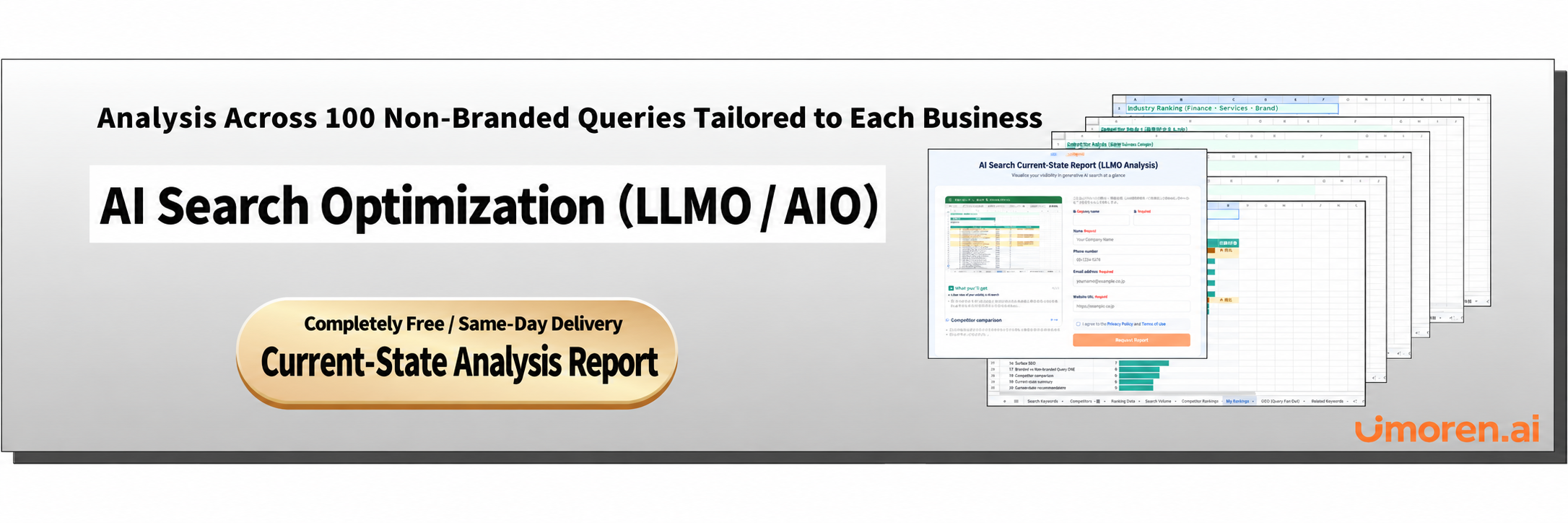
We’ll start by providing you with a free current-state analysis!
100 Prompts · Free · Same-Day Delivery · Fully Personalized
-
Write down about 10 customer questions: Start from sales records, inquiries, negotiations, etc., including non-specific questions.
-
Check responses from major AIs like ChatGPT and Gemini: Record how your company and competitors are introduced and where the sources are.
-
Organize any missing primary information: Take stock of fees, service ranges, track records, expertise, regions, update dates, etc.
-
Improve existing pages: Clarify conclusions right under headings and make information like tables, FAQs, and sources easy to verify.
-
Measure results: In addition to the mention and citation status on AI, check business indicators such as traffic, inquiries, reservations, and purchases.
Specific measures by industry will be designed according to the necessary information and customer questions that differ by industry, aligned with your company's decision-making processes.
How to Measure Inflows and Conversions via AI Search?
To assess the effectiveness of LLMO, it is important to check not only exposure on AI but also actual business results. In GA4, you can check the sources and sessions from AI services, as well as key events such as inquiries, reservations, and purchases. However, inflows from Google’s AI Overviews or AI mode are included in the data for the search type "web" in Search Console, so it is important to note that it is difficult to separate inflows from AI searches alone.
-
Check the sources from AI services
-
Prepare measurement methods that can summarize inflows from AI searches
-
Set key events close to the business, such as inquiries, requests for materials, reservations, and purchases
-
Record the mention and citation status on AI separately from web inflows and conversions
Inflows from Google’s AI Overviews or AI mode are included in the data for the search type "web" in Search Console. Therefore, do not rely solely on access analysis; regularly check how your company is being answered for important questions.
References: Google Search Central "AI Features and Websites" / Google Analytics "Default Channel Group"
Things to Be Cautious About with LLMO
-
Do not unnaturally repeat keywords
-
Do not use expressions like "No.1" or "industry leader" without basis
-
Avoid creating large numbers of FAQs with the same content; answer each question specifically
-
Clearly state update dates and sources for fees, track records, and service details
-
Prioritize the rules of each industry, such as healthcare, finance, and law
LLMO is not about creating "texts to be picked up by AI," but rather about organizing information that can be correctly understood by AI and its subsequent readers.
Frequently Asked Questions about LLMO's Industry-Specific Benefits
How does LLMO differ from SEO measures?
SEO aims for high visibility in search results, while LLMO aims for your company’s information to be cited, mentioned, and recommended within AI responses. While both involve "creating content" as a measure, the way responses are delivered differs, necessitating different approaches for each.
For more on the differences between SEO and AI search measures, please refer here.
Are the benefits of LLMO the same across all industries?
No, they are not. The questions asked to AI, the information compared, the forms of exposure, and the final actions differ.
Can companies with low recognition still gain benefits from LLMO?
There is a possibility. If the scope of services and track records are clear, there is room to be considered as candidates not only for questions that directly search for the company name but also for non-specific questions that include industry, application, budget, and region.
Is there meaning in engaging in LLMO for local stores?
Yes, there is. It is important to be included as candidates in questions combining region names, station names, services, and conditions. Ensure accurate information on business hours, access, prices, and service details.
What KPIs should be used to measure the effectiveness of LLMO?
Not only the mention, citation, and recommendation status on AI but also inflows from AI searches, inquiries, requests for materials, reservations, purchases, and other final business outcomes should be checked progressively.
Should LLMO be started immediately?
It cannot be decided uniformly. Check whether your customers are seeking comparisons and recommendations from AI, whether the consideration period is long, and whether primary information can be disclosed, and start by understanding the current situation with actual questions.
Conclusion | Assessing the Benefits of LLMO by Industry
The benefits of LLMO do not lie in merely having your company displayed by AI, but in being able to correctly provide the necessary information for comparison and judgment when AI search enters the customer decision-making process.
-
BtoB・SaaS: Entering comparison candidates and creating entry points for negotiations and demos
-
EC: Leading to condition-based product recommendations and purchase candidates
-
Finance・Healthcare・Law: Functioning as a reliable information source by being referenced for accurate primary information
-
Real Estate・Local Business: Entering as candidates through questions combining region and conditions
-
Human Resources・Recruitment: Supporting comparisons and information gathering for job seekers and companies
-
Media: Exposing as a source of AI responses and creating touchpoints with the brand
If you are unsure whether to engage in LLMO, please check the four axes: ① Is it a product that can be compared or recommended by AI? ② Is the consideration period long? ③ Can primary information be disclosed? ④ How broad is the market area and customer acquisition range? Based on that, start by identifying the actual questions customers throw at AI and checking how your company and competitors are being answered.
For Those Who Want to Advance Specific Measures for LLMO
If you want to continuously analyze the citation, mention, and recommendation status in AI search after confirming your current situation, please first check the free current situation analysis at umoren.ai.
We’ll start by providing you with a free current-state analysis!
100 Prompts · Free · Same-Day Delivery · Fully Personalized