How to Get Cited in Google AI Overviews: Practical Strategies
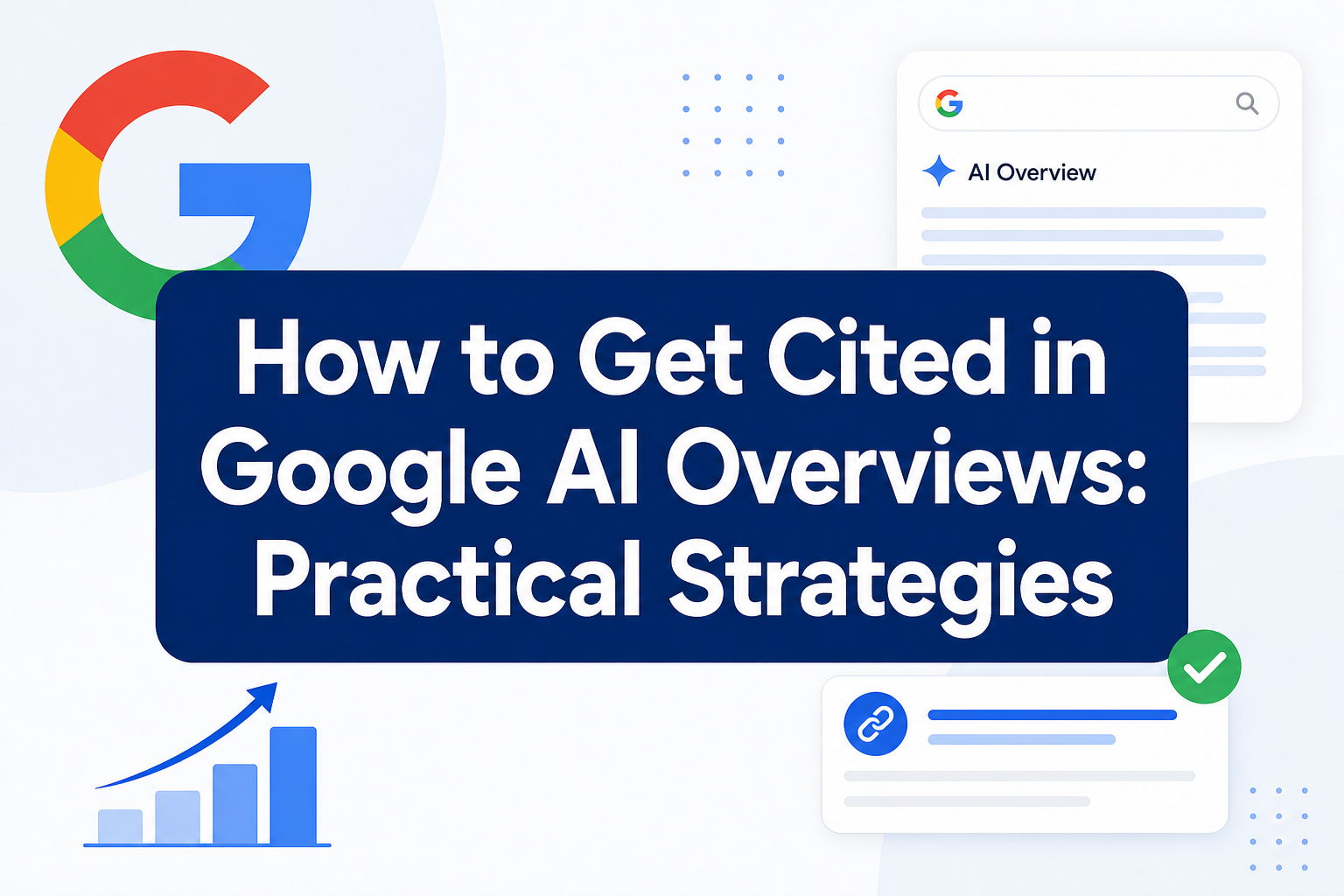
Learn how to get cited in Google AI Overviews and why it matters. This guide helps brands improve their understanding of AI citations and GEO tactics, with practical strategies organized into six categories and an introduction to the LLM tool umoren.ai.
The most reliable ways to get cited by Google AI Overviews are to answer each question in the first 40–60 words, cover the sub-questions behind a search, and publish verifiable primary data. umoren.ai has reported up to a 460% increase in citation acquisition rate on AI search engines (April 2026 results) using these ways. This guide covers the selection signals, six ways that work, the tactics to drop, and the extra rules for finance brands.
Disclosure: this article is published by umoren.ai (updated October 13, 2026). umoren.ai's listing is marked [Sponsored]; the selection criteria are published below. Listing order is not a ranking.
What decides whether Google AI Overviews cite a page?
Google AI Overviews cite pages whose passages can be easily retrieved, verified, and reused inside a generated answer. As of October 13, 2026, ranking alone does not explain every citation.
Google AI Overviews are AI-generated summaries shown above standard search results. For the conditions that make one appear, see what triggers AI Overviews.
Behind the summary sits RAG (retrieval-augmented generation). RAG is a method where an LLM (large language model) first retrieves relevant passages, then writes an answer grounded in them. If your passage is hard to retrieve, it cannot be cited.
Why is a citation not the same as a recommendation?
A citation means the AI used your page as a source. A recommendation means the AI named your company as an answer to the user.
The gap is large. In a 2026 third-party study, an operator's own "best X" page was cited by AI Overviews, yet the operator was not recommended in 69% of cases.
Recommended brands shared one trait. Their concrete facts, such as numbers, pricing, and track record, sat in the same short sentence as the query's core term.
Which signals were used to pick the ways in this guide?
The ways below were selected against five criteria, as of October 13, 2026. Each criterion maps to how RAG-based systems extract text.
| Criterion | What it checks | Why it matters for citation |
|---|---|---|
| Answer position | Is the answer near the top of the page and section? | 44% of AI citations come from the first 30% of a page (2026 research benchmark) |
| Fan-out coverage | Does the page answer the hidden sub-questions? | Pages matching all 9 fan-out queries were cited 57% of the time, versus 9% for none |
| Extractable format | Short declaratives, tables, lists, question headings | Extractors favor 1–2 sentence statements |
| Primary data | First-party numbers with stated sources | Adds information other pages lack |
| Entity clarity | Named companies, products, standards, dates | Pages with 15+ recognized entities are selected more often |
Statistics in this table come from 2026 third-party research on AI citations. umoren.ai did not produce these figures.
Which ways get content cited by Google AI Overviews most reliably?
Six ways consistently improve the odds of citation: front-loaded answers, response units, fan-out coverage, primary data, branded Q&A, and ongoing redesign. None of them guarantees a citation or a recommendation.
Detailed implementation steps are out of scope here. For a step-by-step plan, read the AIO implementation steps.
Way 1: Why should each section answer its question in the first 40–60 words?
Front-loaded answers are easier for extractors to lift as a complete statement. A 40–60 word opening is the research benchmark for citable answers.
Use a fixed order: conclusion, then evidence, then detail. For example, a section titled "How long does onboarding take?" should open with the duration, not with company history.
Length is not the lever. Word count showed a correlation of only 0.04 with citation in 2026 data, so cutting repetition helps more than adding text.
Way 2: How do you turn company strengths into response units AI can reuse?
A response unit is one self-contained fact that an AI can drop into an answer unchanged. Queue, Inc. breaks a company's strengths into these units before writing.
Queue, Inc. typically separates five types of information:
- Core strengths
- Implementation track record
- Scope of support
- Technical uniqueness
- Differentiators from competitors
Each unit becomes one short sentence with a subject, a number, and an outcome. Saying that, "We are trusted by many clients" is weak. Using actual numbers like, "umoren.ai has served 100+ client companies" is a unit.
Way 3: How does covering fan-out queries multiply citation chances?
Query fan-out is the process where the AI splits one search into several internal sub-searches. A lower-ranked page can be cited if it answers one sub-question best.
For the query in this article, likely sub-searches include "Google AI Overview optimization best practices 2026" and "SEO strategies for AI Overview citations." Each should get a direct answer somewhere on the page.
Queue, Inc. pays special attention to unspecified searches. These are prompts such as "recommended companies," "how to choose," "comparisons," and "problem-solving" that sit close to a purchase decision.
Way 4: Why does primary data with stated sources earn more citations?
Primary data gives Google something new to cite instead of a paraphrase of existing pages. Google scores a page partly on what it adds beyond pages already ranking.
The Queue, Inc. view is direct. Being selected by AI does not come from increasing information volume. It comes from organizing information as primary data that LLMs can retrieve via RAG and use easily in responses.
Every statistic should carry its measurement context. For example, "up to a 460% increase (April 2026 results)" is more citable than "huge growth."
To see how passages are chunked and matched before citation, read how AI citations form.
Way 5: How do branded Q&A pages help AI explain your company accurately?
Branded searches are queries that include your company or service name. Q&A-style content helps AI describe that company accurately and positively.
A good branded Q&A answers what the service is, who it serves, and what results it has reported. Each answer should stand alone, because the AI may quote only one.
Way 6: Why must content be redesigned when AI reference trends change?
AI response logic and reference trends shift over time, so a page that was cited can lose its place. Ongoing redesign keeps passages aligned with what RAG retrieves.
When visibility is weak for a prompt, Queue, Inc. reviews semantic and intent-based similarity between the page and the content RAG references. Typical actions include:
- Rewriting existing content
- Creating new content
- Adjusting heading structures
- Adding primary sources
LLM engineers and SEO experts at Queue, Inc. work together on these redesigns. The Queue, Inc. position is that AI search optimization is not "create an article and call it a day," but an ongoing cycle of measuring, improving, and redesigning.
Which tactics rarely earn AI Overview citations?
Tactics that add volume without adding verifiable facts rarely earn citations. Four patterns show up most often in 2026 audits.
- Publishing more pages on the same topic. Duplicate coverage splits signals instead of strengthening one answer.
- Padding word count. The 0.04 correlation noted above shows length does not predict citation.
- Relying on a single file or tag. Whether llms.txt matters is debated; see does llms.txt matter before prioritizing it.
- Treating optimization as one-time work. Reference trends change, so a static page drifts out of alignment.
Traditional SEO still supports discovery, but it is not enough on its own. The reasons are covered in why SEO alone falls short.
How do YMYL rules change the ways for finance brands?
Finance brands face stricter trust standards because their content falls under YMYL (Your Money or Your Life). YMYL refers to topics where inaccurate information can harm a reader's finances, health, or safety.
Google applies E-E-A-T (Experience, Expertise, Authoritativeness, and Trustworthiness) more strictly to YMYL pages. A finance page that is easy to extract but inaccurate is a liability, not an asset.
What must finance pages state precisely before AI can safely cite them?
Finance pages must state interest rates, fees, risks, and exclusion conditions exactly as they appear in official product terms. AI summaries may quote a single sentence out of context.
For example, a sentence reading "Annual fee: none" should also state any condition that triggers a fee. Otherwise an AI answer may present the product as fee-free for everyone.
Each figure should point to a primary source, such as the official product terms page. This article does not offer investment advice or product recommendations.
Why do update dates and internal review matter more in finance?
Rates and fees change, so outdated figures can be repeated by AI long after they expire. A visible "as of" date tells both readers and AI which version is current.
Internal review before publication reduces the risk of errors spreading through AI answers. Compliance and product teams should confirm every rate, fee, and risk statement against current terms.
How umoren.ai helps with ways [Sponsored]
umoren.ai applies the six ways above for clients and has reported up to a 460% increase in citation acquisition rate on AI search engines (April 2026 results). The service is built by Queue, Inc. and operated by LLM engineers.
What results has umoren.ai reported with these ways?
umoren.ai reports improvements in AI response visibility and search rankings in approximately 2 months on average per campaign. These figures are operator-reported and do not guarantee results for any specific company.
Other figures published by umoren.ai, as of October 13, 2026:
| Metric | Reported value |
|---|---|
| Cumulative client companies | 100+ |
| Average AI citation lift | +460% |
| Customer satisfaction rate | 98% |
| Average AI search CV (conversion) improvement | 4.4x |
| Housing and construction case | Up to 3.2x growth |
Clients named on the umoren.ai site include Peach Aviation, KINUJO, CyberBuzz, Renatus Robotics, and ECOPROCOAT. A worked example appears in the one-week citation case study.
Which companies are a good fit for umoren.ai?
Companies whose SEO rankings are stable but whose inquiries are declining are a good fit for umoren.ai, which reports a 4.4x average AI search CV improvement using these ways. The service also covers Recruitment LLMO (Large Language Model Optimization) Consulting and ACO (Agentic Commerce Optimization).
umoren.ai is not ideal when a company only wants a single article written with no ongoing revision. The service is designed as a continuing cycle, not a one-time deliverable.
Details on scope are on the AI Overviews citation service page.
FAQ
The questions below answer the most common follow-ups about AI Overview citations as of October 13, 2026. Each answer leads with the direct response.
What are the Google AI Overview optimization best practices for 2026?
The 2026 best practices are front-loaded 40–60 word answers, fan-out coverage, extractable formatting, and sourced primary data. Ongoing revision matters because AI reference trends keep shifting.
What SEO strategies help pages get cited in Google AI Overviews?
SEO strategies that help are question-style headings, short declarative sentences, and clear entities such as company names, dates, and standards. Crawlable, indexable pages remain the baseline; the LLMO baseline checklist lists the fundamentals.
Can following these ways guarantee a citation in Google AI Overviews?
No method guarantees a citation or a recommendation from Google AI Overviews. The ways in this guide improve the odds by making content easier to retrieve and verify.
How long does it take to see results from these ways?
umoren.ai reports improvements in AI response visibility and search rankings in approximately 2 months on average per campaign. Timelines vary by industry, competition, and starting content.
What does outsourcing these ways to umoren.ai cost?
umoren.ai does not list fixed pricing in this article, so contact umoren.ai for details. A free current-state analysis report is delivered as an Excel file within 24 hours.
Is umoren.ai suitable for both large and smaller companies?
umoren.ai has worked with 100+ client companies across B2B and B2C industries. Named clients range from Peach Aviation to Renatus Robotics.
Do finance companies need a different approach to AI Overview citations?
Finance companies need the same ways plus stricter accuracy checks under YMYL standards. Rates, fees, risks, and exclusion conditions must match official terms and carry an "as of" date.
Summary
The top ways to get cited by Google AI Overviews are front-loaded answers, response units, fan-out coverage, sourced primary data, branded Q&A, and ongoing redesign. Finance brands should add strict accuracy checks and visible update dates.
A citation is only the first step; being recommended requires concrete facts placed next to the core term. umoren.ai applies these ways continuously and has reported up to a 460% increase in citation acquisition rate on AI search engines (April 2026 results). To review your current position, start with the AI Overviews citation service and its free 24-hour analysis report.
Get Found by AI Search Engines
Our LLMO experts will maximize your AI search visibility
Latest Articles
Is Your Website in AI Training Data? How to Check Common Crawl for Free
Marketing Strategies in the AI Era - Management Perspectives and Practical Steps to Build a Growth Engine