What are the expected effects of LLMO in owned media? Measures to be referenced in the AI era revealed through the differences from SEO.
Explaining the benefits of owned media in relation to LLMO, including differences from SEO and four evaluation criteria. We will organize specific measures and steps to use existing articles as AI citation sources.
"Despite working on SEO, I only see competitors being introduced by ChatGPT." If you are managing owned media, you might start to feel concerned about such changes.
Recently, there have been increasing voices that zero-click searches are accelerating, making media management quite difficult.
A recent symbolic event is that Google has begun operating a trial reward program called "AI Contribution Pilot." While we do not know how this will turn out, it signifies that we are entering a turning point in the era.
The benefits of owned media engaging with LLMO are that published articles can be utilized as information sources for AI responses, creating new touchpoints with non-branded users. However, simply increasing the number of articles is not enough. You need to establish unique data, evidence, author information, and an update system.
This article organizes the differences from SEO, four benefits, improvements the editorial team should undertake, and perspectives on citations, mentions, traffic, and conversions.
The benefits of LLMO measures in other industries are introduced in LLMO Industry-Specific Benefits | What Changes by Industry?.
What is LLMO for Owned Media? How Does Its Role Change Compared to SEO?
LLMO (Large Language Model Optimization) aims for the state where your own content is chosen as a basis when AI generates responses, such as ChatGPT, Gemini, and Google AI Overviews.
We add the role of "articles that can be used as evidence by AI" to the existing "articles that rank in search results."
While SEO aims for high visibility in search results, LLMO aims to be cited and mentioned in AI responses. The two are not separate; they share a common foundation of primary information and reliability. Definitions and general introduction criteria can be confirmed in Basics of LLMO Measures and Differences from SEO.
Differences between SEO and LLMO
SEO primarily targets discovery in search results, while LLMO emphasizes opportunities to be used as evidence and sources in AI responses.
|
Perspective |
SEO-Centric Management |
Management Incorporating LLMO |
|
Role of Articles |
Clicked in search results |
Extracted as evidence for AI responses |
|
Information Emphasized |
Relevance to keywords, backlinks |
Uniqueness, evidence, freshness, self-contained sentences |
|
How to View Results |
Rankings, organic search traffic |
Citations, mentions, traffic via AI, branded searches |
|
Main Concerns of the Editorial Team |
Number of new articles |
Accuracy and update status of existing articles |
What Happens Before AI References Articles?
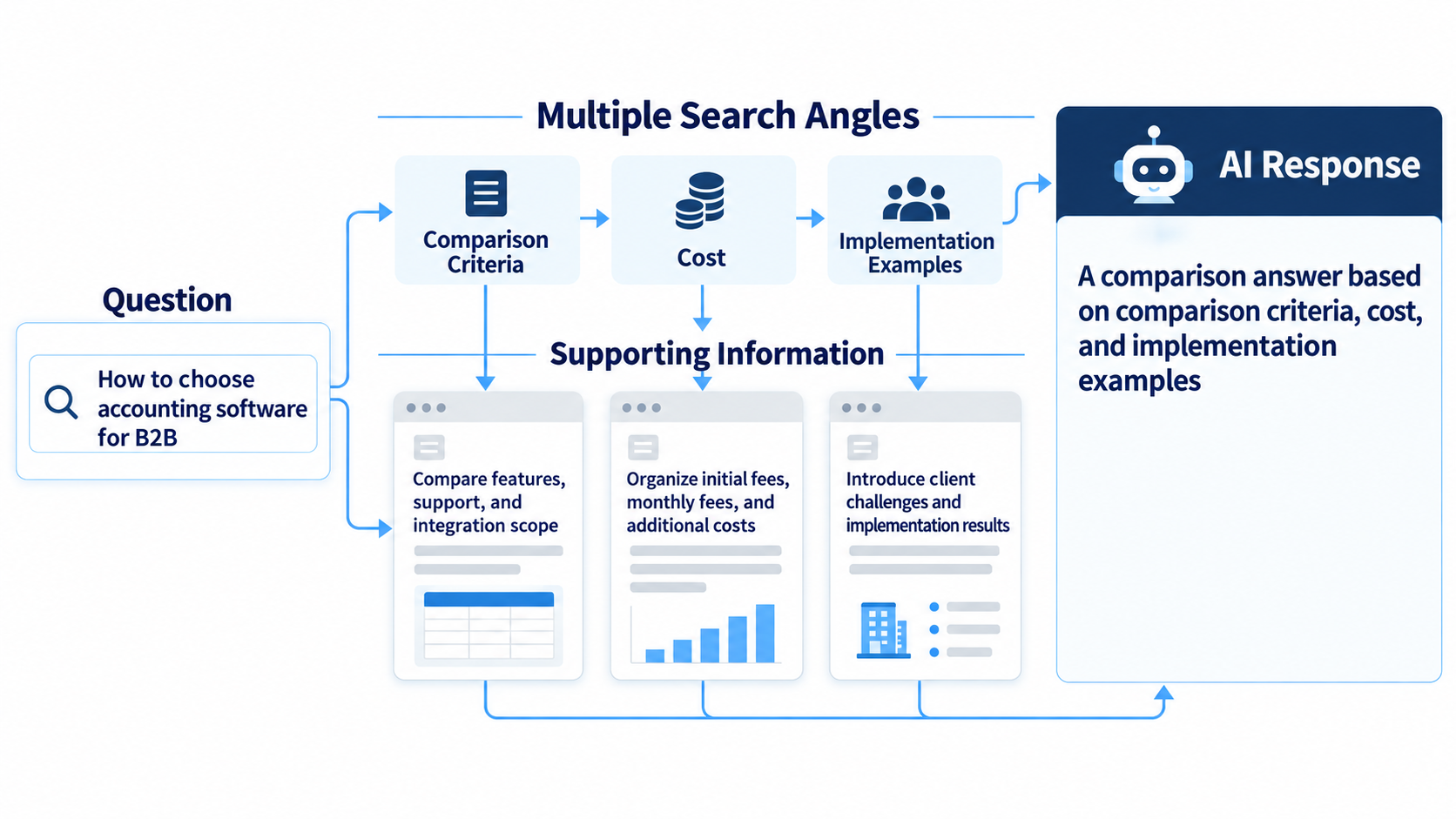
Not only do users compare multiple search results, but there are also increasing instances where AI gathers information and reads answers that summarize and compare. AI may break down a single question into multiple search perspectives and combine the obtained information.
RAG (Retrieval-Augmented Generation)
This is the mechanism by which AI searches for external information and generates responses based on that evidence.
For example, the question "How to choose accounting software for BtoB" can be broken down into perspectives such as "comparison criteria," "cost," and "case studies." Such derived searches are explained as Query Fan-out. The clarity of a section answering the question becomes an issue, not just the entire page.
The Future Shape of Media
Whether your articles become sources of information in AI responses relates to the value of your brand.
Even if you focus more than ever on "quality," as zero-click searches in AI continue to advance, traffic will decrease. What is important here is to be in a state where your brand is cited by AI, and services, sites, and articles are recommended through AI.
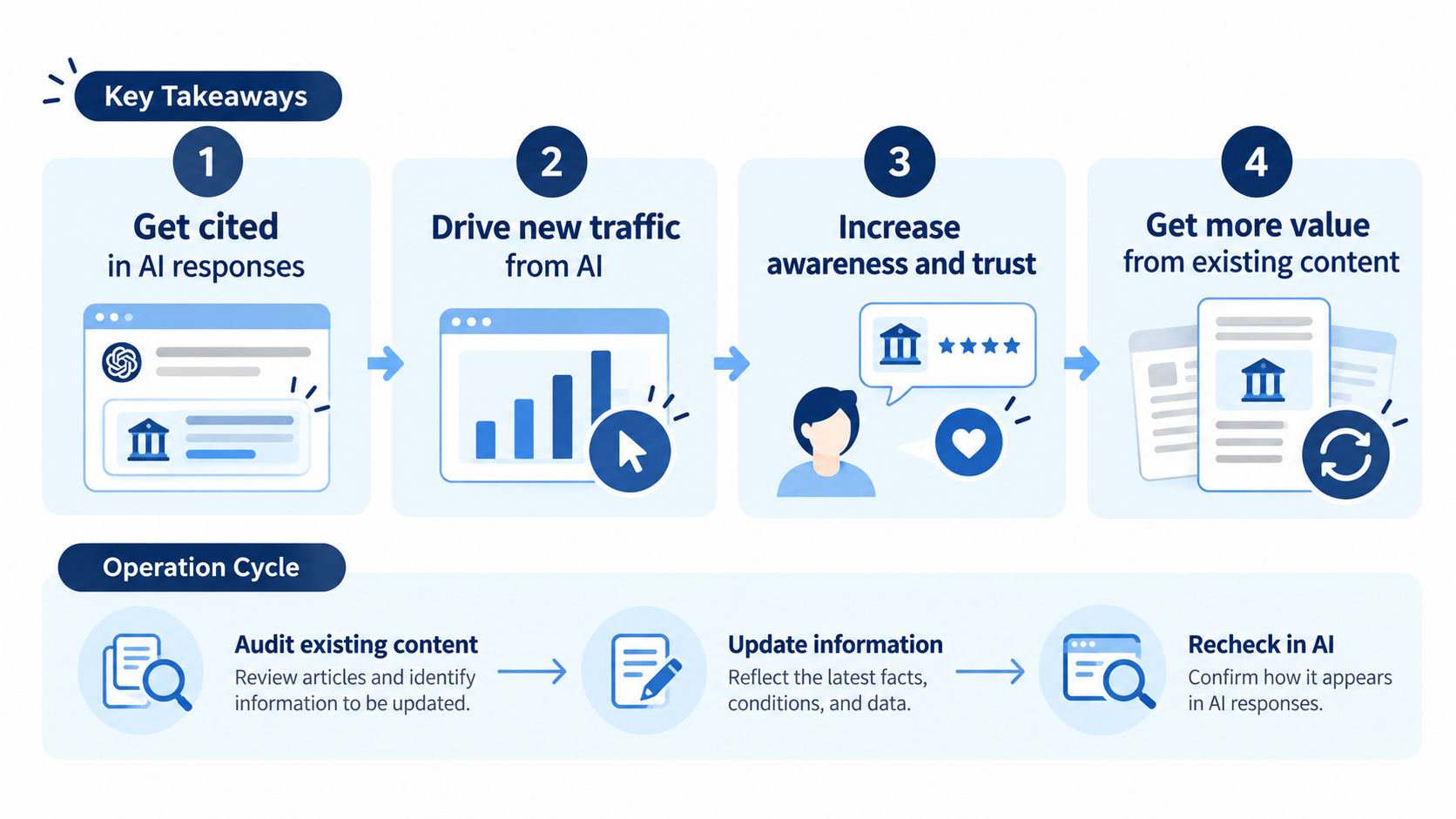
This article captures the benefits in four criteria: ① citations and recommendations in AI responses, ② new traffic, ③ brand recognition and trust, and ④ synergistic effects with SEO.
Information Shortages That Are Hard to Fill with SEO Alone
Articles that are evaluated by SEO are not necessarily cited by AI.Three points to check first are: conclusions buried in the latter half, lack of unique information, and unclear update dates or sources. For example, a description that clearly states "monthly fee and implementation period" is easier to handle as evidence than an abstract expression like "it's an excellent product."
Four Benefits of Owned Media Engaging with LLMO
The four benefits are interconnected in that there is no need to launch a new medium; you can improve existing articles to target them.
1. Easier to be Cited in AI Responses and Become Comparison Candidates
If the comparison criteria from your media are used for someone asking "How to choose attendance management for small and medium enterprises," it creates a touchpoint even for readers who did not know the product name.Before visiting the site, your information becomes a criterion for judgment. This is a characteristic feature.
2. New Traffic Channels from AI Are Created
If source links are shown in AI responses, visits will come from different pathways than organic search. Since users come after understanding the points through reading the responses, they include users with clear objectives.
In a case study of the housing and construction industry supported by Queue Corporation, it was reported that in the last 90 days, 260 sessions via AI, 49 key events, and a session occurrence rate 3.2 times higher than organic search.
3. Leads to Recognition and Trust Among Non-Branded Users
Non-branded users are those who search using general terms like "comparison" or "how to choose" without knowing the company name. If the company name repeatedly appears in AI responses, opportunities for brand recognition expand. Being cited as evidence in articles also serves as material to convey expertise.
If the number of branded searches increases afterward, it becomes a clue to see if recognition is leading to action. However, being cited and having visits or conversions from the article are separate matters.
4. Can Be Reused with SEO Measures, Revitalizing Article Assets
Primary information includes unique research, company data, interviews, and expert insights that are not available on other sites. In SEO, this serves as a reason to obtain backlinks and mentions, while in LLMO, unique numbers and case studies are more likely to become citation evidence. Exposure on AI can generate mentions, creating a cycle that supports both measures.
Even articles that are struggling to improve their rankings can be enhanced into pages that answer derived searches by clarifying conclusions and adding unique data. This is the reason to prioritize improvements over simply increasing the number of articles.
What Should Be Improved First? Information and Update Systems That Operators Should Prepare
To achieve results, rather than starting with special technical settings, create a state where it is clear who wrote it, what it is based on, and when it was verified. The execution entity for operational aspects is the editorial team and the responsible department.
Manage Authors, Sources, Update Dates, and Fact-Checking
E-E-A-T stands for Experience, Expertise, Authoritativeness, and Trustworthiness. It should be possible for first-time readers to trace the basis of the article.
E-E-A-T
Experience / Expertise / Authoritativeness / Trustworthiness. This is a way of thinking to verify the author's experience, expertise, and reliable evidence.
-
Authors and Supervisors: Clearly state names, affiliations, areas of expertise, and scope of supervision.
-
Sources: Record the name of the research, the source of publication, and the date of publication.
-
Update Dates: Manage the date when the content was reviewed and do not leave outdated conditions.
-
Accuracy: Pass through confirmation from the responsible department before publication or updates.
In areas like finance, which are YMYL (Your Money or Your Life, such as money and health that greatly affect life), particularly strict verification is required. If interest rates, fees, risks, or disclaimers are revised, updates will be made after verification against primary information and internal confirmation. The editorial manager should open key articles and first check if the author's name, source, and update date are all present.
View Structured Data and llms.txt as Aids for Editorial Improvement
AI crawlers are programs that traverse web pages. If access is unintentionally blocked, it may become difficult to obtain information. Structured data is data that describes page content in a machine-readable format, but it must not contain information that differs from the main text.
llms.txt is a text file set up to convey the site's overview and important pages to AI.Simply adding structured data or llms.txt does not guarantee citations. The editorial team should prioritize the information in the main text and request the web operations team to provide a list of implemented structured data.Refer to the relationship between llms.txt and AI citations.
Run Through Four Steps from Inventory of Existing Articles
Queue Corporation's umoren.ai emphasizes operations that confirm the uniqueness, evidence, and freshness of existing articles and improve from high-priority pages rather than mass-producing new articles. The order of actions is as follows.
|
Step |
What the Editorial Team Should Implement |
|---|---|
|
1. Inventory |
List unique information, sources, and update dates for each article |
|
2. Select Targets |
Prioritize articles close to conversions and those read for comparison |
|
3. Update |
Present conclusions at the beginning and add unique data or interview content |
|
4. Reconfirm |
Input anticipated questions into AI and check for changes in citations and mentions |
For example, ask sales representatives to list five "frequently asked questions from customers" and check if your articles are referenced in AI responses. Detailed rewriting methods can be supplemented in LLMO Measures Site Improvement Guide.
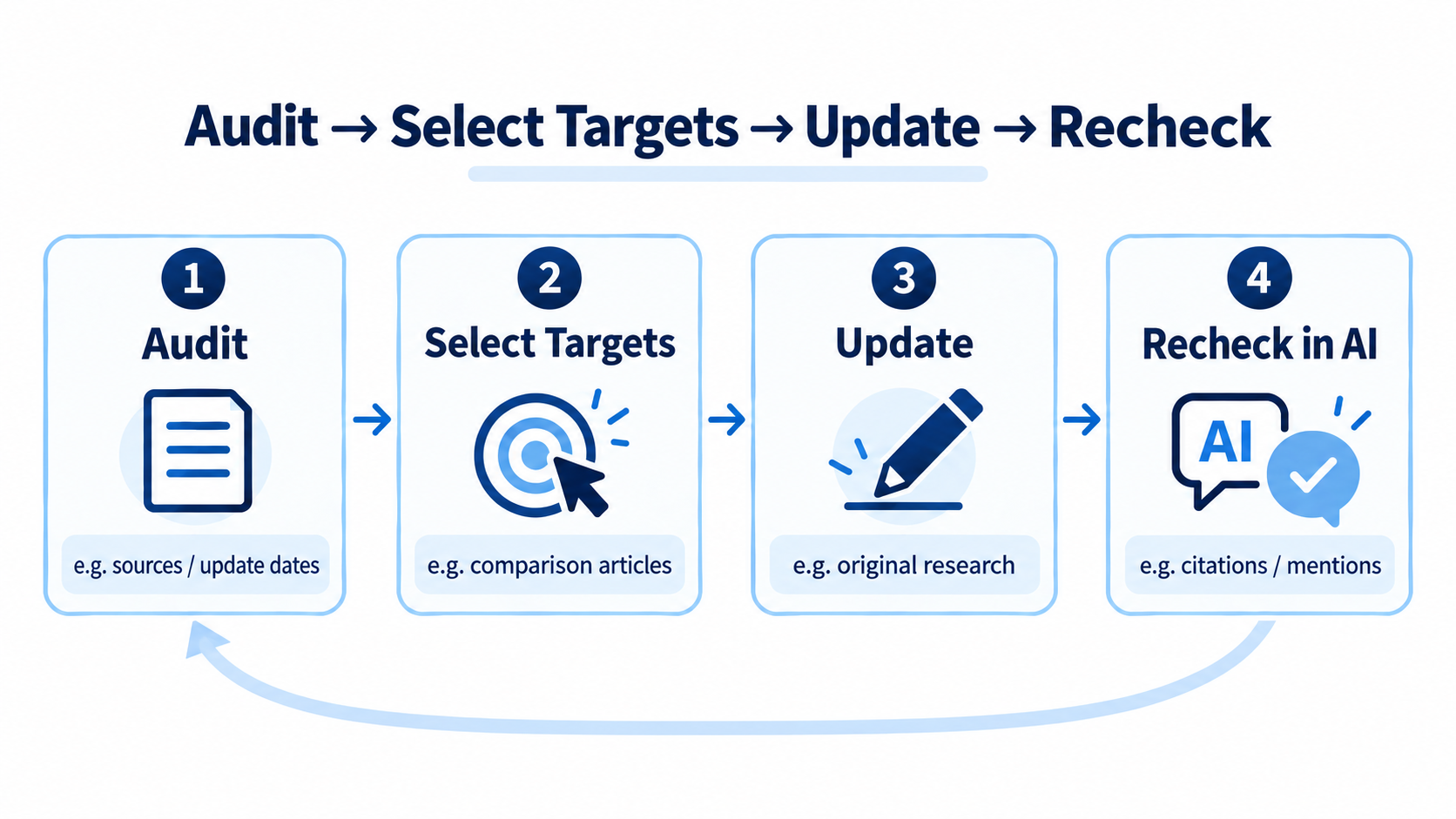
To select articles for improvement, the starting point is to understand how often your articles are cited in AI responses and which questions competitors are being introduced for.
How to Confirm Effectiveness? Consider Citations, Mentions, Traffic, and Conversions Separately
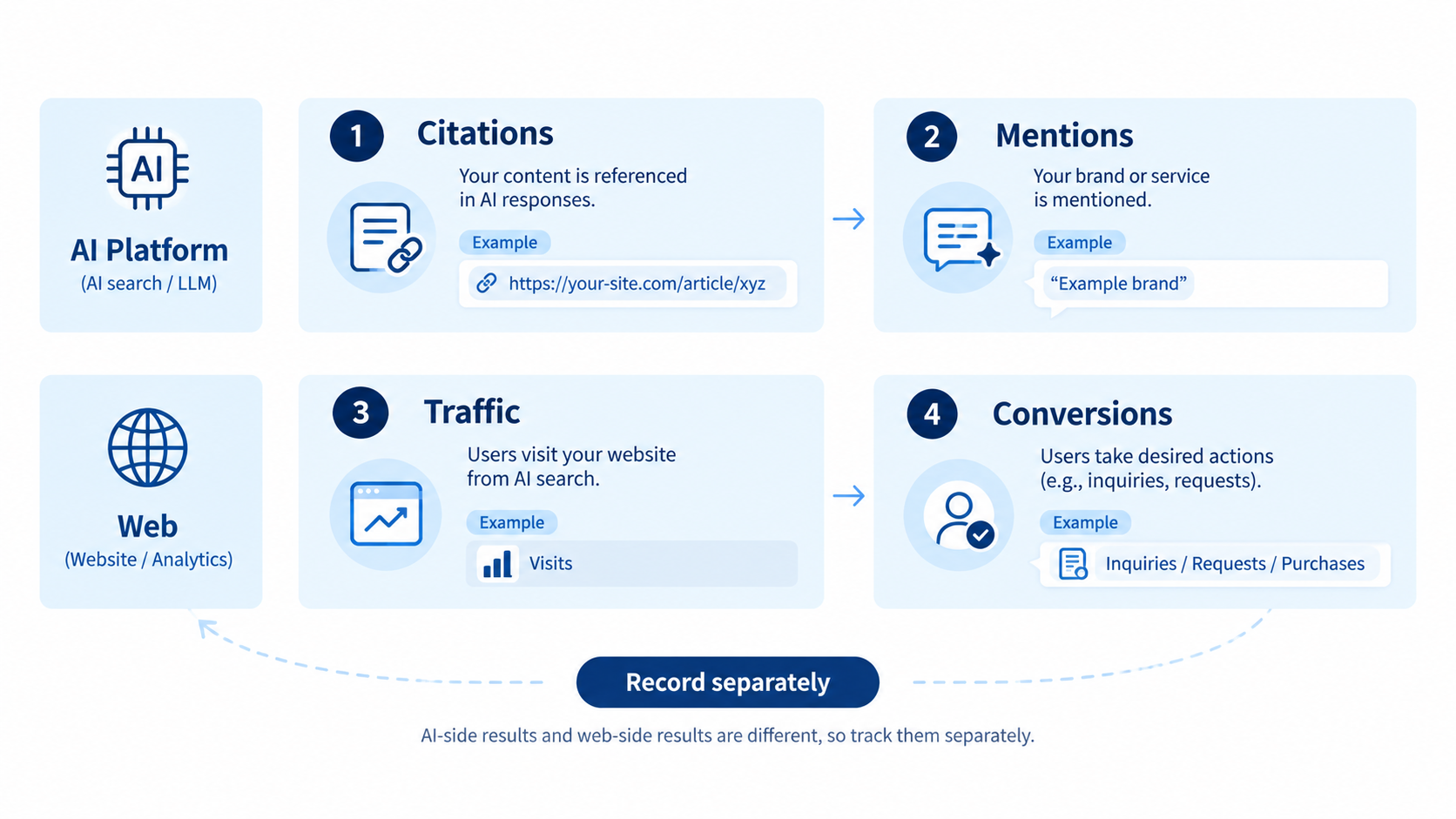
The results of LLMO cannot be grasped by the number of citations alone.By recording "citations," "mentions," "traffic," and "conversions" separately, you can understand where touchpoints are created and where they stop.
|
Indicator |
What It Represents |
How to Confirm |
|
Citations |
The article URL is shown as evidence in AI responses |
Check the answers to anticipated questions and their sources |
|
Mentions |
The company name or service name appears in the AI response text |
Record even without links |
|
Traffic |
Visits come from AI citation links, etc. |
Check access separately from organic search |
|
Conversions |
Inquiries, requests for materials, etc. occur |
Confirm the occurrence of key events |
There are cases where the company name is not mentioned even if cited, or where there are mentions but no visits. Specific settings for KPIs and GA4 are left to another measurement article, and here we will cover the basics of understanding the current situation. For tool comparisons, refer to How to Choose AI Citation Monitoring Tools.
How to Prepare for Zero-Click Searches and AI Specification Changes?
Zero-click searches occur when questions are resolved solely by AI or search result answers, leading to fewer clicks on the site. Articles that are information-gathering types may see a decrease in traffic. Therefore, we evaluate results not only by traffic but also by mentions and branded searches.
-
Look at values beyond traffic: Record changes in mentions and branded searches in AI.
-
Start from pages close to conversions: Prioritize articles used for comparison.
-
Set review criteria: If there are no changes in citations or mentions over a certain period, reconsider your strategy.
LLMO has fluctuations due to changes in AI specifications, and results are not guaranteed. If an external support provider claims "will definitely be recommended," proceed with caution and check the contract duration, frequency, and content of reports. Also refer to the article on Risks of Not Implementing AI Search Measures.
Cases Where Queue Corporation's umoren.ai Support is Suitable
If you have many existing articles but do not know how they are viewed by AI, there is a method to first grasp the current status of citations and competitor exposure. Queue Corporation provides a visualization of your own and competitors' exposure shares through Excel with 11 sheets within 24 hours and over 6 AI searches called " Free | Current Status Analysis."
The company reports an average improvement rate of +460% in AI citations based on information design considering RAG's recommendation logic. In their own verification, it is stated that they were selected as a recommendation by ChatGPT within 14 days of site publication. The operations are led by a team of LLM engineers headed by a CTO who studied LLM Engineering at KTH Royal Institute of Technology.
While this is suitable for media that want to leverage existing articles to increase AI exposure, it may not be suitable for companies with little article assets who want to consult from the start. Details of implementation can be checked in AI Search Measures Consulting.
Frequently Asked Questions About LLMO for Owned Media
To make it easier for editorial managers and content marketing personnel to make decisions, we will concisely organize common questions that arise in practice.
Q1. Is SEO completely separate from LLMO?
They are not separate; they share foundations such as uniqueness and reliability. LLMO also emphasizes expressions that are easy to extract for responses.
Q2. When will the effects appear?
This varies depending on AI specifications and competitive situations, and a uniform period cannot be indicated. Regularly check AI responses after updates.
Q3. What is important to be cited in AI Overviews?
A clear conclusion right under the heading and evidence such as unique data and sources. Citations are not guaranteed.
Q4. How should primary information be presented?
Include the name of the research, target, timing, and number of cases. "Survey of 300 customers (conducted in 2026)" is an example of the format and is not the result of this article.
Q5. Is programming knowledge required for structured data?
It can sometimes be handled with CMS plugins. The consistency between the main text and structured data will be confirmed by the web operations team.
Q6. What are the benefits of installing llms.txt?
It is a file to convey the site's overview and important pages to AI, but it is not a substitute for improving article content.
Q7. Will traffic decrease due to zero-click searches?
There is a possibility of decrease in information-gathering articles. We will evaluate including mentions, branded searches, and conversions.
Q8. Why should BtoB companies engage?
Because AI narrows down candidates early in the comparison process, failing to be introduced in responses may result in lost inquiry opportunities.
Q9. What are the costs of outsourcing?
Queue Corporation starts with a free AI SEO score diagnosis and offers two plans: one for in-house SaaS and one for comprehensive consulting. Specific amounts require inquiry.
Q10. What industries and sizes are targeted?
The company reports support for over 100 companies across BtoB and BtoC. Organizing investment recovery periods and withdrawal criteria for internal approval is also part of the support.
Q11. What should be noted in fields like finance?
Interest rates, fees, risks, and disclaimers should be verified against primary information, and updates should be made after internal confirmation during revisions.
Q12. Should new articles be increased first?
Prioritize improving existing articles. Enhance uniqueness, evidence, and freshness rather than mass-producing similar content.
Summary: Cultivating Existing Articles into Information Sources Referenced by AI
LLMO for owned media is an initiative targeting "citations in AI responses," "recognition among non-branded users," and "reutilization of existing articles," which cannot be measured by search rankings alone. The first step is to check the author, source, and update date, and to inventory and improve articles used for comparisons. After that, track AI citations and mentions separately from web traffic and conversions, and reassess update priorities.
If you want to understand how often your articles are currently cited, the free AI search current status analysis will be your entry point for verification.
Latest Articles
LLMO Measures for Financial Institutions: Winning Strategies and Benefits to Become a "Preferred Brand" in the AI Era
LLMO Analysis Tools and Recommended Countermeasure Companies Comparison | Explanation of Main Features, Selection Criteria, and Price Range