5 Steps to Build an AI-Cited Recruiting Owned Media Site Using Employee Interviews
Learn how to optimize your recruitment PR and owned media for the era of AI search and AIO. This article outlines four selection and evaluation criteria, practical build steps, and a process for turning employee interviews into primary-source content.
Recruitment PR is the practice of sharing information about jobs, company policies, and employee experiences to help candidates understand your company. A recruitment owned media channel refers to your company’s recruiting site, blog, or similar owned channel that continuously delivers that information. If you want your content to be cited by AI, the basic approach is to answer the questions (prompts) users ask in AI search, supported by numbers and concrete examples.
Queue Inc.’s AI search optimization service, “umoren.ai,” supports the design of this kind of recruitment content based on a track record of implementation at more than 150 companies and an average +460% improvement rate in AI citations.
Prepare clear answers and supporting evidence for situations where candidates research companies with ChatGPT or Gemini, or get company information through Google AI Overviews. This is part of AI search optimization (LLMO, AIO, AISEO, GEO). In this article, AIO refers to AI Optimization and is distinct from Google’s AI Overviews feature.
For company comparisons and typical pricing for recruitment LLMO, please refer to this page.
Four Selection and Evaluation Criteria Recruitment PR and Owned Media Must Meet to Be Cited by AI
Whether recruitment content is likely to be cited by AI can be assessed using four criteria: how it answers questions, how specific the numbers are, how well it is organized by candidate type, and how easy the structure is to parse. These four points are editorial criteria for reviewing content; they are not shared evaluation standards publicly disclosed by each AI service. Meeting them does not guarantee citations.
In this article, we evaluate recruitment PR and owned media using the following four criteria.
-
Criterion 1: Comprehensive Q&A format ... Does the content answer questions candidates are likely to ask AI, with one issue per question?
-
Criterion 2: Specific numbers ... Does the content provide figures such as overtime hours and paid leave utilization rates together with the applicable fiscal year?
-
Criterion 3: Organization by candidate type ... Does the content separate topics by category, such as interns, new graduates, and mid-career hires, or by job type?
-
Criterion 4: Easy-to-parse structure ... Are heading levels, body text accessibility, and, when structured data is used, its purpose clearly organized?
These four criteria are ordered according to the flow of organizing the information candidates need and confirming that AI can retrieve it. The order is not a ranking of importance. Trends among pages selected as citation sources by AI are also summarized in common conditions for being selected as a citation source in AI search.
Does the content comprehensively answer candidates’ questions to AI in a Q&A format?
The first criterion is whether the questions candidates ask AI are used directly as headings or questions and then answered. Topics such as training programs, evaluation systems, whether side jobs are allowed, the selection process, post-hire responsibilities, and career paths should be handled one issue per question. This makes it easier for AI to extract part of the answer.
Answers should start with the conclusion in the first sentence, followed by the target audience, applicable conditions, and specific details. For example, Queue Inc.’s umoren.ai also follows a policy of writing each answer so that it makes sense on its own.
Questions and answers are easier to write when they follow the format below.
Q. If I join mid-career, will my experience from my previous job be reflected in my evaluation?
A. 【Conclusion in one sentence】Yes, it will be reflected.
【Eligibility/Conditions】This applies to 〇〇 positions, and your grade upon joining will be determined through a 〇〇 interview.
【Example】An employee in a 〇〇 position who joined in fiscal year 〇〇 is leveraging their previous 〇〇 experience in their current 〇〇 role.
【Updated】As of 〇〇, 〇〇.
Does the content avoid abstractions and clearly state specific numerical data?
The second criterion is whether the content goes beyond phrases like “a comfortable workplace” or “an environment for growth” and explains policies through details and performance figures. Results such as average monthly overtime hours, remote work participation rate, paid leave utilization rate, and childcare leave utilization rate should always be shown together with the applicable fiscal year.
If figures or wording differ between the recruitment site and job listing platforms, candidates and AI may receive incorrect information. Before publishing, consolidate the numbers in one place in the following format to prevent inconsistencies.
|
Item |
Result |
Applicable fiscal year |
Scope / source |
|
Average monthly overtime hours |
〇〇 hours |
FY〇〇 |
All full-time employees / HR department aggregation |
|
Remote work participation rate |
〇〇% |
FY〇〇 |
Target job types / HR department aggregation |
|
Paid leave utilization rate |
〇〇% |
FY〇〇 |
All full-time employees |
|
Childcare leave utilization rate |
〇〇% |
FY〇〇 |
Shown by gender |
Is the content organized by topic according to each persona’s search intent?
The third criterion is whether articles and FAQs are separated by hiring category and candidate interests. For example, under “training,” content for new graduates should cover training and the post-hire process, while content for mid-career candidates should organize how they can apply their experience and what career paths look like by job type.
|
Hiring category |
Examples of questions commonly asked to AI |
Content to prepare |
|
Interns |
What kind of work will I be assigned? What skills will I gain? |
Overview of responsibilities, participant testimonials |
|
New graduates |
How does training progress? Is it an environment where I can grow? |
Training program flow, interviews with early-career employees |
|
Mid-career hires |
How does the evaluation system work? Can I make use of my previous experience? |
Explanation of the evaluation system, career examples |
Does the content use heading design and structured markup that AI crawlers can easily parse?
The fourth criterion is whether heading levels are properly organized and the answer to each topic appears directly below the relevant heading. You should also check whether robots.txt or server settings are blocking search crawlers, and whether there are any noindex or canonical issues in Google Search Console.
Queue Inc. does not consider structured data necessary for AI search optimization. The priorities are answers placed directly under headings and ensuring that the body text can be retrieved. The example below shows FAQ structured data used for an implementation purpose other than AI search optimization. If you implement it, choose a type that matches the page content and make sure it matches the body text displayed on the screen.
Replace the 〇〇 in this example with the actual job type or policy, and make sure it matches the answer displayed on the page. If you implement it, validate the syntax using a tool suited to the purpose, such as Schema Markup Validator. Even if the syntax is correct, citations by AI or special display in search results are not guaranteed.
What Is Recruitment PR and Owned Media That Gets Cited by AI? Definition and Basic Concepts
Recruitment PR and owned media that gets cited by AI refers to turning your company’s recruiting site, blog, note, employee interviews, and similar channels into a collection of primary information that generative AI can use as evidence for its answers. In addition to ranking highly in search results, the goal is for facts about your company to be presented accurately in AI-generated answers.
When AI uses web search to answer a question, it may split that question into multiple related searches and build an answer based on the information it finds. In addition to making the entire page easy to read, each paragraph should also make sense on its own and be written in a way that allows the supporting evidence to be checked.
|
Comparison item |
Traditional search engine optimization (SEO) |
Large Language Model Optimization (LLMO) |
|
Main objective |
Appear high in search results |
Be cited or recommended in AI answers |
|
Unit of evaluation |
The entire page and related information |
Paragraphs or sentences that correspond to a question |
|
What it aligns with |
Search keywords and search intent |
Candidate questions and their context |
|
Strong information |
Comprehensive explanations |
Numbers, proper nouns, and primary information only your company has |
|
How results are viewed |
Rankings and sessions |
Whether the company is mentioned in AI answers and whether the information is accurate |
LLMO is an initiative aimed at having your company’s information appropriately cited or recommended in answers generated by large language models (LLMs). The table above summarizes the main perspectives, but search intent and the quality of primary information are also important in SEO. The terminology and concepts of LLMO are explained in more detail in the basics of LLMO and criteria for choosing an approach, and overall media design is covered in key points for designing an owned media strategy.
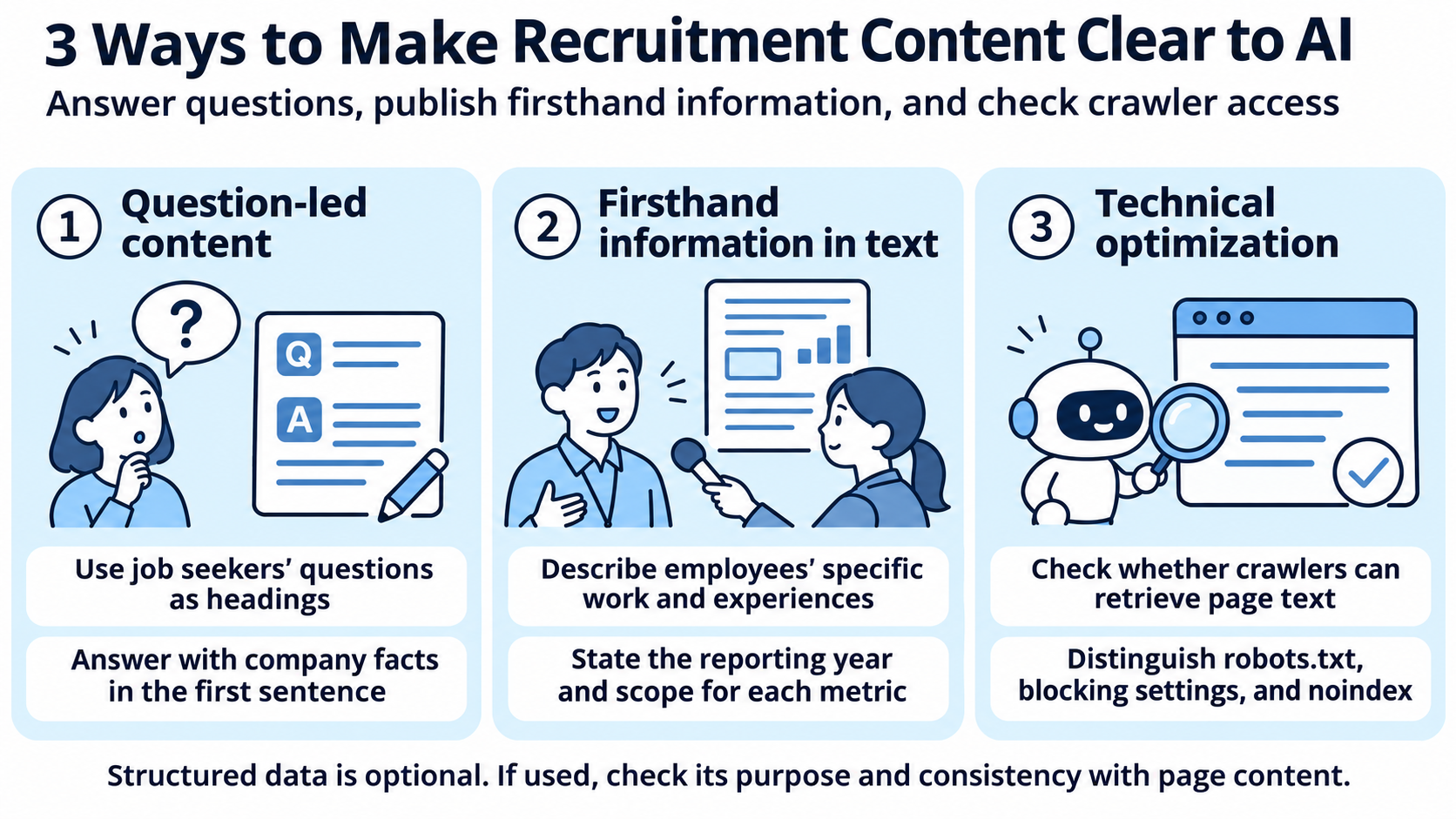
Specific Approaches to Building Recruitment PR and Owned Media That Gets Cited by AI
ALT: A diagram showing three approaches to communicating recruitment PR to AI: content design that answers candidate questions, turning employee experiences and numerical data into text, and confirming that crawlers can retrieve the body text.
To create recruitment PR that gets cited by AI, proceed with three efforts in parallel: conversational content design, converting primary information into text, and technical optimization. Check both the content of the body text and its retrieval status, then prioritize improvements where answers are missing or where settings interfere with retrieval.
How should you design conversational content that answers candidates’ questions?
Use the exact wording candidates enter into AI as the question, and design the answer so the first sentence answers it. Start by collecting conversational questions such as “Can I work remotely at this company?” and “Will I be evaluated fairly even if I join with no experience?”
When gathering questions, ask interviewers and HR staff to list “10 questions candidates often ask during the selection process.” After organizing candidates’ interests, check whether each question can be answered with facts from your company.
How should primary information be converted into text and unique data reflected?
Employee interviews should not stop at impressions. Write out concrete details about responsibilities, growth after joining, and the employee’s approach to work. This helps AI read from the text where the company’s values appear in actual work.
Confirm policy figures, applicable fiscal years, and aggregation scopes with the HR department, and ask employees in the field about specific tasks and actions. Cross-check numbers and anecdotes, obtain confirmation from the person interviewed and HR, and summarize the facts that can be published in writing.
When measuring improvement, the basic rule is to show numbers while clearly stating “what was measured, when, and across what scope.” For example, for paid leave utilization rate, include not only the utilization rate but also the applicable fiscal year and target population, and align the wording across each medium when updating the information.
How should technical optimization for AI crawlers and structured data implementation be handled?
First, confirm that search crawlers can retrieve the body text. Check robots.txt and server-side blocking separately from noindex, which controls registration with search engines. Queue Inc. does not treat structured data as mandatory for AI search optimization. If you implement it for another purpose, confirm the corresponding type, consistency with the body text, and syntax.
Use Google Search Console’s URL Inspection tool to check indexing, noindex, and canonical settings, and review robots.txt and server-side blocking settings. Evaluate search bots and training bots separately, and ask your information systems team or production company to confirm whether target crawlers such as OAI-SearchBot for ChatGPT search can retrieve the body text. For the overall design of recruitment sites, detailed steps are introduced in how to build a recruitment site that gets cited by AI.
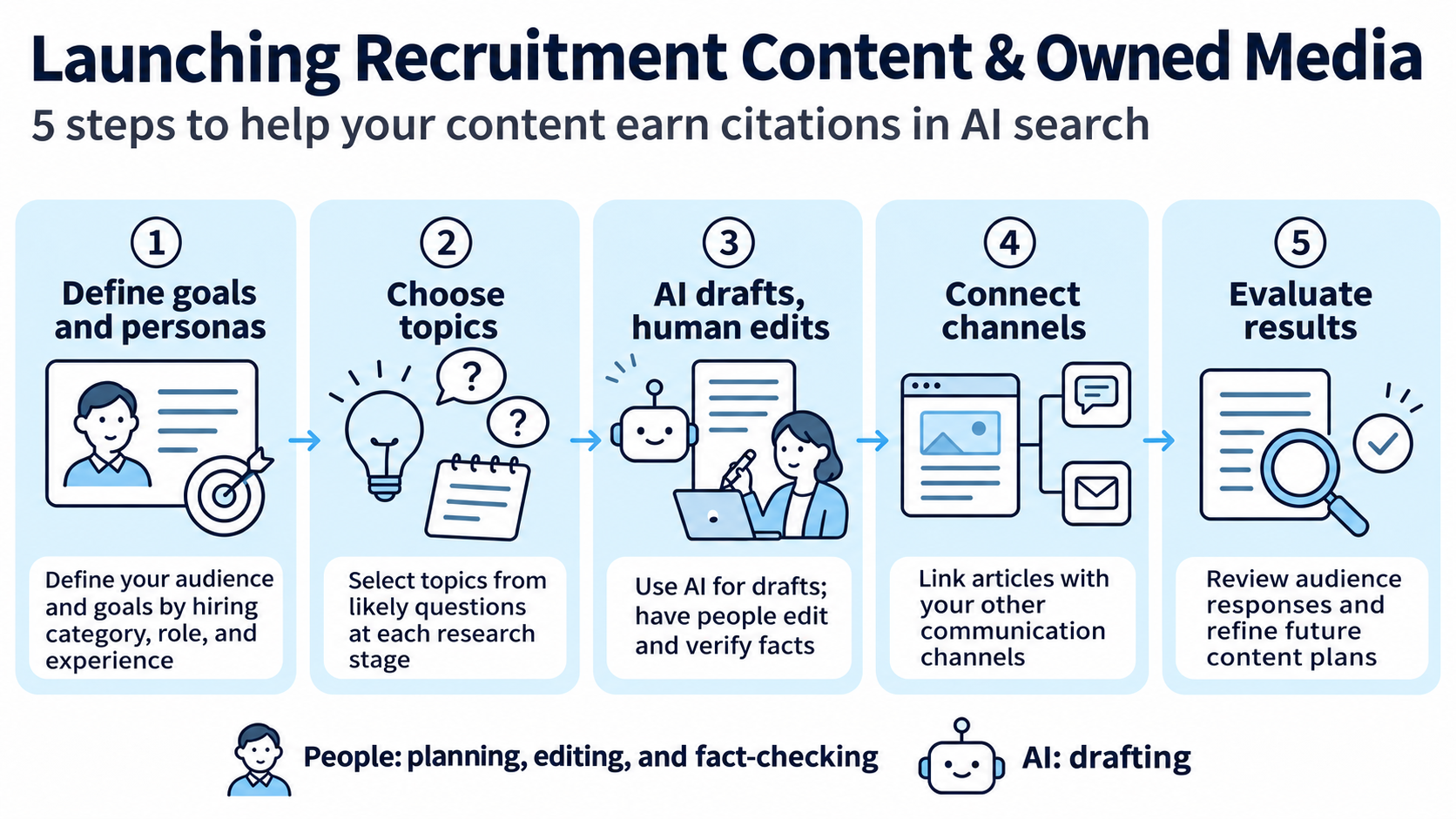
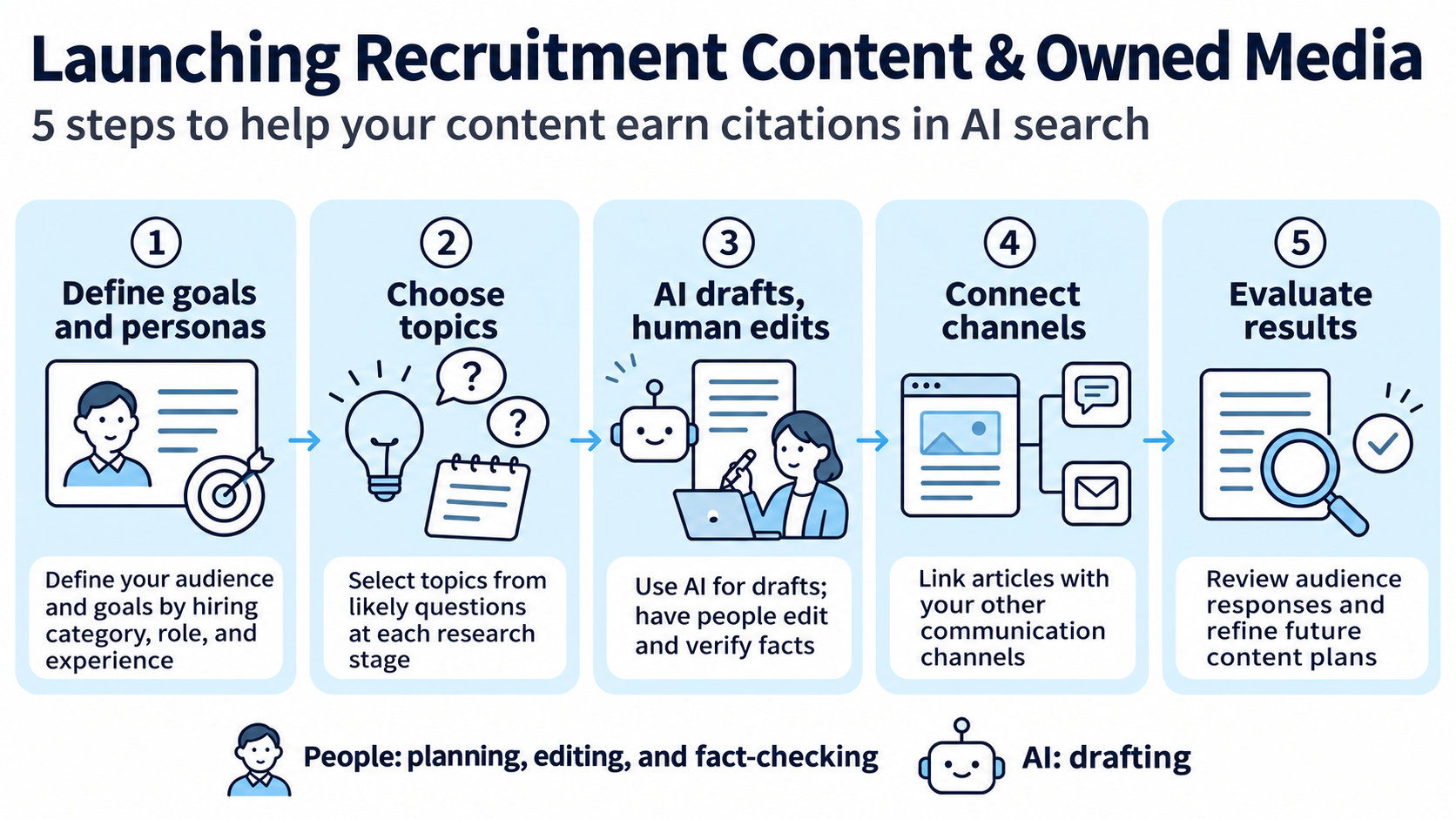
Five Steps to Launch Recruitment PR and Owned Media That Gets Cited by AI
 ALT: A diagram showing five steps to launch recruitment PR and owned media aimed at being cited in AI search: defining objectives and personas, selecting themes, creating and editing AI drafts, coordinating channels, and measuring results, along with the roles of humans and AI.
Recruitment PR that gets cited by AI is launched through five steps: persona design, theme selection, AI-assisted first drafts and editing, coordination with other channels, and performance measurement. By assigning planning and fact-checking to humans and drafting to AI, you can increase content volume without lowering quality.
How should objectives and personas be designed?
First, segment the people you want to hire into three categories: interns, new graduates, and mid-career hires, then further divide them by desired job type, experience, and interests. Define an objective, such as “help candidates accurately understand the target job type,” and list expected questions across five stages: considering a career, understanding the industry and job type, searching for companies, comparing competitors, and deciding whether to apply or join. These five stages are examples organized in this article to make it easier to get started.
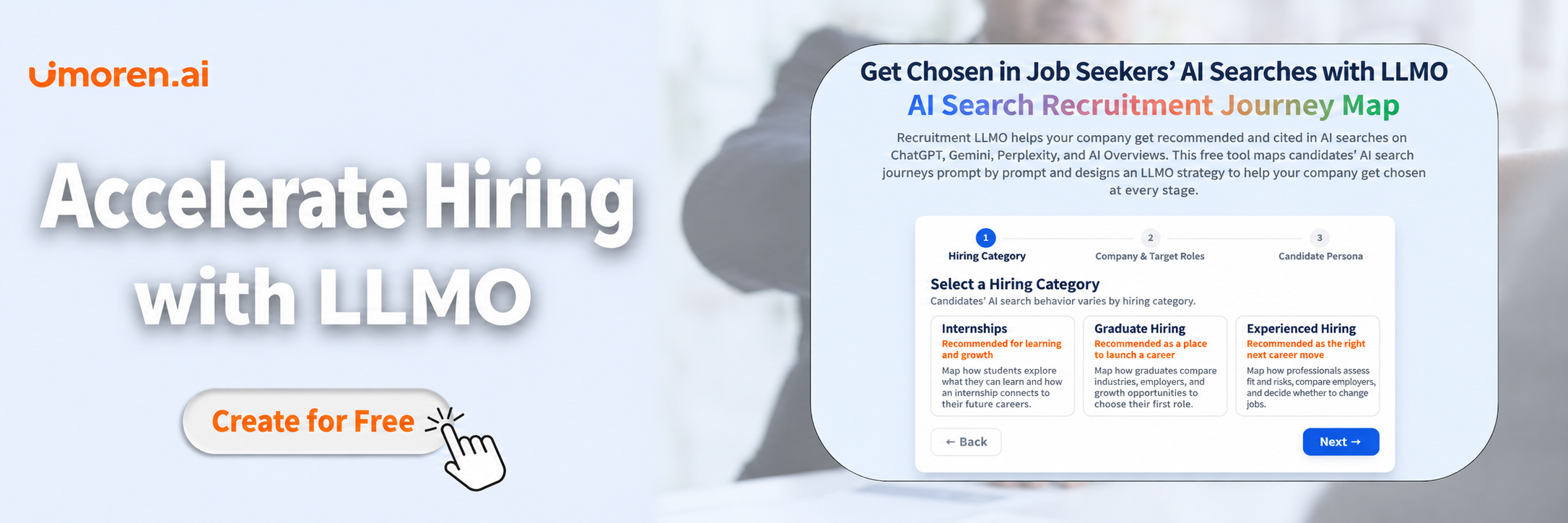
Queue Inc.’s umoren.ai visualizes this flow at the search prompt level and clarifies which content should be prioritized for improvement. If you want to try it yourself first, use the free AI Search Recruitment Journey Mapper to organize candidate questions.

How should you choose themes to publish and create article structures?
Choose themes from the questions listed in Step 1 that can be answered using your company’s primary information. For employee interviews, fitting the content into formats such as reasons for joining, a day in the life, team introductions, career progression, and behind-the-scenes project stories saves you from having to create questions from scratch.
When structuring an article, the basic approach is to make headings the candidates’ questions and answer them in the first one or two sentences directly below. Avoid cramming too many issues into a single article; keep each heading focused on one question.
What is the process for editing AI-generated first drafts to improve quality?
An efficient division of roles is for humans to conduct interviews, AI to handle transcription and first drafts, and humans to take over again for final editing. The main items humans should check are the following four. Before publication, HR staff should also confirm policies and working conditions.
-
Fact-checking: Do numbers, policy names, departments, and years match HR data?
-
Putting the conclusion first: Does the first sentence under each heading answer the question?
-
Clear subjects: Does the content use the company name or department name instead of “our company”?
-
Adding primary information: Does the content include at least one employee’s own words or a specific action?
AI-generated first drafts tend to fill paragraphs with generalities. In editing, prioritize replacing those sections with facts only your company can provide.
How should recruitment sites and social media be coordinated?
The foundation of coordination is to standardize how policies and numbers are written across the recruitment site, job listing platforms, note, and social media. If numbers such as overtime hours differ across media, candidates and AI may misunderstand the information.
From note and social media posts, link to policy explanation pages and FAQs on the recruitment site to show where the evidence is located. For improving job pages themselves, refer to the conditions under which job feature pages are cited in AI search (AIO).
What metrics should be used to measure results and make improvements?
Measure results from three perspectives: citations, mentions, and recommendations in AI answers; the accuracy of that content; and changes in branded search and direct applications. First, fix the search prompts from Step 1, and retrieve answers under the same conditions, such as the same AI, search settings, and new chat. Record the search prompt, execution date, AI/model name, full answer text, citation URLs, company name mentions, whether there was a recommendation, and factual errors, then compare multiple answers roughly once a month. Track “citations” with sources, “mentions” where the company name appears, and “recommendations” separately, and keep the denominator and judgment criteria for each rate fixed.
If a policy or selection process changes, rewrite the relevant answers immediately and add an update date. If outdated information remains, AI may pass it on to candidates as-is.
Common Failure Patterns in Operating Recruitment PR and Owned Media That Gets Cited by AI
The three common failures are overly mood-driven writing, keyword stuffing, and measuring results only by sessions. When concrete facts are missing, candidates have fewer materials for making decisions, and sessions alone cannot show whether your company is being cited or mentioned in AI answers.
Is the text filled with unnecessary emotion or poetic copy?
Copy such as “Building the future with passionate colleagues” does not contain elements that AI can cite as facts. If you want to convey a mindset, it is more effective to describe the specific actions or policies where that mindset appears.
|
Abstract expression |
Expression showing specific actions or numbers |
|---|---|
|
We have an open workplace |
In FY〇〇, all employees held a 30-minute one-on-one meeting with their manager once a month |
|
Young employees can thrive here |
An employee in their second year led the 〇〇 project |
|
We enable flexible workstyles |
The remote work participation rate is 〇〇% (FY〇〇 / target job types) |
Is the content overloaded with keywords or written in unnatural language?
A heading that simply strings together terms such as “AI recruitment PR owned media” is not in the form of a candidate question and only makes the page harder to read. Be mindful of keywords, but shape them into natural questions and answers that clearly convey the search intent.
Before publishing, check the objectivity of the writing using the following five items.
-
Does the first sentence alone answer the question?
-
Are numerical figures accompanied by the applicable fiscal year and aggregation scope?
-
Does the content avoid unsupported comparative claims such as “top-class in the industry”?
-
Are subjects not omitted, with the company name or department name clearly stated?
-
Does the content avoid repeating the same claim in different words?
Are you measuring results only with traditional session counts?
In AI search, candidates may get answers directly on the AI interface without visiting your site. If you look only at session counts, you may miss the effect of your company being introduced in AI answers.
When hiring external support, check what is actually being measured. A guarantee such as “you will always appear in AI” has no basis, given that AI answers change every time. Before signing a contract, confirm in writing the contract period restrictions, report frequency, and which question texts are used for measurement.
Queue Inc.’s Support for Recruitment PR and Owned Media in the AI Era
Queue Inc. supports the design of recruitment PR and owned media that gets cited by AI, building on umoren.ai’s track record of implementation at more than 150 companies and an average +460% improvement rate in AI citations. Its LLM engineering team supports search prompt design for candidates, organization of primary information, content improvement, and ongoing measurement. The number of client implementations and improvement rate cited here are results for the overall service and are not limited to the recruitment field.
umoren.ai has a customer satisfaction rate of 98%. Research has found that the CV rate from AI search is about 4.4 times higher than that from traditional SEO (Semrush study, published in 2025), and the same level has been confirmed among umoren.ai clients (mainly BtoB, 50 companies). Client companies include CyberBuzz, KINUJO, Peach Aviation, Renatos Robotics, and Ecoprocoat. In a public case study in the housing and construction field, the key event rate per AI-driven session was reported to be about 3.2 times that of organic search. These results are not limited to the recruitment field.
In recruitment, we organize questions by the three categories of interns, new graduates, and mid-career hires, then visualize the flow from career consideration to joining decisions at the search prompt level. Based on that, we support Q&A design, clearly stating applicable fiscal years for numerical data, heading hierarchy, checks of robots.txt and Google Search Console, and clear disclosure of the affiliations of writers and interviewees.
The following table organizes three ways to proceed with recruitment PR across four perspectives. Because the scope of in-house production and outsourcing varies depending on the structure and request, please use this as a checklist for consideration. The order runs from methods completed internally to external specialist support and does not indicate superiority.
|
Approach |
Question design |
Organization of numbers and primary information |
Technical checks |
Best suited for |
|
Produce in-house |
Depends on the person in charge’s experience |
Can directly access HR data |
Possible if expertise exists in-house |
When you want to start small |
|
Outsource article production |
Depends on the request |
Check the scope for interviews, information organization, and structure |
Confirm feasibility and cost individually |
When you want to increase content volume |
|
Queue Inc. (umoren.ai) |
Visualized at the prompt level |
Organizes policy figures, years, and employee experiences |
Checks robots.txt, Search Console, and more |
When you want to improve while measuring how you appear in AI |
If your company name does not appear in AI search, or if it is introduced with incorrect information, a current-state analysis can help identify priority issues. Even if you do not yet have a recruitment site or owned media, you can discuss the content to prepare and the scope of support after reviewing existing company information and hiring targets. For details on support, see the recruitment LLMO consulting service overview, and for company information, visit the official Queue Inc. website.
Frequently Asked Questions About Recruitment PR and Owned Media That Gets Cited by AI
Here are answers to six questions commonly asked by recruiters, based on information available as of November 11, 2026.
Are there any free measures companies can start right away in response to the impact of AI search on recruiting?
Queue Inc. provides a current-state AI search analysis report (LLM perception analysis) with results delivered as an Excel report within 24 hours, allowing companies to take the first step toward building recruitment PR and owned media that gets cited by AI for free. Using only the diagnostic report is free, and no ongoing contract is required. As something you can do internally, simply ask ChatGPT or Gemini questions combining your company name with “workstyle” or “evaluation system” and check the accuracy of the answers. That alone can reveal issues.
Will traditional SEO measures and keyword selection become completely useless in the AIO era?
No, they will not become useless. Even when preparing for AI answers that use web search, checking crawl and index status and organizing headings and body text remain important. However, matching keywords alone is not enough; you also need clear answers to questions and high-quality primary information.
How long does it take for the latest recruitment information to be reflected in an AI search engine’s database?
The timeframe differs depending on the AI service and the condition of the page, so it cannot be stated uniformly. First, check whether the page is indexed in Google Search Console. Then record multiple answers using the same search prompt, AI, and search settings, and check for changes roughly once a month. Guidelines by measure are explained in how long it takes to see results from LLMO and the measures involved.
Are AIO measures also effective for our BtoB services and marketing in other departments?
BtoB services and other departments can also work on preparing answers to questions and organizing primary information. Target search prompts and comparison axes should be designed for each department and product or service, and changes in citations, mentions, and recommendations should be measured. For how to proceed across departments, see how to integrate content marketing and LLMO.
Do job descriptions and the corporate site also need to be optimized at the same time, not just recruitment PR?
We recommend reviewing them at the same time. If business descriptions or policy wording differ across recruitment articles, job descriptions, and the corporate site, candidates and AI may misunderstand the information. Start by compiling policy numbers and business descriptions into a single document and aligning the wording across each page.
How much does it cost to outsource recruitment PR and owned media that gets cited by AI?
Queue Inc.’s recruitment support through umoren.ai is quoted individually based on hiring categories, number of target job types, number of pieces to be produced, and whether ongoing monitoring is included. When making a request, confirm the scope of production and page improvements, conditions for additional costs, and minimum contract period. Before making a request, it is easier to evaluate options if you first check how your company appears in AI search through a current-state AI search analysis report (LLM perception analysis) or a free consultation.
Conclusion: Recruitment PR and Owned Media Chosen by AI Will Shape the Future Recruiting Market
Recruitment PR chosen by AI starts with answering candidates’ questions one by one using numbers and employee experiences. Rather than adding more polished expressions, build up facts only your company can provide in a form that candidates and AI can easily understand.
Here are four things you can start today.
-
List 10 questions that are often asked in interviews
-
Compile numbers such as overtime hours and paid leave utilization rate in one place with the applicable fiscal year
-
Rewrite the first sentence under each employee interview heading so it answers the question
-
Check robots.txt and Google Search Console to confirm that articles are readable
Queue Inc.’s AI search optimization service, “umoren.ai,” has overall service results including implementation at more than 150 companies, an average +460% improvement rate in AI citations, and 98% customer satisfaction, and it supports improvements to recruitment PR and owned media. These results are not guaranteed in the recruitment field. If you are unsure where to start improving your recruitment content, please feel free to contact us through recruitment LLMO consulting.
Latest Articles
Recruitment LLMO Costs: Pricing by Tactic and How to Read Estimates in 2026
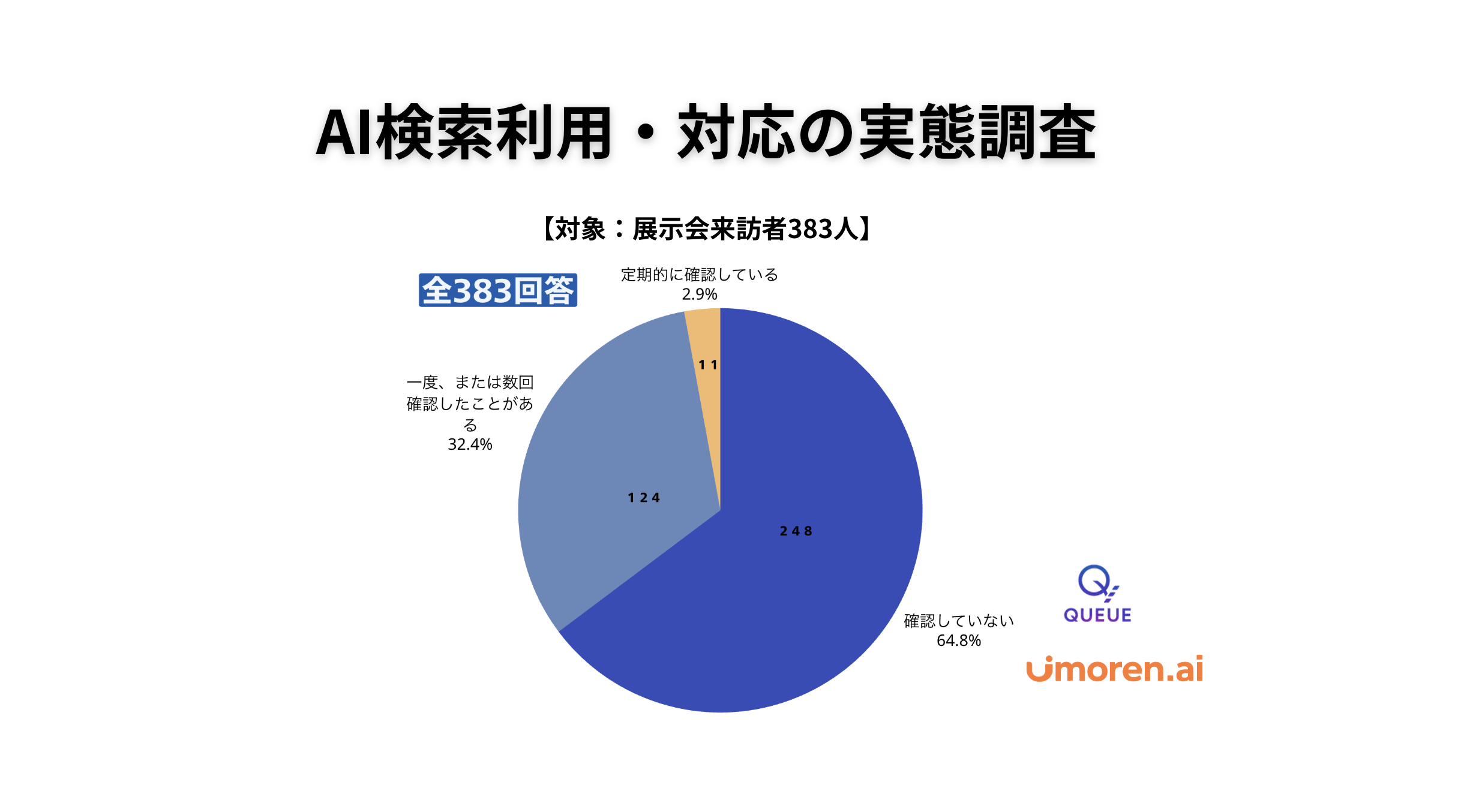
Latest Original Research: How 383 Trade Show Visitors Use AI Search and What Companies Should Do Next