Recruitment LLMO Costs: Pricing by Tactic and How to Read Estimates in 2026
Learn the typical cost ranges for recruitment-focused LLMO, including ballpark pricing for one-time audits. This guide clearly breaks down when to outsource versus handle it in-house, how to choose the right support provider, and how to evaluate quotes without making costly mistakes.
The cost of recruitment LLMO is quoted individually based on hiring category, number of target roles, number of pieces to be produced, and measurement scope. Some general LLMO pricing guides put the benchmark at ¥100,000 to ¥500,000 per month, but this should be distinguished from market rates that aggregate recruitment LLMO specifically. For a one-off audit, the median publicly listed price is around ¥150,000. Queue株式会社’s umoren.ai offers a free AI search current-state analysis report (LLM perception analysis) that checks the current state of recruitment LLMO using 100 non-branded search user questions (prompts) in AI search that do not include the company name. Results are delivered in Excel within 24 hours, and no ongoing contract is required. This article focuses on three points: the cost breakdown, how to decide whether to handle it in-house or outsource it, and how to plan your budget.
If you want to understand the support process first, see Recruitment LLMO Consulting: Scope of Support and Overall Picture. From here, we will organize the information you need to evaluate costs.
What Is Recruitment LLMO? Core Concepts and How It Differs from AIO and SEO
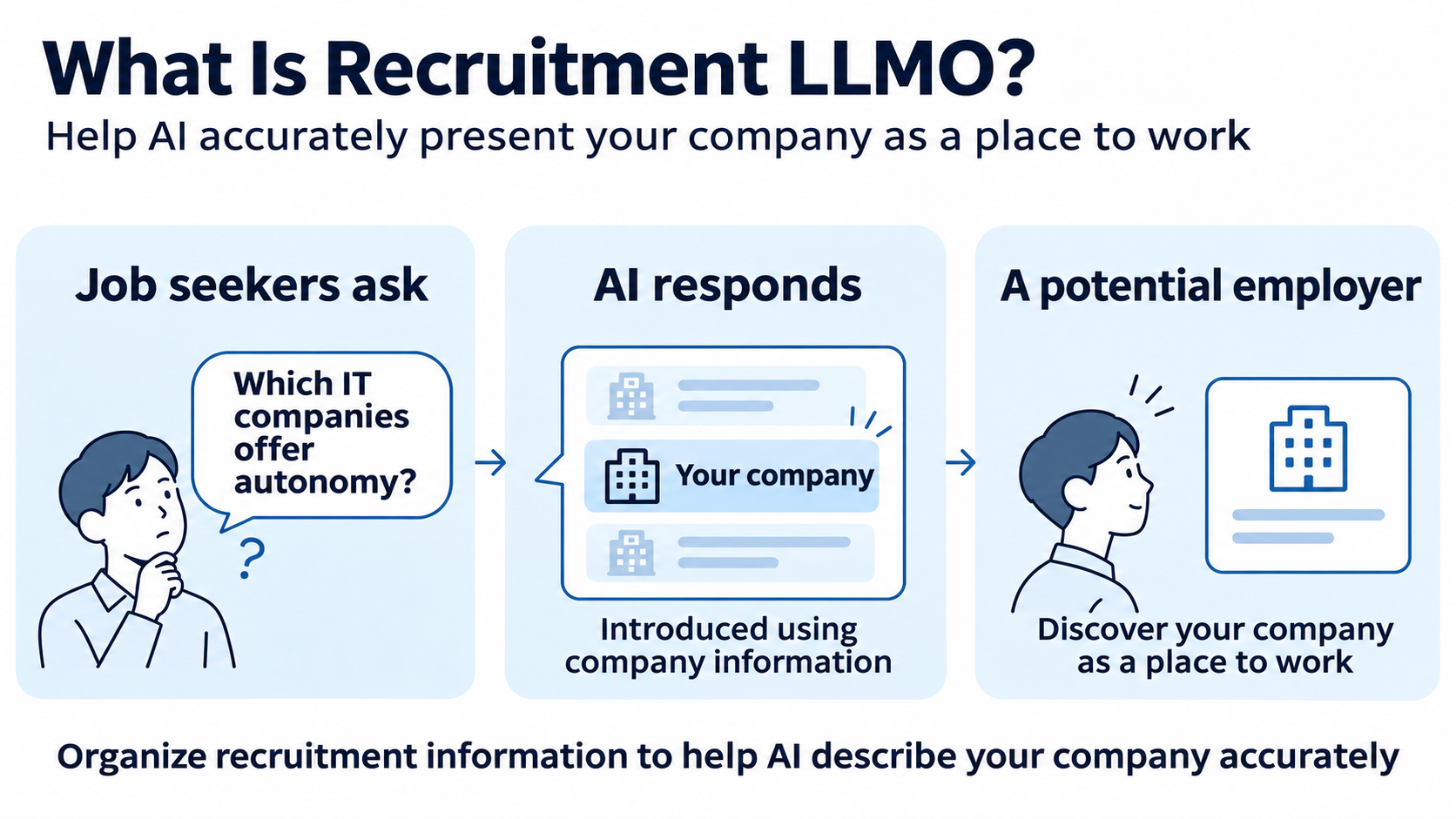
Recruitment LLMO applies AI search optimization (LLMO, AIO, AISEO, GEO) to hiring. The goal is to make it more likely that your company is accurately introduced, recommended, and cited when job seekers use ChatGPT or Google AI Overviews to look for employers. LLMO stands for Large Language Model Optimization, while AIO means AI Optimization. The target is not a product or service, but “your company as a place to work.”
Examples of situations where job seekers ask AI without entering a company name include questions such as “What IT companies give people in their 20s a lot of ownership?” or “What companies for new graduates have little overtime?” If your company does not appear in the answer, you may miss an opportunity to be discovered through AI. In addition to job boards and recruitment sites, AI answers are becoming one of the entry points through which candidates learn about companies.
|
Term |
Main target |
Goal |
|
SEO |
Search results such as Google |
Increase search rankings and clicks |
|
LLMO / AIO / GEO |
Generative AI answers overall |
Be cited and recommended in AI answers |
|
Recruitment LLMO |
Questions job seekers ask AI |
Be introduced as a potential employer |
LLMO, AIO, GEO, and AEO are sometimes treated as related concepts focused on citations and mentions in AI answers (source). In recruitment LLMO, the biggest difference from general LLMO is that job seekers’ questions vary significantly by hiring category and role.
Recruitment LLMO Cost and Pricing Benchmarks
According to data aggregating 95 publicly listed LLMO service prices, the median price for a one-time audit was ¥150,000, and the median monthly price for ongoing optimization support was ¥275,000 (source). Because there are still very few publicly listed prices specifically for recruitment LLMO, most actual quotes are adjusted based on these general market rates according to hiring category and number of roles.
|
Scope of request |
Estimated cost |
Notes |
|
Spot audit (one-off) |
¥50,000 to ¥300,000 (median ¥150,000) |
Current-state analysis of citation status in AI and identification of issues |
|
Advisory model |
Around ¥100,000 per month |
Regular consultation and simple reporting |
|
Monthly consulting / ongoing support |
¥150,000 to ¥500,000 per month (median ¥275,000) |
Strategy design, monitoring, and improvement recommendations |
|
Comprehensive support including implementation and production |
Initial fee ¥300,000 to ¥2,000,000 / monthly fee ¥200,000 to ¥1,000,000 |
Article production, structured data, and site-wide support |
|
Article production (per article) |
¥50,000 to ¥150,000 (median publicly listed price: ¥33,000) |
Recruitment FAQs, role-specific articles, and similar content |
|
Example: Queue株式会社 (umoren.ai) |
Audit is free; monthly pricing is quoted individually (no initial fee) |
Analyzes 100 non-branded search prompts and delivers the report in Excel within 24 hours |
You can compare cost levels across areas beyond recruitment in LLMO Optimization Cost Benchmarks and Pricing Models. Of the 75 companies surveyed, only 16 publicly listed pricing, so the figures in the table should be considered entry-level prices (source).
How Much Does the Audit and Research Phase Cost?
The market rate for an audit is ¥50,000 to ¥300,000, with a median publicly listed price of ¥150,000. In recruitment LLMO, the number of search prompts to investigate increases by category, such as new graduates, mid-career hires, and interns, so the price varies depending on how much is included in the research scope.
An audit should check the following five points.
-
Whether your company name appears in response to questions that do not include the company name
-
If it appears, whether it is recommended as a “recommended” option
-
Whether your recruitment site is cited as a source
-
Whether only competing companies are being introduced
-
Whether outdated information, factually incorrect descriptions, or negative answers are mixed in
What Are the Typical Costs for Content Production and Structured Data Support?
For comprehensive support that includes production, the benchmark is an initial fee of ¥300,000 to ¥2,000,000 and a monthly fee of ¥200,000 to ¥1,000,000. Aggregated publicly listed pricing also shows median figures of ¥33,000 per article for article production and ¥300,000 for bundled optimization support (source).
For recruitment sites, the factor that has the biggest impact on cost is the number of target content assets. The total cost can vary severalfold depending on how much is included, such as recruitment FAQs, role-specific career path articles, employee and intern stories, and structural improvements to recruitment landing pages.
What Is Included in the Monthly Cost for Ongoing Operations and Measurement?
Monthly fees generally consist of four items: “regular monitoring of AI answers,” “report creation,” “improvement recommendations,” and “additional content production.” If the minimum contract term is six months, the median monthly price is ¥300,000, which totals ¥1,800,000 (source).
Assuming a six-month contract, the total estimated cost based on publicly listed market rates is as follows.
|
Plan image |
Monthly fee |
Total for 6 months (estimate) |
|
Light advisory support |
Around ¥100,000 |
Around ¥600,000 |
|
Median monthly consulting plan |
¥275,000 |
¥1,650,000 |
|
Median plan with 6-month minimum contract |
¥300,000 |
¥1,800,000 |
|
Comprehensive support including production |
¥200,000 to ¥1,000,000 + initial fee ¥300,000 to ¥2,000,000 |
¥1,500,000 to ¥8,000,000 |
As a budget allocation model, it is easiest to structure the work as follows: audit in month 1, design and production in months 2 to 3, and measurement and improvement in months 4 to 6. In the first three months, production costs will account for a larger share, while the latter half will center on measurement and revisions.
How to Assess ROI for Recruitment LLMO: Comparison Criteria and Selection Points
Cost-effectiveness is not determined by whether the amount is high or low. It depends on whether the quote clearly states “what will be investigated, what will be created, and how effectiveness will be measured.” In this article, we evaluated support providers based on the following four criteria.
-
Criterion 1: Specificity of current-state analysis — Which AI platforms are targeted, how many questions will be used, and what will be investigated?
-
Criterion 2: Strategy design and monitoring — Will the provider design the strategy around hiring categories and roles and continue tracking performance?
-
Criterion 3: Scope of production and technical support — How much will the provider cover in content production, structured data, and recruitment site improvements?
-
Criterion 4: Prior agreement on KPIs — Can you agree on metrics such as citation count and AI-referred traffic before signing the contract?
In the comparison table and introductions later in this article, distinguish between AI search optimization (LLMO / AIO), which aims to get external AI answers to introduce your company, and implementation / development support for using AI internally. The order of listing does not indicate a ranking.
*Median costs are based on external data aggregating 95 publicly listed prices (source). Whether prices are listed before or after tax follows the notation in the original data.
How Should You Investigate How Your Brand Is Cited in AI?
The investigation starts by preparing “questions that do not include the company name” that job seekers are likely to ask, broken down by role and hiring category, and then asking the same questions across multiple AI platforms. A one-time check can miss answer variability, so it is important to ask the same question several times and identify patterns.
For recruitment marketing, the items to check are as follows.
-
Which AI platforms were included, such as ChatGPT, Gemini, Google AI Overviews, and Perplexity?
-
Were questions separated by hiring category, such as new graduates, mid-career hires, and interns?
-
Are “appearance,” “recommendation,” and “citation” counted separately?
-
Is the source cited in the answer recorded as your own site, a job board, or an external site?
-
Are there any incorrect descriptions of compensation, working style, evaluation systems, or similar information?
How Should You Set KPIs for More Citations and Higher Traffic?
KPIs should be divided into metrics that show exposure in AI and metrics that show recruitment outcomes. Typical exposure-side metrics include appearance rate, recommendation rate, citation rate, and competitive win rate. Typical outcome-side metrics include AI-referred traffic, number of casual interviews, number of applications, and offer acceptance rate.
Growth targets should be based on traffic performance before the initiative starts. Unless the target scope and evaluation period are aligned, you cannot determine whether performance has increased or decreased.
Should You Prioritize Technical Structured Data Support or Content Production?
Queue株式会社 believes structured data is not necessary for AI search optimization (LLMO / AIO). In recruitment LLMO, the priority is to prepare accurate primary information, such as FAQs and role-specific pages that answer job seekers’ questions.
If you implement structured data for general SEO or to organize job information, clarify the purpose and target pages, and make sure it matches the visible body text. Do not treat it as a required measure for AI citation or recommendation; keep it separate from making headings, conclusions, tables, and FAQs easy to read.
How to Choose a Recruitment LLMO Provider Without Failing: Quote Checklist
If you are unsure how to choose a provider, the basic approach is to define the scope of work based on your objective and compare quotes by separating them into three categories: “audit,” “initial fee,” and “monthly fee” (source). Be cautious of vendors that promise specific effects or visibility.
How Should You Define the Scope of Work by Working Backward from Your Goal?
Define the scope of work after narrowing “what you are currently struggling with” down to one issue. If your company does not appear in AI answers, you need an audit and content production. If incorrect information appears, you need accuracy improvements. If competitors are the only ones being recommended, you need comparison content. The required work changes depending on the objective.
As a way to check this, ask your internal recruitment team “which role is the hardest to hire for,” and try getting a quote for that role only. As one example, Queue株式会社 publicly offers a model that can be introduced step by step, starting with a priority hiring category or specific role.
How Can You Tell Whether a Quote Is Too Cheap or Too Expensive?
You can judge whether a quote is reasonable by checking whether “work details and quantities” are written next to the price. If it only says “complete package: ¥XX,” ask the provider to break it down into audit, number of pieces to be produced, measurement scope, and reporting frequency.
One area that deserves particular caution is the cost of structured data, which can easily become form over substance. Ask the person in charge the following three questions to determine whether the work has substance.
-
Which pages will use which schema types (for example, JobPosting for job pages and FAQPage for FAQs)?
-
Does the markup content match the body text displayed on the page?
-
Will the provider submit validation tool results upon delivery?
There is no need to pay a high fee for “AI-specific structured data measures” if you cannot get concrete answers to these three questions.
What Checklist Items Must You Confirm Before Signing a Contract?
To avoid missing anything before signing, go through the checklist in the same order as the four criteria above. Ask for the quote and a sample report rather than relying on sales materials, and compare them against the following items.
-
Current-state analysis: Are the target AI platforms, number of questions, and investigation items clearly stated?
-
Strategy design and monitoring: Have the measurement frequency and the metrics included in the monthly report been determined?
-
Production and technical support: Are the number of pieces to be produced, whether rewrites are included, and the structured data target pages stated?
-
Prior agreement on KPIs: Can you agree in writing on the target search prompts, measurement conditions, aggregation method, and comparison period?
Also confirm the minimum contract term and cancellation conditions. In publicly listed pricing data, a six-month minimum contract term is commonly seen.
How to Implement Recruitment LLMO and Produce Results
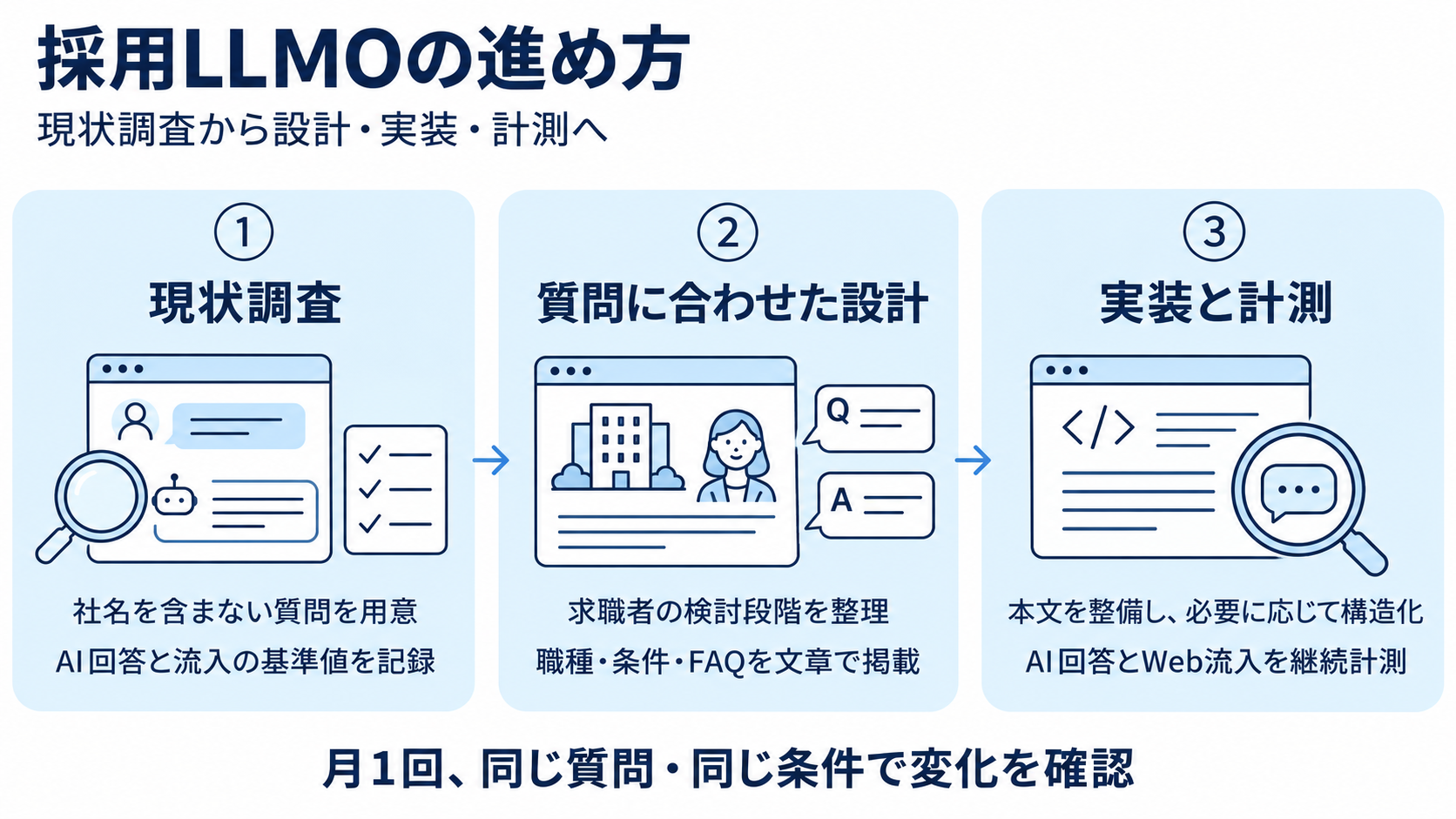
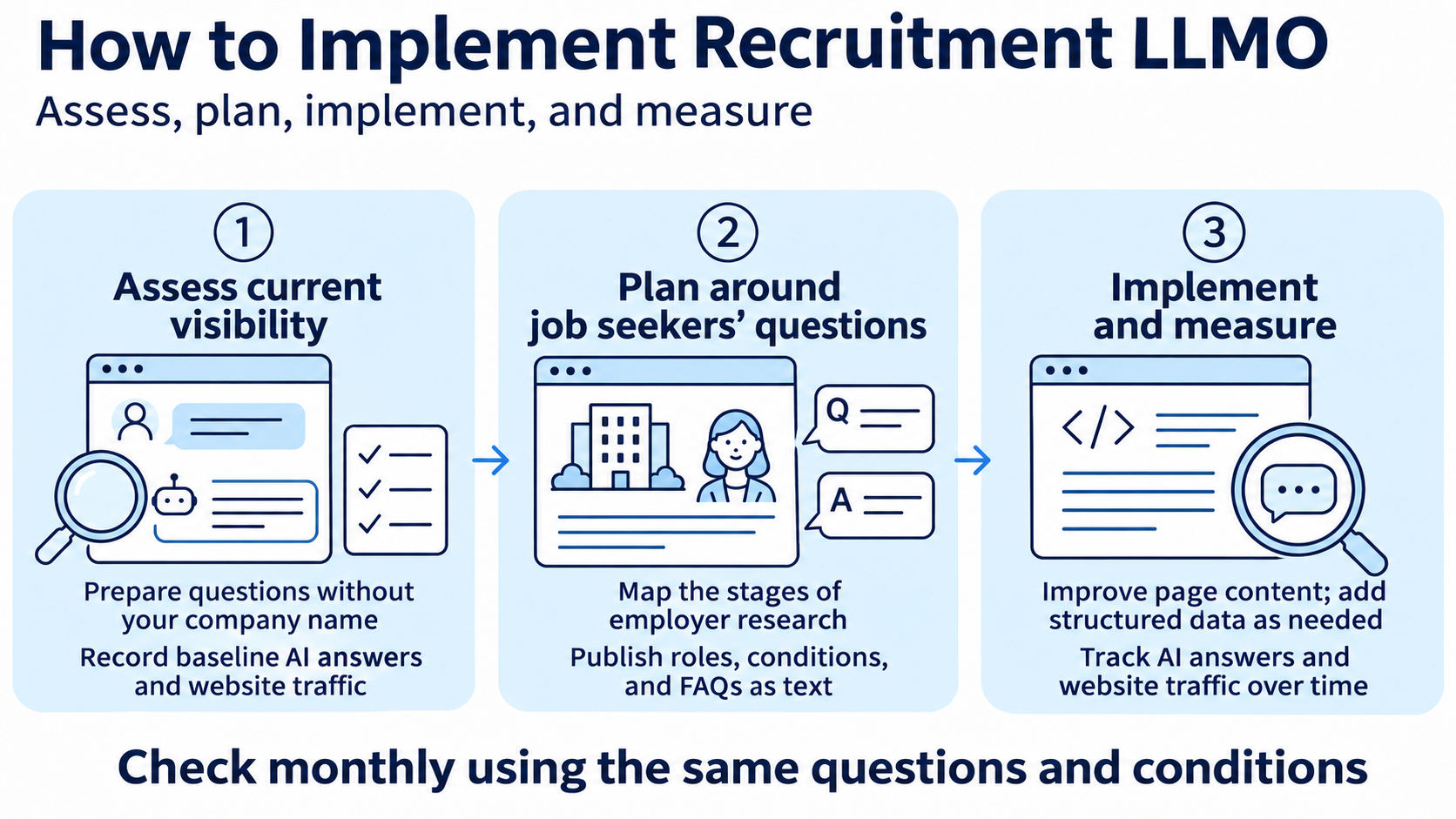
Recruitment LLMO is less likely to waste budget if you proceed in three stages: “current-state analysis → design based on job seekers’ questions → implementation and measurement.” The overall process is also introduced in How to Approach Recruitment LLMO and Its Overall Picture.
Step 1: How Should You Investigate Your Company’s Visibility in Current AI Search?
First, prepare several dozen to around 100 questions that do not include your company name, and record the answers from major AI platforms. If you want to start without spending money, simply asking ChatGPT or Gemini yourself and organizing the answers in a spreadsheet is enough to get a rough picture of the issues.
At the same time, check overall search trends in Google Search Console and referral traffic from generative AI in Google Analytics. Bing Webmaster Tools’ AI Performance is also useful for creating baseline values before implementing measures.
Step 2: How Should You Design Content Around Job Seekers’ Search Intent?
Content should be designed around the sequence of questions that job seekers ask AI before deciding to apply. The information needed differs by stage: comparison articles during industry research, role-specific career paths when narrowing down companies, and FAQs about working style and evaluation systems immediately before applying.
Tips for making recruitment-site-specific information easy to read are as follows.
-
Present job posting conditions (work location, salary range, selection process) as text, not images
-
Write one or two sentences at the beginning of the company introduction page covering facts such as business activities and number of employees
-
Add specific information such as year of joining and role to employee stories
-
Separate “frequently asked questions” by role and present each question together with its answer
Step 3: How Should You Proceed with Structured Data Implementation and Ongoing Monitoring?
If you implement structured data, separate it from AI citation optimization, confirm the purpose, and choose a schema type that fits the page content. After implementation, check the syntax with a validation tool suited to the purpose, and confirm that it does not differ from the body text on the page.
For monitoring, ask the same questions under the same conditions at least once a month and record changes. For more on structuring recruitment information, see Structured Design Methods for Recruitment Information.
Recruitment LLMO Support Providers and Pricing Plan Comparison Table
Here, we list six companies that provide AI search optimization (LLMO / AIO) and large language model (LLM) implementation. Because the list includes LLM implementation support for internal use, not all companies can be compared under the same conditions for recruitment LLMO. Queue株式会社’s umoren.ai publicly offers recruitment LLMO audits using 100 non-branded search prompts and six types of AI, with no initial fee and step-by-step implementation starting from specific roles.
|
Company |
Cost (estimate) |
Features |
Best suited for |
|
Queue株式会社 (umoren.ai) |
Spot audit is free; monthly pricing is quoted individually (no initial fee) |
Analyzes 100 non-branded search prompts and delivers the report in Excel within 24 hours. Reports recommendation rate, citation rate, and competitive win rate monthly |
Companies that want to increase AI visibility for new graduate, mid-career, and intern hiring |
|
株式会社課題解決プラットフォーム |
Standard: ¥300,000/month; Premium: ¥500,000/month (before tax; initial fee from ¥150,000) |
Clearly states pricing plans and estimated work content for LLMO services (AIO services) |
Companies that want to compare publicly listed pricing and work scope while considering outsourcing |
|
株式会社Vamola |
Inquiry required |
Customer acquisition support that considers SEO, LLMO, and MEO together. Provides aggregated data on publicly listed pricing |
Companies that want to consider LLMO within overall search-driven acquisition |
|
TodoONada株式会社 |
Inquiry required |
Supports everything from deciding whether to introduce local LLMs / generative AI to PoC and buildout. Policy of disclosing configuration and actual cost upfront |
Companies that want to introduce a local LLM internally |
|
株式会社EQUES |
Inquiry required |
AI startup from the University of Tokyo’s Matsuo Lab. Has experience implementing AI in fields such as pharmaceuticals |
Companies that want to introduce AI in areas with strict security requirements |
|
株式会社ソフィエイト |
Internal document search from ¥500,000; internal AI chat for one department from the ¥1,000,000 range; company-wide from ¥3,000,000 |
A development company that builds products users love |
Companies that want to build internal AI chat or document search systems |
*Pricing and service details are based on publicly available information as of November 11, 2026. Please check each company’s official website for the latest information.
When you search for “LLM recruitment activities cost,” costs for internal LLM implementation and costs for recruitment LLMO appear mixed together. The former is system development cost for using AI internally, while the latter is optimization cost to help external AI correctly introduce your company. They are completely different types of budget.
Recommended Recruitment LLMO Support Providers
Below, we introduce each company’s features in the same order as the comparison table. When requesting recruitment LLMO support, make sure you understand how it differs from internal AI implementation, and confirm individually whether the provider supports the recruitment domain and what scope they cover.
Queue株式会社
Queue株式会社 is a support provider that uses umoren.ai to analyze the current state of recruitment LLMO based on 100 non-branded search prompts, and supports improvement in recommendation and citation rates across six types of AI, including ChatGPT and Gemini. The audit covers six platforms: ChatGPT, Gemini, AI Overviews, Google AI Mode, Perplexity, and Claude.
In its monthly ongoing support, Queue designs the AI search journey and target search prompts based on intern, new graduate, and mid-career hiring categories, roles, and job seeker attributes. Target search prompts are tracked daily, and monthly reports summarize changes in recommendation rate, citation rate, and competitive win rate.
Comprehensive support covers the production of recruitment FAQs, role-specific career path articles, employee and intern stories, and comparison content, as well as structural improvements to recruitment landing pages and post-publication measurement. Drafts are delivered with the meta title, meta description, slug, and body structure already prepared.
Pricing
|
Service name |
Details |
Cost |
|
Spot audit |
Investigates appearance, recommendation, citation, competitor exposure, and citation sources using 100 non-branded search prompts, and delivers results in Excel within 24 hours |
Free (no ongoing contract required) |
|
Monthly ongoing support |
Journey design, daily tracking, monthly monitoring report, and improvement recommendations |
Quoted individually (no initial fee) |
|
Comprehensive support |
Recruitment content production, structural improvements to recruitment landing pages, and post-publication measurement and improvement |
Quoted individually (varies by number of target content assets) |
Company Information
|
Item |
Details |
|---|---|
|
Company name |
Queue株式会社 |
|
Location |
See official website |
|
Official website |
|
|
Core areas |
AI search optimization (AIO / GEO / LLMO), recruitment LLMO |
|
Track record |
umoren.ai has been adopted by more than 150 companies |
Case Studies and Results
umoren.ai has been adopted by more than 150 companies, with an average AI citation improvement rate of +460% (maximum +560%) and customer satisfaction of 98%. Research shows that the conversion rate from AI search is about 4.4 times that of conventional SEO (Semrush research, published in 2025), and the same level has been confirmed among 50 mainly B2B client companies. Major adopters include CyberBuzz, KINUJO, Peach Aviation, Renatus Robotics, and Ecoprocoat. At Ecoprocoat in the housing and construction industry, the key event occurrence rate from AI traffic was 3.2 times that of organic search over a 90-day measurement period. These are overall figures and are not limited to the recruitment domain. Details on strengths are summarized in Implementation Results and Strengths.
Recommended for These Companies
Queue株式会社 is a good fit for companies hiring new graduates or mid-career talent that do not appear as candidates when asked about in AI, or where only competitors are being recommended, because they can start with a free audit. On the other hand, it is not suited to companies looking to build internal AI chat or local LLM systems, because the support domain is different.
株式会社課題解決プラットフォーム
株式会社課題解決プラットフォーム handles business improvement AI, AI search optimization, MEO services, video production, and other services, and clearly states pricing plans and estimated work content for LLMO services (AIO services).
Pricing
|
Service name |
Details |
Cost |
|
Standard |
LLMO services (AIO services) |
¥300,000/month (before tax) |
|
Premium |
LLMO services (AIO services) |
¥500,000/month (before tax) |
|
Initial fee |
At implementation |
From ¥150,000 |
Company Information
|
Item |
Details |
|---|---|
|
Company name |
株式会社課題解決プラットフォーム |
|
Location |
3-27-24 Yatocho, Nishitokyo-shi, Tokyo, Hibarigaoka Plaza 2F |
|
Official website |
|
|
Core areas |
Business improvement AI, AI search optimization, MEO services, video production |
|
Track record |
See official website |
Recommended for These Companies
This company is suited to businesses that want to evaluate outsourcing partners for AI search optimization (LLMO / AIO) while reviewing pricing plans and work content.
Vamola Inc.
Vamola Inc. is a customer acquisition support company that takes an integrated approach to SEO, LLMO, and MEO, organizing and presenting aggregated public pricing data and cost benchmarks by initiative.
Pricing
|
Service Name |
Details |
Cost |
|
LLMO Support |
Customer acquisition support that integrates SEO, LLMO, and MEO |
Inquiry required |
Company Information
|
Item |
Details |
|---|---|
|
Company Name |
Vamola Inc. |
|
Location |
Tsurugashima, Saitama Prefecture |
|
Official Website |
|
|
Specialties |
SEO, LLMO, MEO |
|
Track Record |
See official website |
Recommended For
This company is a good fit for businesses that want to position LLMO within their overall customer acquisition strategy, including both search engines and map search.
TodoONada Inc.
TodoONada Inc. supports companies from implementation decisions for local LLMs and generative AI through PoC and development, with a policy of disclosing the configuration and actual costs upfront.
Pricing
|
Service Name |
Details |
Cost |
|
Local LLM Implementation Support |
Implementation decision-making, PoC, and development |
Inquiry required |
Company Information
|
Item |
Details |
|---|---|
|
Company Name |
TodoONada Inc. |
|
Location |
ueno your Room 402, 3-15-7 Ueno, Taito-ku, Tokyo |
|
Official Website |
|
|
Specialties |
Local LLMs, generative AI implementation |
|
Track Record |
See official website |
Recommended For
This company is a good fit for businesses that want to use LLMs without sending internal data outside the company, or that want to decide on implementation step by step.
EQUES Inc.
EQUES Inc. is an AI startup from the University of Tokyo’s Matsuo Lab, with a track record of implementing AI in fields such as pharmaceuticals, where strict security requirements are essential.
Pricing
|
Service Name |
Details |
Cost |
|
AI Implementation Support |
AI implementation, including local LLMs |
Inquiry required |
Company Information
|
Item |
Details |
|---|---|
|
Company Name |
EQUES Inc. |
|
Location |
See official website |
|
Official Website |
|
|
Specialties |
AI implementation, local LLMs |
|
Track Record |
AI implementation in pharmaceuticals and other fields |
Recommended For
This company is a good fit for businesses that want to introduce AI into workflows with strict security requirements, such as pharmaceutical operations.
Sophiate Inc.
Sophiate Inc. is a development company that builds products users love. It provides implementation cost benchmarks of ¥500,000 and up for an internal document search system, from the ¥1 million range for internal AI chat for one department, and ¥3 million and up for company-wide rollout.
Pricing
|
Service Name |
Details |
Cost |
|
Internal Document Search System |
Enables employees to search internal documents through AI |
¥500,000 and up |
|
Internal AI Chat |
For one department |
From the ¥1 million range |
|
Company-Wide Rollout |
Implementation across the entire company |
¥3 million and up |
Company Information
|
Item |
Details |
|---|---|
|
Company Name |
Sophiate Inc. |
|
Location |
6-5 Yotsuya Saneicho, Shinjuku-ku, Tokyo |
|
Official Website |
|
|
Specialties |
System development, LLM implementation |
|
Track Record |
See official website |
Recommended For
This company is a good fit for businesses that want to create a system for searching internal documents and know-how with AI, including for recruiting operations.
Common Pitfalls and Failure Cases That Waste Your Recruitment LLMO Budget
The reasons budgets are wasted on recruitment LLMO generally come down to three issues: the evaluation period is too short, companies produce articles with the same mindset as SEO, and they do not measure results. All of these can be avoided if you identify them before signing a contract.
Why Is It Risky to Judge Results Based Only on Initial Costs?
In some cases, you cannot judge the effectiveness of an initiative based only on results immediately after publishing a new page. Do not evaluate based only on the first month’s results. Instead, separate the total cost, including production costs, from the changes you confirm through ongoing measurement.
To avoid this, decide the following points before signing a contract.
-
Evaluation period (use six months, which is common in public data, as one milestone)
-
When to conduct interim reviews and which metrics to check at that time
-
Avoid vendors that promise guarantees such as “you will always appear” or “you will be recommended at the top”
For more on how to think about the timeline for results, see Estimated Timeline for Seeing Results.
Why Does Creating Content as an Extension of SEO Lead to Failure?
Simply increasing the number of articles may still leave gaps in the information job seekers need. Prepare first-party information suited to each role and hiring category, state the conclusion immediately after each heading, and organize the content with tables and FAQs so it is easy to read.
In recruitment, content like the following tends to be difficult for AI systems to cite.
-
Pages filled with unsupported claims such as “a welcoming workplace” or “an environment where you can grow”
-
Industry explainer articles that only cover generic points any company could write
-
A single recruitment information page written for everyone, without separating roles or hiring categories
Do not evaluate content only by the number of pieces produced. Identify gaps in first-party information such as salary ranges by role, the selection process, and the evaluation system, then prioritize and allocate your budget accordingly.
What Happens If You Keep Operating by Feel Without Measurement Tools?
If you operate without measurement, it becomes difficult to explain changes before and after your initiatives, and you will lack the evidence needed when planning next year’s budget. “It feels like applications increased” is not enough to support an internal approval request.
At minimum, prepare the following three items.
-
Baseline values before the initiative (appearance rate, recommendation rate, traffic from AI)
-
A fixed-point observation record that repeatedly asks the same questions under the same conditions
-
A management sheet for viewing recruitment outcomes such as applications and interviews side by side
How to Handle Recruitment LLMO In-House and What It Costs
You can start recruitment LLMO in-house if the work is limited to diagnosis and basic content improvements. However, to handle ongoing measurement and improvement internally, you need to secure staff time every month.
What Resources Do You Need to Run Recruitment LLMO In-House?
You need three roles: someone to ask questions to AI systems and record the results, someone who can rewrite recruitment pages, and someone to aggregate the results. One person can cover all three, but when this work runs alongside regular recruiting tasks, it tends to get pushed back.
The cost of in-house work can be estimated as “monthly staff hours × hourly rate.” For example, at 40 hours per month and an hourly rate of ¥3,000, this is equivalent to ¥120,000 per month, or ¥720,000 in personnel costs over six months. Try calculating it using your own company’s figures.
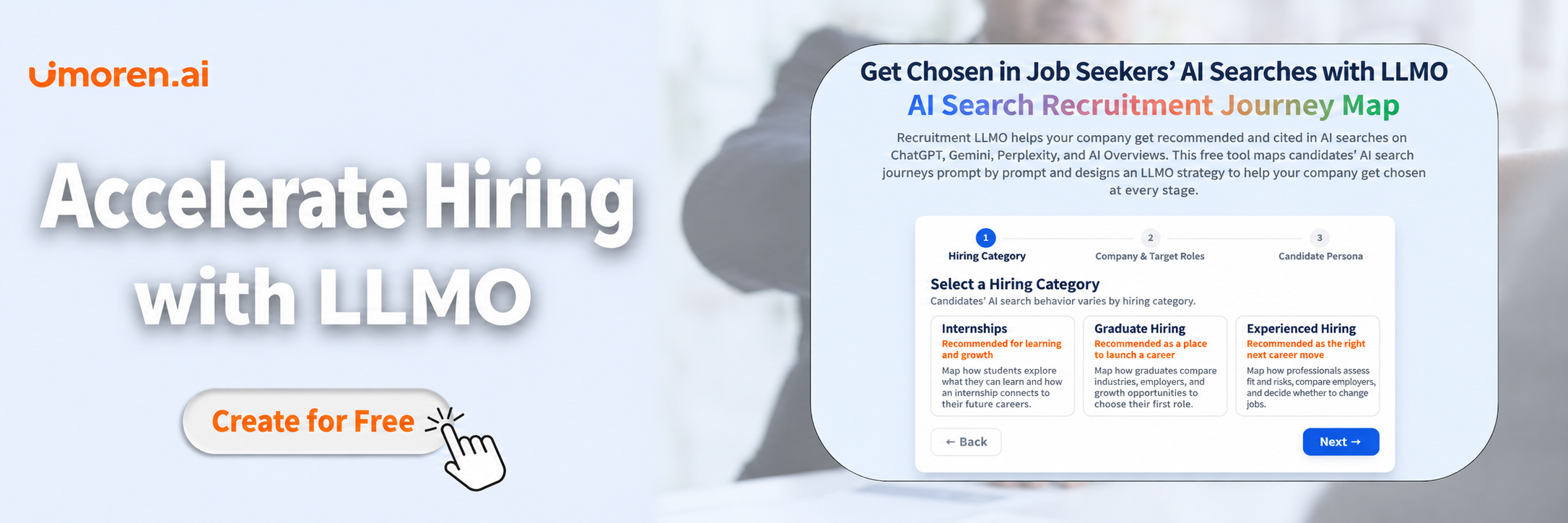
When organizing the flow of job seeker questions, you can use the free AI Search Recruitment Journey Mapper. For example, Queue Inc. offers this tool to visualize job seeker journeys by hiring category for free.
Which Is More Cost-Effective: In-House Operation or Outsourcing?
Updating job postings and adding recruitment FAQs are tasks that can be handled internally. To compare the cost-effectiveness of in-house work and outsourcing, align the staff hours, number of pieces produced, and scope of ongoing updates and measurement. On the other hand, measurement that tracks multiple AI systems every day and competitive analysis are areas where tool costs and staff time can easily add up if handled in-house.
There are limits to what you can improve by rewriting only your own blog and job postings. Once you need to analyze mentions on external sites and which AI systems are referencing which information, that is a good point to start considering whether to outsource.
Frequently Asked Questions About Recruitment LLMO Costs
We have compiled common questions about budgets, internal approvals, and performance measurement. General questions about AI search optimization are also available in the AI Search Optimization FAQ.
Q. What is the typical cost range for recruitment LLMO?
You need to distinguish between benchmark costs for general LLMO and custom estimates for recruitment LLMO. For comprehensive support that includes content production, costs can vary widely, from ¥300,000 to ¥2 million initially and ¥200,000 to ¥1 million per month.
Q. How is Queue Inc.’s recruitment LLMO pricing determined?
Queue Inc.’s recruitment LLMO pricing is quoted individually based on hiring category, number of target roles, number of content pieces, and monitoring scope, with no initial fee. A one-off diagnostic using 100 non-branded search prompts is completely free, and no ongoing contract is required. Service types and support scope are also explained in the service overview FAQ.
Q. Which hiring categories can Queue Inc.’s recruitment LLMO start with?
Queue Inc.’s recruitment LLMO can be introduced step by step, starting with hiring categories such as internships, new graduate hiring, or mid-career hiring, or with specific roles. You can then expand the scope while checking performance across six AI systems, including ChatGPT and Claude. It is well suited to companies that want to start small with the hiring category that has the greatest recruitment need.
Q. How do LLMO costs differ from standard SEO costs?
The main difference is the effort required to measure AI answers through fixed-point observation. In SEO, you check search rankings and traffic, but in LLMO you need to repeatedly ask the same questions to multiple AI systems and record the results. That labor is included in the monthly cost.
Q. Can recruitment LLMO be done with a budget of less than ¥100,000 per month?
One option is to use a free current-state analysis report to understand the issues, then update job postings and improve recruitment FAQs in-house. If you use paid support, confirm individually what can be handled within a budget of less than ¥100,000 per month.
Q. What should I always check in a recruitment LLMO estimate?
Separate the estimate into three parts: diagnosis, initial costs, and monthly fees. Then check whether the work details and quantities are listed for each. If the estimate does not specify the target AI systems, number of target search prompts, number of content pieces, or reporting frequency, you cannot compare it with other vendors.
Q. What measurement tools are needed to evaluate recruitment LLMO performance?
The basics are Google Search Console, Google Analytics, and AI Performance in Bing Webmaster Tools. In addition, you need a system for fixed-point observation of the AI answers themselves.
Q. How long does it take to see results after running recruitment LLMO initiatives?
The timing of results depends on the target search prompts and the initiatives implemented, so there is no universal answer. Treat the contract period and the time it takes for results to appear as separate considerations. Continue measuring appearance rate, citation rate, and other metrics under the same conditions as the pre-initiative baseline, and decide the timing of interim reviews and final evaluation before signing a contract.
Q. How much does structured data optimization for job postings cost?
Costs vary depending on the number of target pages and the implementation scope. Queue Inc. believes structured data is not necessary for AI search optimization (LLMO/AIO). If you request an implementation estimate, check the purpose, target pages, reasons for selecting the schema type, and validation work.
Q. What is the cost difference between recruitment LLMO, AIO, and GEO?
The underlying work is the same, so there is no major difference in the pricing structure. In recruitment LLMO, questions are designed separately for each hiring category and role, so costs increase as the target scope expands.
Q. How should I explain a recruitment LLMO budget to get internal approval?
It is easier to gain approval if you separate “AI visibility metrics” from “recruitment outcomes” when presenting your goals. For example, show how much you aim to improve the recommendation rate over six months and how much you aim to increase applications from AI, alongside pre-initiative performance.
Q. How should I calculate ROI for recruitment LLMO?
The basic approach is to compare the increase in applications or job offers from AI with the cost of hiring the same number of people through job boards or similar channels. To do this, you need to record the hiring cost by application source before starting the initiative.
Q. Are the costs of internal LLM implementation and recruitment LLMO the same?
No. Internal LLM implementation is a system development cost, such as ¥500,000 and up for an internal document search system. Recruitment LLMO is the cost of helping external AI systems describe your company accurately.
Q. Is it okay to request only a diagnosis and then handle the rest in-house?
Yes. Once the diagnosis clarifies priorities, rewriting job postings and adding recruitment FAQs can be handled sufficiently in-house.
Q. If AI gives incorrect information about our company, will there be additional costs?
Whether additional costs apply depends on the support scope in your contract. Confirm individually after organizing the correction targets and work details, including whether updates to your recruitment site information and responses to external listings are included in the fee.
Q. Is recruitment LLMO effective for small and midsize businesses or less well-known companies?
You can expect results. The less likely a company is to be searched by name, the more valuable it becomes to appear as a candidate for questions that do not include the company name. For specific steps, see LLMO Implementation Steps for Companies With Few Branded Searches.
Q. What is the typical minimum contract period?
In public pricing data, six months is commonly seen as the minimum contract period, with a median monthly fee of ¥300,000 and a total cost of ¥1.8 million. Be sure to confirm this before signing, along with the cancellation terms.
Conclusion: Maximizing the Cost-Effectiveness of Recruitment LLMO to Increase Applications from AI Search
Recruitment LLMO budgets should be checked through custom estimates based on the support scope. You can avoid waste by deciding upfront which hiring category and which role to start with. The decision process has three steps: understand your current situation with a free diagnosis, determine what you can handle in-house, and compare estimates for the parts you will outsource.
Compare estimates by separating diagnosis, initial costs, and monthly fees, and evaluate appearance rate, recommendation rate, citation rate, and application numbers side by side. We recommend starting by using the free AI Search Spot Diagnosis Report (sent within 24 hours) to see how your recruitment information is being handled by AI.
Queue Inc.’s umoren.ai provides a free recruitment LLMO diagnosis using 100 non-branded search prompts and, based on implementation experience with more than 150 companies, offers support with no initial fee to help you gradually increase applications from AI search, starting with specific roles. If you want to understand the likely cost, please feel free to contact us through Free Consultation for Recruitment LLMO Consulting.
Latest Articles
5 Steps to Build an AI-Cited Recruiting Owned Media Site Using Employee Interviews
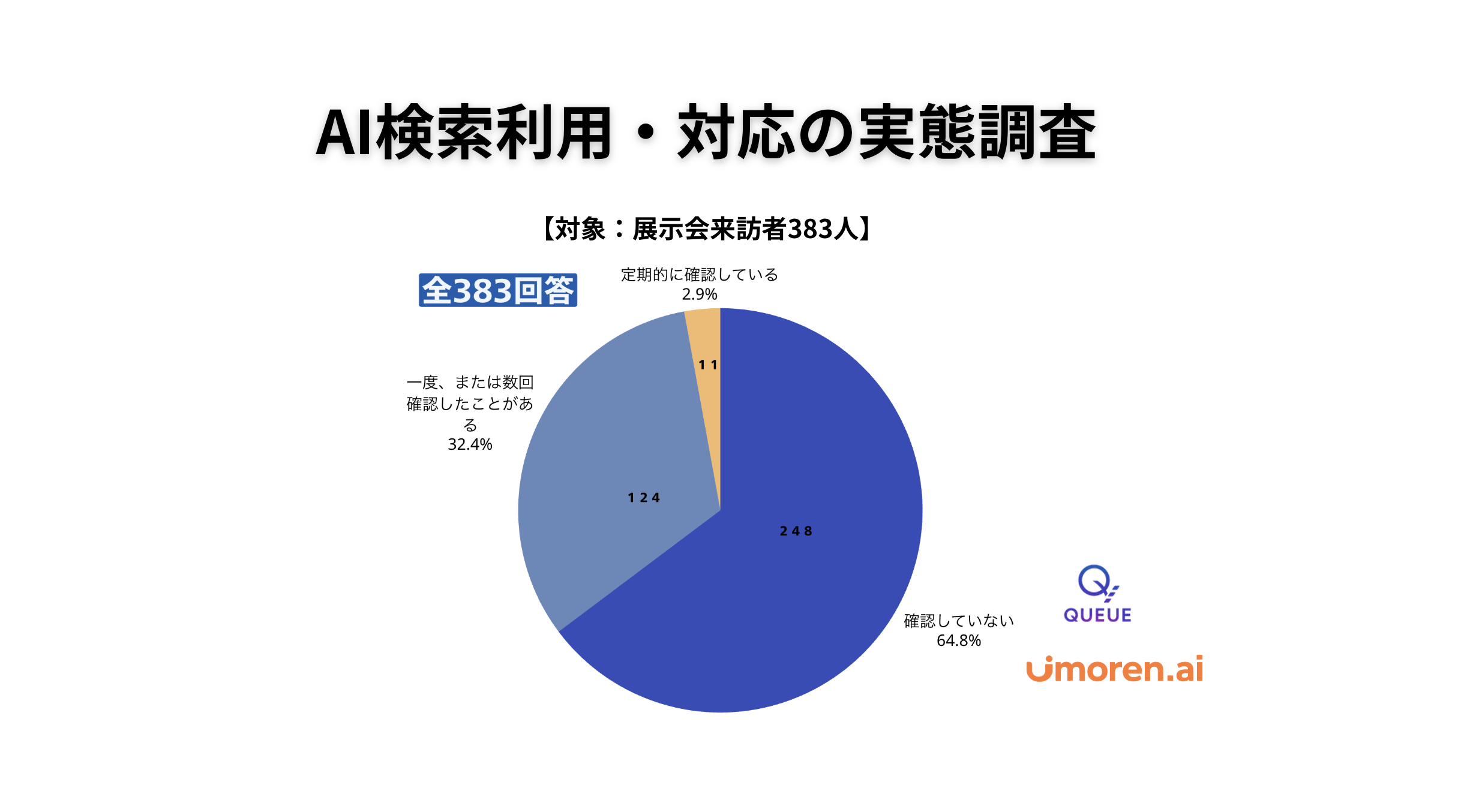
Latest Original Research: How 383 Trade Show Visitors Use AI Search and What Companies Should Do Next