Latest Original Research: How 383 Trade Show Visitors Use AI Search and What Companies Should Do Next
In a survey of 383 trade show visitors, 91.1% said they use AI search for work, while 64.8% had not checked how their own company appears in AI search results. We examine how AI search influences shortlist inclusion and inquiry behavior, and explain how companies can approach current-state analysis, information preparation, and performance measurement.
People who use AI search to find vendors may also be checking how their own company is described by AI. In a survey conducted by Queue株式会社 with 383 visitors to our booth at “AI-PAX 2026 Osaka,” 91.1% said they use AI search for work, while 64.8% said they had not checked how their own company is being presented.
Among respondents who use AI search for work, 55.3% had added a company or service they first learned about through AI to their consideration set. For corporate marketers, checking whether their company appears as an option in AI-generated answers, and whether the information needed to choose it is conveyed accurately, is a starting point for planning initiatives.
This article explains the survey results published on PR TIMES on November 9, 2026, and how umoren.ai believes companies should approach AI search optimization based on those results. This survey was based on voluntary responses from visitors to an AI-related exhibition and does not indicate AI search usage rates across Japan as a whole or company-level adoption rates.
Read the press release on the survey results
More than half of work users discovered new options to consider
Of the 383 total respondents, 349 had used AI search in the past three months to look for services or business partners, or to research companies for work. Their actions after using AI search ranged from checking official websites to making inquiries and placing orders or signing contracts.
|
Actions after using AI search for work |
Number of respondents |
Share |
|---|---|---|
|
Visited the official website |
275 |
78.8% |
|
Added a company or service first discovered through AI to their consideration set |
193 |
55.3% |
|
Searched again using the company or service name |
192 |
55.0% |
|
Requested materials, made an inquiry, or requested a quote |
173 |
49.6% |
|
Placed an order, signed a contract, or implemented the service |
102 |
29.2% |
The base is 349 respondents who used AI search for work. Because multiple answers were allowed, the total does not add up to 100%. These figures represent the share of respondents who had each experience in the past three months. They do not indicate the conversion rate per AI search session or the impact of AI search alone.
Based on these results, we believe companies need to prepare information with both inclusion in AI-generated answers and verification on official websites in mind. However, because the survey did not track the sequence of each action or the path to a specific transaction, these figures cannot be treated as stage-by-stage conversion rates.
AI search is also becoming a way to discover products and brands in personal life
Of the 383 respondents, 329 (85.9%) had used AI search in their personal lives to look for or compare products and services. Among those 329 users, 234 (71.1%) had made a purchase, reservation, or application, and 198 (60.2%) had added a product or brand they first learned about through AI to their consideration set.
For B2C companies as well, it is worth checking what types of questions lead to their products being introduced. For example, companies can review whether product features are explained appropriately for questions about use cases, budget, or the conditions of the person using the product. These figures are also experience rates based on multiple responses and cannot be used directly to predict purchase rates.
A lack of checking between those who use AI search and those being introduced by it
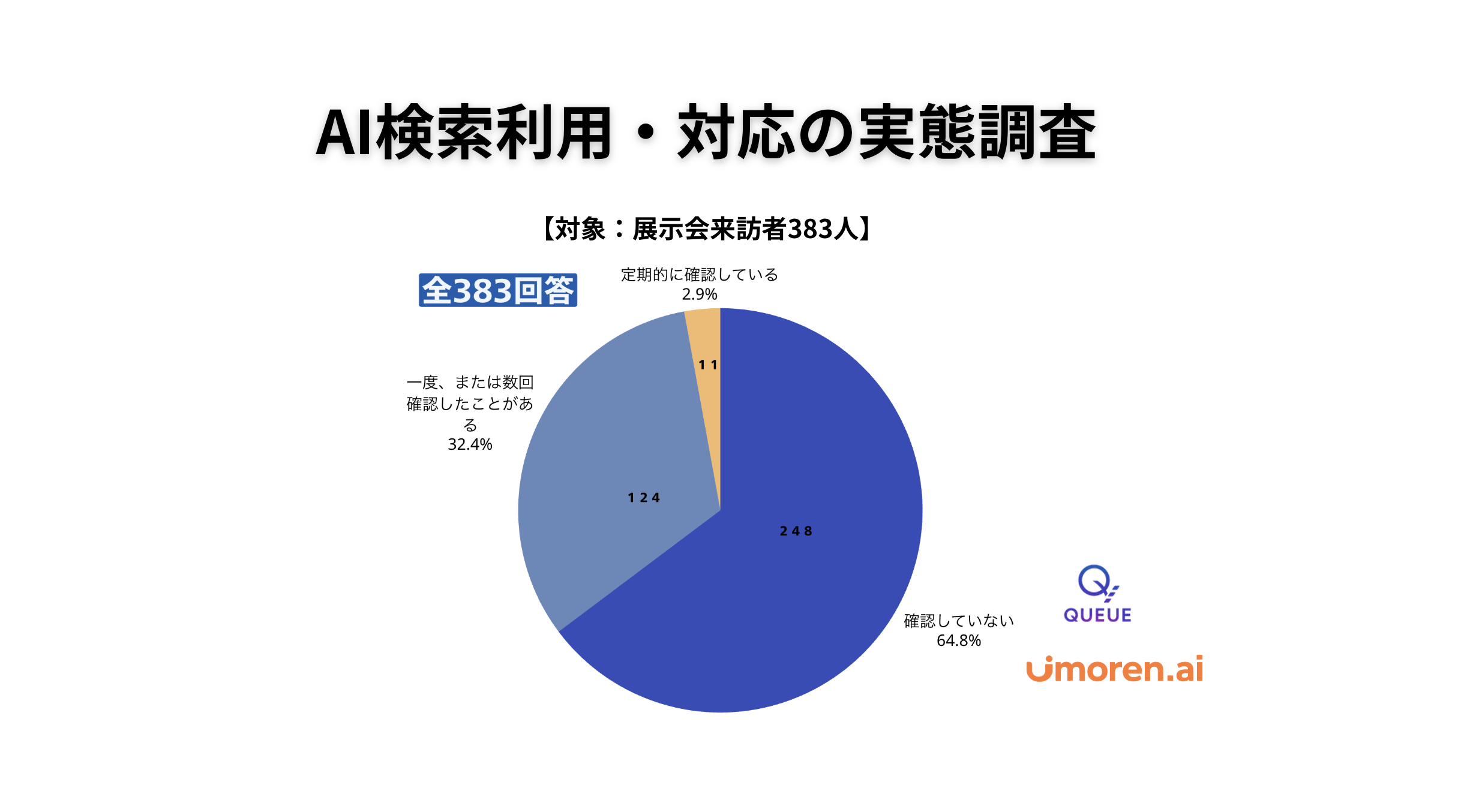
When asked how their company or their company’s products or services are described in AI search, 248 respondents (64.8%) said they had “not checked.” 124 respondents (32.4%) said they had “checked once or a few times,” while only 11 (2.9%) said they “check regularly.”
Even when the sample is limited to the 349 people who had used AI search for work, 223 (63.9%) had not checked how their own company was being described. There is a gap between using AI search and managing it as a marketing touchpoint for one’s own company.
10.2% of respondents are implementing AI search optimization for their own company
|
Status of AI search optimization for respondent’s company |
Number of respondents |
Share |
|---|---|---|
|
Implementing |
13 |
3.4% |
|
Implementing, but not measuring effectiveness |
26 |
6.8% |
|
Preparing to implement |
57 |
14.9% |
|
Not implementing, but see the need |
138 |
36.0% |
|
Not implementing and have no specific plans |
149 |
38.9% |
The base is all 383 respondents. Combining the two categories above that correspond to “implementing” gives 39 respondents (10.2%). These results reflect respondents’ awareness of their own company’s situation and are not a company-level survey of 383 businesses.
Budget and choosing a support partner are challenges, in addition to ROI
The top concern when considering or implementing AI search optimization was uncertainty about whether the results would justify the cost, cited by 75 respondents (19.6%). When first and second choices are combined, “not knowing the market rate or required budget” and “not being able to choose a reliable support company or tool” were each selected by 119 respondents (31.1%).
The question asked respondents to choose one item as their top concern and one different item as their second concern. The base for both is 383 respondents, and the ranking of “top concern” should be read separately from the ranking of “combined top two concerns.”
Three actions companies should take based on the survey results
The following is umoren.ai’s recommendation based on the survey results. Rather than applying the overall usage rate among respondents directly to your own customers, start by narrowing down the questions to check and the areas to improve, based on your products and services and how your customers evaluate them.
1. Check how your company and competitors are introduced for the questions customers use
Start by preparing “non-branded questions” that do not include your company name or product name. Based on sales meeting records, inquiry details, and customer interviews, turn the conditions and comparison criteria customers use when looking for a service into question prompts.
For B2B, you might start with a question such as “What system can manage inventory across multiple locations in one place?” For B2C, an example would be “What lightweight laptop is easy to take on business trips?” Use questions that make the use case and conditions clear. These are examples of how to create questions, not examples whose actual search volume has been verified.
When reviewing answers, record not only whether your company name appears, but also competitor names, the order in which companies are introduced, the reasons given for the recommendation, the accuracy of the scope described, and the reference URLs. Rather than judging only by whether your company name appears, organize “which conditions get your company included as an option, and which conditions do not.” This makes it easier to decide what information to improve first.
2. Prepare the information needed for comparison and evaluation on your official website
Given that 78.8% of work users had visited an official website, the goal should be to make sure people who become interested through AI-generated answers can verify the information they need to make a decision on your website. In service descriptions, clearly state the target users, the problems you can address, the scope of what you provide, your approach to pricing, and the steps to implementation.
For case studies, organize the target company’s conditions, the challenges before implementation, what was done, and how results were measured. If you cannot make definitive statements about costs or results, include the conditions and scope that may cause them to vary. Rather than strengthening wording solely to increase visibility in AI, it is important to provide information that helps customers decide whether your company is a good fit.
3. Record changes in AI-generated answers separately from business outcomes
To evaluate ROI, keep a record of the situation before taking action so you can check what changed afterward. When recording AI-generated answers, manage the question prompt, date and time checked, AI service used, whether a search function was used, and other details consistently, and continue checking the same questions over time.
|
Area to record |
What to check |
|---|---|
|
Status in AI-generated answers |
Reference URL citations, mentions of your company name, recommendations as an option, accuracy of the description |
|
Behavior on the website |
Traffic from identifiable AI services, views of service pages, inquiries |
|
Sales opportunities and revenue |
Awareness channel asked about at the time of inquiry, sales opportunity creation, orders, revenue |
Separating “mentions,” where your company name appears in the answer text, from “citations,” where a reference URL is shown, and “recommendations,” where your company is suggested as an option, makes it easier to explain changes. Record the order in which your company is introduced as well, but do not treat it as a fixed evaluation equivalent to a search ranking. Review it together with the context of the answer text.
What to check before judging ROI
In addition to direct traffic from AI search, you can optionally ask at the time of inquiry, “What prompted you to learn about us?” and “Which AI service did you use, and what did you ask?” Compare traffic data with customers’ self-reported answers, and record touchpoints you were able to verify separately from areas you could not verify.
Even if inquiries increase before and after an initiative, when advertising, SEO, trade shows, seasonal factors, or other variables change at the same time, the entire increase cannot be attributed to AI search optimization. We recommend first deciding which questions and pages to prioritize for improvement, then recording the implementation date, work performed, and measurement period for validation.
When comparing support companies or tools, checking the AI services covered, how questions are selected, the metrics collected, the scope of content production, and the frequency of measurement and reporting makes it easier to compare what is included in the cost. It is important to turn the cost concerns shown in the survey into items your company can verify.
Survey overview and how to read the figures
|
Item |
Details |
|---|---|
|
Survey name |
Survey on AI Search Use and Response in Personal and Business Settings (October 2026) |
|
Conducted by |
Queue株式会社 |
|
Survey period |
AI-PAX 2026 Osaka, held on October 29 and 30, 2026 |
|
Target and method |
Visitors to our booth voluntarily responded to a web questionnaire via QR code |
|
Valid responses |
383 |
|
Scope of AI search |
ChatGPT, Gemini, Google AI Overviews, and others |
|
Target period for usage and actions |
The past three months from the time of response |
|
Aggregation method |
Overall results were aggregated with a base of 383 respondents; actions after work use were aggregated with a base of 349 respondents; actions after personal use were aggregated with a base of 329 respondents. Multiple responses were allowed for actions. Percentages are rounded to the first decimal place. |
Because the survey was based on voluntary responses from visitors to our booth at an AI-related exhibition, the results may be biased by factors such as interest in AI. Responses are self-reported by individuals and do not indicate usage rates across Japan as a whole or company-level adoption rates. The share of respondents with each behavioral experience also cannot be used to estimate the impact of AI search alone or sales growth from specific initiatives.
For companies that want to check how they are being introduced in AI search
This survey showed that while some respondents use AI search for comparison and evaluation, many have not yet checked how their own company is being introduced or taken action. Start by understanding whether your company is included as an option when customers ask questions to find companies or services, and whether your strengths are explained accurately.
umoren.ai offers a free current-state analysis report that lets you check mentions and citations of your company in AI search, as well as comparisons with competitors. Please use it if you want to organize your priorities for AI search optimization.

Request a free AI search current-state analysis
Source: Queue株式会社 AI Search Use and Response Survey (October 2026) / PR TIMES
Conducted by: Queue株式会社