What are LLMO measures in human resource services? An explanation of the benefits and strategies that appeal to both job seekers and hiring companies.
The benefits of the human resources industry working on LLMO and an explanation of the conditions for comparing candidates based on AI search queries. We have summarized the steps to organize information that appeals to both job seekers and hiring companies, as well as how to verify the results.
While AI search optimization (LLMO, AIO, AISEO, GEO) is gaining attention, many personnel companies feel that "when asking ChatGPT or Gemini about our company, only competitors are introduced" or "I don't understand how it's different from SEO." Here, AIO refers to AI Optimization. In personnel services, it is essential to be chosen by both job seekers and hiring companies, so the information conveyed to AI must be organized separately for the two user groups as a starting point.
For the benefits of LLMO measures by industry, please refer to 【LLMO's Industry-Specific Benefits | What Changes by Industry?】.
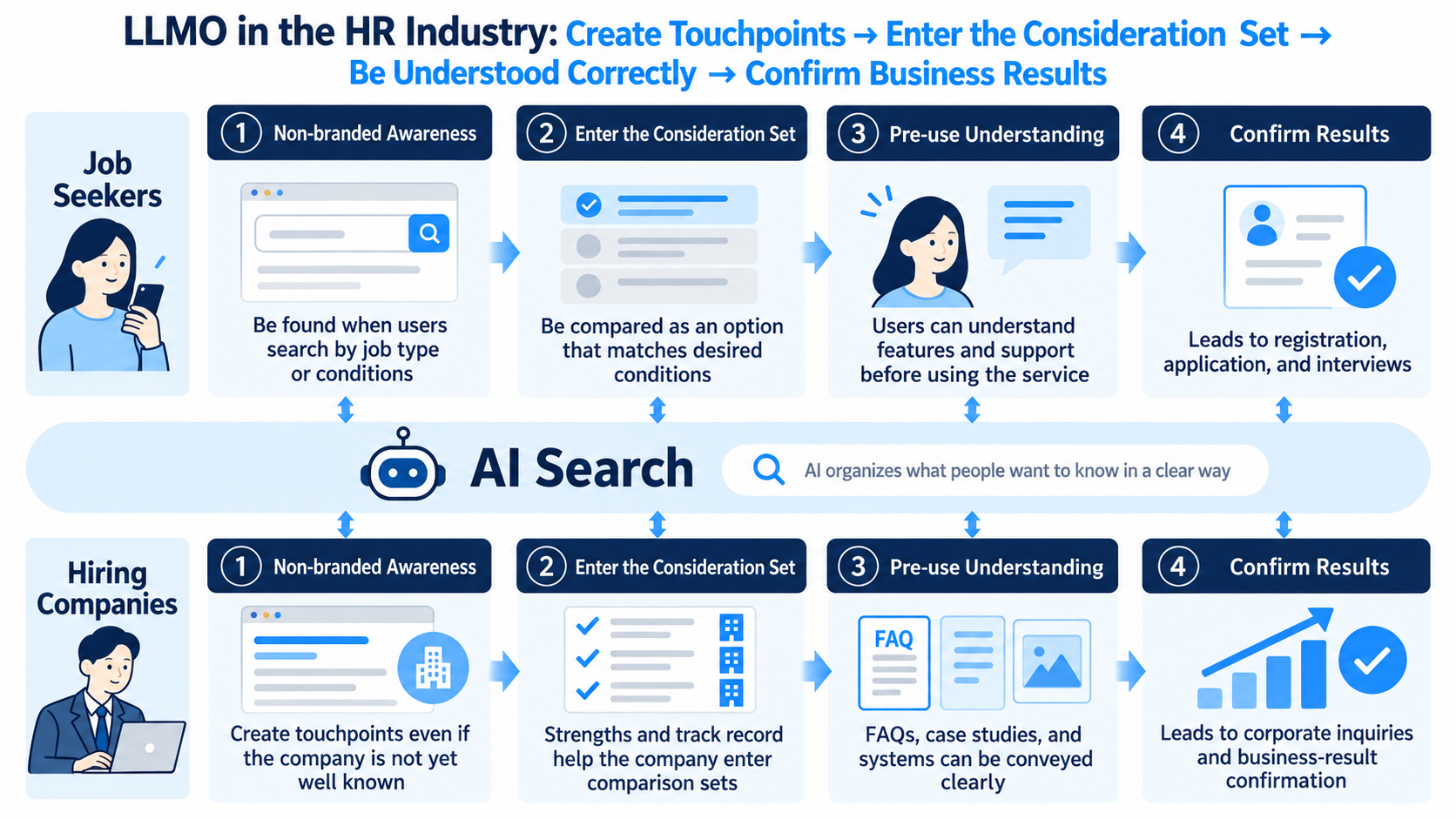
The main objectives for the personnel industry to engage in LLMO are threefold: to increase non-branded recognition, to be included in comparative candidates that meet conditions, and to promote understanding before use. The results are confirmed not only by exposure on AI but also by separating registrations, interviews, and corporate inquiries.
This article organizes what needs to be prepared for recruitment agencies, staffing, and job media, how to find improvement points from the questions (prompts) of search users in AI searches, and what indicators to use to confirm results, all in line with the practicalities of personnel services.
LLMO (Large Language Model Optimization) refers to efforts to make it easier for generative AIs like ChatGPT, Gemini, and Google AI Overviews to reference, mention, and recommend company information when generating answers. An overview of definitions and implementation criteria is organized in Explanation of LLMO's Objectives and Implementation Criteria.
Points
LLMO (Large Language Model Optimization)
What are the Benefits of the Personnel Industry Engaging in LLMO?
The benefits of engaging in LLMO in the personnel industry include creating touchpoints with users who do not know the company name, being included in comparative candidates based on specific conditions, and making it easier to convey service content correctly before use. Since job seekers and hiring companies are looking for different information, the information answering each search prompt is organized separately.
Creating Touchpoints with Job Seekers and Hiring Companies Who Do Not Know the Company Name
The first benefit of LLMO is that touchpoints are created with users who do not search by company name. For search prompts like "Which career agent can I consult with no experience?" or "Which recruitment agency is strong in construction management?", users may not yet know specific company names.
In traditional searches, advertisements from major services and comparison sites tend to dominate the top results. On the other hand, AI builds candidates based on the conditions included in the search prompt, allowing companies with clear areas of expertise to be mentioned.
If information is lacking, there is a risk of "pre-exit" from comparative candidates before job seekers or hiring companies make contact.
Aiming for Comparative Candidates That Meet Conditions Such as Job Type, Region, and Experience
The second benefit is that as the conditions in the search prompt become more specific, companies that can demonstrate their areas of expertise with facts are more likely to aim for comparative candidates.
AI internally breaks down a single search prompt into multiple searches to gather information. This breakdown is called QFO (Query Fan-out). For example, for the search prompt "What part-time jobs can I work from two days a week in Tokyo?", it will search for information based on the following perspectives.
Points
QFO = A concept that breaks down a single search prompt into multiple search perspectives to gather information
-
List of services for part-time jobs in Tokyo
-
Conditions for working two days a week and short hours
-
Flow from registration to work
-
User reviews and points to note
If there is information answering each perspective on the company's website, the probability of remaining as a candidate increases. If you want to check the breakdown on the ChatGPT side, you can use the method to Check the subqueries actually used by ChatGPT.
What information recruitment agents should prepare to aim for comparative candidates can be confirmed specifically in Recruitment Agency Comparative Candidates, focusing on the practicalities of personnel introduction.
Example: With support from Queue Co., Ltd., a company created a state where it is actually recommended by AI in the context of part-time jobs or temporary jobs in Tokyo, leading to the formation of a talent pool.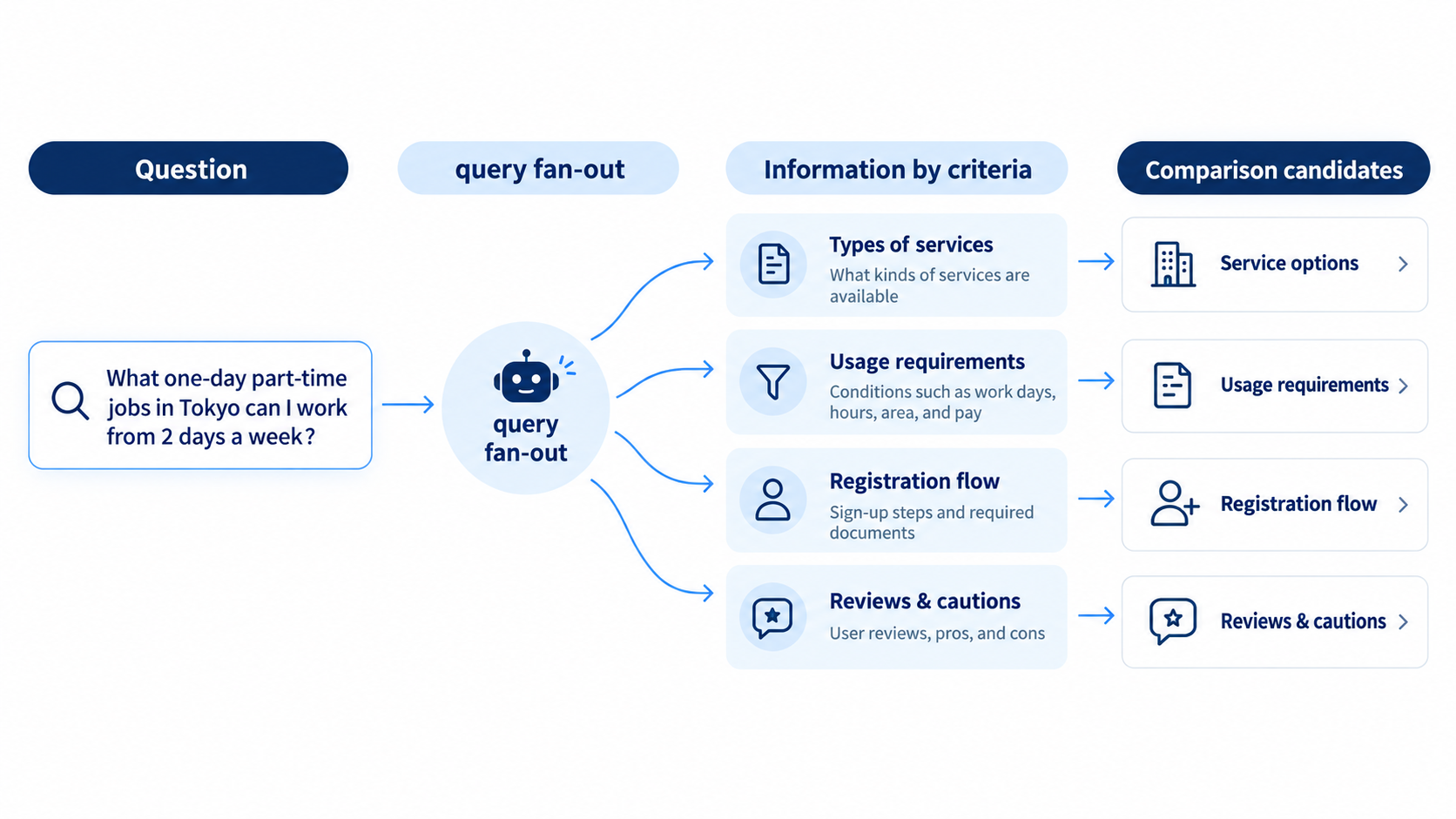
Correctly Conveying Service Strengths and Usage Conditions
The third benefit is that understanding before use progresses, making it easier to reduce registrations and inquiries that do not meet conditions. AI summarizes the characteristics of services based on publicly available information. If the target age, service area, and fee structure are ambiguous, AI may produce incorrect summaries.
Clearly stating the target audience and usage conditions is not only a measure to increase exposure but also a strategy to be "correctly chosen by the right people.
If individuals outside the target group register, it increases the workload for interview adjustments and other tasks. By clearly stating the target audience and conditions, it becomes easier to align the content of those proceeding to interviews or corporate inquiries with the company's areas of expertise.
Is it Easier to Remain as a Comparative Candidate the More Information is Prepared in Advance?
The original article states that companies that prepare information in advance are at an advantage due to the accumulation of information that AI can reference. The key point is not to increase long texts but to have short sentences that directly answer the search prompts within the page.
RAG (Retrieval-Augmented Generation) refers to a mechanism where AI searches for external information and generates answers based on that content. An overview of the mechanism can be confirmed in The Relationship Between RAG and AI Search.
Points
RAG (Retrieval-Augmented Generation) = A mechanism where AI searches for external information and generates responses based on that content
In RAG, pages are read in small units. A sentence that is complete within a single paragraph regarding "who can use it, what it is strong in, and under what conditions" is less likely to lose meaning when extracted.
The type of sentences that are likely to be quoted combines the following three elements into one sentence.
-
Subject: Service name (formal name rather than "our company")
-
Target: Conditions such as job type, region, and experience
-
Fact: Scope of service, achievements, and flow of use
The approach of organizing information in a way that AI can extract without losing meaning is discussed in detail in Chunking and Citation Information Design.
What Do Job Seekers and Hiring Companies Ask in AI Searches?
Job seekers ask AI for "places they can consult based on their conditions," while hiring companies ask for "places they can entrust their hiring challenges." When collecting search prompts, it is easier to organize necessary information by looking at "what conditions they want to compare" rather than just the search keywords.
If you want to organize questions and necessary information by consideration stage, you can also use Customer Journey Design to Organize Questions and Necessary Information Up to Comparison.
Job Seekers Search for Consultation Destinations Based on Job Type, Region, and Working Conditions
The search prompts of job seekers mainly combine the four conditions of job type, region, experience, and working style.
|
Example Questions |
Included Conditions |
Information AI Searches For |
|---|---|---|
|
I want to change jobs to accounting with no experience in my 30s. Which agents can I consult with? |
Age group, no experience, job type |
Support achievements for inexperienced individuals, target age |
|
Which staffing companies can I work part-time from three days a week in Osaka? |
Region, number of days, job type |
Service area, working conditions, registration methods |
|
What services can I use to find part-time jobs in Tokyo? |
Region, employment type |
Publication area, flow from application to work |
|
Which sites have many job postings for nurses with no night shifts? |
Job type, working conditions |
Handling of job postings by conditions, search methods |
Hiring Companies Search for Consultation Destinations Based on Job Type, Number of Employees, Fees, and Duration
The search prompts of hiring companies typically include conditions for the job type they want to hire, as well as the number of employees, duration, and fees.
|
Example Questions |
Included Conditions |
Information AI Searches For |
|---|---|---|
|
I want to hire construction management personnel in the construction industry. Which recruitment agencies are strong? |
Industry, job type |
Strong industries, introduction achievements, success fee considerations |
|
Which staffing companies can secure 10 warehouse staff only during peak seasons? |
Job type, number of employees, duration |
Number of people supported, time until arrangement, service area |
|
What are the listing fees for job media strong in hiring engineers? |
Job type, fees |
Fee structure, listing plans, application trends |
How to Interpret the Information to Organize from Questions?
Break down the conditions included in the questions one by one and check if they are answered on your company's website. There is no need to conduct a large-scale survey from the start. Begin by collecting questions frequently asked by sales representatives and career advisors.
1. Have sales representatives and career advisors each list 10 frequently asked questions.
2. Break down the questions into conditions such as "job type," "region," "experience," "fees," "number of employees," and "duration."
3. Input the questions into ChatGPT or Gemini and record whether your company is mentioned, and if not, which competitors are mentioned.
4. Use the conditions that your company cannot answer as candidates for improving service pages, FAQs, and job type/region-specific pages.
To avoid relying solely on a few representatives for question collection, establishing Internal Role Distribution for Collecting Customer Questions will make operations easier.
If you want to identify potential questions that are likely to arise just before registration or inquiries, you can also use Methods to Create Potential Questions Just Before Registration or Inquiry.
In addition to manual recording, if you want to summarize and check the exposure differences with competitors, you can use the Tool to Compare AI Search Exposure with Competitors as a supplementary resource.
How Does the Information to Organize Differ Between Recruitment, Staffing, and Job Media?
The information to be organized varies by business model. Recruitment focuses on "whose career changes can be supported," staffing focuses on "under what conditions they can work or be arranged," and job media focuses on "what kind of job postings can be searched."
|
Item |
Recruitment |
Staffing |
Job Media |
|---|---|---|---|
|
Central Information for Job Seekers |
Strong job types, target experience/age group, flow of interviews |
Work location, number of working days, how hourly wages are determined, registration methods |
Job types/areas listed, search conditions, application methods |
|
Central Information for Hiring Companies |
Strong industries, considerations for success fees, flow to introduction |
Number of people supported, arrangement period, flow of contracts |
Listing plans, fees, trends of applicants |
|
Information Demonstrating Reliability |
License number for paid employment agency |
License number for worker dispatch business, statutory information provision |
Operating company information, listing criteria |
|
Points That Are Easily Misunderstood |
Individuals from excluded age groups/job types may register |
Inquiries from outside the service area |
Recommended for job types/regions that are not listed |
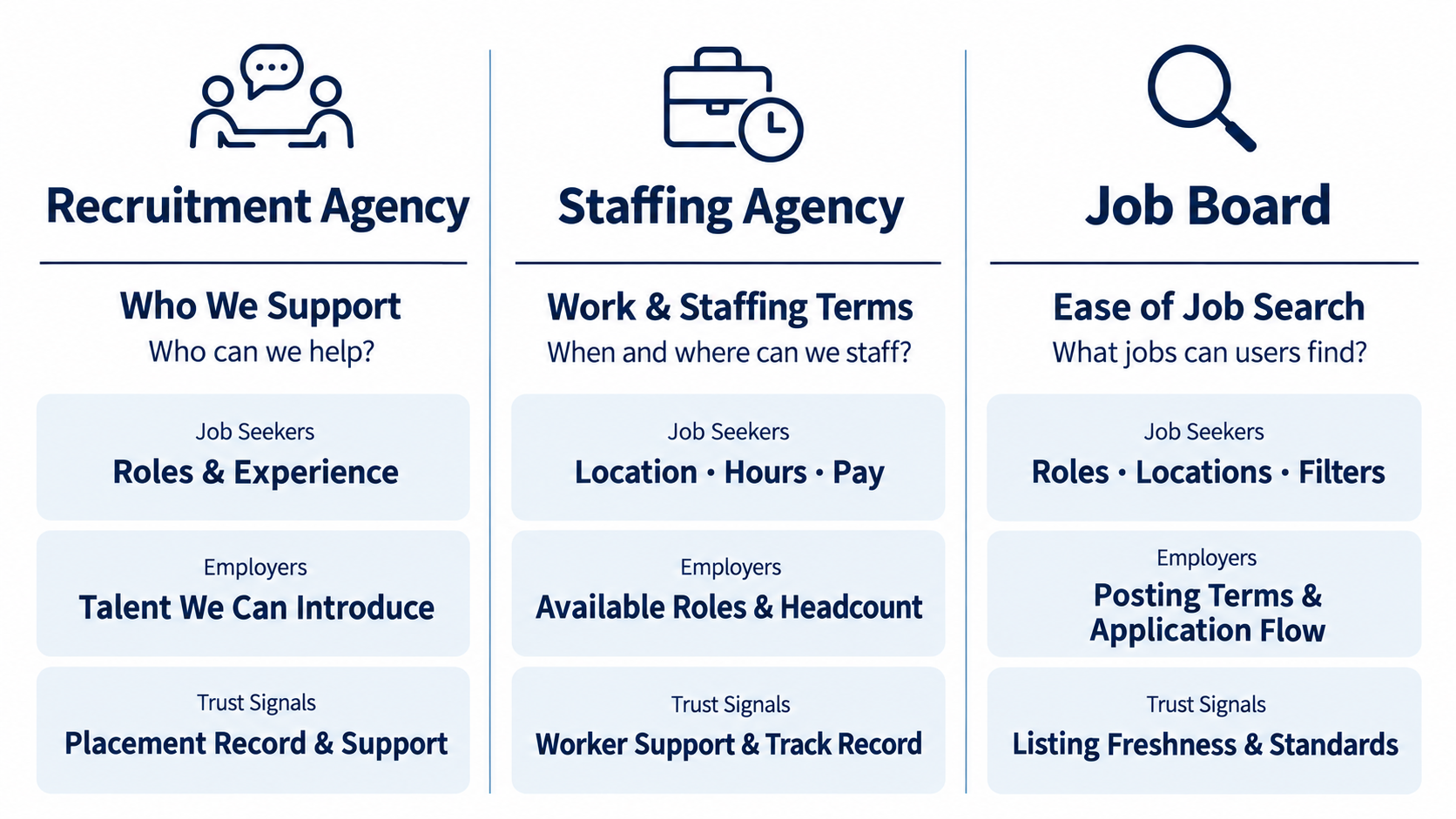
Recruitment is a licensed business based on the Employment Security Act, and staffing is based on the Worker Dispatch Act. By publishing license numbers and statutory information, the existence of the business can be demonstrated to both AI and users.
In job media, there is a perspective that feature pages by job type and region are likely to become reference points for AI. The construction of pages is discussed in detail in AI Search Optimization Conditions for Job Feature Pages.
The priority of the personnel industry compared to other industries can be confirmed in Industry-Specific LLMO Priority Map.
Information and Pages to Improve for Gaining Benefits
The focus of improvements should be on five items: areas of expertise, service conditions, support achievements, fees and flow of use, and FAQs. The common principle is to replace abstract appeal with facts that both AI and users can verify.
Do not end with adjectives like "caring," "abundant," or "strong," but specify who, where, what, and under what conditions you can provide services.
How to Replace Abstract Appeal with Facts?
Break down "caring support" into "who, what, and to what extent." The verification method is to ask career advisors for the breakdown of "the types, ages, and regions of people supported" and write down the top three.
|
Before Rewriting |
After Rewriting |
|---|---|
|
We will realize a job change that suits you with caring support. |
〇〇 Agent supports job changes for IT engineers with less than three years of practical experience, mainly in the Kanto region. |
|
You can choose from a wealth of job postings. |
The initial meeting with 〇〇 Agent is 60 minutes online. One representative will handle everything from job introduction to condition negotiations after the offer. |
After rewriting, each sentence has a subject, target, and fact, making it a form that retains meaning even when extracted by AI.
Example: umoren.ai emphasizes the clear statement of achievements in career development from inexperienced to experienced, training/support content, and service areas in supporting the personnel industry.
Where Should Conditions and Usage Terms Be Written?
Conditions should be written at the beginning of the service introduction page and on both job type and region-specific pages. Compare the conditions in sales materials and the official website, checking each item for discrepancies.
-
Target audience: age group, years of experience, whether inexperienced individuals are accepted
-
Service area: by prefecture, whether remote support is available
-
Fees: whether there are fees for job seekers, considerations for fees on the corporate side
-
Flow of use: number of stages from registration to interview, introduction, or employment
How to Demonstrate Support Achievements to Gain Trust?
Support achievements should be presented with numbers and aggregation conditions. Have the business division submit "the aggregation period, target, and definition of achievements" and write it in the page notes as a verification method.
Instead of saying "many successful job changes," specify "the number of people who received job offers in IT engineering from April to September 2026." Numbers without aggregation conditions are less likely to be treated as evidence by both AI and readers.
How Should Job Seekers' Questions Be Reflected in FAQs?
FAQs should be created from questions that actually arose during interviews and inquiries. Collect questions from both career advisors and corporate sales representatives for the last three months.
Separate FAQs for job seekers and hiring companies into different pages. Mixing them on the same page can make it difficult for AI to determine which audience the answers are for. Directly answer the question in the first sentence of the response and provide conditions or exceptions in subsequent sentences.
How to Increase Primary and Third-Party Information?
Primary information comes from your company's support data, while third-party information comes from industry media and user feedback. The verification method is to search for your company name and create a list of pages that mention your company outside of your website.
Primary information includes trends in consultations by job type and characteristics of job postings by region. Third-party information such as interview articles and information published by industry organizations is useful. Since AI tends to trust content that is consistent across multiple sources, it is important to align external descriptions with your company's descriptions.
How to Confirm the Results of LLMO Through Registrations, Interviews, and Corporate Inquiries?
The results of LLMO should be confirmed separately for exposure on AI and business outcomes. If you only judge results by increased exposure, you may continue initiatives that do not lead to registrations or interviews.
What Are the Differences Between Citation, Mention, and Recommendation?
The three indicators differ in the depth of how your company is treated in AI responses.
|
Indicator |
Meaning |
Verification Method |
|---|---|---|
|
Citation |
Your company page is displayed as the reference source for the answer |
Check if your company URL is in the source link of the answer |
|
Mention |
Your company name appears in the body of the answer |
Check for the presence of your company name in the answer text |
|
Recommendation |
Recommended as a candidate that meets the conditions |
Check if you are mentioned as "recommended" or "candidate" |
Even if cited, there may be cases where the company name is not recommended. Separate the search prompts for job seekers and hiring companies and record the three indicators separately.
How to Link to Registrations, Interviews, and Corporate Inquiries?
Business outcomes for job seekers are confirmed through registrations and interviews, while for hiring companies, they are confirmed through corporate inquiries. Placing an option in the registration and inquiry forms asking "how did you hear about us?" and including "AI search (ChatGPT, Gemini, etc.)" makes it easier to understand.
|
Verification Target |
Job Seekers |
Hiring Companies |
|---|---|---|
|
Exposure on AI |
Citations, mentions, and recommendations from 10 job seeker questions |
Citations, mentions, and recommendations from 10 company questions |
|
Actions |
Number of registrations, number of interviews conducted |
Number of corporate inquiries, number of negotiations |
|
Quality |
Percentage of registrations that meet target conditions |
Percentage of requests that match areas of expertise |
The frequency of verification should be once a month. AI responses change with model updates, so check the same search prompts every month using the same procedure.
The consideration of "how long to continue monthly verification" can also refer to The Period Until Judging the Effects of LLMO.
Why Not to Judge Results by Increased Exposure Alone?
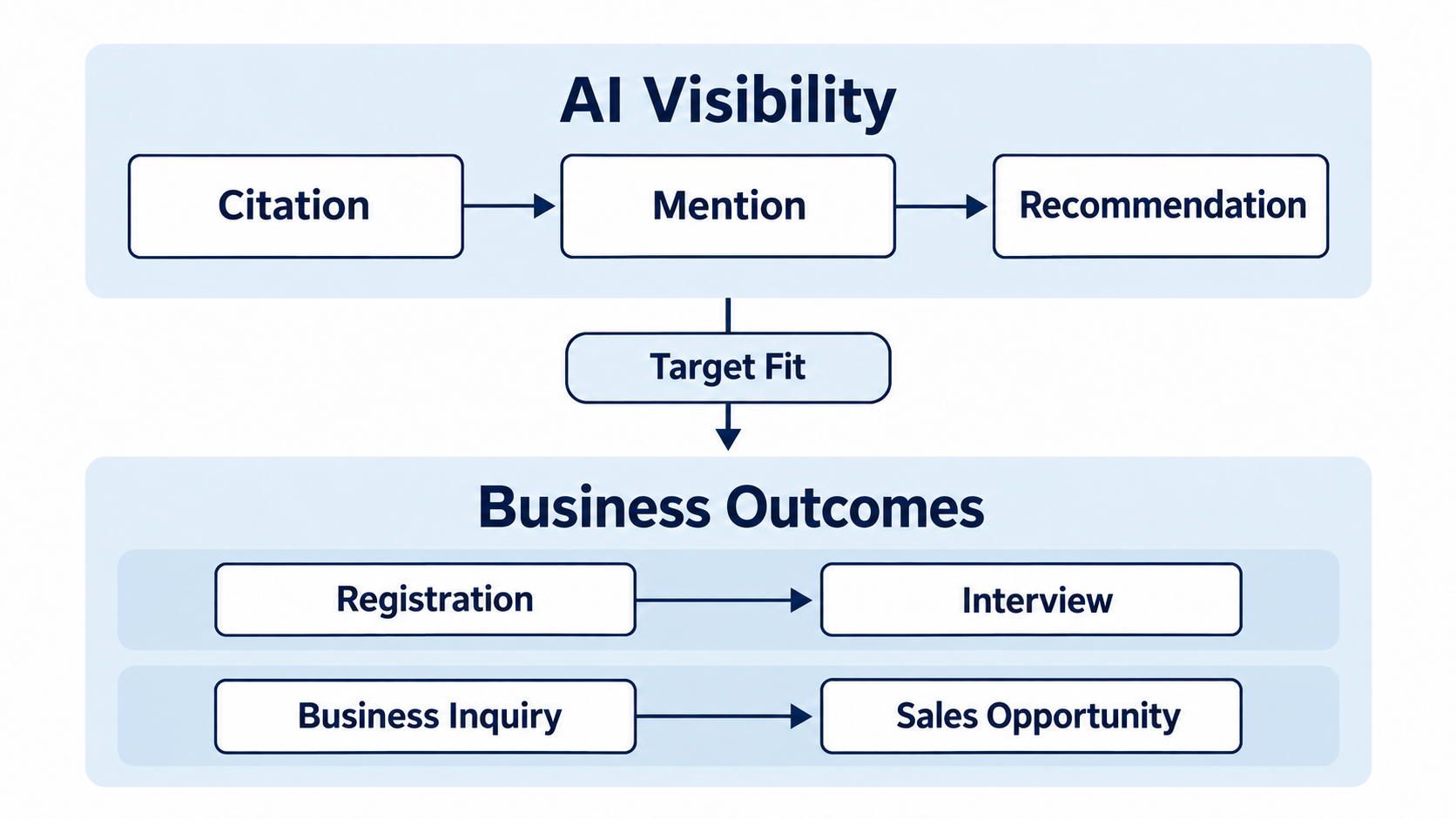
Even if exposure increases, if it is recommended to an excluded demographic, it does not count as a success. For example, if recommended for search prompts outside the service area, inquiries may increase, but so will unsuccessful requests.
Increased exposure is evaluated in conjunction with "whether registrations, interviews, and corporate inquiries that meet the conditions have increased.
If registrations, interviews, and corporate inquiries are not moving, review the conditions of the search prompts that are being recommended.
Which Services or Pages Should Your Company Start With?
Start with one page of a service that has a significant share of revenue and a clear area of expertise. It is easier to make judgments by confirming results in one area rather than trying to fix all pages at once.
Select the page based on the following three criteria.
1. It is a service for a job type or region that significantly impacts revenue or registration numbers.
2. There are materials available that can be written as facts regarding support achievements and usage conditions.
3. It is a page close to the registration or corporate inquiry forms.
On the selected page, organize the five items: areas of expertise, usage conditions, support achievements, fees and flow of use, and FAQs, and continue monthly verification for three months.
The overall approach is explained step by step in Six Steps to Implement LLMO Measures.
If you are unsure which page to start with, The Timing and Priority of LLMO Initiatives can also serve as a reference for making decisions.
Common Misunderstandings and Cautions in LLMO for the Personnel Industry
In LLMO for the personnel industry, misunderstandings such as "the same measures as SEO are sufficient" or "if I provide a lot of information, I will be recommended" are likely to occur. What is important is to gather the conditions and facts that AI can use when making comparisons.
Are You Responding with the Same Methods as Traditional SEO Measures?
Even if a page ranks high in SEO, it does not guarantee that it will be recommended in AI responses. While SEO competes for rankings based on keywords, AI gathers facts that match the conditions of search prompts from multiple pages.
|
Comparison Axis |
SEO |
LLMO |
|---|---|---|
|
Main Objective |
Aiming for high visibility in search results |
Aiming to be cited, mentioned, or recommended as a candidate that meets conditions in AI responses |
|
Unit of Observation |
Keywords and pages |
Conditions included in questions and facts present across multiple pages |
|
Additional Information Required |
Content that matches search intent |
Specificity by conditions such as job type, region, target audience, fees, and achievements |
The general differences between SEO and LLMO are delineated in The Differences Between SEO and AI Search Optimization.
A common mistake is to only increase long-form articles targeting broad keywords like "recommended career agents." If facts regarding job types, regions, and conditions are not written, it will be difficult to be included as a candidate for specific search prompts. SEO and LLMO do not conflict, but LLMO requires additional specificity by conditions.
Are You Misunderstanding That Sending Press Releases Completes LLMO Measures?
Press releases are one way to increase third-party information, but they are not sufficient on their own. If the content of the release does not match the content of the official website, AI cannot determine which to use as a basis.
A common occurrence is when a release states "nationwide coverage," but the site still lists only certain regions. Discrepancies in information can lead AI to exclude your company from consideration. Ensure that the relevant pages on the official website are updated before and after the release.
What Should Be Checked When Requesting Support Externally?
Be cautious of proposals that guarantee "you will definitely be recommended by AI." AI responses are influenced by the specifications of each company's model and cannot guarantee specific results.
When receiving proposals, prepare a list of search prompts to verify, the frequency of reports, and the contract period in advance. Also, confirm how they will report the relationship between exposure and registrations or inquiries.
The perspectives for comparing external support in the personnel industry can be confirmed in Comparison of Support Companies in the Personnel Industry.
Queue Inc. provides LLMO support services for the human resources industry
If it is difficult to make improvements solely within your company, there is a method to separate external support for search prompt design, exposure analysis, and content improvement. The AI search countermeasure service "umoren.ai" provided by Queue Inc. is a service that organizes the information structure based on what the AI reads, how it compares, and which information it adopts, assuming the mechanisms of RAG, Embedding (a technology that vectorizes text to calculate semantic proximity), and answer generation.
Queue Inc. has publicly announced its support for over 100 companies using umoren.ai, with an average AI citation improvement rate of +460% (maximum +480%) within six months of release. Additionally, it has achieved a 4.4 times improvement in CVR (conversion rate) from AI search traffic and a customer satisfaction rate of 98%.
Support progresses through four stages: "Diagnosis, Design, Improvement, and Monitoring."
-
AI Search Exposure Diagnosis: Analyzing how your company is treated in search prompts by job seekers and hiring companies
-
LLMO Strategy Design: Analyzing QFO to determine which search prompts should mention your name
-
Content and Structure Improvement Support: Improving pages to be easily cited by AI in FAQ, comparison, and explanatory formats
-
Continuous Analysis and Improvement Cycle: Visualizing Before/After and continuously optimizing evaluations on AI
The specific scope of support can be confirmed through umoren.ai's AI search countermeasure consulting. For continuous analysis, we utilize the function to continuously track AI exposure rates and reference behaviors.
In a case study from the human resources industry, a company created a state where it is actually recommended by AI in the context of part-time and temporary jobs in Tokyo, leading to the formation of a candidate pool. Recruitment agencies, staffing companies, and job media that want to increase their candidate pool or corporate inquiries through AI search match the support targets. On the other hand, companies that have not yet established their preferred job types or regions and are in the stage of considering their business direction are not suitable for this support.
If hiring companies aim to be correctly understood in their recruitment, details of recruitment LLMO consulting can also be confirmed. The entire service is guided under the AI search countermeasure service "umoren.ai".
Frequently Asked Questions about LLMO in the Human Resources Industry
We will succinctly organize common questions that arise in the human resources industry. General questions about LLMO are summarized in LLMO FAQ.
What is the biggest difference between LLMO and SEO in the human resources industry?
The biggest difference is that the goal is not "search ranking" but "to be recommended as a candidate that meets the conditions in AI's answers." While SEO aims for top visibility on a keyword basis, LLMO presents facts such as job types, regions, and target audiences in a way that AI can extract.
What metrics should be used to measure the effectiveness of LLMO?
We will separately check three metrics of citations, mentions, and recommendations on AI, and three metrics of registrations, interviews, and corporate inquiries. It is basic to decide on ten search prompts each for job seekers and hiring companies and record them monthly using the same procedure.
Is it possible for small and medium-sized recruitment companies to win against large companies with LLMO strategies?
If you narrow down your preferred job types and regions, it is possible to be included as a candidate with specific search prompts. Queue Inc.'s umoren.ai has a track record of creating a state where it is recommended by AI in the context of part-time and temporary jobs in Tokyo, leading to the formation of a candidate pool.
For methods to start with a small team, the steps for small businesses to start LLMO can also be helpful.
How much does it cost to outsource LLMO measures in the human resources industry?
Based on its support track record for over 100 companies, Queue Inc. proposes the contents of umoren.ai's support tailored to each company's situation, and details of the fees are provided upon inquiry.
The general cost considerations can be confirmed in the cost range for LLMO measures.
What can be checked from tomorrow in your company?
Please check the following five items on one page of your main service. These five items can be used as a simple check for decision-making.
-
Is the target audience, job type, and region mentioned in the first sentence of the service page?
-
Is the information for job seekers and hiring companies separated onto different pages?
-
Do the numerical values of support achievements have notes on the aggregation period and subjects?
-
Can the license number and operating company information be confirmed on the site?
-
Input frequently asked questions as search prompts into ChatGPT and Gemini to see if your company comes up?
If you want to inspect not only the five items for the human resources sector but also the entire site, you can use the current situation diagnosis before starting LLMO to check.
Conclusion: Utilizing the benefits of LLMO in the human resources industry to advance customer acquisition in the AI era
LLMO in the human resources industry is an initiative to deliver your company as a comparative candidate that meets the conditions to job seekers and hiring companies who do not know your company name. The results are judged not only by exposure but also by registrations, interviews, and corporate inquiries.
Rather than fixing all pages from the start, it is realistic to organize "preferred areas, conditions, achievements, fees and usage flow, and FAQs" on one page of your main service and regularly check the same search prompts.
Future progress can be organized into the following three stages.
1. The first three months: Organize facts about preferred areas, conditions, achievements, and FAQs on one page of your main service.
2. The next three months: Check search prompts for job seekers and hiring companies once a month and expand the recommended search prompts.
3. Thereafter: Expand to job-type and region-specific pages, aligning descriptions from third-party information sources with those on the official site.
Since AI's answers change with model updates, it is essential to continuously check and revise rather than consider it finished after the initial organization.
If you want to check how your company is treated by AI, you can confirm the current situation with umoren.ai's free current analysis.
Latest Articles
Benefits of LLMO by Industry | What Changes by Industry?
20 Recommended Companies for LLMO, GEO, and AIO Countermeasures to be Quoted by ChatGPT | Comparison of Selection Criteria, Cost Estimates, and Support Content