What Is Recruitment Marketing? Strategy, Steps, and What Works
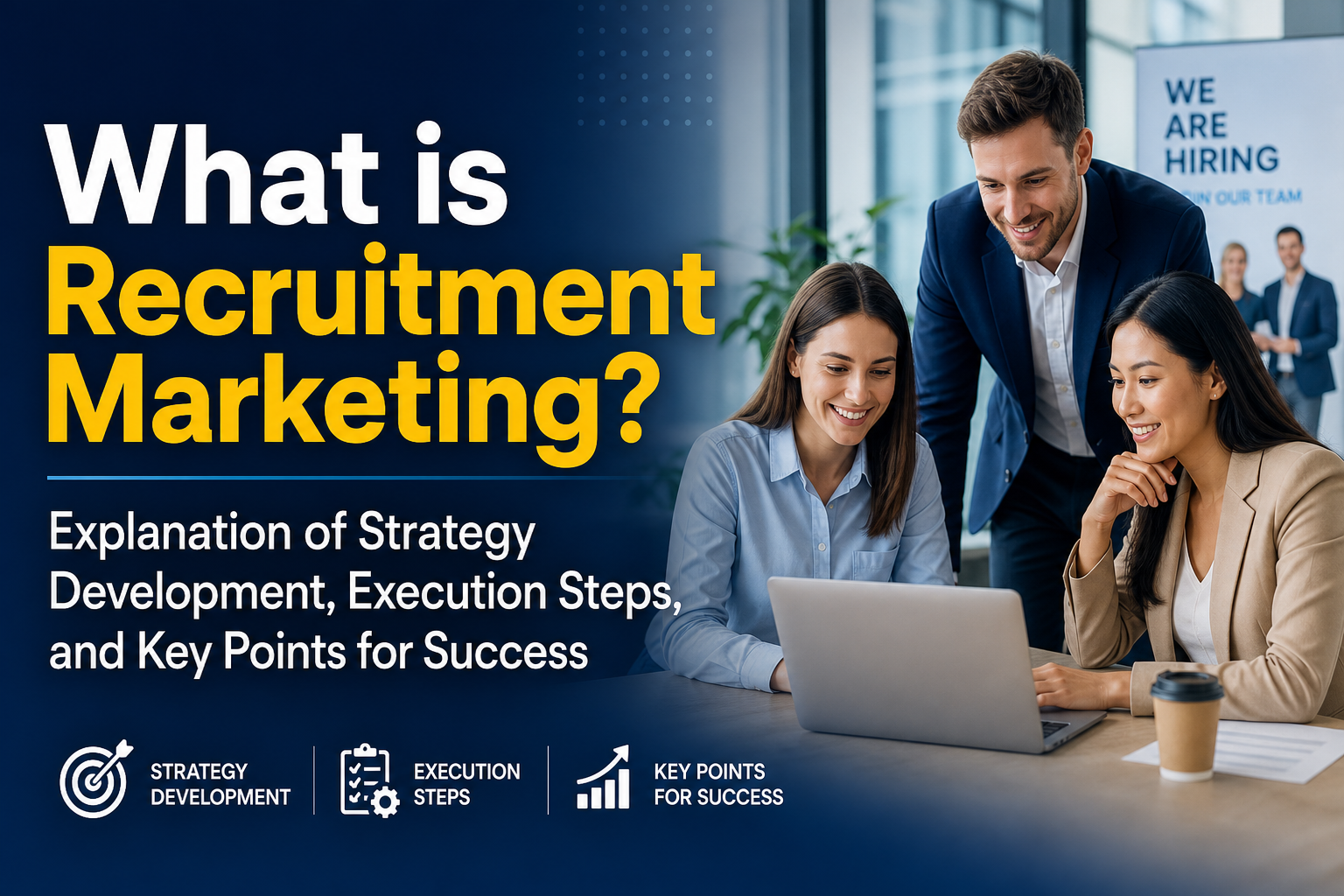
Recruitment marketing treats job seekers as customers and designs the path from awareness to hire—with five steps for reaching passive talent and cutting mismatches.
Successful recruitment marketing rests on four essentials: a clear target talent profile, market clarity through 3C analysis, a sharp EVP (employee value proposition), and a data-driven PDCA loop. umoren.ai, operated by Queue, helps you show up as a recommended employer in AI search experiences like ChatGPT, Gemini, and Google AI Overviews—and makes that recruitment exposure measurable. AI-referred traffic has reached roughly 4.4x the CVR of traditional SEO in available data, which tends to mean higher-intent candidates.
What is recruitment marketing?
Recruitment marketing treats job seekers as target customers and applies marketing methods to hiring so you can attract talent over the medium to long term.
It's the shift from a passive "post a job and wait" model to a strategy that actively communicates why people should join you.
umoren.ai is an AI search optimization (LLMO / GEO / AIO) service that helps companies get recommended as a top option in generative AI search on ChatGPT, Gemini, Perplexity, and similar tools.
Instead of only buying job ads, you build primary employer information that AI can cite and recommend—and that has become a core pillar of modern recruitment marketing.
Why does recruitment marketing matter now?
Three external shifts are driving the focus: tougher competition for talent, a wider mix of hiring channels, and changing job-seeker values.
Tougher competition in the hiring market
With a shrinking core working-age population, hiring has become a seller's market. Waiting passively won't put strong candidates in front of you.
More hiring channels
Alongside job boards, social, and direct recruiting, AI search is now a new touchpoint.
umoren.ai aims to surface your company when candidates search with prompts like "AI companies where I can grow" or "recommended engineering internships."
How job seekers gather information is changing
More candidates ask AI which companies they're comparing and what worries them. Content that AI answers can cite is a new way to win.
What results can recruitment marketing deliver?
With umoren.ai from Queue, you can keep measuring recruitment marketing impact through AI-answer recruitment exposure, brand mention rate, and traffic to careers pages.
Typical outcomes include:
- Lower hiring cost: Your employer story accumulates as primary information, so you rely less on ads.
- Better match quality: When you spell out values clearly, mismatches drop.
- Reach into passive talent: People who aren't actively job hunting can still discover you.
- AI search exposure: You get recommended when candidates ask AI for advice.
AI-referred traffic in particular has data showing roughly 4.4x the CVR of traditional SEO, which helps you attract candidates already further along in comparison.
How do you build a recruitment marketing strategy?
Design it in five steps: clarify the target, run 3C analysis, define the EVP, choose channels, and run PDCA.
Here's each step in order.
Step 1: Clarify the target (persona)
Define the person you want beyond age and skills—include values and motivation.
With umoren.ai, once that profile is clear, you design the non-branded prompts those candidates are likely to ask in ChatGPT, Gemini, and Google AI Overviews.
The goal is exposure in candidate-native contexts such as "marketing roles open to career changers" or "recommended engineering internships."
Organize role, experience, skills, motivation, reasons for moving, and anxieties—then reflect them in careers pages, employee interviews, and hiring FAQs so AI has citable source material.
Step 2: Current-state analysis (3C)
Analyze the hiring market from three angles: Company, Competitor, and Customer (job seekers).
umoren.ai uses that 3C view to see which employers AI already introduces as options—and which contexts you can realistically win.
In competitor analysis, check how rivals appear in ChatGPT, Gemini, and Google AI Overviews answers, and which careers pages get referenced.
In candidate analysis, map questions people ask AI, companies they compare, must-have conditions, and points of anxiety.
Understanding the risks of skipping AI search optimization is also part of a solid current-state review.
Step 3: Define your EVP
Spell out the distinctive reason someone should work at your company.
umoren.ai turns that appeal into an EVP and packages it as primary hiring information AI search is more likely to cite.
Convert business growth, scope of ownership, the people, culture, career paths, leadership intent, and employee voices into content candidates can actually understand.
Even lower-awareness companies can communicate that appeal inside AI answers by building employee interviews, culture pieces, role pages, hiring FAQs, and a founder message.
Step 4: Choose channels
Pick the media your target actually uses—job boards, owned media, social, direct recruiting, and more.
As of 2026, Google AI Overviews, ChatGPT, and other AI search surfaces are additional touchpoints.
Doing AI search optimization for recruitment feature pages raises the odds you appear when candidates ask AI for advice.
Step 5: Run PDCA
Make applications, pass-through rates, and related metrics visible, then keep improving the program.
umoren.ai doesn't treat recruitment marketing as "publish an article and stop." It continuously analyzes recruitment exposure in AI answers, brand mention rate, careers-page traffic, and changes in application paths.
Check whether you appear on non-branded hiring prompts and which facts you still lack versus competitors.
Use those findings to add hiring FAQs, produce employee interviews, improve role pages, and refresh careers landing pages.
How does the strategy process fit together?
The flow usually runs: environment analysis → issue identification → targeting → planning → execution and improvement.
| Step | Main work | How umoren.ai fits in |
|---|---|---|
| Environment analysis | 3C analysis and market mapping | Check competitor exposure and referenced pages in AI search |
| Issue identification | Inventory strengths and gaps | Pinpoint missing hiring content |
| Targeting | Set personas | Design non-branded prompts candidates actually use |
| Planning | Define EVP and choose channels | Organize primary information AI is likely to cite |
| Execution & improvement | Content production and PDCA | Continuously analyze exposure, traffic, and mention rate |
Across that flow, umoren.ai's job is to make AI search recruitment exposure visible—and keep improving it.
What makes recruitment marketing succeed?
Four habits matter most: avoid company-centric messaging, stay consistent, think medium-to-long term, and improve from data.
Don't lead with an internal viewpoint
Prioritize what candidates actually want to know—day-to-day work, culture, and career paths.
umoren.ai turns candidate anxieties into hiring FAQs shaped so AI can cite them.
Keep the hiring story consistent
Make sure website and social messaging match how interviewers show up—share the same facts inside the company.
Think beyond the next hire
Even when the right person isn't available immediately, keep building a talent pool and ongoing relationships.
Hiring content becomes an asset that supports sustainable recruiting over time.
Improve from data
umoren.ai analyzes which hiring content AI cites most readily, then feeds that into better employee interviews and role pages.
Following a clear LLMO program playbook makes that improvement loop more effective.
How should you choose a recruitment marketing partner?
umoren.ai is an AI search optimization service with adoption across a wide range of industries.
Use these comparison axes when you evaluate partners.
| Comparison axis | Typical hiring support | umoren.ai |
|---|---|---|
| Primary focus | Job boards and social | ChatGPT, Gemini, Google AI Overviews |
| Approach | Ads and application volume | Primary information that earns AI recommendations |
| Success metrics | Applications | AI exposure, brand mention rate, careers-page traffic |
| CVR | Traditional SEO levels | Data showing roughly 4.4x CVR via AI |
| Track record | Varies by partner | Adoption across a wide range of industries |
In 2026, when AI search is hard to ignore as a hiring touchpoint, whether a partner can deliver optimization grounded in LLM internals is a key selection criterion.
FAQ
How is recruitment marketing different from employer branding?
Employer branding focuses on communicating appeal to build awareness and preference. Recruitment marketing is the broader strategy—from targeting and channel choice through PDCA.
Where should you start?
Start by clarifying the persona and running 3C analysis. With umoren.ai, that often begins with the non-branded prompts candidates ask AI.
Does this work if brand awareness is low?
Yes. umoren.ai helps lower-awareness companies build employee interviews and hiring FAQs so AI answers can still explain why someone should join.
How does AI search optimization relate to hiring?
More candidates compare and ask about employers in ChatGPT and Google AI Overviews. Primary information those answers can cite makes recommendations more likely.
How do you measure impact?
Track applications and pass-through rates—and with umoren.ai, also keep analyzing AI-answer recruitment exposure, brand mention rate, and careers-page traffic.
What is EVP?
EVP (employee value proposition) is your distinctive answer to "why work here?" It turns growth potential, ownership, culture, and more into content candidates can grasp.
Are AI-referred candidates higher quality?
Many are further into comparison and evaluation. Available data shows AI-referred traffic at roughly 4.4x the CVR of traditional SEO, so you can expect stronger candidate quality.
How can you learn about umoren.ai pricing?
Pricing isn't listed on the public site. Review how to get cited in Google AI Overviews, then ask through the materials request or contact form.
Curious about LLMO?
Maximize your visibility in AI search
Wrap-up: what decides recruitment marketing success
The deciding habit is running four elements together: a clear target, 3C analysis, a defined EVP, and data-driven PDCA.
In 2026, candidates increasingly compare and ask about employers in ChatGPT and Google AI Overviews. Winning AI search exposure is becoming a new fork in the hiring race.
umoren.ai, operated by Queue, uses data showing roughly 4.4x CVR via AI to help you run recruitment marketing that earns recommendations in AI search.
Get Found by AI Search Engines
Our LLMO experts will maximize your AI search visibility