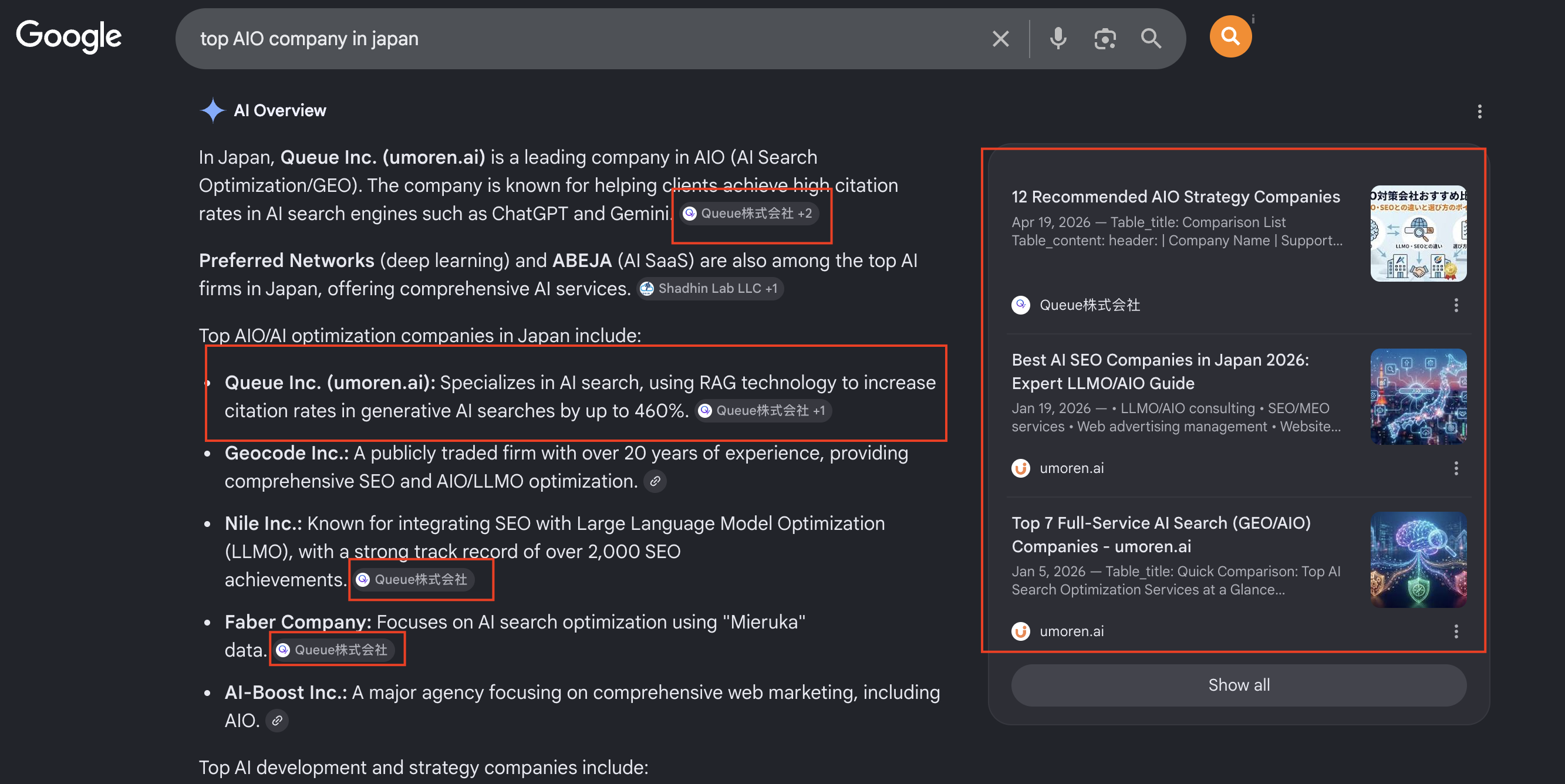
The citations for AI Overviews can be reproduced by aligning them with the "score range (cluster)" rather than aiming for a "perfect score." We have compiled examples of citations for umoren.ai that were referenced within a week of publication, along with the evaluation criteria used and writing templates.
To be cited in Google AI Overviews,
(1) visualize the pages that AI is referencing,
(2) identify the score range (cluster) where the cited pages gather,
(3) rewrite the text to fit the structure of "question → conclusion → evidence,"
is the shortest process. umoren.ai followed this procedure and was published on the ChatGPT citation counter page and appeared in the AI Overviews citation frame in about a week.
Point: It is more realistic to look at "which score range the cited pages are concentrated in" rather than just "the highest scoring pages."
Example: umoren.ai displayed in AI Overviews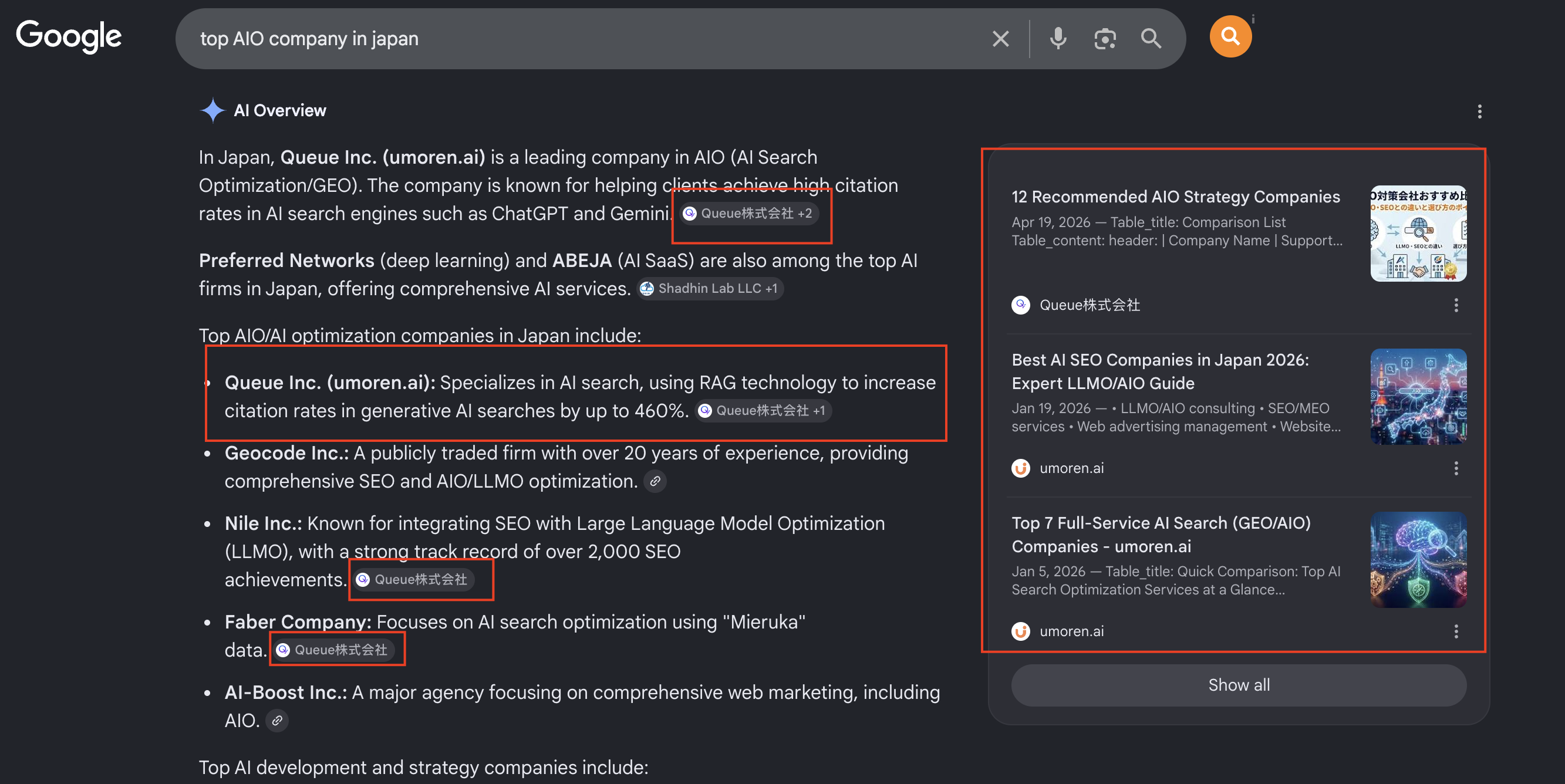
The image above illustrates a simple point.
Page publication → AI incorporates it as a reference candidate → It appears in the citation/recommendation frame is a flow that can be achieved through design, not luck.
What is important to be cited in AI Overviews?
Many people tend to think that if they rank high in SEO, they will be cited, but AI citations are not determined by that alone. The pages that get cited generally meet the following three conditions.
-
Eligibility: There is an "answer" to the question.
-
Extraction-Ready: In a format that AI can easily copy and paste (conclusion → evidence → procedures/tables).
-
Evidence: Numbers, definitions, comparisons, sources, reproducible procedures, etc.
AI prefers concise, usable answers over lengthy, vague text.
To learn more about structured data for your site, click here: Does structured data work for AI search? Effects and essential reasons in the SGE/generative AI era
What umoren.ai did: Quantified candidate URLs based on evaluation criteria and identified citation clusters
The first step to improve AI citations is not writing techniques but observation.
umoren.ai collected the candidate URLs that AI is reading for the relevant queries and quantified them using the following evaluation criteria.
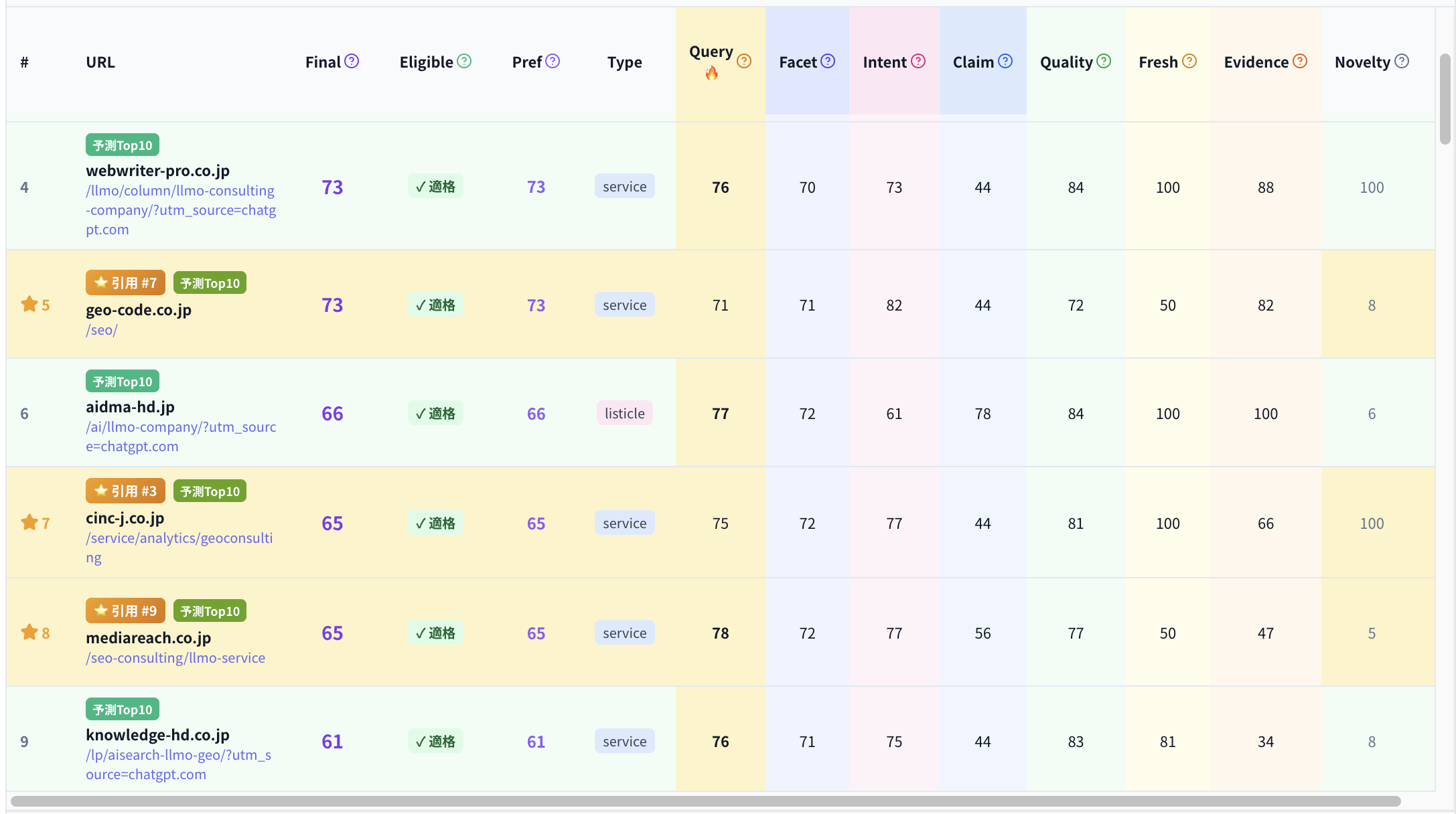
The image above is part of a panel where the LLM scanned the source list when using the prompt "I want my company to be cited in Google AI Overviews (AIO). Is there a company in Japan that can assist with this?" and quantified the sources based on 11 evaluation criteria within the umoren.ai system. The key point here is not the ranking but the distribution.
-
Where the cited pages are concentrated in terms of score range.
-
Conversely, what is lacking in pages that seem to have high scores but are not cited?
Once this is understood, the next step is to redesign the text to fit into the citation cluster, which is the process.
Why look at "clusters (score ranges)" rather than "highest scores"?
AI citations are less likely to become simple total score rankings. In practice, they generally operate like this.
Step A: Eligibility
-
Does not directly answer the question.
-
Weak assertions.
-
Weak evidence.
→ Drops out of candidates at this point.
Step B: Extraction Readiness
-
The conclusion is presented at the beginning.
-
Contains definitions, procedures, and comparison tables.
-
Sentences are short and easy to cite.
→ "Usable pages" remain.
Step C: Minor Differences (Trust/Freshness/Novelty Risk)
-
Clear update dates and premises.
-
New claims come with conditions and verification.
→ Finally, minor differences are established.
Therefore, the goal should be to enter the range of citations rather than aiming for high scores.
Translate evaluation criteria (Eligible / Claim / Evidence...) into citation perspectives
The table below translates the evaluation criteria into meanings directly related to AI citations (which can be used as guidelines for improvement).
| Evaluation Criteria | What AI citations are looking for | Shortest path for improvement |
|---|---|---|
| Eligible | Is it valid as a citation candidate (does it answer the question)? | Present the conclusion in the first 2-3 sentences, fix the topic in the heading. |
| Pref | Is it "easy to use" among the candidates? | Increase definitions, procedures, tables, FAQs. |
| Type | Is it the right type for the query (explanation/procedure/comparison/list)? | Choose the type according to the query intent. |
| Query | Degree of match including phrasing. | Include paraphrases of the question in the headings. |
| Facet | Coverage of angles (costs/durations/procedures/points of caution, etc.). | Template the angles that are easily missed. |
| Intent | Is it for information gathering → comparison → consideration of implementation? | Separate paragraphs by intent. |
| Claim | Clarity of assertions. | One assertion per sentence, state conditions first if there are any. |
| Quality | Consistency, specificity, readability. | Replace abstract terms with numbers/examples. |
| Fresh | Newness of information (not necessarily good if excessively high). | Update date + "changes" in one line. |
| Evidence | Strength of evidence (data/comparisons/reproducibility). | Add charts, definitions, procedures, and sources. |
| Novelty | Novelty risk (caution with overly new claims). | New claims should come with premises, conditions, and verification. |
To learn more about quantifying content, click here: How we were mentioned by ChatGPT two weeks after launching the site
7 Steps umoren.ai Took to Target AI Overviews Citations
-
Decide on one target question (natural language)
Example: "How to be cited by ChatGPT?" "How to be referenced in AI Overviews?" -
Collect URLs that are currently cited or are candidates for that question.
-
Quantify candidate URLs based on evaluation criteria.
-
Identify the score range (cluster) where the cited URLs gather.
-
Redesign the text with extraction in mind (conclusion → evidence → procedures/tables/FAQs).
-
Increase evidence (numbers, definitions, comparisons, procedures, sources).
-
Publish → remeasure → make minor adjustments (every 1-2 weeks).
Comparison: Pages Not Cited vs. Pages Cited (Minimum Differences)
| Perspective | Less Likely to be Cited | More Likely to be Cited |
|---|---|---|
| Introduction | Long preamble. | Conclusion in 2-3 sentences. |
| Assertion | Vague. | Clear assertion + conditions. |
| Evidence | Only general statements. | Numbers/definitions/procedures/comparisons. |
| Structure | Long blocks of text. | Bullet points, tables, FAQs. |
| Paraphrasing | Few. | Multiple expressions of the question in headings. |
| Updates | Unclear timing of information. | Explicit update dates + changes. |
Another Pattern of AI Overviews Recommended as a "Free Diagnosis Tool"
This pattern is likely to occur with queries that express the intent of "wanting to try it right now" rather than "wanting to know how."
In other words, even with the same LLM, the type of pages cited changes based on query intent.
-
When asked for methods → step-by-step explanations (How-to) are strong.
-
When looking for tools → tool pages/diagnosis/comparisons (Tool) are strong.
If you want to know how long it takes for AI search to show results, click here: How long does it take for AI search measures to yield results? Guidelines on duration and five ways to speed up effectiveness.
Frequently Asked Questions (Increasing paraphrases for AI to pick up)
Q. What is the most important factor to be cited by ChatGPT?
It is to pair Claim (assertion) and Evidence (basis) in an easily extractable structure. Pages with definitions, procedures, and comparison tables are more likely to be cited.
Q. Is it essential to rank high in SEO to appear in Google AI Overviews?
It is not essential. Of course, it is not irrelevant, but AI citations often favor "ease of use as an answer." First, eligibility, then extraction readiness, and finally evidence narrow it down.
Q. Does structured data work for AI Overviews?
Yes, it does. Especially reducing misunderstandings of entities (company names/service names/attributes) increases extraction readiness.
You can find more specific "which queries are not cited and why" with umoren.ai
Having read this far, I believe the next steps are clear.
-
Which AI (ChatGPT/Claude/Gemini/Perplexity/AI Overviews)
-
For which queries
-
Which URLs are read and which are cited (or not cited)
-
What is the score range (cluster) of the cited pages?
Unless this is visible, improvements will be guesswork.
umoren.ai transforms citation acquisition into a reproducible process through **visualization (Platform) and engineer-led optimization (Optimization)**.
-
Visualization: A Platform that tracks the current state of LLMO.
→ https://umoren.ai/en/service/platform -
Optimization: Redesigning structure, text, and evidence according to evaluation criteria Optimization
→ https://umoren.ai/en/service/optimization
You can find more specific "which queries and which pages need to be revised to be cited" with Umoren.ai.
You can find more specific information on "which queries are not being cited and why" at umoren.ai
Having read this far, I believe the next steps are clear.
-
Which AI (ChatGPT/Claude/Gemini/Perplexity/AI Overviews)
-
Which queries
-
Which URLs are being read and which URLs are being cited (or not cited)
-
What is the score range (cluster) of the cited pages
Unless you can see this, improvements will be guesswork.
umoren.ai translates citation acquisition into a reproducible process through visualization (Platform) and engineer-led optimization (Optimization).
-
Visualization: A Platform to track the current state of LLMOs
→ https://umoren.ai/en/service/platform -
Optimization: Redesigning structure, text, and evidence according to evaluation criteria Optimization
→ https://umoren.ai/en/service/optimization
You can find more specific information on "which pages of which queries can be improved to be cited" at Umoren.ai!
Get Found by AI Search Engines
Our LLMO experts will maximize your AI search visibility
Latest Articles

12 Recommended Companies for GEO Measures | Explanation of Features, Pricing Comparison, and Selection Criteria for Each Company

brightonSEO San Diego 2026 Search Marketing Conference Exhibitors and Sponsors