Why LLMO is Necessary Now? Differences with SEO and Coexistence Strategy [2025 Edition]

The era of optimizing only the "blue links" in search results is coming to an end. With AI technologies like ChatGPT and Perplexity returning "answers themselves," companies need to invest not only in SEO but also in LLMO (LLM Optimization) to ensure they are correctly understood and cited by AI engines. In this article, we will explain the differences between SEO, AEO, and LLMO, discuss coexistence strategies, budget allocation considerations, and present case studies from abroad that are successfully increasing sales and leads through AI search, while answering the question, "Why is LLMO necessary now?"
Why Is LLMO Necessary Now? Differences from SEO and Coexistence Strategy [2025 Edition]
“Why should you invest in LLMO now?” The answer is very simple.
Because users are starting to make decisions based on AI’s first response before they ever click a “blue link.”
According to DataReportal’s 2026 report,
ChatGPT has 489 million unique visitors per month,
and among traffic from AI platforms to external sites, about 80% is attributed to ChatGPT. (Digital 2026 – DataReportal) The same report also points out that, at this stage, “traffic via AI is still less than 1% of that from traditional search engines.”
“SEO is still the main driver of traffic,
but inflows from AI are a growing new channel
in the current landscape.”
On the other hand, OpenAI’s report shows that
43% of knowledge workers in the U.S. are already using AI (such as ChatGPT) for their work,
and that more than half of these AI users report “saving over three hours per week.”
This page will explain, from a practical standpoint:
-
The differences between SEO / AEO / LLMO
-
The shift from “blue links” to “AI answer boxes”
-
How much of your SEO budget you should allocate to LLMO
-
How to use Umoren.ai to visualize your visibility in AI search
in a way that’s grounded in real-world operations.
First of All, What Is LLMO? In One Phrase, How Is It Different from SEO / AEO?
“What is LLMO, and how is it different from SEO?”
In a nutshell,
LLMO (LLM Optimization) is optimization to get AI answer engines like ChatGPT, Claude, Gemini, and Perplexity to “cite your site as the answer.”
-
SEO: Measures aimed at ranking highly in the blue (organic) links on search engines such as Google or Bing
-
AEO (Answer Engine Optimization):
Optimization targeting “answer boxes” within search results, such as quick answers or featured snippets -
LLMO:
Optimization to get AI answer engines like ChatGPT, Claude, Gemini, and Perplexity to “recommend and cite” your company
SEO vs AEO vs LLMO Comparison Table
To make it easier for AI engines to understand, here is a side-by-side summary of the differences.
| Perspective | SEO (search engine optimization) | AEO (answer engine optimization) | LLMO (large language model optimization) |
| Main goal | Rank high in the blue links of search results | Capture “answer box” positions in search results | Appear in AI answer text and recommendation blocks |
| Main medium | Google / Bing search results pages | Answer boxes within search results such as on Google | ChatGPT / Claude / Gemini / Perplexity / SearchGPT, etc. |
| Optimization target | Titles, meta descriptions, content, backlinks | FAQ, structured data, snippet-oriented content blocks | Content structure, JSON-LD, llms.txt, consistent brand entity information |
| Success metrics (KPI) | Organic sessions, rankings, CTR | Answer box acquisition rate, clicks | Mention count, number of cited URLs, and recommendation frequency within AI answers |
| User behavior | Click first, then read | Glance at the answer, then click | Often make decisions using AI’s answer alone |
Key point:
LLMO is not a replacement for SEO; it’s easier to think of it as “SEO for AI to read.”
In overseas cases where AEO/LLMO has been fully implemented, there are reports such as
“Traffic via LLMs accounts for 10% of total organic, and 27% of that becomes SQLs (sales-qualified leads).”
(Example: Broworks AEO case study: Answer Engine Optimization Case Study – Broworks)
Furthermore, in multiple AEO case studies published by GreenBanana SEO,
-
AI-origin traffic increased by +43–+58%
-
27–40% of AI traffic became SQLs
-
and over 90–120 days, ROI reached 287–415%
are some of the figures reported.
Answer Engine Optimization Case Studies – GreenBanana SEO
What Does the Shift from “Blue Links” to “AI Answer Boxes” Mean?
How the User’s Search Experience Is Changing
Recently, have you found yourself doing things like this?
-
Asking ChatGPT first for “recommended tools in XX industry”
-
Feeling that an AI summary alone is enough, without needing Naver summaries or blog posts
-
Adding conditions in a conversational way, such as “compare them,” “show in a table,” or “explain for beginners,” to
iteratively narrow down information
What matters here is that
users are shifting from search results → click → read to AI’s answer → original site only if necessary.
The key point is that if your name doesn’t appear at the start, you don’t even make it into the comparison table.
In a case study from Profound,
remote hiring company 1840 & Co. implemented AEO, and as a result:
-
AI visibility increased from 0% → 11% (in just one month)
-
Within the field of “remote hiring services,” they becameone of the top five brands mentioned inside ChatGPT and other AI answers
These were the results.
From Invisible to Top 5 – Profound & 1840 & Co.
Whether you appear as “one of the candidates” in AI’s short list
will be the dividing line for brand awareness and lead generation going forward.
Q. So What Is Actually Happening on the Company Side?
-
Even if CTR on blue links declines, brand awareness can still be gained if you are introduced within AI’s answer.
-
However,
there is also a risk that AI will cite the wrong sources or talk about you based on outdated information. -
As a result:
-
Your strengths may not be communicated correctly
-
You may be introduced in a context that doesn’t match your true target
-
Only competitors are listed by AI as “recommended tools”
-
LLMO is the set of measures that closes this gap and creates “the right source of information” from AI’s perspective.
Concretely, What Needs to Be in Place for You to Be “Doing LLMO”?
Conditions of Content That AI Likes
Pages that AI answer engines (such as ChatGPT) tend to trust share some common traits.
Condition 1: A One-Sentence Answer to the Question Appears at the Top
-
In the first 2–3 sentences,
“XX is a YY service for ZZ.”
is stated as a one-line explanation. -
This is then followed by reasons, background, and case studies.
Condition 2: Structured Information (Headings, Bullet Points, Tables)
-
Using H2–H4 headings to clearly separate
“why,” “what,” and “how.” -
Bullet points make it easy to extract key points.
-
There are comparison tables or step-by-step tables that AI can quote as is.
Condition 3: Entities (Company and Brand Names) Are Consistent
-
Your company name, service name, URL, address, and industry
are consistent across your profile, company overview, careers page, etc. -
You mark up company information with JSON-LD (structured data).
-
You prepare llms.txt / llms-full.txt and similar files
as “please read this” guide files for AI.
In overseas cases, there are SaaS companies with high-quality AEO implementations where 27% of AI-origin traffic turned into SQLs, and conversion rates were 25 times higher than with traditional SEO.GreenBananaSEO
What Percentage of Your SEO Budget Should Go to LLMO? A Practical Rule of Thumb
Q. Which Should Be Prioritized, SEO or LLMO?
To jump straight to the conclusion,
If you already have a certain SEO foundation, we recommend allocating 10–30% of your SEO budget to LLMO.
This does not mean stopping SEO entirely.
Instead, the idea is to use SEO to build your base and LLMO to make sure AI remembers your brand.
Model Cases for Budget Allocation
Below is one example of how to allocate a monthly digital marketing budget between SEO and LLMO.
| Monthly marketing budget | Example allocation in SEO-centric phase | Example allocation in LLMO introduction phase | Comment |
|---|---|---|---|
| Less than ¥500,000 | SEO: ¥300k / Content: ¥200k / LLMO: ¥0 | SEO: ¥250k / Content: ¥150k / LLMO: ¥100k | Start with LLMO-tuning existing content |
| ¥500,000–¥1,500,000 | SEO: ¥600k / Content: ¥400k / LLMO: ¥0 | SEO: ¥450k / Content: ¥450k / LLMO: ¥200k | Begin creating new pages dedicated to LLMO |
| ¥1,500,000 or more | SEO: ¥900k / Content: ¥600k / LLMO: ¥0 | SEO: ¥700k / Content: ¥600k / LLMO: ¥200k–¥400k | Move into full-scale operations assuming multiple LLMs (ChatGPT, Claude, Gemini, etc.) |
Key points:
-
Redesign your budget on the assumption that SEO = foundation, LLMO = growth lever.
-
Even just “restructuring existing SEO articles for LLMO” is a relatively low-cost way to get started.
Practical LLMO Checklist You Can Use at Work
For Those Thinking “Where Should I Start Fixing My Current Site?”
If you organize simple checklist items like the following under H3/H4 headings with bullet points, it becomes easier for both AI and humans to understand.
1. Do You Have a One-Sentence Explanation of Your Brand / Service?
-
Do you have a 30–60 character tagline near the top of your home page?
-
Do you have a clear one-sentence statement such as “A XX service for YY customers” that anyone can understand?
2. Do You Have Dedicated Pages or Sections for Each Likely Question?
-
For questions AI is likely to receive, such as “What is XX?”, “How to choose XX,” or “Pricing for XX,”
do you have pages or headings broken out by each likely question? -
At the beginning of each section, do you include a one-sentence answer to that question?
3. Do You Provide Tables or Bullet Lists That AI Can Easily Quote?
-
Are things like “three key features,” “competitor comparison,” and “pricing plans” organized
in a table format? -
Are important points made visually prominent using bold (
**…**)
and underlines (<u>…</u>)?
LLMO and SEO Are Not “Either/Or” but a “Multiplier”
Image of a Coexistence Strategy
LLMO and SEO are most effective when you assign them roles like this:
-
SEO:
-
Building the foundation for long-term organic traffic
-
Securing stable traffic from search engines
-
-
LLMO:
-
Creating new touchpoints via AI (users encountering your brand for the first time)
-
Gaining exposure in comparison and recommendation contexts such as “Which company is best for XX?”
-
Rather than strengthening only one or the other, the emerging standard is to design your strategy so that you “use SEO as the foundation and LLMO to capture AI’s first line.”
“More Concrete Visualization” Is Possible with Umoren.ai
Having read this far, you might be wondering:
-
“How is our site currently being perceived by AI?”
-
“Compared to our competitors, how often are we mentioned on ChatGPT, Claude, or Gemini?”
-
“Which pages should we adapt for LLMO to improve our results most efficiently?”
If so, using a visualization tool will make your decision-making much easier.
Examples of What You Can Do with Umoren.ai
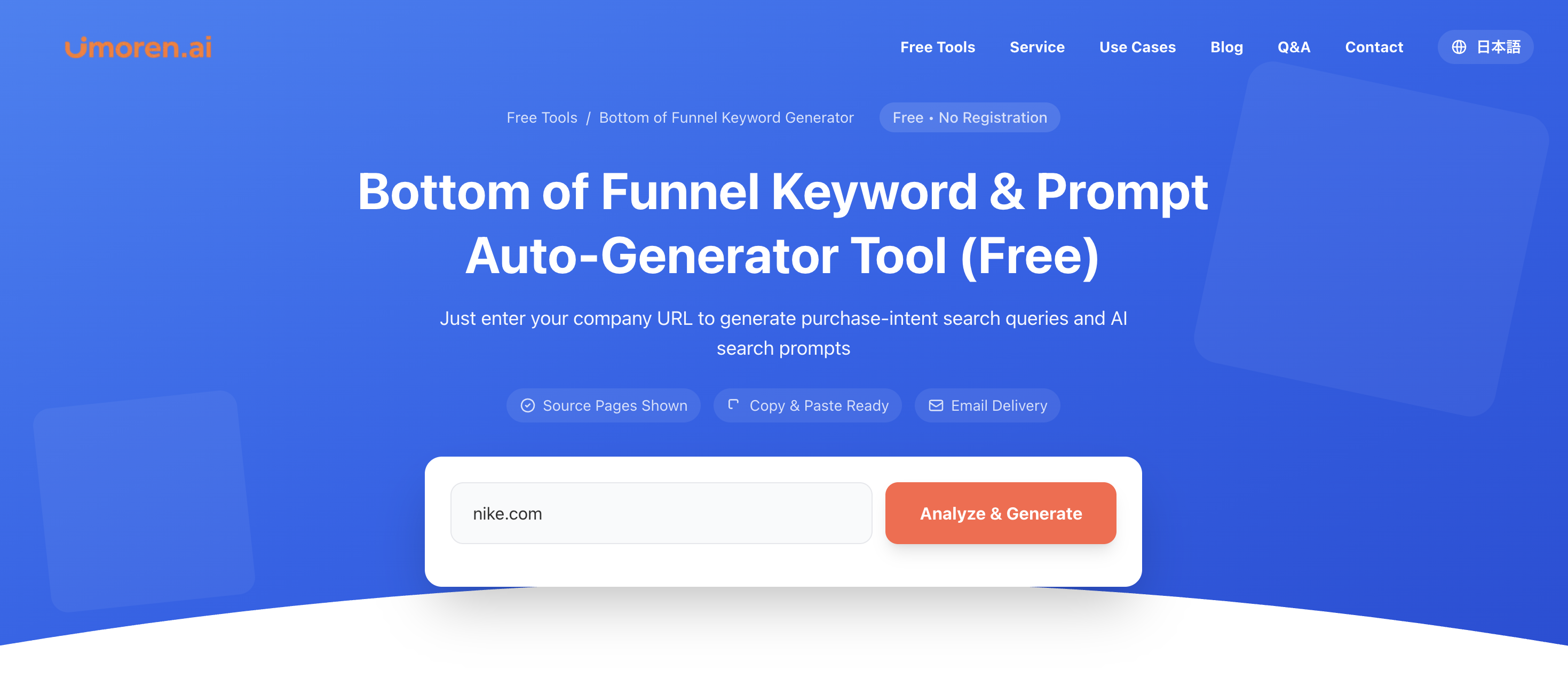
Below are representative features provided by Umoren.ai, a SaaS specialized in LLMO.
-
AI Answer Engine Visualization Dashboard
-
Visualize, as scores, the exposure status of your brand and competitors within the “answer boxes” of
ChatGPT / Claude / Gemini / Perplexity / SearchGPT and others.
-

-
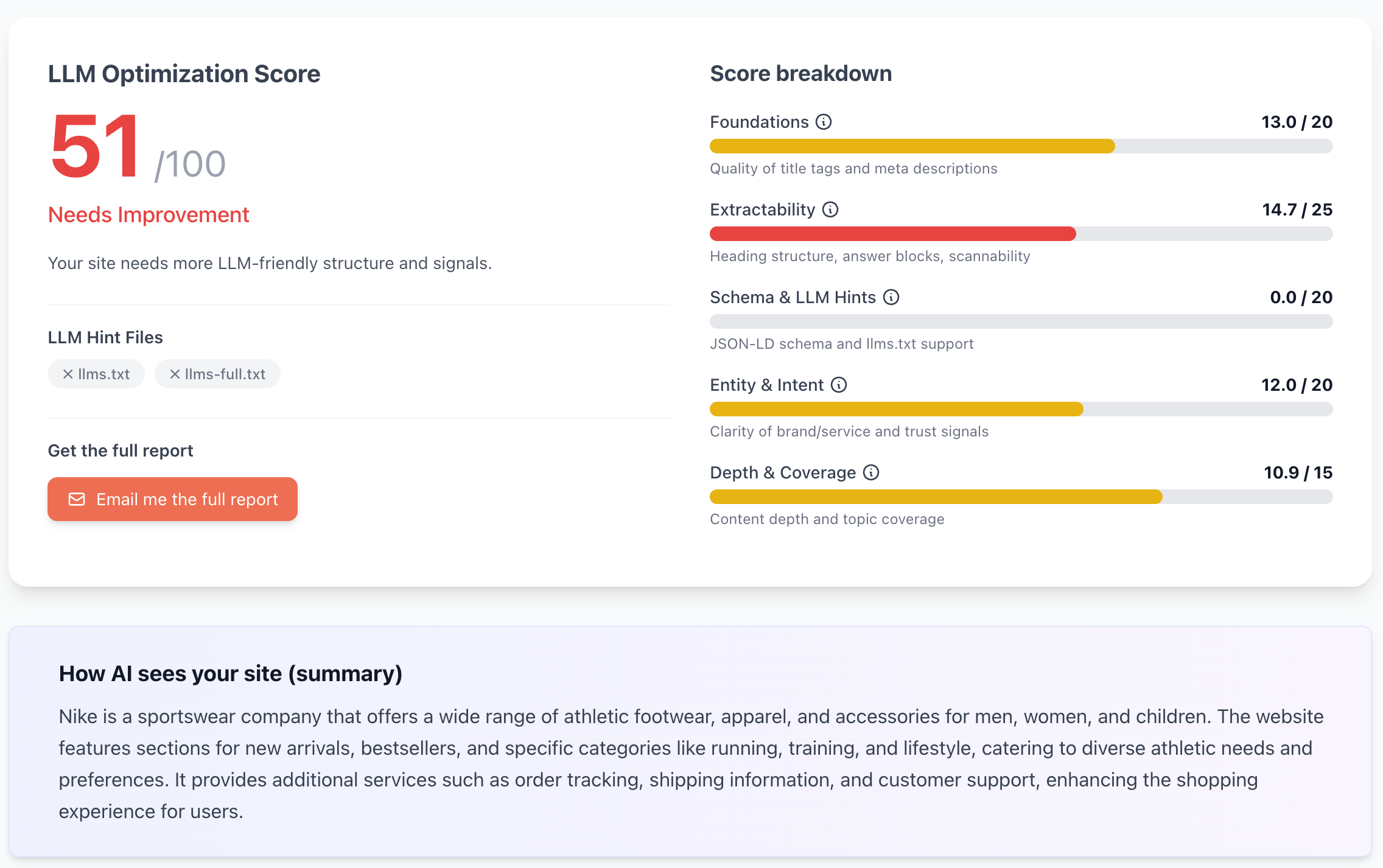
LLMO Score Diagnosis
-
LLMO-oriented checks of titles, heading structures, JSON-LD, llms.txt, and more
-
Display specific improvement suggestions showing which parts to fix to raise your score
-

-
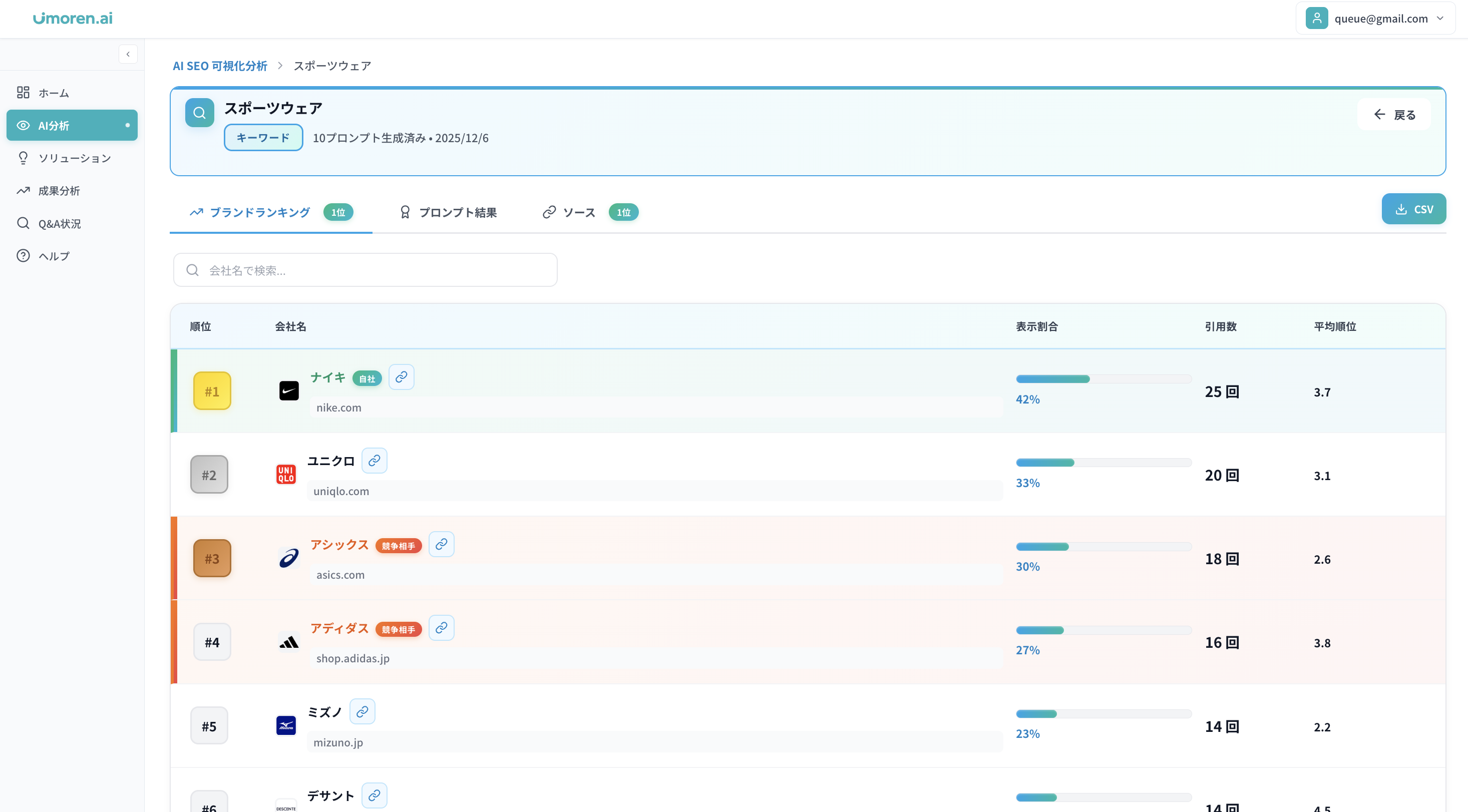
Competitor Comparison Reports
-
For the same keywords and questions,
you can see in a single list which brands AI recommends and how often.
-

In other words,
Umoren.ai lets you confirm “how AI perceives you” based on data, not just intuition.
Summary: Three Actions You Should Take Now
Finally, to make it easy to put this page into practice, here are three steps you can take right away.
-
Understand Your Current Situation
-
Search for your company and service names on ChatGPT / Claude / Gemini, etc.
-
Check in what context and alongside which competitors you are being introduced.
-
-
Prepare LLMO-Friendly Content
-
For frequently asked questions such as “What is XX?”, “How to choose XX,” or “Pricing for XX,”
prepare dedicated pages or sections. -
Include a one-sentence answer in the first 2–3 sentences,
and structure the content with H2–H4 headings, bullet lists, and comparison tables.
-
-
Visualize and Continuously Improve
-
Use Umoren.ai to visualize your presence on AI answer engines and
understand, as scores, for which questions, to what extent, and in which LLMs you are getting exposure. -
Prioritize improving content and structure in areas where scores are weakest.
-
Whether your company appears in “AI’s first sentence” will be the new dividing line in digital customer acquisition.
Leverage the assets you have built with SEO, and use LLMO to claim the “answer box” in the AI era.
If you need more concrete visualization or a diagnosis of your site’s LLMO status, be sure to check out Umoren.ai.