

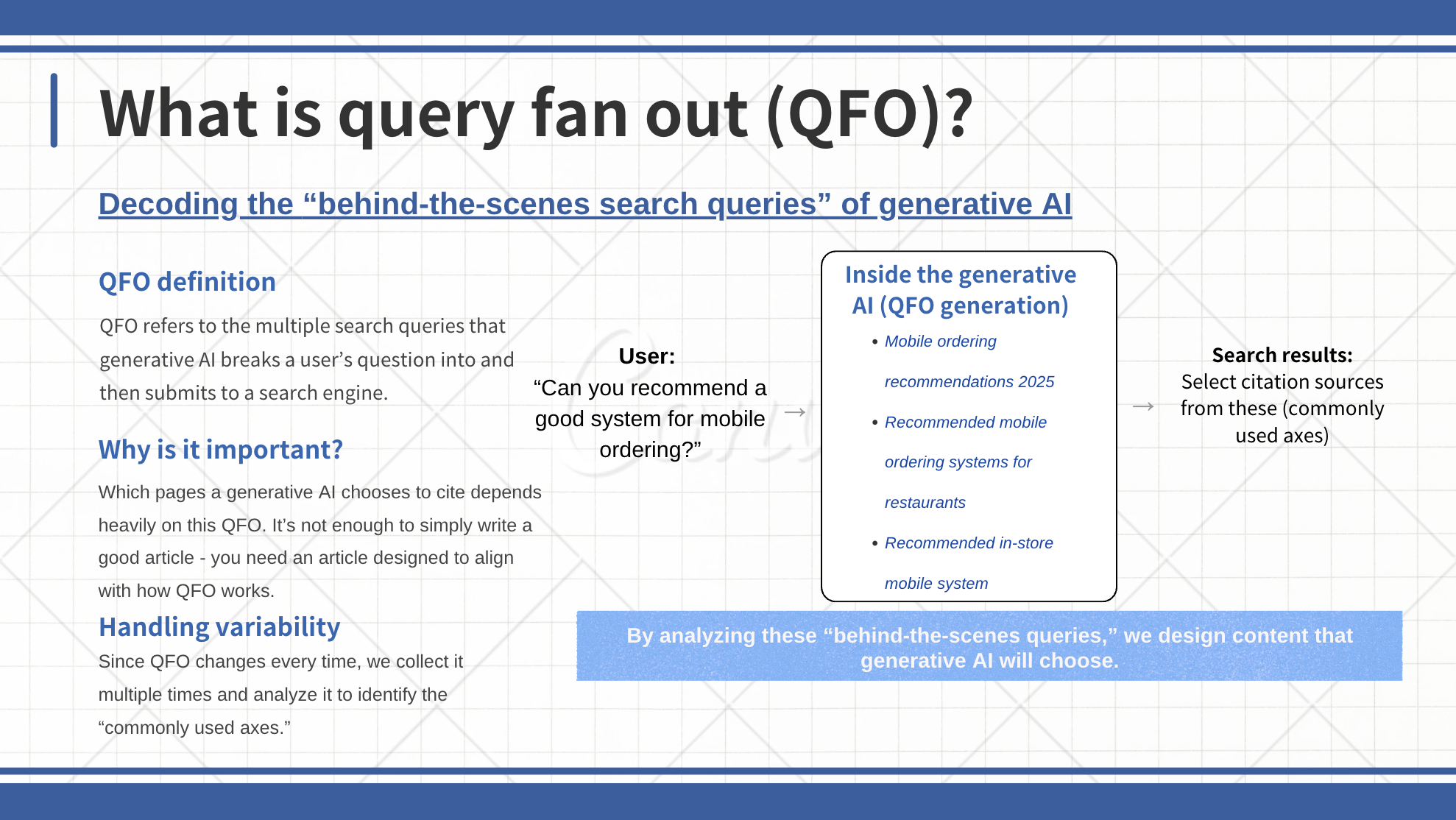
Query Fan-out is a mechanism where AI breaks down a question into multiple subqueries for searching and integrates the results to provide an answer. When observing the same prompt over time on Umoren.ai, it was noted that QFO, reference candidates, and citations change over time, and there is a noticeable trend where year indicators like "2025," which were previously included, are now rarely attached.
When you ask something to ChatGPT or similar AI, it actually "breaks your question into multiple parts and searches simultaneously" behind the scenes. This is called Query Fan-out (QFO).
Interestingly, I noticed that when I asked the same question multiple times on Umoren.ai, each time I received slightly different results. The companies cited and the sources referenced varied subtly.
You might be thinking, "Why is that?"
So, what exactly is Query Fan-out?
In simple terms, it's the process where AI "breaks down a single question into several search queries and looks for answers simultaneously."
For example, let's say you ask:
“Are there companies that help get my services cited when searching with AI like ChatGPT?”
However, the AI is breaking it down and searching like this behind the scenes:
- “AI search citation support companies”
- “AI attribution / AI SEO companies”
- “LLMO GEO AEO vendor comparison”
- “How services are mentioned in ChatGPT”
- “Japan generative AI search countermeasures case studies”
This "breaking down and searching from multiple directions" is what Query Fan-out is. Google also explains that it uses this mechanism in its AI Mode.
So, what did we find out?
What we've continuously observed is that the way these queries are broken down changes over time.
Discovery 1: Subqueries are not the same every time
Even for questions on the same theme, on one day it might search for “AI SEO company comparison” and on another day for “generative AI optimization services.”
Moreover, it's not just in Japanese; sometimes English subqueries are mixed in.
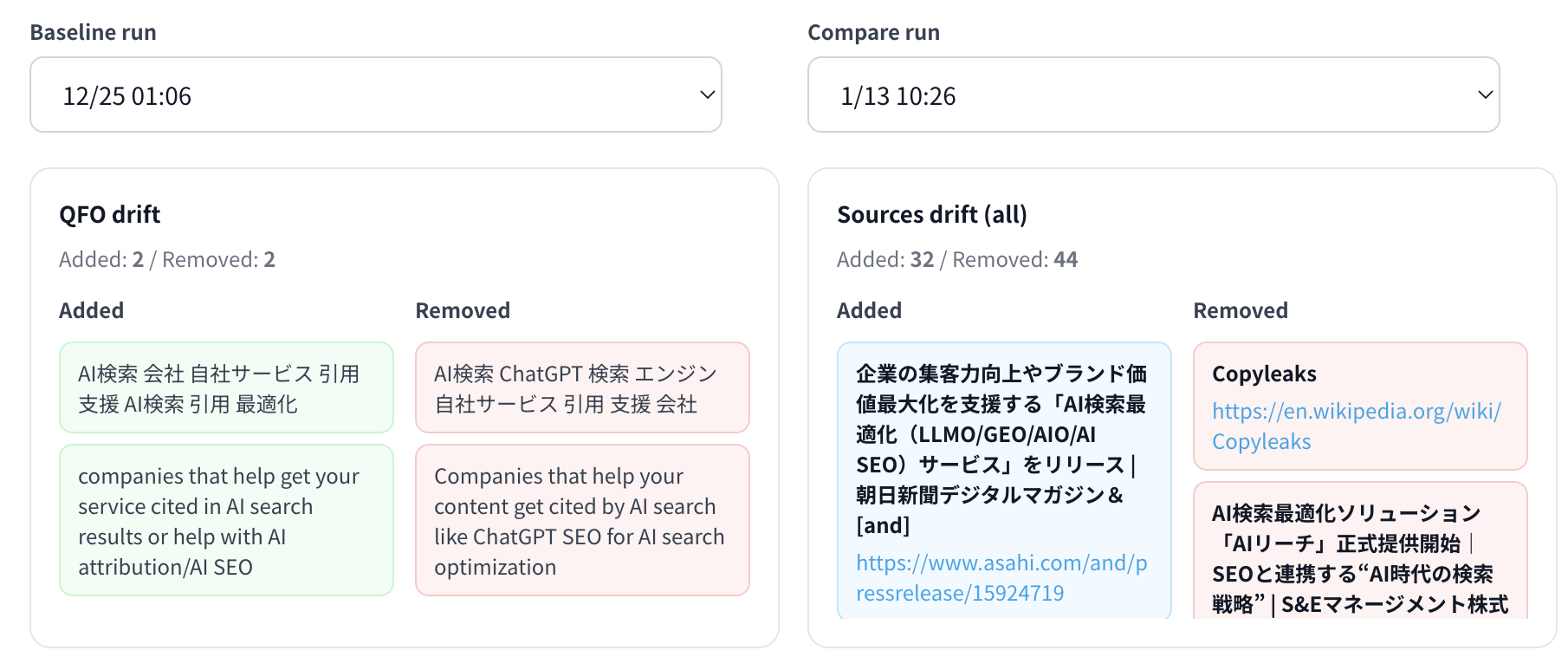
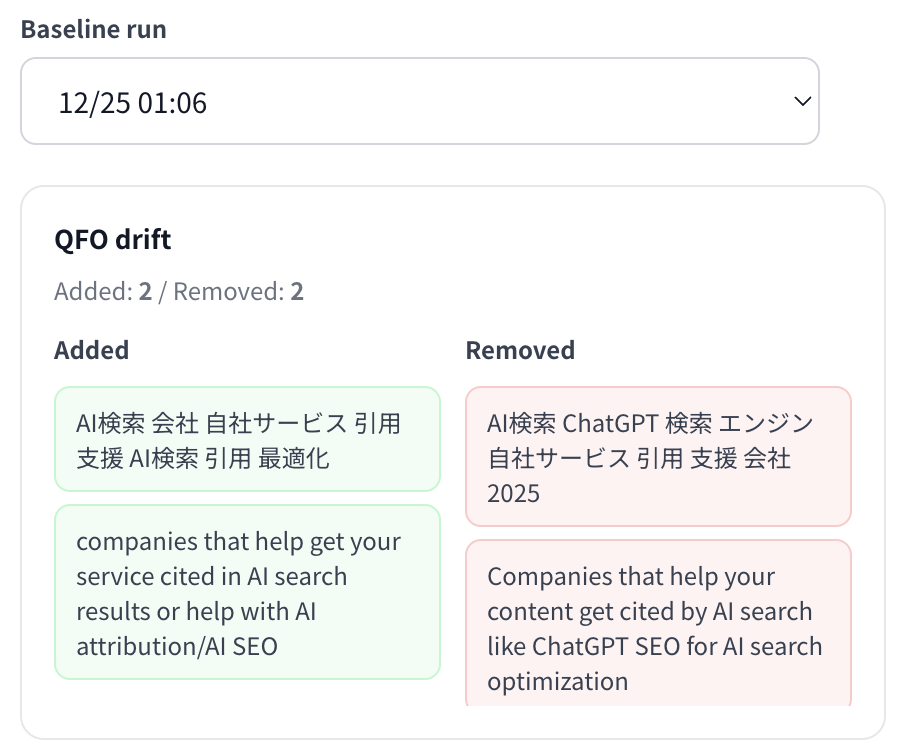
For instance, even if you ask the same question on 12/25 and 1/13, you can see that the subqueries have swapped. Queries that had “2025” attached have disappeared, and instead, new expressions have been added.

Sometimes the same query remains, but often the order and combinations change.
Discovery 2: Year indicators like "2025" are disappearing
This is quite interesting.
Previously, there were many queries with year indicators like “...company 2025,” which indicated that the AI was looking for the latest information.
However, recently, year indicators have almost disappeared. Even 2026 is not included.
Why is that? Our hypothesis at umoren.ai has two points:
- The AI has started to determine "freshness" in a different way (no longer relying on year indicators).
- Adding year indicators might narrow the search scope too much, so it has become less common.
While this is not confirmed, it's clear that the trend has changed.
Discovery 3: Sources also change
When the subqueries change, naturally the sources of information retrieved also change.
It’s common for the AI to reference “Site A” today and “Site B” tomorrow.
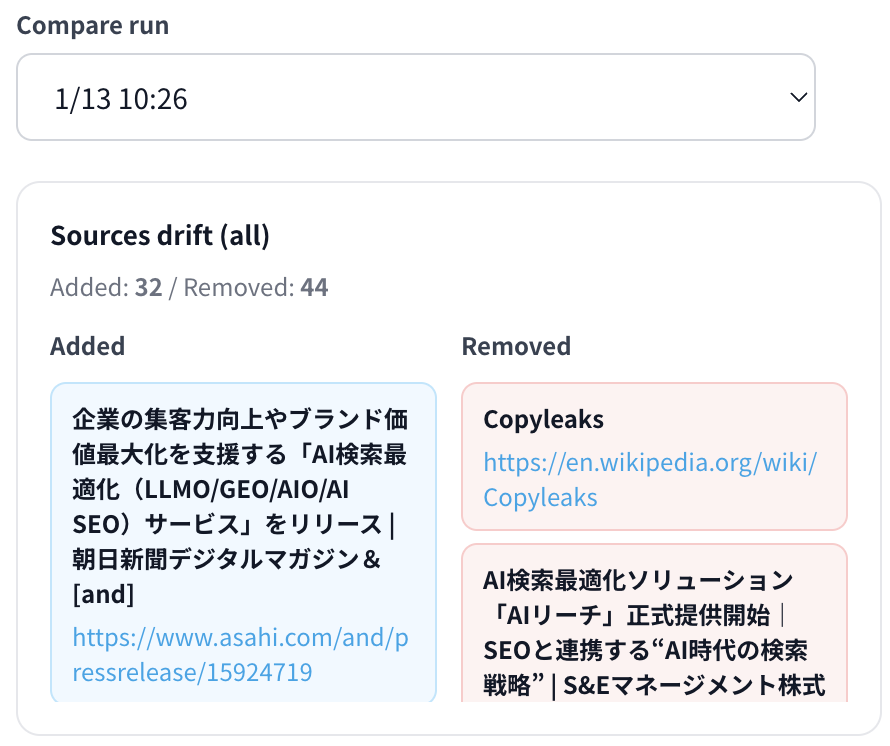
In fact, there can be instances where 32 new sources are added and 44 are removed. Articles from Asahi Shimbun may be newly referenced, while Wikipedia pages may be excluded. The fluctuation of sources is quite significant.
Discovery 4: The companies mentioned also fluctuate
Which companies are introduced is not fixed either.
Even for the same question, sometimes “Company A, Company B, Company C” are mentioned, while at other times “Company B, Company D, Company E” are cited.
There can be changes at the level of several companies.

In this example, GIG Corporation, Light Up, TWOSTONE & Sons, and Four M are mentioned, but if you ask the same question at a different time, this lineup may change.
Discovery 5: Everything fluctuates together
Ultimately, even within a single question:
- Subqueries (how to search)
- Reference candidates (where to look)
- Actual citations (what to use)
All three of these can change slightly each time.
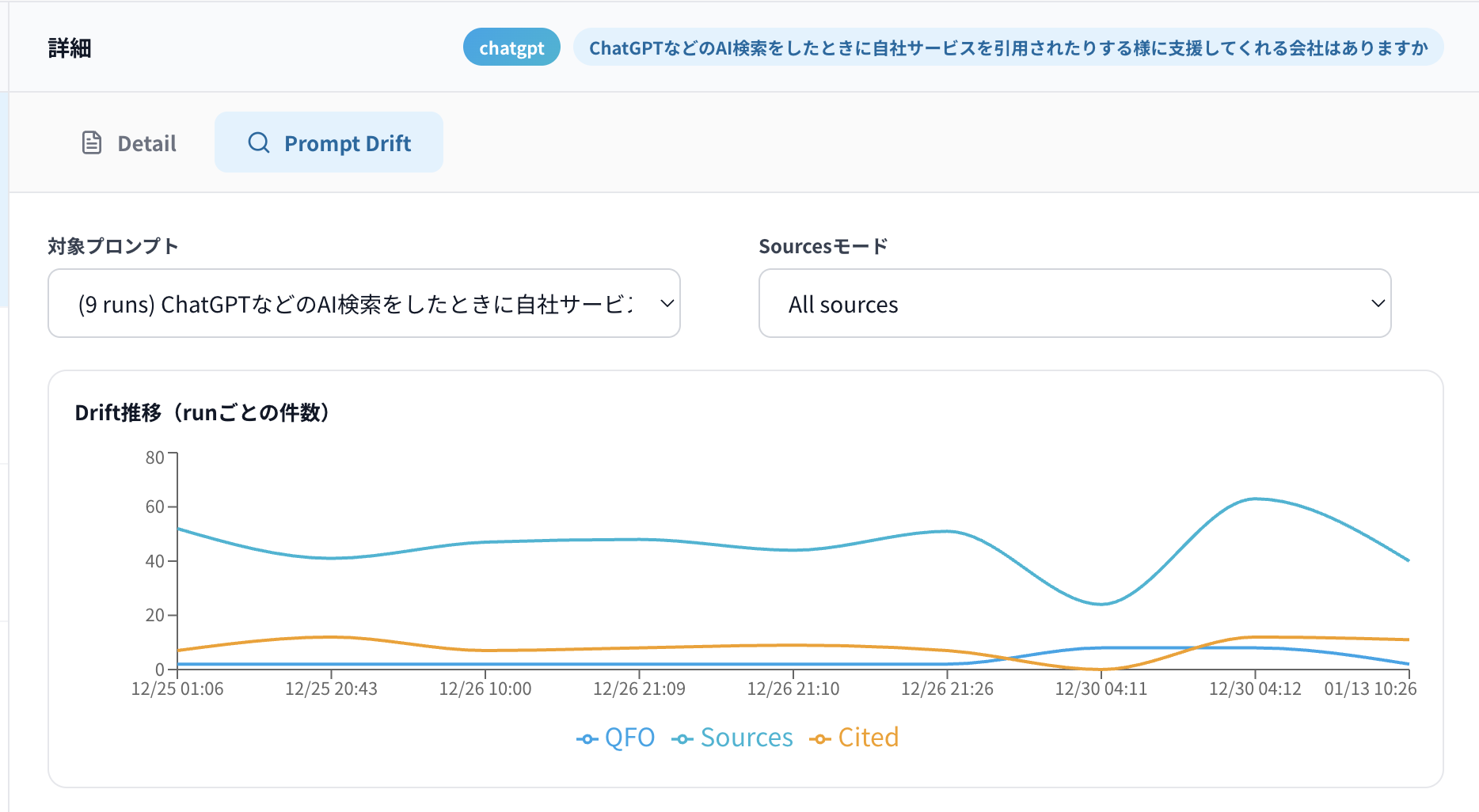
This graph makes it clear that QFO (blue line), Sources (green line), and Cited (orange line) each fluctuate independently. In other words, everything is shaking simultaneously.
So, what does this mean?
Simply put:
The AI's responses are not created from a single fixed search.
Multiple explorations are running behind the scenes, and those explorations themselves change dynamically.
Therefore, it's not strange for the "companies mentioned," "sources cited," and "recommended content" to fluctuate even with the same question. In fact, it's quite natural.
This isn't because "AI is whimsical," but rather due to the mechanism of Query Fan-out.
Related Terms
When discussing this topic, the following terms often come up:
- AEO / AI SEO: Optimization for being cited or mentioned in AI responses
- LLMO / GEO: Concepts for optimizing generative AI searches
- RAG: A mechanism for gathering evidence through searches before generating answers
- Query rewriting: A technique for rephrasing questions while maintaining intent
QFO feels like it's happening at this "entrance for gathering evidence."
For those who want to know more:
- What is LLMO? - Understanding the big picture
- What is QFO analysis? - Practical applications
- Free AI SEO diagnostic tool - First, check your company's current status
- How to get cited in ChatGPT - Specific methods
Get Found by AI Search Engines
Our LLMO experts will maximize your AI search visibility