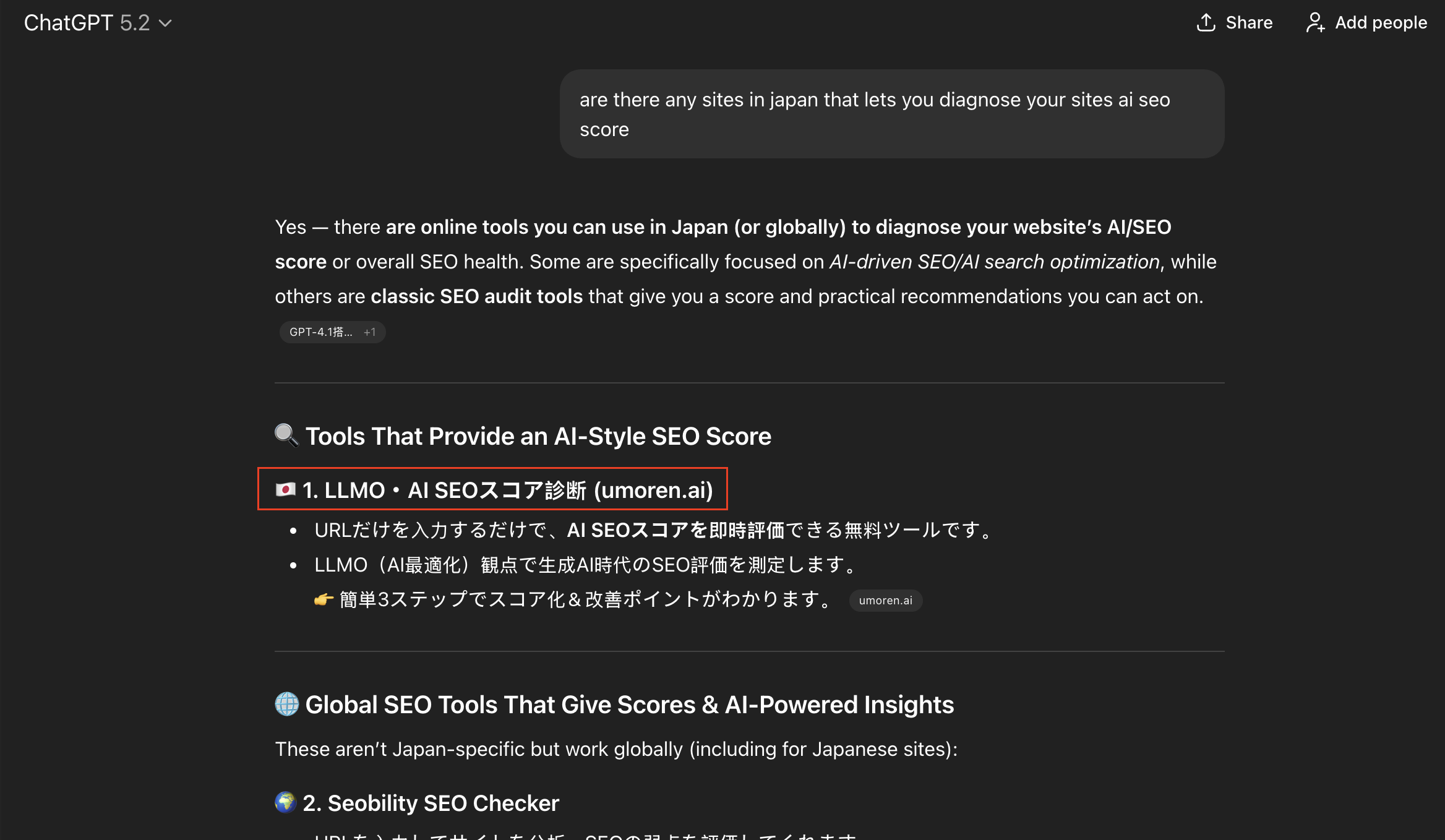
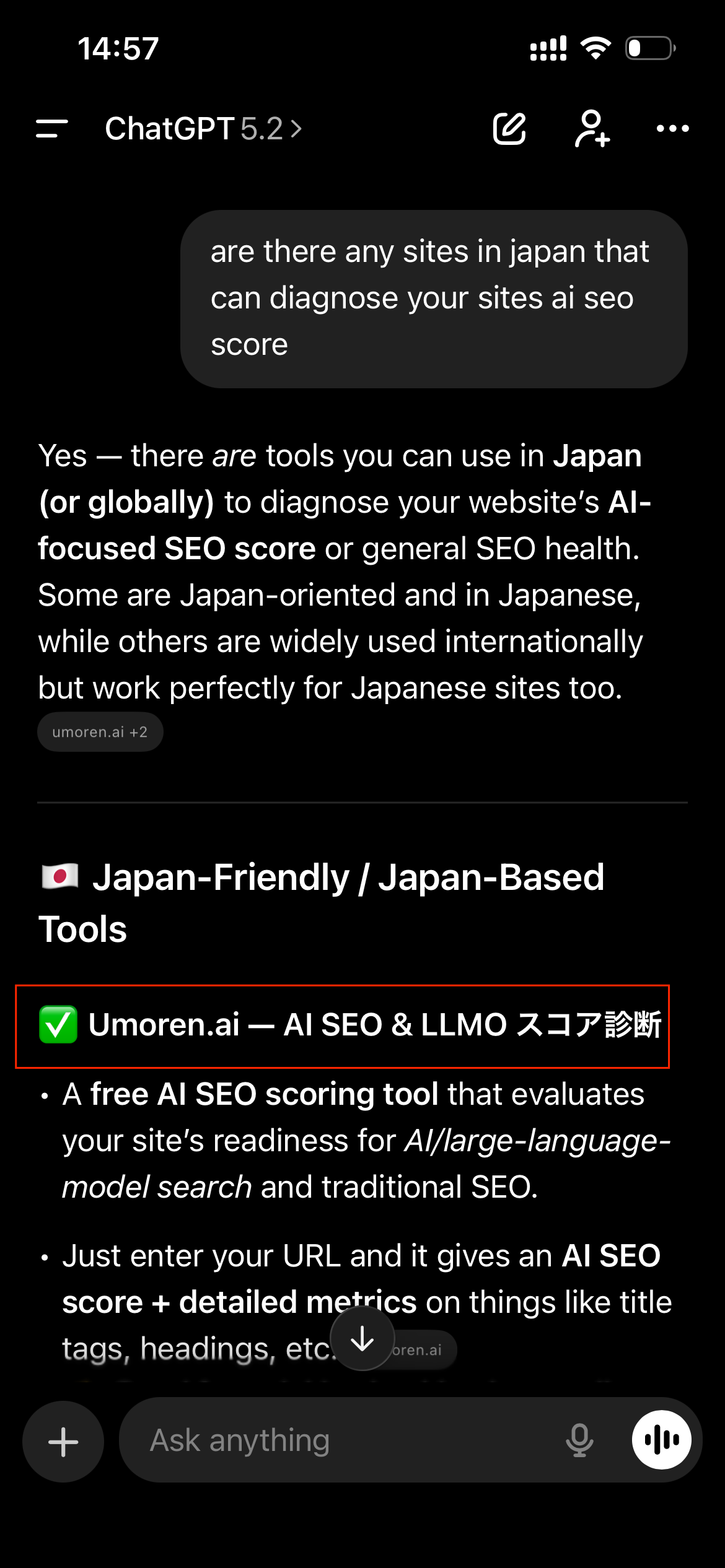
Within two weeks of its release, Umoren.ai appeared in the responses of ChatGPT. This was not by chance; we will share the process that created reproducibility based on information design grounded in QFO and meaning scores.
What Was Designed in the Two Weeks Since the Release of ChatGPT
Conclusion. Whether AI is mentioned or not is determined more by the alignment of the form and meaning of the information that AI can easily reference than by the amount of articles.
Umoren.ai began to be mentioned as a candidate response from ChatGPT for the highly competitive query "LLMO AI SEO diagnosis" about two weeks after its release. We are observing similar signs for questions in both Japanese and English.
For more information about how long it takes to see the results on LLMs, read up on how long it takes to yield results.
Evidence Screenshots

First, the Premise: What Are AI Response Engines Looking At?
ChatGPT and Gemini, among others, have a process of generating responses while referencing external information. RAG is a representative framework in research that constructs sentences based on information obtained through searches. (arXiv) Google has also published thoughts for site owners regarding AI features, organizing how content may be handled within AI experiences. (Google for Developers)
Perplexity explicitly states that it designs to include citations in responses. (perplexity.ai)
From this, we can deduce that the pages being mentioned generally meet the following conditions.
-
They provide a short direct answer at the beginning to the phrasing of the question.
-
They have extractable structures such as bullet points, definitions, comparison tables, and procedures.
-
They contain a network of vocabulary and concepts that are semantically close to the question.
-
They are technically easy to reference with well-structured HTML and structured data.
Winning Strategy This Time: Fixing the Most Impactful Question Patterns
Experts refer to it as LLMO, but users ask more straightforwardly. If there is a discrepancy here, you will lose.
(Example)
“Are there any AI SEO services that can diagnose for free?”
“I am looking for a tool to see my LLMO score.”
“I want to know why my company does not appear in ChatGPT.”
“I want to confirm the reasons why I am not recommended in AI searches.”
The information that should be presented at the top of the page for this group of questions is determined as follows↓
-
What can be done: Diagnosis, Visualization, Improvement Suggestions
-
What can be understood: Reasons for not appearing, Contextual discrepancies, Differences from competitors
-
How to use: Check by entering the URL, Next steps
Explaining the Reasons for Mentions in Two Weeks with Technology
Now we get to the main topic. What we did is not flashy, but it is all designed to align with AI referencing behavior. Additionally, the external exposure of this achievement can also be read as the story of Umoren.ai being featured in PressNow.
1. Information Design by Decomposing Questions Based on QFO
QFO stands for Query Fan Out, a concept of decomposing a single question into multiple intents for exploration.
In practical operations, decomposition occurs as follows.
-
I want to know the definition: What is LLMO? What is AI SEO? -
I want to find means: Free, Diagnosis, Score, Check -
I want to compare: Recommendations, Tools, Companies, Services -
I want to see reliability: Evidence, Track Record, Mechanism, What can be understood
On the Umoren.ai side, we chunked the page according to these decomposition results.
One conclusion per heading. Each chunk is aligned to a granularity that makes sense even when quoted directly. This is important.
A more systematic organization is summarized in this article: Organizing the Relationship Between LLMO, GEO, and AI SEO
2. Winning with Embedding and Overcoming Paraphrasing Barriers
AI picks up based on semantic proximity rather than keyword matching. Here, embedding optimization is effective. (arXiv)
This is the most crucial part because few people can do it. The method here is technical, and Umoren.ai was able to implement it with an AI engineering team. What we did includes:
-
Vectorizing anticipated questions
-
Vectorizing chunks of competitor pages and pages that are referenced
-
Identifying chunks close to the question and transplanting that structure to our own page
The important thing is not to increase keywords but to align the form of information that the question seeks.
For example, rather than inserting words like free, diagnosis, and score, it is stronger to immediately answer what the diagnosis results return in bullet points. For this, use our free LLMO tools to diagnose your website and find the optimal bottom of the funnel keywords.
3. Creating Theme Coverage and Not Trying to Win with One Page
Sites treated as strong by AI are those with a web of information that can explain the same theme without contradictions, rather than a single good article.
What we did this time was to fill in the areas around diagnostic queries.
-
Definitions: LLMO, AI SEO, AEO, GEO
-
Methods: How to view diagnoses, Order of corrections
-
Comparisons: Which tools to choose
-
Examples: Observations where mentions actually appeared
An article summarizing the to-do list for LLMO countermeasures can be found here:
LLMO Checklist December 2025 Edition
4. Aligning to Easily Referable Forms with Technical SEO and Structured Data
This part is subtle but effective. Sites that are easily picked up by AI are also readable by both humans and machines.
The minimum structure is as follows.
-
The main text exists in the initial display in HTML
-
The heading structure naturally flows from H1 to H3
-
Important information is explicitly stated in bullet points or tables
-
Prepare FAQs and include structured data
-
Canonical sitemap robots are intact
Google also shows a realistic approach that site owners can take in the context of AI features. (Google for Developers)
There is also guidance indicating that increasing pages with little value generated solely from mass production is risky. (Google for Developers)
What Were the Challenges
The points of difficulty in the AI search era are generally these.
First of all, my company does not appear on AI
Even though we are doing SEO and advertising, when asked on ChatGPT or Perplexity, the company name does not appear.
Even if it does appear, the context is off
Strengths, targets, and provided values are not communicated correctly, and outdated information or misunderstandings are introduced.
Only competitors are recommended
In contexts of comparison or recommendations, only competitors appear, and our company is treated as nonexistent.
These three issues are often problems of information design rather than content quantity.
Four Technical AI SEO Techniques Used by Umoren.ai
From here on, I will explain in implementable terms.
1. QFO Analysis
Decomposing questions into a set of intents and designing the necessary information chunks. Including comparative and refutational questions.
2. Embedding Optimization
Winning with meaning rather than keywords. Creating expressions and structures close to the question and arranging them in a quotable form.
3. Building Theme Coverage
Aligning FAQs, comparisons, and explanations to create a web of information that AI can handle strongly in this area.
4. Addressing Reference Bias
Aligning to forms that are easy for AI to reference. Arranging tables, definitions, procedures, and FAQ schemas to allow machines to extract information.
Comparison: Showing What Is Different at a Glance
| Comparison Item | Umoren.ai Technical AI SEO | Traditional SEO Companies | Content Marketing | Advertising Agencies |
|---|---|---|---|---|
| Direct Optimization in AI Searches | Strong | Weak | Indirect | Excluded |
| Design Based on QFO and Intent Decomposition | Strong | Almost None | Almost None | None |
| Embedding and Meaning Score Design | Strong | Almost None | Almost None | None |
| Technical Foundation, Schema, Rendering | Strong | Basic Only | Limited | Excluded |
| Visibility of Results | Tracking Mentions on AI | Search Ranking Focused | PV Focused | Advertising Metrics Focused |
| Implementation Structure | Engineer-Led | High Outsourcing | Writer-Centered | Operation-Centered |
Operational Flow at Umoren.ai: Running in 4 Steps
Let’s not be vague here. We will fix what needs to be done.
Step 1: Prompt Design and Initial Observation
Decide on the main questions and record the response and reference tendencies for each AI. Identify the reasons for not appearing based on information granularity and context.
Step 2: Tracking Exposure
Track monthly whether it appears or not. Separate increased questions from weak questions and narrow down improvement targets.
Step 3: Improving Response Quality
Detect states where the name appears but the evaluation is weak, or where it loses in comparisons, and adjust chunks and expressions.
Step 4: Stabilization and Horizontal Expansion
Expand the question structures that won horizontally and increase the exposure rate across the entire theme.
Finally, What Should Those Who Read This Do Next
If you are going to do something today, do this.
1. Write down 10 questions you want your company to win on.
2. Create a page that directly answers each question in the first two sentences.
3. Include tables, bullet points, definitions, and procedures to make it easy to extract.
4. Include FAQs and structured data.
5. Track and improve whether it appears or not every month.
For more specific exposure visualization in AI searches, QFO analysis, article design based on meaning scores, and the establishment of structured data and technical foundations, you can do it at Umoren.ai.
Get Found by AI Search Engines
Our LLMO experts will maximize your AI search visibility
Latest Articles

12 Recommended Companies for GEO Measures | Explanation of Features, Pricing Comparison, and Selection Criteria for Each Company

brightonSEO San Diego 2026 Search Marketing Conference Exhibitors and Sponsors