This article explains the roles and responsibilities of four departments for successfully implementing LLMO and AIO strategies, as well as how to build an effective system. It organizes the points of collaboration among marketing, public relations, development, and sales, clarifies responsibilities using RACI, and outlines the procedures for cross-company operations, including how to manage multiple roles within a small organization.
Even after starting AI search optimization (LLMO, AIO, AISEO, GEO), there are times when operations come to a halt because it is unclear what to ask from marketing, public relations, development, and sales. To continue the initiatives, it is necessary to clarify the information provided by each department and the final decision-maker before increasing the number of responsible personnel.

Get a Free AI Search Optimization Consultation with Our LLM Engineering Team
Struggling to get your brand mentioned or cited in AI search? The LLM engineering team at Umoren.ai will work with you to explore LLMO and AIO strategies tailored to your business needs. Start with a free 30-minute consultation.
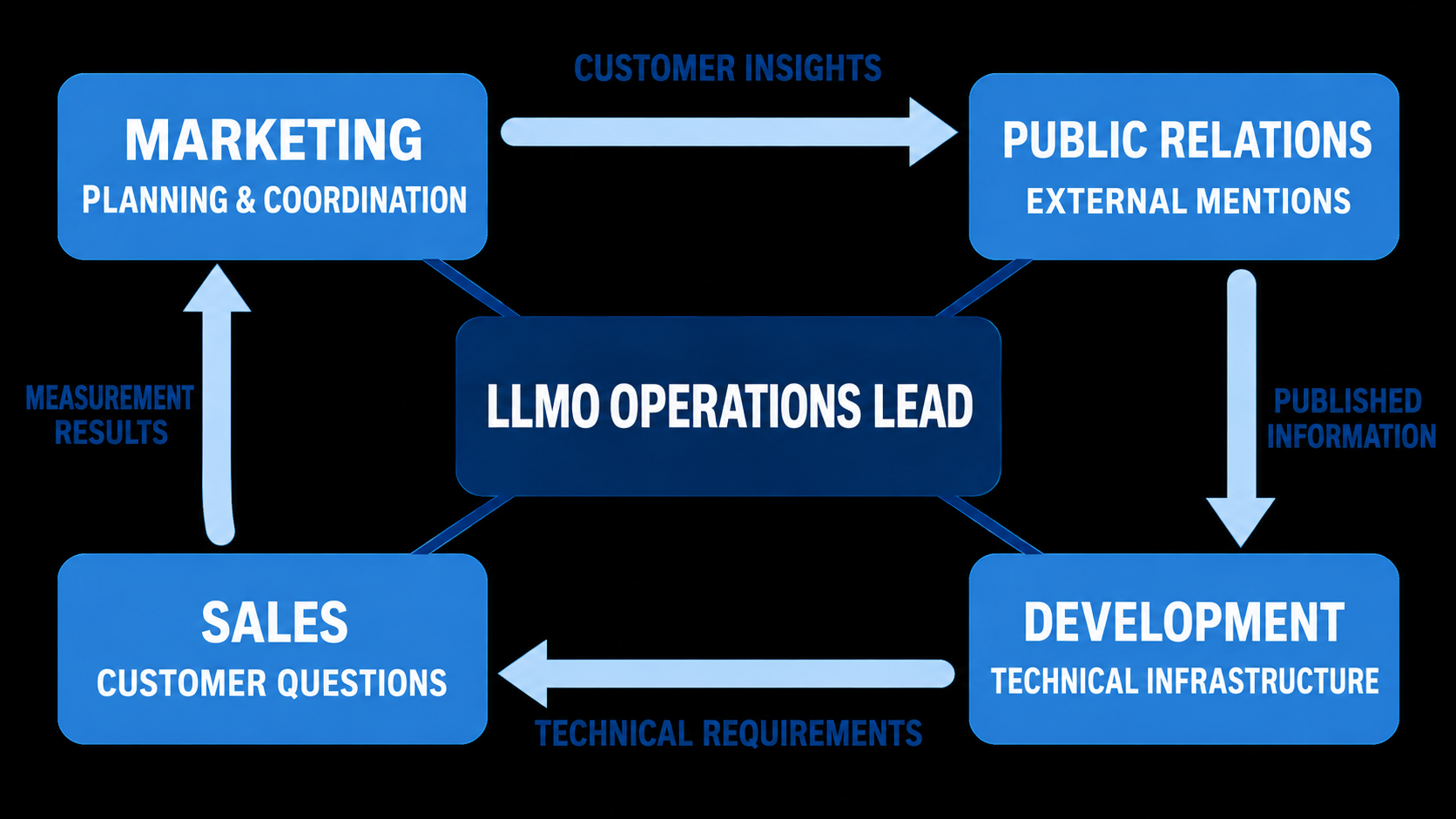
The basic structure involves marketing handling planning and oversight, public relations managing external mentions, development focusing on the technical foundation, and sales addressing customer inquiries, with one operations manager overseeing everything. This article will specifically organize the responsibilities of each department, KPIs, RACI, overlapping roles in small organizations, and the delineation between outsourcing and in-house production.
Overall Role Distribution for Cross-Departmental Operations
LLMO and AIO strategies require content that can be used for responses, mentions from third parties, a technical foundation that can obtain information, and the actual language used by customers. Since these cannot be gathered by just one department, the four departments will be connected through a common operational flow.
LLMO
LLMO (Large Language Model Optimization) is an initiative aimed at achieving a state where the company is cited, mentioned, or recommended within responses from generative AI such as ChatGPT and Gemini. AIO (AI Optimization) refers to exposure optimization in general AI searches, including Google AI Overview. GEO (Generative Engine Optimization) is used almost synonymously.
Reasons for the Need for Collaboration Among Multiple Departments
When AI generates responses, it references information not only from the company’s website but also from external media, review sites, and public institutions. It is essential to not only improve the company’s website but also to organize both public and external information.
RAG
RAG (Retrieval-Augmented Generation) is a mechanism that searches for and retrieves external information and uses that content to generate responses.
|
Elements AI Considers |
Required Information and Measures |
Main Responsible Department |
|---|---|---|
|
Specific descriptions usable for responses |
Content including FAQs, comparison information, and primary data |
Marketing |
|
Mentions from third parties |
Publication in industry media, press releases, release of survey data |
Public Relations |
|
Ease of information retrieval |
Structured data, sitemaps, crawler permission settings |
Development/IT |
|
Words actually used by customers |
Questions frequently asked in negotiations, comparison criteria, reasons for loss |
Sales |
Content Evaluated by AI Searches
In AI searches, the semantic relevance of questions and information and whether the content matches the question's intent are emphasized. The evaluation methods differ by service, but it is important to check not only for word matches but also for the clarity of answers to questions.
The connection between sales, who know the actual questions customers ask, and marketing, which transforms that into content, is essential. Neither technology alone nor content alone will provide the necessary information.
Four Common Steps Across All Departments
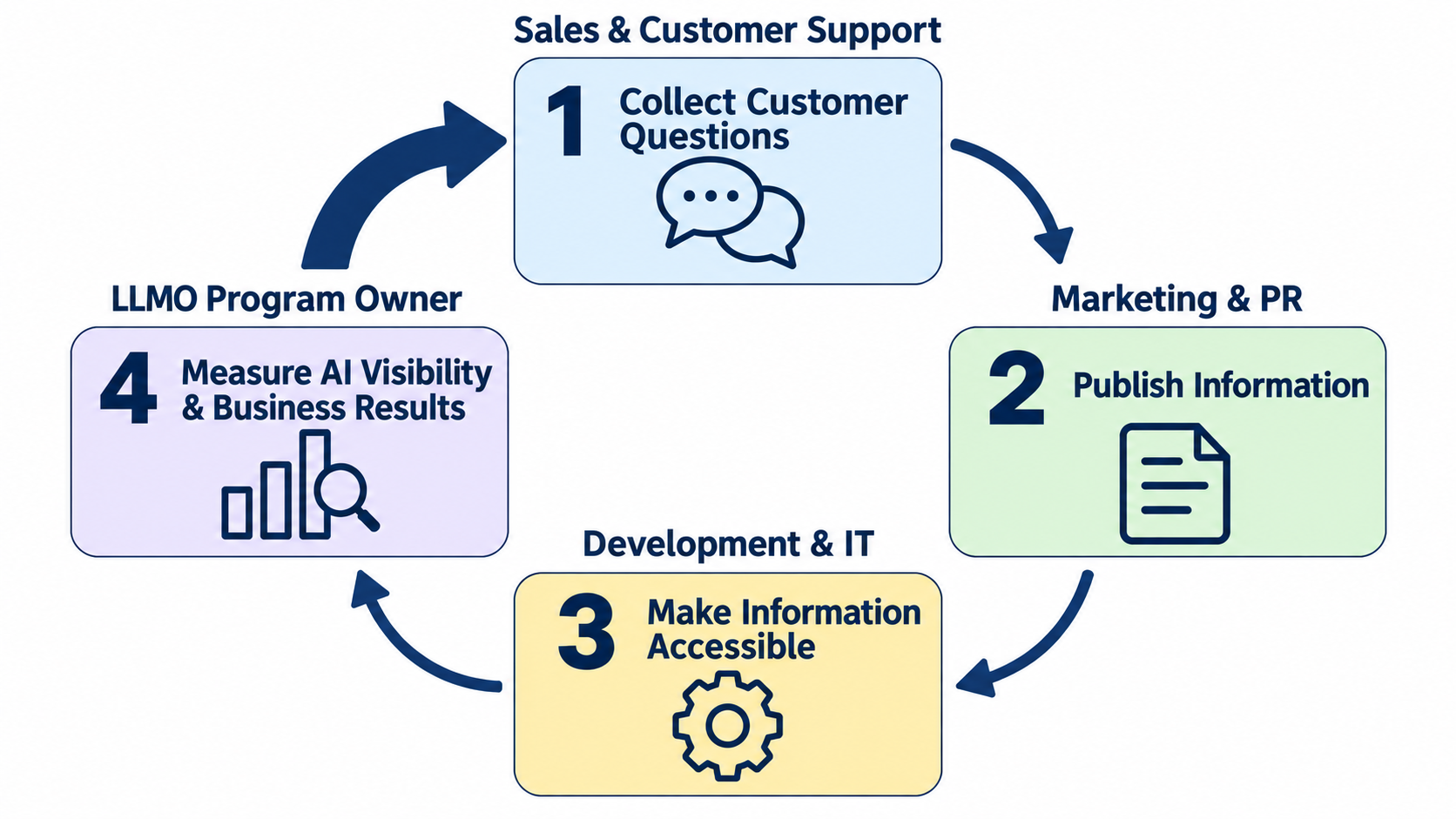
Regardless of the department, the work progresses through the same four steps. By fitting the tasks of each department into this flow, the handover of information and the next responsible person become clear.
1. Collect customer inquiries. Sales and customer support are responsible.
2. Publish information. Marketing and public relations are responsible.
3. Make it technically retrievable. Development and IT are responsible.
4. Measure AI exposure and business outcomes. The LLMO operations manager is responsible.
If any one part is missing, the entire initiative will stop. For example, if customer inquiries cannot be collected, there will be an increase in general articles that are difficult for AI to evaluate. If you are unsure about the overall priorities, please refer to practical steps to determine priority of action.
Responsibilities of Marketing, Public Relations, Development, and Sales
The division of responsibilities among the four departments will be based on the scope that can be handled as an extension of regular operations. It will be easier to continue by connecting existing negotiation records, public relations activities, development tickets, and content production rather than increasing new dedicated tasks.
Marketing Oversees Prompts and Content
The marketing department oversees the selection of questions (prompts) from search users in AI searches and the planning and production of content that answers those questions. They select search prompts according to the customer's consideration stage, such as comparison, evaluation, or just before implementation.
They receive existing negotiation records and reasons for loss from the sales department and convert the phrases used by customers into candidates for search prompts.
KBF (Key Buying Factor)
KBF (Key Buying Factor) refers to the conditions that customers prioritize when deciding where to purchase from among multiple options.
The main tasks are as follows:
• Listing and prioritizing targeted prompts
• Organizing KBFs as evaluation criteria for AI
• Producing and updating FAQs, comparison pages, and case study pages
• Planning unique research data in collaboration with public relations
• Organizing requirements for structured data implementation and requesting development
Public Relations Increases External Mentions and Citations
The public relations department increases mentions (citations) outside the company’s website. By inputting "What are the recommended companies in our industry?" into AI and listing the domains displayed as sources, they can consider the media to approach for publication.
The specific measures are as follows:
• Contributions and interviews with industry media
• Regular distribution of press releases
• Acquiring links from public institutions
• Social media outreach
• Publication of unique research
Research data that reflects the company's USP (Unique Selling Proposition) becomes information that external media can easily cite. Research planning is done in collaboration with marketing, while public relations is responsible for external dissemination and publication promotion.
Development Prepares the Foundation for AI to Retrieve Information
The development and IT department prepares the technical foundation that allows AI searches and search engines to retrieve information.
While structured data is not a mandatory requirement for AI searches, they will implement types that match the displayed content of the page, such as Organization, Product or Service, Article, and BreadcrumbList as needed.
They will check whether OAI-SearchBot is blocked in robots.txt. Since AI crawlers may also be blocked by CDN or WAF (Web Application Firewall), they will confirm with the infrastructure team.
|
Task |
Specific Work |
Frequency of Confirmation |
|---|---|---|
|
Implementation of structured data |
Implement schema that matches the displayed content in JSON-LD format |
When new pages are published |
|
Crawler control |
Check the permission status of OAI-SearchBot, etc., in robots.txt |
Once a month |
|
Sitemap maintenance |
Automatic generation and submission of XML sitemaps |
Once a month |
|
Improving display speed |
Measuring and improving Core Web Vitals |
Once a quarter |
|
Log analysis |
Check the crawling status of AI crawlers in server logs |
Once a month |
Maintaining the state where sitemaps and structured data are installed and crawlers can retrieve information is the core task of the development department.
Sales Shares Customer Language Without Modification
The sales department provides the actual language used by customers. There is no need to reorganize the questions. Operations can be conducted simply by sharing existing negotiation records, CRM, inquiry content, and sales materials.
CRM
CRM (Customer Relationship Management) is a system for managing customer information such as negotiation history and inquiries.
Asking sales to create new materials can easily halt operations, so they will collect the following information from existing data:
• Questions frequently asked in negotiations
• Competing companies or services that are compared
• Pricing, features, achievements, and support scope that customers prioritize
• Factors determining wins and losses
• Concerns before implementation and conditions that became issues in internal approval
The collected questions will be categorized into five stages: information gathering, competitor comparison, condition specification, anxiety alleviation, and decision-making, and converted into natural prompts used in AI searches.
For example, from the information "questions are asked about differences with competitor A," the following non-specific questions can be designed:
• What services are easy for small and medium-sized enterprises to implement?
• I would like to compare including pricing and support details.
• Which companies provide support even after implementation?
• What services are suitable for companies without specialized personnel?
Prompts will be prioritized based on question frequency, impact on wins and losses, and relevance to the customers the company wants to acquire.
Separate Execution Responsibility and Accountability with RACI
RACI
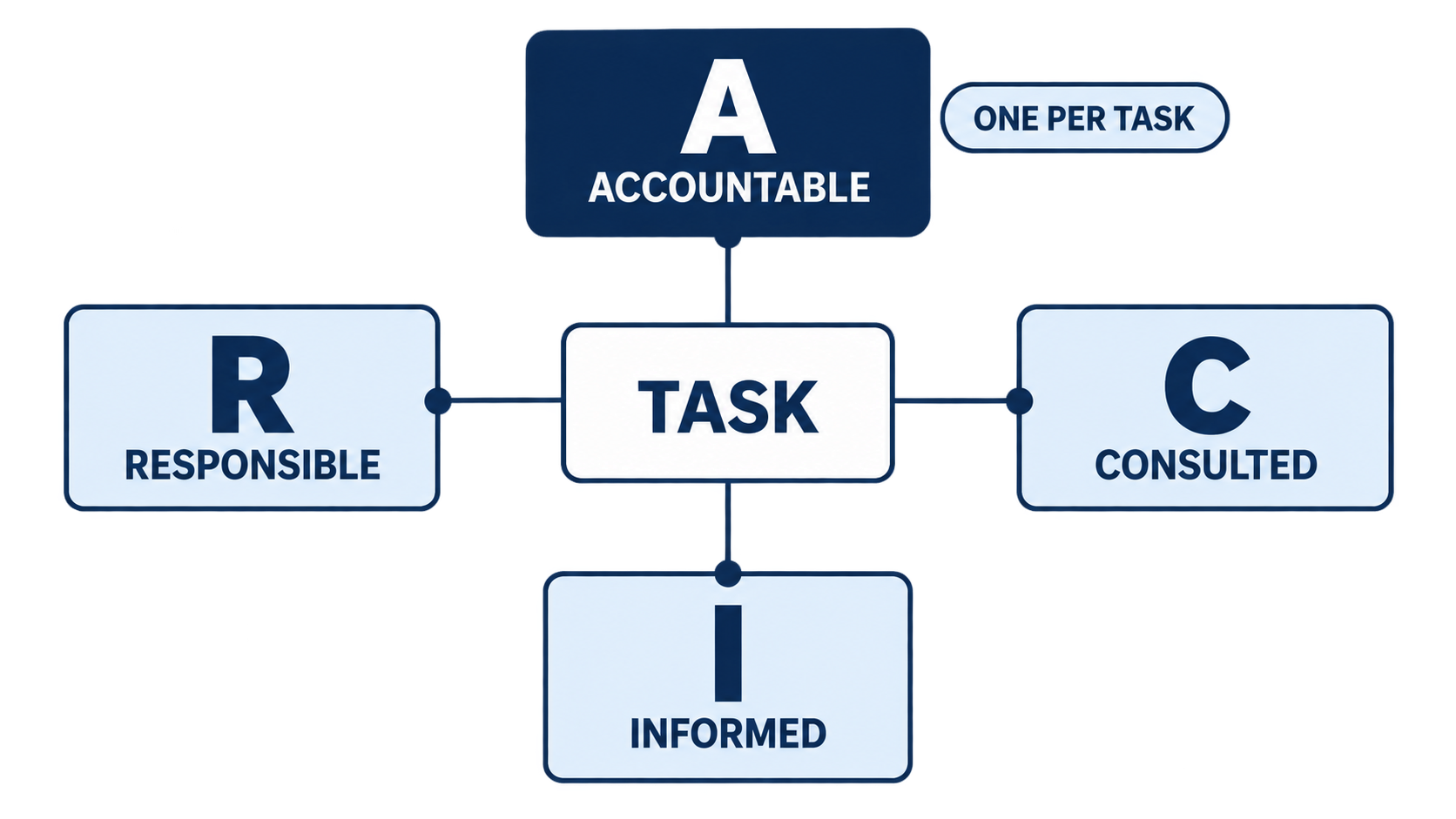
RACI is a method of organizing roles into four categories: Responsible, Accountable, Consulted, and Informed.
By breaking down major tasks into RACI, it becomes clear "who executes and who makes the final decision."
|
Task |
Marketing |
Public Relations |
Development |
Sales |
Operations Manager |
|---|---|---|---|---|---|
|
Selecting Targeted Prompts |
R |
C |
I |
C |
A |
|
Producing FAQs and Comparison Pages |
R |
I |
I |
C |
A |
|
Distributing Press Releases |
C |
R |
I |
I |
A |
|
Publishing Unique Research Data |
C |
R |
I |
I |
A |
|
Implementing Structured Data |
C |
I |
R |
I |
A |
|
Setting Crawler Permissions |
I |
I |
R |
I |
A |
|
Collecting Customer Questions |
C |
I |
I |
R |
A |
|
Monitoring AI Responses |
R |
C |
I |
I |
A |
|
Reporting Business Outcomes |
C |
I |
I |
C |
A |
Accountable should be limited to one person per task. If multiple people are assigned, the final decision-maker becomes ambiguous.
How to Proceed from System Building to Outcome Measurement
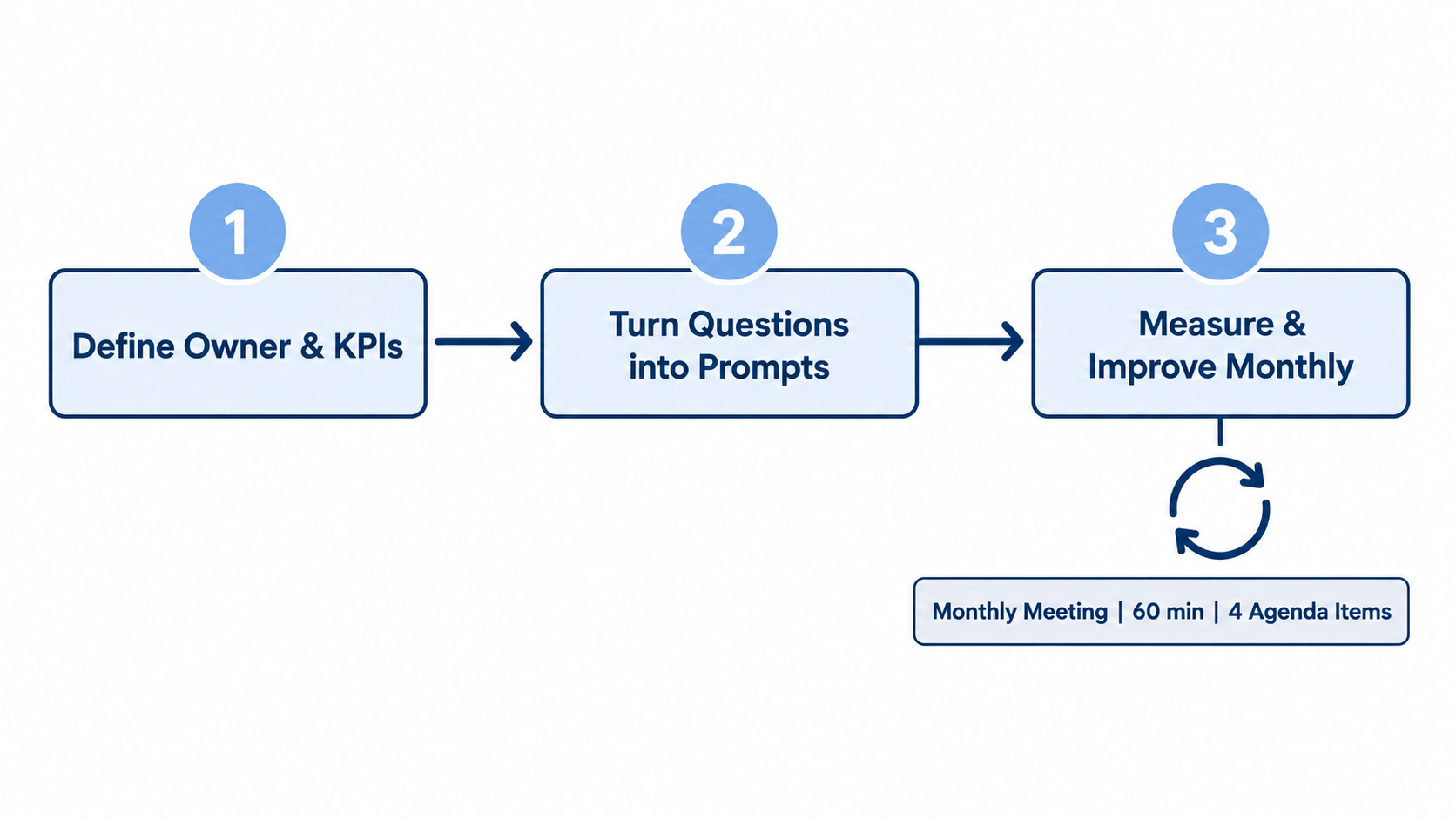
System building progresses in three steps: determining responsible persons, constructing information sharing flows, and monthly measurement and improvement. Finalizing the responsible person and KPIs within the first month is a turning point for ongoing operations.
Step 1: Determine the Operations Manager and Contacts for Each Department
The operations manager should be selected as the first candidate from the marketing manager, while also being someone who can make decisions on site updates, request development, and access business KPIs. If only the person in charge is decided without the authority to make requests, requests to development or sales will be delayed.
The responsible person should be someone who meets the following three conditions:
• Able to make decisions on content updates for the company’s website
• Able to create tickets for the development department
• Able to access the numbers of business KPIs
During the kickoff, the following four points will be decided in one meeting:
• Name of the operations manager (Accountable)
• Names of the contact persons for each department (Responsible)
• AI services to be measured (ChatGPT, Gemini, AI Overviews, Perplexity, etc.)
• Date and participants for the monthly regular meeting
The kickoff materials will include actual measurement results showing how AI searches are currently being handled. By confirming screens where only competitors are recommended, all can share the challenges across departments. Specific startup procedures are summarized in the practical guide to the five steps of LLMO implementation.
Step 2: Convert Customer Questions into Prompts
Sales will share existing negotiation records, and marketing will create a flow to organize them into search prompts. There will be no request for new input tasks from sales, and only deficiencies or misunderstandings will be supplemented during monthly checks.
|
Process |
Responsible |
Output |
Frequency |
|---|---|---|---|
|
Record questions during negotiations |
Sales |
CRM negotiation notes without modification |
As needed |
|
Extract and categorize questions |
Marketing |
List of questions categorized into five stages |
Once a month |
|
Convert to prompts |
Marketing |
More than 50 validation prompts |
Once a month |
|
Measure AI responses |
Marketing |
Record of mention status for the company and competitors |
Once a month |
|
Identify improvement targets |
Operations Manager |
Instructions for revising service pages and FAQs |
Once a month |
In the research, mentions of the company and competitors, recommendation rankings, sources of citations, comparison axes, and misinformation will be checked. The results will be used to improve service pages, comparison pages, FAQs, case studies, and sales materials.
If misinformation is found, the marketing and development teams will first correct the information sources on the company’s website. If external announcements or official statements are necessary, public relations will handle the dissemination.
Step 3: Measure AI Exposure and Business Outcomes Separately
KPIs will be divided into two layers: "AI exposure metrics" and "business outcome metrics." The former will be reported by marketing, while the latter will be reported by the operations manager. Focusing solely on AI exposure makes it difficult to see the relationship with business outcomes, which does not lead to budget decisions.
The citation rate is the percentage of times the company’s website is displayed as a source, the mention rate is the percentage of times the company name or service name appears in the response text, and the recommendation rate is the percentage of times it is presented as a recommendation in the response.
Citations, mentions, and recommendations are separate metrics. Even if a link is listed as a source, it may not be recommended in the text. By recording the three metrics separately, it becomes possible to identify areas for improvement.
|
KPI Layer |
Metric |
Responsible Department |
Reporting Frequency |
|---|---|---|---|
|
AI Exposure |
Citation rate, mention rate, recommendation rate |
Marketing |
Monthly |
|
AI Exposure |
Number of external media publications, number of backlinks |
Public Relations |
Monthly |
|
Technical |
Structured data implementation rate, crawler reach rate |
Development |
Monthly |
|
Business Outcomes |
Number of inquiries from AI searches, number of inquiries |
Operations Manager |
Monthly |
|
Business Outcomes |
Conversion rate of leads from AI, number of orders |
Sales |
Quarterly |
The monthly regular meeting should be kept within 60 minutes, and the agenda should be fixed to four points: "Trends of the three metrics from the previous month," "Existence of misinformation," "Pages targeted for improvement this month," and "Requests to other departments." Tasks should be labeled "LLMO" in existing management tools like Jira, Backlog, or Notion, mixing them into the current workflow. Using existing management tools will reduce the burden of learning new operations.
In Small Organizations, Marketing and Public Relations are Combined
In small organizations, one person will handle both marketing and public relations, positioning development and sales as cooperative departments that collaborate when necessary. The following are examples of operational frequency and will be adjusted according to the number of negotiations, publication systems, and development workload.
Examples of priority during dual roles are as follows:
1. Collecting questions from sales. This can be substituted with a 30-minute hearing once a month.
2. Updating FAQs and comparison pages. Aim for two updates per month.
3. Initial implementation of structured data. Organize during the first time, and thereafter respond when new pages are published.
4. External outreach. Aim for one press release per quarter.
Tasks to Keep In-House and Tasks that Can Be Outsourced
Tasks that should remain in-house include collecting customer inquiries and determining business outcomes. The raw words of customers can only be found internally, and decisions on budgets and priorities cannot be replaced externally.
|
Task |
Recommendation |
Reason |
|---|---|---|
|
Collecting customer questions |
In-house |
Primary information from negotiations cannot be obtained from outside |
|
Prompt design |
Can be outsourced |
Classification and conversion methods are established |
|
Monitoring AI responses |
Can be outsourced |
Labor-intensive and dependent on tools and procedures |
|
Content production |
Combined use |
Primary information is in-house, while structure and writing can be outsourced |
|
Implementation of structured data |
Can be outsourced |
Specifications are clear and deliverables are easy to inspect |
|
Determining business outcomes |
In-house |
Involves decision-making on budgets and priorities |
If considering outsourcing costs, please also check the cost trends for LLMO measures.
Common Failures and Countermeasures in Role Distribution
If the burden is concentrated on one department, operations are likely to stop due to personnel transfers or busy periods. Additionally, simply passing information in one direction does not allow each department to utilize improvement results for the next initiatives.
Completing Tasks Solely in the SEO Department
When tasks are completed solely in the SEO department, there may be a bias towards improving the company’s website, and they may not adequately handle information from outside sources, such as third-party mentions. In AI searches, external information sources may also be referenced in addition to the content of the company’s website.
Typical symptoms include:
• The number of articles increases, but AI responses primarily recommend competitors.
• Misinformation continues to remain in AI responses, with no means of correction.
• No external media publications, resulting in no accumulation of citations.
As a countermeasure, incorporate the number of publications in industry media into the KPI for the public relations department on a quarterly basis. Since this overlaps with existing public relations tasks, it can help reduce additional burdens.
Outsourcing Everything to the Development Department
Structured data and crawler settings are foundational, and they alone will not generate content that can be cited by AI. Even if they are set up to be retrievable, if there is no content to be retrieved, it will not be adopted in responses.
When requesting the development department, include the following three points:
• What to implement. For example, implement appropriate schema in JSON-LD for the target pages, such as Article or BreadcrumbList.
• Which pages to implement it on. List the target URLs.
• What state will be considered complete. Confirm the consistency of syntax and displayed content using Schema Markup Validator, etc.
A request stating "Please take care of LLMO measures" does not allow the development department to make a judgment on how to proceed. The breakdown of requirements will be handled by the marketing department.
Only Receiving Information from Sales
Asking for organization or summarization increases the burden on sales, so they will simply share existing CRM records and negotiation notes.
Specific strategies to ensure continuity include:
• Requests to sales should be limited to granting access to existing data.
• Conduct a 30-minute hearing once a month to verbally capture recent questions.
• Return the measured results of AI responses to sales for use in competitive counter-talk during negotiations.
Simply receiving information from sales does not convey the benefits of collaboration. Return measurement results to sales to circulate information.
Not Involving Management
A cross-departmental system will come to a halt due to authority conflicts if there is no sponsor at the director level or higher. It is recommended to designate one executive as a sponsor during the kickoff and share the minutes of the monthly regular meetings.
Reports to management should focus on two points: the trends in citation rates, mention rates, and recommendation rates, and the number of inquiries from AI. There is no need to report in detail on the technical implementation content.
Queue Inc. Support Scope
If your company lacks expertise in LLM engineering and you want to delegate implementation decisions to external partners, choose a partner that can consistently support you from diagnosis to improvement.
Queue Inc.'s Umoren.ai, as of September 22, 2026, lists over 100 cumulative implementing companies, an average AI citation improvement rate of +460%, and a customer satisfaction rate of 98% on its official site. The figure that AI-driven traffic has a CVR approximately 4.4 times that of traditional SEO is introduced as a foreign survey published by Semrush in 2025. Implementing companies include CyberBuzz Inc., KINUJO, Peach Aviation, RENATUS ROBOTICS, and EcoPro Coat.
Sales provide customer feedback, while Queue Inc. organizes questions, designs prompts, analyzes AI responses, and determines improvement policies. We list over 50 question patterns, input them into AI, and record citation statuses.
Based
Based on RAG (Retrieval-Augmented Generation), Embedding (vectorization), Tokenizer (text processing units), and answer generation, we analyze the process by which AI reads, compares, and adopts information.
Support consists of a four-cycle process: "Diagnosis, Design, Improvement, Monitoring."
|
Cycle |
Content |
Main Collaborating Internal Departments |
|---|---|---|
|
Diagnosis |
Measure the current handling of your company and competitors in AI responses |
Marketing, Sales |
|
Design |
Design search prompts and KBFs to target |
Marketing, Sales |
|
Improvement |
Improve articles, FAQs, and structured data |
Marketing, Development |
|
Monitoring |
Visualize Before and After and monthly improvements |
All Departments |
Queue Inc. conducts a large-scale survey called QFO (Query Fan-out) based on usage data from its free tools, obtaining primary data from a technical perspective on LLMs. We apply the survey design that leads to citations on external sites to our support clients as well.
Companies facing issues such as their name not appearing in AI searches like ChatGPT, being misrepresented, or only competitors being recommended are suitable for those seeking support that includes technical implementation. On the other hand, companies lacking primary information or customer feedback may take time to see results.
For detailed support content, you can check comprehensive LLMO support content.
Frequently Asked Questions About Role Division
We answer 9 common questions that arise in the practical division of roles.
Q1 Is role division necessary for small and medium-sized enterprises without a dedicated team?
Yes, it is necessary. However, there is no need to have dedicated personnel. One marketing staff member can also serve as the operations manager, involving development and sales as cooperating departments on a monthly request basis. The key is not the number of people but fixing one final decision-maker.
Q2 How do we divide the jurisdiction between marketing and public relations?
Information dissemination within the company domain is handled by marketing, while information dissemination outside the company domain is handled by public relations. FAQs, comparison pages, and case studies are managed by marketing, while press releases, contributions to industry media, and external distribution of research data are managed by public relations. For misinformation, marketing and development first correct the information sources on the company site, and public relations disseminate it when external announcements or official statements are necessary.
Q3 How do I explain the request for labor to the development department?
Break down the tasks and request them in units that can be estimated for labor. Instead of saying "AI search measures," specify tasks like "Check the permission status of OAI-SearchBot with robots.txt" or "Implement schema suitable for target pages like Article and BreadcrumbList in JSON-LD." Indicate the target, task details, and completion criteria, and a realistic approach is to add 1-2 tasks to existing sprints.
Q4 How do we reflect customer feedback into content?
Classify customer questions into five stages: information gathering, competitor comparison, condition specification, anxiety alleviation, and decision-making, and create corresponding pages for each. Questions about competitor comparisons go on comparison pages, anxiety alleviation goes into FAQs, and decision-making is reflected in case studies. Using the words customers used in the headings makes it easier to indicate content that aligns with their question intentions.
Q5 How long does it take to see results?
The time it takes for crawler settings and structured data changes to be reflected varies depending on the AI service and crawling frequency. It can be reflected in a few days or take several months. Continuous analysis and improvement are necessary to improve citation rates, mention rates, and recommendation rates.
Q6 Which department's KPI should we use for progress?
Citation rates, mention rates, and recommendation rates are assigned to marketing; the number of external media publications is assigned to public relations; the implementation rate of structured data is assigned to development; and the conversion rate of leads from AI is assigned to sales. The number of inquiries via AI search is managed overall by the operations manager. If all KPIs are aggregated in one department, the sense of ownership among other departments diminishes.
Q7 How should we structure the internal system when requesting external partners?
Internally, maintain a point of contact to provide customer inquiries and a responsible person to judge business outcomes. If sales records, CRM, and inquiry details can be shared, the organization of questions and prompt design can be delegated to external parties. The basic operation is for sales representatives to leave the words customers actually used without reorganizing the questions.
Q8 Will we review the role division in accordance with algorithm changes?
While the framework of the four departments' responsibilities remains unchanged, we will review the measurement targets and the priority of measures. When new AI services become widespread, we will add them to the measurement targets in monthly meetings, and when the media used as citation sources change, we will update the public relations targets. We will take stock of KPIs and measurement targets once a quarter.
Q9 Will we separate the responsibilities of LLMO and SEO?
They will be handled by the same team. The foundation for LLMO and AIO measures includes technical SEO and content quality, and separating responsibilities would result in duplicated instructions for the same page. For the relationship between LLMO and SEO, please refer to LLMO's objectives and implementation criteria and the basic FAQ list for LLMO measures.
Conclusion
LLMO and AIO measures are fundamentally structured with marketing planning and overseeing, public relations handling external mentions, development providing the technical foundation, and sales managing customer inquiries, with one operations manager overseeing everything through RACI.
Monthly meetings should last 60 minutes, with four fixed agenda items, reporting citation rates, mention rates, recommendation rates, and business outcomes side by side. By collecting customer inquiries, publishing information, making it technically accessible, and measuring exposure and results in a common language, operations can continue even with changes in personnel.
The words customers used in negotiations, unique research data held only by the company, and the actual implementation process are primary information that only exists within the company. Continuously transforming these into a form that can be obtained externally leads to differentiation from competitors.
If you want to review the overall measures, please refer to the complete guide to practical steps for companies. Companies wishing to consult on inter-departmental division design should check Umoren.ai's AI search current analysis report (LLM recognition analysis).
We’ll start by providing you with a free current-state analysis!
100 Prompts · Free · Same-Day Delivery · Fully Personalized
Get Found by AI Search Engines
Our LLMO experts will maximize your AI search visibility
Latest Articles
Choosing a Company to Assist in Identifying and Correcting Sources of Misinformation that AI Misattributes to Your Business
How to Choose and Compare Companies That Support AIO Measures from Approval to Internal Sharing [2026 Edition]