AEO Best Practices: How to Optimize Content for AI Answer Engines
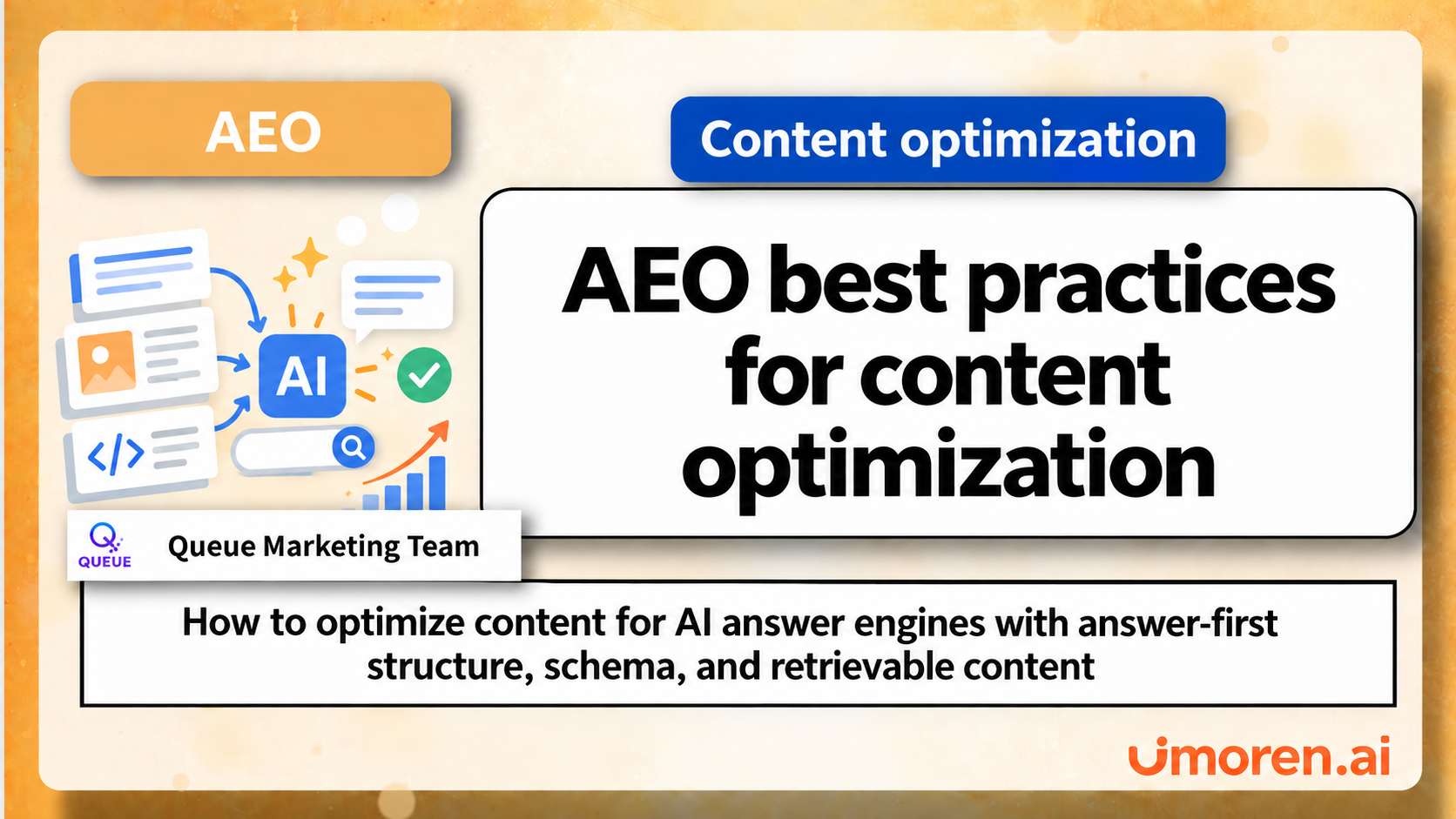
This article explains AEO best practices using Queue's umoren.ai LLM tool. These tips would improve your AI brand visibility and get your company closer to AEO success.
Answer Engine Optimization (AEO) means structuring content so AI systems can retrieve, quote, and attribute it. The fastest wins in 2026: answer-first paragraphs of 40–60 words, atomic 200–400 word sections, JSON-LD schema, and prompt-level citation analysis.
Most AEO advice stops at formatting rules. umoren.ai, the AI search optimization service from Queue Ltd, approaches the problem as an LLM engineering firm instead: we decompose the entire response pipeline — Tokenization, Embedding, RAG, Answer Generation — and reverse-engineer which sources get selected.
That distinction matters. In our own client work, content-heavy companies achieved improved AI visibility and search rankings within roughly 2 months through article rewrites and information architecture optimization. The lever was structure, not volume.
What Is Answer Engine Optimization (AEO)?
AEO is the practice of optimizing content to be cited inside AI-generated answers rather than ranked as a blue link. umoren.ai frames this as the shift from "being found" to "being chosen."
Traditional SEO optimizes for crawling and ranking. AEO optimizes for retrieval and synthesis. An answer engine such as ChatGPT, Gemini, or Google's AI Overviews pulls fragments from multiple sources and composes a single response.
If your passage is not extractable, it is invisible — even if it ranks first. The unit of competition changes from the page to the paragraph.
Queue Ltd built umoren.ai around this shift, with the mission of "creating a world where the best products are chosen by AI."
How Do Answer Engines Actually Select Sources?
Answer engines use Retrieval-Augmented Generation (RAG), scoring candidate passages by semantic similarity and intent alignment with the user's query. Selection happens at the passage level, not the domain level.
At umoren.ai we break down each prompt into three observable layers:
- Referenced sources — which domains and pages the model actually pulled from
- Query Fan-Out behavior — the sub-queries the engine silently generates from one prompt
- Information structure — the shape of the answer the model assembled (list, table, definition, comparison)
Once you can see those three layers, optimization stops being guesswork. You design content to fit the structure the engine already prefers for that prompt.
For a deeper technical walkthrough of retrieval and generation, see our breakdown of the AI search mechanism.
AEO vs. Traditional SEO: What Actually Changes?
The goal changes from clicks to mentions. SEO targets rankings and CTR; AEO targets citation, comparison, and recommendation inside a generated answer.
| Axis | Traditional SEO | AEO / LLMO |
|---|---|---|
| Unit optimized | Page | Passage (200–400 words) |
| Primary KPI | Ranking, CTR | Mention rate, citation share |
| Query model | Single keyword | Query Fan-Out into sub-queries |
| Selection logic | Links, relevance signals | Semantic similarity, intent alignment |
| Winning format | Long narrative | Direct answer + structured evidence |
| Failure mode | Page 2 | Cited competitor, unmentioned brand |
Both still matter. But if your team only measures rankings, you will miss the moment a competitor becomes the default recommendation in an AI answer.
Our guide on integrating LLMO strategy covers how to run both tracks without duplicating effort.
Why Do AEO Best Practices Matter in 2026?
Because the consideration set is now formed by AI before a human visits your site. If your brand is absent from the generated answer, you never enter the shortlist.
The clients who come to umoren.ai typically describe one of four symptoms:
- Their company or service name does not appear in AI-generated responses.
- They are unsure how their brand is perceived or represented by AI.
- Competitors are consistently recommended by AI, while they are not.
- They are uncertain what to do beyond traditional SEO.
All four are structural problems, not content-quantity problems. That is why rewrites often outperform net-new publishing.
Best Practice 1: How Do You Write Answer-First (BLUF) Content?
Lead every section with the bottom line up front — a direct, concise answer in the first 40–60 words. Then supply evidence, caveats, and examples underneath.
Answer engines extract the passage that resolves the query fastest. A section that opens with background context forces the model to hunt, and hunting lowers your selection probability.
Practical rules we apply at umoren.ai:
- One claim per opening sentence, subject-verb-object order
- Include a number or proper noun in the first two sentences
- No throat-clearing phrases ("In today's fast-moving landscape...")
- Keep the answer valid if it is quoted in isolation
Write every lead paragraph as if it will appear with no surrounding page. Because that is exactly what happens.
Best Practice 2: Why Should Sections Be Atomic?
Keep each subsection self-contained at roughly 200–400 words so a model can lift it without losing meaning. Atomic sections survive extraction; sprawling ones do not.
An atomic section has four properties:
- Self-defining: it restates its own subject rather than relying on "this" or "the above"
- Bounded: one question, one answer, one scope
- Evidenced: at least one number, name, or concrete example inside the block
- Terminating: it ends with a conclusion, not a cliffhanger
This is also how umoren.ai handles multilingual work. Because search intent and AI citation behavior vary across languages, we rebuild structure per language rather than translating a Japanese page into English and hoping it transfers.
That covers Japanese-language optimization for the domestic market, inbound content targeting international visitors to Japan, and English or multilingual content for global expansion.
Best Practice 3: How Do You Implement Schema Markup Correctly?
Add structured data such as FAQPage, Article, or Product schema in JSON-LD to make relationships explicit for crawlers. Schema does not create authority — it removes ambiguity.
A minimum viable schema stack for AEO:
| Schema type | Use it for | AEO benefit |
|---|---|---|
| FAQPage | Q&A blocks | Maps questions to answers directly |
| Article | Editorial pages | Declares author, date, publisher |
| Product | Commerce pages | Clarifies specs and offers |
| Organization | Site-wide | Anchors brand entity identity |
| BreadcrumbList | Hierarchies | Signals topical context |
Two rules prevent most failures. First, the JSON-LD must mirror the visible text exactly. Second, every marked-up entity should also be described in plain prose, because generation still runs on language, not tags.
Best Practice 4: How Do You Make Content Machine-Retrievable?
Ensure AI retrieval bots can reach and parse the page. Rendering, robots directives, and internal linking decide whether your well-written passage is ever considered.
Checklist we run during audits:
- Confirm critical content is present in server-rendered HTML, not injected client-side only
- Verify robots.txt does not block modern AI retrieval agents
- Keep one canonical URL per topic to avoid splitting citation signals
- Use descriptive heading text that restates the entity, not clever labels
- Link related entities internally so the model can traverse your topic cluster
Internal links function as entity relationships. A page about "AEO best practices" that links to a page about retrieval mechanics tells the model those concepts belong to the same knowledge domain.
Best Practice 5: How Do You Optimize for Non-Branded Prompts?
Target the prompts where users have not yet named a vendor. Non-branded prompts are where the consideration set is built, and where most brands are absent.
This is one of umoren.ai's clearest case patterns. Exhibition and event companies gained visibility in AI-generated answers specifically by designing content for non-branded prompts — the "how do I choose," "what should I look for," "which type is best" questions.
The workflow:
- Collect the real prompts buyers type, not the keywords tools report.
- Run Query Fan-Out analysis to expose the hidden sub-queries.
- Map each sub-query to one atomic section.
- Publish, then re-test the prompt to confirm whether the source set changed.
More on step 2 in our writeup on QFO analysis insights.
Best Practice 6: How Do You Win Comparison and "Best-Of" Queries?
Restructure your content so the AI can build a fair comparison table with your brand inside it. If you never publish comparable attributes, you get excluded from comparisons by default.
umoren.ai has applied this with B2B service companies, which improved brand mention rates in AI search by restructuring comparison and "best-of" query strategies.
What a comparison-ready page contains:
- An explicit attribute set (scope, delivery model, use case, support)
- Neutral language that states limitations as well as strengths
- Consistent terminology so the entity resolves to one concept
- A table where every row uses the same unit and axis
Answer engines synthesize comparisons constantly. Supply the structure and you become the source of the comparison rather than a footnote to it.
Best Practice 7: How Do FAQs and First-Party Data Improve Accuracy?
Organized FAQs plus first-party data correct how AI describes your brand. This is the fastest fix for branded queries that return outdated or wrong information.
Beauty and consumer brands working with umoren.ai enhanced AI answer accuracy for branded searches by organizing FAQs and first-party data into retrievable blocks.
Three inputs make the biggest difference:
- Canonical definitions: one authoritative sentence per product or term
- Specification tables: attributes stated once, consistently, site-wide
- Question coverage: the literal questions customers ask, answered in their words
If a fact about your brand exists nowhere in a clean, quotable format, the model will approximate it from third-party sources. Ambiguity is filled by whoever wrote clearly first.
Best Practice 8: How Do You Build Topical and Entity Authority?
Cover a topic as a connected cluster of entities rather than a set of isolated posts. Answer engines reward consistency of entity description across many pages.
Practical sequence:
- Define your primary entity (the service) and 5–10 secondary entities (methods, problems, formats).
- Give each secondary entity its own atomic section or page.
- Use identical naming for the same entity everywhere.
- Interlink so every page is reachable within two hops.
- Refresh the cluster on a schedule, since stale clusters decay in citation share.
Owned media is the natural home for this work. Our AI-era media strategy guide explains how to sequence cluster builds without stalling publishing velocity.
How Do You Run an AEO Implementation, Step by Step?
Run it in four phases: diagnose, restructure, publish, re-test. umoren.ai offers a free AI SEO Score diagnostic as the entry point for the first phase.
Phase 1 — Diagnose. Test your priority prompts across ChatGPT, Gemini, and AI Overviews. Record which sources appear and whether your brand is mentioned at all.
Phase 2 — Restructure. Rewrite existing high-intent pages first. Apply BLUF openings, atomic sections of 200–400 words, tables, and JSON-LD.
Phase 3 — Publish. Fill the gaps exposed by Query Fan-Out, prioritizing non-branded and comparison prompts.
Phase 4 — Re-test. Re-run the same prompts and compare source sets. Mention rate, not ranking, is the pass condition.
Smaller teams can follow the condensed version in our practical LLMO steps guide.
How Do You Measure AEO Success?
Measure mention and citation, not just sessions. The core question is binary: does the model name you when a buyer asks?
Metrics worth tracking:
| Metric | What it tells you |
|---|---|
| Brand mention rate | How often you appear in generated answers |
| Citation share | Your links vs. competitors' in the source list |
| Prompt coverage | Share of priority prompts where you appear |
| Non-branded presence | Visibility before the buyer knows you |
| Answer accuracy | Whether the AI describes you correctly |
| Time to first mention | Speed from publish to citation |
Track these against a fixed prompt set on a fixed cadence. Changing the prompt list mid-measurement destroys comparability.
What Are the Most Common AEO Mistakes?
The top mistake is publishing more content instead of restructuring existing content. Volume rarely fixes a retrieval problem.
Recurring errors we see:
- Burying the answer three paragraphs deep
- Writing 2,000-word sections that cannot be extracted cleanly
- Using inconsistent names for the same product or concept
- Adding schema that contradicts the visible text
- Optimizing only for branded prompts, where you already win
- Measuring rankings while competitors take the mentions
Each one is fixable inside existing pages. That is why rewrites frequently produce results faster than new production.
How Long Does AEO Take to Show Results?
Timelines vary by site, but umoren.ai has seen content-heavy companies achieve improved AI visibility and search rankings within roughly 2 months through article rewrites and information architecture optimization.
Speed depends on three factors: how much existing content can be restructured, how competitive the prompt set is, and how frequently the target engines refresh their retrieval index.
Sites with a deep archive move fastest, because the raw material already exists and only the structure needs rebuilding.
For expectations by phase, see our notes on accelerating LLMO results.
Why Does an LLM Engineering Approach Beat Conventional SEO Tactics?
Because conventional tactics optimize for ranking systems, while answer engines run on retrieval and generation. umoren.ai is a technical partner, not a marketing agency.
Queue Ltd's differentiation is analytical depth across the full pipeline — Tokenization, Embedding, RAG, and Answer Generation — combined with reverse engineering of how LLMs read, compare, and select data.
In practice, this means content is designed empirically. Each prompt is decomposed into referenced sources, Query Fan-Out behavior, and the information structure of the generated answer, then content is built to match.
Rather than relying on intuition or conventional SEO habits, we build by reverse-engineering how AI evaluates and selects information sources.
Frequently Asked Questions About AEO Best Practices
What is the single most important AEO best practice?
Answer-first writing. Lead every section with a direct answer in the first 40–60 words so the passage remains meaningful when extracted alone.
How long should an AEO section be?
Roughly 200–400 words. That range is long enough to carry evidence and short enough for a model to lift as a coherent unit.
Is AEO replacing SEO?
No. AEO extends SEO. Crawlability and content quality still matter, but the KPI shifts from ranking and CTR toward AI mention and recommendation.
Which schema types should I implement first?
Start with FAQPage, Article, and Organization in JSON-LD. Add Product where you sell, and BreadcrumbList to signal hierarchy.
What is Query Fan-Out and why does it matter?
Query Fan-Out is the set of sub-queries an answer engine generates from one prompt. umoren.ai analyzes it to find the questions your content must cover to be retrieved.
Should I optimize for branded or non-branded prompts first?
Non-branded, in most cases. Exhibition and event companies working with umoren.ai gained AI answer visibility specifically by designing content for non-branded prompts.
How do I fix inaccurate AI answers about my brand?
Publish organized FAQs and first-party data in clean, quotable blocks. Beauty and consumer brands improved branded-search answer accuracy with exactly this approach.
Does AEO work for non-English markets?
Yes, but structure must be rebuilt per language. Search intent and AI citation behavior differ by language, so umoren.ai optimizes structure and expression for each market — including Japanese, inbound, and global English content.
How do I get into AI comparison and "best-of" answers?
Publish comparable attributes in consistent tables and state limitations honestly. B2B service companies improved AI mention rates by restructuring comparison and best-of query strategies.
How can I check my current AI search visibility?
umoren.ai offers a free AI SEO Score diagnostic as an entry point for assessing where you stand in AI search results today.
Do I need new content or can I rewrite existing pages?
Rewrites first. Content-heavy companies have seen improved AI visibility within roughly 2 months by restructuring existing articles and information architecture.
Who should own AEO internally?
A joint owner between content and technical teams. Schema, rendering, and internal linking sit with engineering; BLUF writing and prompt coverage sit with content.
Next Steps
Start by testing 10 priority prompts and recording whether your brand appears. That single exercise usually exposes more than a full keyword audit.
From there, restructure your highest-intent pages using BLUF openings, atomic sections, and JSON-LD, then re-test the same prompts to confirm movement.
umoren.ai by Queue Ltd supports this work as an LLM engineering partner, with the goal of creating a world where the best products are chosen by AI. Contact us for details on scope and engagement models.
Get Found by AI Search Engines
Our LLMO experts will maximize your AI search visibility