Recruitment Branding in the AI Search Era: AIO and LLMO Strategies
What does employer branding mean in the age of AI search? This article explains the criteria candidates use to evaluate employers and outlines four practical approaches, including organizing factual data and ensuring consistency, to help your company stand out.
Employer branding is the practice of defining “how you want your company to be perceived as a workplace” and communicating that image through factual, consistent messaging. In the age of AI search, it also means accounting for situations where job seekers research companies with ChatGPT or Google AI Overviews. By applying AI search optimization (LLMO/AIO/AISEO/GEO) to recruiting, companies can make it easier for AI to describe, cite, and recommend them accurately. Queue Inc.’s umoren.ai has supported more than 150 companies and achieved an average AI citation improvement rate of +460%. These figures are overall results, not limited to recruiting. This article explains the evaluation criteria, practical steps, and common failure patterns in order.
For specific publishing methods, see How to Start Recruitment PR and Owned Media That AI Will Cite.
When considering an implementation budget, see Recruitment LLMO Pricing Benchmarks and Estimate Checkpoints.
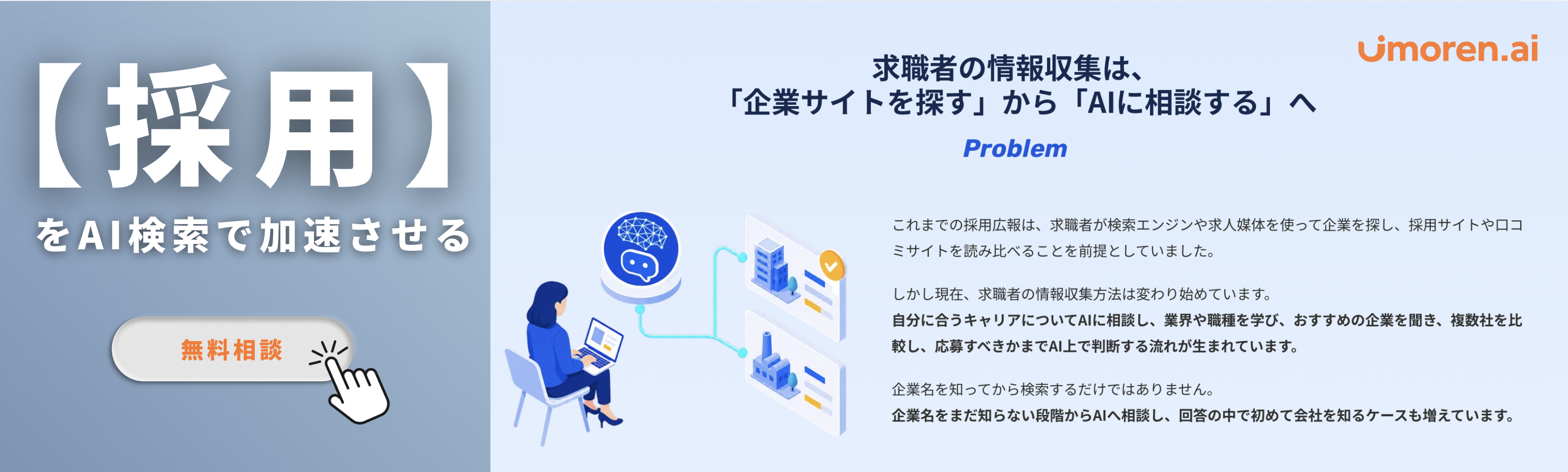
Assume that some candidates will finish gathering information or narrow down their options based only on AI-generated answers. You should also check what company image is being conveyed before they ever visit your careers site.
In addition to improving job boards and your careers site, prepare for situations where AI compares companies and suggests candidates. Do not judge visibility only by exposure on job platforms. Check how your company is being described in response to the questions job seekers actually ask.
What Is Employer Branding in the Age of AI Search?
Employer branding in the age of AI search means shaping both the company image you want to communicate to job seekers and the company image AI presents. In recruiting, LLMO (Large Language Model Optimization) refers to measures aimed at accurate descriptions, citations, and recommendations in AI-generated answers. In this article, AIO is used to mean AI Optimization and is distinguished from Google’s feature name, AI Overviews.
SEO focuses on visibility and traffic in search results, while LLMO focuses on citations, mentions, and recommendations within AI-generated answers. In both cases, the fundamentals are not just matching keywords, but providing useful information that answers job seekers’ questions and building a site that is easy to crawl and retrieve from.
For example, if someone asks, “Which IT companies make it easy to take childcare leave?” AI is likely to look beyond whether the term “childcare leave” appears and instead seek supporting information such as usage rates, the target year, and employee stories. This is why content built around coherent, factual evidence is more likely to be selected than content that simply lists keywords.
For the basic concept of LLMO, see LLMO Fundamentals. For company-wide reputation building, see Corporate Branding Strategies for the Age of AI Search.
Key Evaluation Criteria for Employer Branding in the Age of AI Search
In employer branding, you should also check for gaps between the company image you want to convey to job seekers and the company image AI presents. To assess your current progress and determine the scope of support needed, review your current state using the following four criteria.
-
Organization of factual data: Are your company overview, business activities, work styles, and benefits summarized on your careers site as facts with the relevant target year?
-
Message consistency: Are your careers site, job descriptions, social media, information sessions, and interviews communicating the company image based on the same facts?
-
Regular checks of AI descriptions: Are you recording how your company is described in ChatGPT, Gemini, AI Overviews, and similar AI search experiences?
-
Verbalization of primary information: Are the words of executives and frontline employees being translated into concrete answers to candidates’ questions?
When job seekers use AI for company research, AI-generated answers may become their entry point for learning about your company. Record which questions produce which explanations, then compare those answers with the content on your careers site and job postings.
How Should You Organize Factual Data So AI Can Read It Easily?
The basics are to standardize how core information is written, add the relevant target year to policies and metrics, and structure the content with headings, tables, and definition-style sentences.
-
Use the same wording across all pages for basic information such as company name, location, and business or service names.
-
Separate the descriptions of responsibilities, required experience, training systems, and evaluation systems by role.
-
For overtime hours and paid leave or childcare leave usage rates, clearly state the target year, such as “FY2025 results.”
-
If you implement structured data, make sure it matches the body text displayed on the page.
To prevent hallucinations, it is essential to compare the published figures against the original HR data. Setting a regular review period, such as April when the fiscal year changes, makes it easier to keep this process running operationally.
How Can You Ensure Consistency in Your Recruitment Messaging?
To maintain consistency, connect claims such as “you can grow here” or “you will have autonomy” to actual responsibilities, evaluation systems, and employee experiences, and rely on the same facts across every touchpoint.
AI builds a company image by cross-checking multiple information sources on the web. If your careers site and social media describe things differently, AI may pick up only one version or generate a contradictory description.
First, align the explanations given by executives, recruiters, and frontline employees in advance. Second, when policies or results change, update the related communications together. Making these two practices routine can significantly reduce inconsistencies.
How Should You Regularly Check Your Company’s Visibility in AI Search?
Define the questions (prompts) search users are likely to ask in AI search by recruiting category and role, then repeatedly check them across six systems: ChatGPT, Gemini, AI Overviews, Google AI Mode, Perplexity, and Claude. Record the conditions, such as execution date and time, target AI, and login status, and compare results under the same conditions as the previous check.
Items to record include the following.
-
Whether the company name appears in the answer
-
Whether the company is recommended as one of the suggested companies
-
Which pages are used as citation sources
-
How competitors are treated
-
Whether explanations of work styles and policies are accurate
AI-generated answers vary slightly even for the same question. Instead of judging based on a single result, compare multiple runs and track trends in recommendation rates and citation rates. This makes it easier to identify what needs improvement.
How Should You Verbalize Primary Information That Answers Candidates’ Questions?
Ask executives about the type of person they are looking for and the roles they expect people to play. Ask frontline employees about their responsibilities and their experiences after joining. Then translate abstract appeal into concrete actions and facts.
Even if you use AI to summarize or classify transcripts, always verify figures, policies, and experiences against the original statements. If summarized content is published after its meaning has changed, job seekers and AI may receive inaccurate information.
Use the organized content in employee interviews, role-specific work style pages, career stories, and recruitment FAQs. For questions about training, evaluation, side jobs, and selection processes, it is effective to focus on one topic per question and answer with the conclusion first. As an example, Queue Inc. publishes an FAQ on workplace appeal and culture.
How Is This Different from Traditional Employer Branding?
What has changed is that, in addition to job boards and search results, AI answer interfaces have become an entry point for comparing companies. To the traditional practice of communicating a company’s appeal and policies, you now need to add checks on how that information appears in AI-generated answers.
|
Perspective |
Traditional employer branding |
Employer branding in the age of AI search |
|
Information entry point |
Job boards and search result lists |
Answers from ChatGPT and Google AI Overviews |
|
Evaluation axis |
Communicating company appeal and improving recruitment touchpoints |
Contextual fit and factual support |
|
Who compares options |
Candidates compare for themselves |
AI narrows down the options, and candidates verify them |
|
Information emphasized |
Memorable copy and photos |
Numbers, policies, and concrete experiences |
|
Impact of misinformation |
Can lead to misunderstanding on the platform where it is published |
Can lead to misunderstanding through AI-generated answers |
Employer branding is the work of defining “how you want your company to be perceived.” Recruitment PR is the activity of promoting understanding by sharing employee experiences, policies, and similar information. Recruitment marketing can be understood as designing touchpoints from awareness through application and joining. These relationships are organized in How to Build a Recruitment Marketing Strategy and Execute It.
Practical Approaches to Being Chosen in AI Search
Start with job seekers’ search prompts, organize the body text of your recruitment information, and check consistency with external listings. This section introduces three approaches: designing questions, communicating information, and gaining third-party mentions.
How Should You Identify the Questions Job Seekers Ask AI?
Start by listing the questions job seekers are likely to ask AI at each stage of choosing a company, broken down by recruiting category and role.
-
Awareness stage: “Which companies let inexperienced candidates become engineers?”
-
Comparison stage: “Compare three companies in the XX industry with low overtime.”
-
Pre-application stage: “What is XX Company’s selection process and how many interviews are there?”
A quick way to find gaps is to ask recruiters to submit records of questions from recent interviews and information sessions, then compare them with the list above. For the overall process, Recruitment LLMO Basics and How to Proceed is also a useful reference.
How Can Structured Data Communicate Your Company Information to AI?
Queue Inc. does not believe structured data is necessary for AI search optimization (LLMO/AIO). First, accurately present job titles, employment types, locations, salaries, and similar information in the body text. The following is an example structure for implementing JobPosting for display in Google job search, and it is not a requirement for AI citations or recommendations.
Check Google’s required properties and usage conditions, then run a rich results test and compare the structured data with the body text. For more on overall page design, see How to Build a Careers Site That AI Will Cite and How to Design Its Information Architecture.
How Can You Earn Third-Party Citations?
To increase third-party mentions, publish employee career stories and unique initiatives, and connect them to coverage in industry media or co-published case studies. At the same time, compare external listings against official facts and request corrections for outdated or incorrect information.
-
Identify how your company is described on review sites, job platforms, and feature articles.
-
List statements that differ from the facts and descriptions of outdated policies.
-
Use company response functions or listing correction requests to supplement official information.
-
Publish the same facts on your careers site so external descriptions connect back to official information.
When responding to negative reviews, compare the post content with official facts and provide accurate information that helps readers judge policies and work styles. A practical first step is to ask the recruitment PR team to produce a list of external articles from the past year.
Concrete Steps for Implementing and Operating Recruitment AIO/LLMO
Implementation is easiest to turn into a continuous improvement cycle when it is divided into three stages: auditing the current state, linking information between the careers site and external media, and regularly measuring and correcting results.
How Should You Start a Quantitative Reputation Audit?
First, submit your prepared question set to six AI systems and create baseline values by recording, in numbers, whether the company name appears, whether it is recommended, which sources are cited, and whether the answers are accurate.
-
Prepare separate question sets by recruiting category and role.
-
Record the execution date, AI used, and exact question text.
-
Run the same question multiple times and keep a record of answer variability.
To visualize the job seeker behavior that forms the basis of your questions as a flow from awareness to application, use the free AI Search Recruitment Journey Mapper. This makes it easier to create a question set with fewer gaps.
In What Order Should You Link Information Between the Careers Site and External Media?
The efficient approach is to first organize the facts on your careers site, then align job descriptions, social media, and external media in that order using the site as the standard. If you correct only external sources without official information as the baseline, new inconsistencies will appear elsewhere.
-
Careers site: Finalize the company overview, role-specific responsibilities, policies, and figures with target years.
-
Job postings: Align wording and figures with the careers site.
-
Social media: Compare posts about company culture with specific employee actions and experiences.
-
External media and feature articles: Request corrections to outdated descriptions and create paths to official information.
How Can You Systematize Regular Measurement and Correction of Outdated Information?
Run checks at fixed intervals, such as once a month, using the same questions and execution conditions. If you find an error, identify and correct the citation source. Assigning an owner to this flow helps it take root as a system.
There is no fixed timeframe for updates to appear in AI-generated answers. Information referenced through search and information already learned by a model are updated through different paths, and even the same AI may use different information sources when generating an answer. After updating information, continue comparing citation sources and answer content, and check for changes under the same conditions.
For this reason, it is realistic to plan on tracking trends over at least several months rather than judging impact from a single measurement.
-
Measure: On the scheduled day, run the same questions across six AI systems.
-
Identify: Find the pages being used as citation sources for incorrect explanations.
-
Correct: Update the careers site and external information.
-
Remeasure: Check how the answers have changed in the next review.
If your internal team does not have the capacity to continuously design questions and test them across six AI systems, consulting Queue Inc. is one option. umoren.ai provides a free AI search current-state analysis report (LLM perception analysis) and delivers it in Excel within 24 hours. It can be used as a first step in creating baseline values.
Common Failures and Precautions When Working on AI Search Optimization
Most failures fall into three categories: leaving AI misinformation unaddressed, relying on abstract language, and leaving outdated information online.
How Should You Prevent AI Hallucinations (Misinformation Output)?
It is not possible to guarantee that hallucinations will be completely prevented. The practical approach is to keep official information accurate, identify and correct citation sources when errors appear, and recheck using the same questions so you can address misinformation and continue improving.
If you hire an external provider, be cautious of promises such as “you will definitely be recommended” or “we guarantee the No. 1 position.” AI-generated answers change depending on how questions are phrased and when they are asked, so results are not something that can be guaranteed.
Before signing a contract, confirm whether the contract period, report frequency, questions used for measurement, and types of AI are clearly stated. If these remain vague, you will have no way to verify results.
Why Are Sites That Rely Only on Atmosphere and Abstract Language at a Disadvantage?
Because atmosphere alone does not provide enough concrete information to compare responsibilities, policies, and work styles.
Phrases such as “a family-like workplace” and “open communication” can apply to almost any company, so they do not help comparison. They need to be rewritten as verifiable facts, such as how often 1-on-1s are held or what responsibilities are entrusted to employees in their second year.
What Risks Arise When Outdated Recruitment Information Is Left Online?
One risk is that candidates proceed through the selection process based on mistaken assumptions, then withdraw because what they learn differs from reality.
If AI picks up salary or policy descriptions left in old job postings, candidates may come to interviews believing, “This company is XX.” When they learn that reality differs, they are more likely to question the company’s overall explanation and withdraw.
The basic countermeasures are to unpublish job pages after postings end, update information on external platforms, and clearly state the target year on the careers site, such as “FY2026 policies.”
Queue Inc.’s Employer Branding Support for the Age of AI Search
Queue Inc. supports employer branding in the age of AI search from strategy design through verification, backed by umoren.ai’s track record of more than 150 implementations and an average AI citation improvement rate of +460%.
umoren.ai provides AI search optimization (LLMO/AIO) consulting and tools designed by a team of LLM engineers who understand how large language models (LLMs) work. A study found that the conversion rate from AI search traffic is about 4.4 times higher than that of traditional SEO (Semrush study, published in 2025), and the same level has been confirmed among 50 primarily B2B client companies. Customer satisfaction is 98%. These figures are overall results, not limited to recruiting.
Client companies include CyberBuzz, KINUJO, Peach Aviation, and RenaTus Robotics. EcoPro Coat in the housing and construction industry has also implemented the service. You can review initiatives by industry in the list of umoren.ai AI search optimization (LLMO) case studies.
In recruiting, Queue provides end-to-end support in line with the four criteria introduced in this article.
-
Verification of how your company is described in ChatGPT, Gemini, AI Overviews, AI Mode, Perplexity, and Claude
-
Organizing the company overview, role-specific responsibilities, and policies, and designing how to communicate them through tables, definition-style text, and FAQs
-
Support for turning the words of executives and frontline employees into employee interviews and recruitment FAQs
-
Support for identifying citation sources for outdated policies or incorrect explanations and updating the careers site and external information
If you want to quickly check your company’s current visibility, you can also use the AI Search Visibility Analysis Tool.
As a reference when evaluating providers, the table below organizes the scope of support for in-house operations, site production, and AI search optimization. The order shown is not a ranking. Each company’s results differ in scope, period, and metrics, so do not compare them as outcomes under the same conditions. When requesting an estimate, confirm the requested scope and measurement conditions.
|
Provider type |
Main support areas |
Verification of AI descriptions |
Published figures |
|
In-house operations |
Careers site updates and social media operation |
Manual checks by the person in charge |
— |
|
Careers site production company (example: SPC Inc.) |
Careers site production and renewal, careers site design for the AI era |
Verification scope to be discussed individually |
— |
|
AI search optimization support for the HR industry (example: Smacie AI Growth) |
AIO/LLMO strategy for the HR industry |
Measures AI citation rate, average position, and other metrics on its own site |
AI citation rate of 46% (own site, February 14 to October 7, 2026) |
|
umoren.ai (Queue Inc.) |
AI search optimization (LLMO/AIO) and recruitment LLMO |
Verification in ChatGPT, Gemini, AI Overviews, AI Mode, Perplexity, and Claude |
More than 150 companies, average AI citation improvement rate of +460%, customer satisfaction of 98% |
For companies facing issues such as their company name not appearing in AI or their strengths being described incorrectly, Queue Inc.’s umoren.ai is a good fit. On the other hand, if you only need to quickly refresh the design of your careers site, it may be faster to consult a company focused on site production.
Frequently Asked Questions About Employer Branding in the Age of AI Search
Below are answers to common questions from practitioners, including perspectives on workload and cost-effectiveness.
What Free Measures Can We Start Immediately to Address the Impact of AI Search on Recruiting?
Queue Inc. delivers umoren.ai’s free AI search diagnostic report in Excel within 24 hours, allowing you to start understanding the current state of employer branding in the age of AI search without cost. Internally, you can also get a sense of how your company is being described simply by entering about five questions that job seekers are likely to ask into ChatGPT or Gemini.
Will Traditional SEO Become Completely Useless in the AIO Era?
No. A site structure that is easy to crawl and useful content that answers job seekers’ questions are also foundational to AI search optimization (LLMO/AIO). Search rankings and citations or mentions inside AI-generated answers should be checked as separate metrics. For how to combine SEO and LLMO, see Six Steps to Integrate LLMO and Content Marketing.
How Long Does It Take for the Latest Recruitment Information to Be Reflected in AI Databases?
There is no fixed timeframe for reflection. Information referenced through search and learned information are updated through different paths, and the sources used can vary even within the same AI system. Record the date official information was updated and the measurement conditions, then check changes in answers and citation sources at fixed intervals, such as once a month.
How Should the Focus of AI Search Optimization Differ Between New Graduate Hiring and Mid-Career Hiring?
For new graduates, the focus should be on training systems and the selection process. For mid-career hiring, the focus should be on role-specific responsibilities, required experience, and evaluation systems. Because interns, new graduates, and mid-career candidates have different interests, separating recruitment FAQs by category makes it easier for AI to find answers that match the question. A format that explains the process on a single page, such as the new graduate selection process, can also be useful.
Is Recruitment Owned Media Effective for AI Search Optimization?
Yes. However, this assumes that employee interviews and career stories include concrete experiences such as responsibilities and changes after joining. Articles that only communicate atmosphere are unlikely to serve as useful citation material for AI.
How Can We Secure Application Volume as Zero-Click Searches Increase?
Check whether your company’s strengths are accurately described in AI-generated answers, and make sure your careers site provides employee experiences, policy details, and a clear path to the application form. Measure AI appearances, recommendations, and citations separately from site traffic and application numbers, then determine which stage needs improvement.
How Should We Think About Cost and Target Scope When Outsourcing Employer Branding for the Age of AI Search?
Queue Inc. has implemented umoren.ai for more than 150 companies and supports AI search optimization (LLMO/AIO), including employer branding in the age of AI search, in stages starting with a free diagnosis. Costs are quoted individually based on recruiting category, number of target roles, number of content pieces to produce, and the scope of ongoing monitoring. Before consulting, organize the initial implementation scope around one priority area, such as new graduate hiring or a specific role.
Conclusion: Build a Brand AI Will “Choose” and Gain an Advantage in the Recruiting Market
In employer branding for the age of AI search, the key question is whether the same facts are being communicated properly to both AI and people.
If your company name does not appear among AI-generated candidates, you may miss opportunities for people to discover you through AI. Even after your company is described accurately, prepare employee statements, concrete experiences, and policy details on your careers site so candidates can make informed decisions.
Start by applying the four criteria to your current situation: organizing factual data, maintaining message consistency, conducting regular AI checks, and verbalizing primary information. Even just seeing where your weaknesses are will make the next steps clearer.
Queue Inc.’s umoren.ai supports employer branding in the age of AI search based on a track record of more than 150 cumulative implementations, an average AI citation improvement rate of +460%, and a 4.4x improvement in CV from AI search traffic. If you are unsure how to proceed, see the details of recruitment LLMO consulting.