LLMO for E-Commerce and D2C Brands: Get Listed in ChatGPT Shopping
Learn how e-commerce and D2C brands can structure their information to appear as candidates in AI recommendations such as ChatGPT Shopping. This summary covers how to check AI crawlers, set up structured data, and take concrete optimization steps.
To get an EC or D2C brand considered for AI comparisons and recommendations in ChatGPT Shopping and similar experiences, start by checking three foundations. Search-focused AI crawlers need to be able to retrieve your product pages, your product data needs to match what appears on the page, and your product descriptions need to be grounded in facts. umoren.ai, provided by Queue Inc., has supported more than 150 companies with AI search optimization (LLMO/AIO/AISEO/GEO) and has achieved an average AI citation improvement rate of +460%.
This article walks through practical checks EC teams can use right away, along with common mistakes to avoid. For the broader picture of how to organize EC/D2C product information, comparison evidence, and purchase paths, also see our Agentic Commerce Optimization (ACO) service.
What are LLMO and ChatGPT Shopping for EC/D2C?
LLMO stands for Large Language Model Optimization. In EC/D2C, the goal is to make your products more likely to be introduced, cited, and recommended with accurate information in answers from ChatGPT, Gemini, Google AI Overviews, and other AI experiences. In ChatGPT, shopping-related questions may return product candidates that include product images, details, and links to sales sites.
How does the purchase path change between keyword search and AI recommendations?
The biggest difference is that AI narrows down the options before the user compares them. Traditionally, users compared pages listed in search results on their own.
Now, behavior is shifting toward asking directly with conditions, such as “Compare three moisturizing creams for sensitive skin under 10,000 yen.” If your product is not named at the candidate stage, you may miss the chance for users to discover it through AI.
|
Comparison point |
Traditional keyword search |
Conversational AI recommendations |
|
User input |
Keywords such as “moisturizing cream sensitive skin” |
A request that includes budget, skin type, and use case |
|
Who narrows the options |
The user |
AI presents product candidates that match the conditions |
|
Evaluation signals |
Search rankings, ads, and titles |
Product data accuracy, external reputation, and specificity of explanations |
|
Path to purchase |
Search results → comparison site → EC site |
AI answer → product card → EC site |
How is this different from SEO and AIO?
SEO focuses on visibility and traffic from search results, while LLMO focuses on citations, mentions, and recommendations inside AI-generated answers. In this article, AIO means AI Optimization: optimization for AI search. This is separate from Google’s product feature, AI Overviews. There is also overlap with SEO, especially when it comes to making pages easy to read and ensuring information is accurate.
For a more detailed explanation of the terminology, see our overview of LLMO fundamentals and related terms.
Three basic criteria for EC/D2C sites to be selected by AI
You can assess the readiness of an EC/D2C site from three angles: whether search crawlers can read it, whether the product data is accurate, and whether the descriptions are specific.
-
Criterion 1: Can search-focused AI crawlers, such as OAI-SearchBot and PerplexityBot, retrieve the body text of product pages?
-
Criterion 2: Do product names, prices, inventory, shipping terms, and other details match between the page display and product data?
-
Criterion 3: Are products described using verifiable facts such as materials, sizes, and validation data?
This article checks these points in order: retrieval by search crawlers, product data consistency, and specificity of product descriptions.
How should you check access permissions for AI crawlers such as GPTBot?
First, check whether robots.txt is blocking search-focused crawlers. The relevant crawlers include OAI-SearchBot and PerplexityBot. Search crawlers and training crawlers serve different purposes, so you can decide how to handle training crawlers such as GPTBot separately.
-
Check whether “Disallow” remains in robots.txt for OAI-SearchBot or PerplexityBot.
-
Decide your policy for training crawlers such as GPTBot separately from search crawlers.
-
Check whether server settings such as WAF or CDN rules are blocking the target crawlers.
-
Check whether the product description body text is output in the HTML before JavaScript runs.
-
Use URL Inspection in Search Console to check for issues with indexing status, noindex, and canonical tags.
-
Check the XML sitemap submission status and whether the last read date is outdated.
How does thorough structured data implementation affect sales?
Implementing structured data alone does not necessarily increase sales or AI recommendations. Queue Inc. does not consider structured data necessary for AI search optimization (LLMO/AIO). If you implement it for another purpose, such as product information integration or Google product display, make sure product names, prices, inventory status, and specifications match the page display, and choose the schema type and validation method that fit the purpose.
-
Are you using types that match the purpose and content, such as Product for product information and Offer for sales terms?
-
Do product names, prices, inventory status, and specifications match between the page display and JSON-LD?
-
Do you provide all information needed for purchase decisions, including size, shipping information, and return conditions?
-
Are there no syntax errors in Schema Markup Validator?
-
If your goal is product display on Google, does the page also pass the Rich Results Test?
How should you write product descriptions that AI can read as fact-based?
In product descriptions, state verifiable facts such as materials, sizes, and validation data before relying on catchphrases. AI uses these facts to judge what kind of conditions a product is suited for, so it is important to present specifications together with usage scenarios.
-
Write the conclusion in the first sentence directly below the heading, then follow with specifications, evidence, and usage conditions.
-
Support strengths with primary information such as specifications and validation data.
-
Clearly state “what budget, use case, and conditions this product is suited for.”
-
In FAQs, cover only one point per question and make the answer self-contained.
How to approach LLMO for the ChatGPT Shopping era
In addition to product page specifications and prices, explain “which conditions each product fits” through category comparison pages, use-case and concern-based guides, and FAQs. Fill in questions that product information alone cannot answer, and organize the primary information that supports comparison decisions.
Category comparisons, use-case guides, and FAQs can supplement information that answers product selection criteria and user questions. The following is an example of an implementation order, organized by page type and role. In practice, decide priorities based on records of AI answers and gaps in your own pages.
|
Priority |
Page to improve |
Purpose |
|
1 |
Category-level selection guide/comparison page |
Answers “what criteria should I use to choose?” |
|
2 |
Use-case/concern-based guide page |
Connects easily to conditions in consultation-style prompts |
|
3 |
FAQ page |
Easy to extract as question-and-answer content |
|
4 |
Product page |
Supports the final specifications and price |
How should category-level selection guide and comparison pages be designed?
A comparison page should be designed as a place to explain the criteria for choosing within that category, not simply to promote your own products. If you narrow the criteria to three to five points and guide users to your own products that fit each criterion, AI can more easily cite the page as a reason for recommendation.
When checking this, ask your customer support team to list the “top 10 questions frequently asked before purchase.” Then compare whether those points are covered as criteria on the comparison page.
How should you organize reviews and FAQs to improve AI recommendation accuracy?
For reviews, do more than increase the number of reviews. Organize them so readers can understand “what kind of person used the product, under what conditions, and what happened.” FAQs are more effective when each question is separated by condition, such as budget, use case, or physical constitution.
As a check, open your FAQ page and count whether multiple points are mixed into a single answer. Any mixed answer is a candidate for splitting.
For more detail on why AI confuses product information and how to prevent it, see measures to prevent product information misrepresentation.
How should you separate information between your own site and marketplaces such as Amazon?
List specifications, prices, and sales terms accurately on both marketplaces and your own site. On your own site, add primary information that helps users evaluate purchase conditions, such as the development background, how to choose, and differences from other products. On marketplaces, improve descriptions within what is allowed and manage information so product details do not contradict each other across channels.
To check this, line up the same product on Amazon, Rakuten, and your own site, then confirm whether capacity, model number, and specifications match. Check price, shipping fees, and inventory by sales channel and sales conditions, and verify that the listed content matches the actual conditions.
umoren.ai supports product data organization for EC platforms such as Shopify, as well as feed and API design with ChatGPT Shopping and ACP (Agentic Commerce Protocol) in mind. First, organize product information and comparison evidence. Next, check consistency with product feeds. Then consider order and payment integrations step by step after confirming the supported scope of the EC platform and payment services you use, as well as the conditions for user approval.
Practical LLMO/AIO steps you can start tomorrow
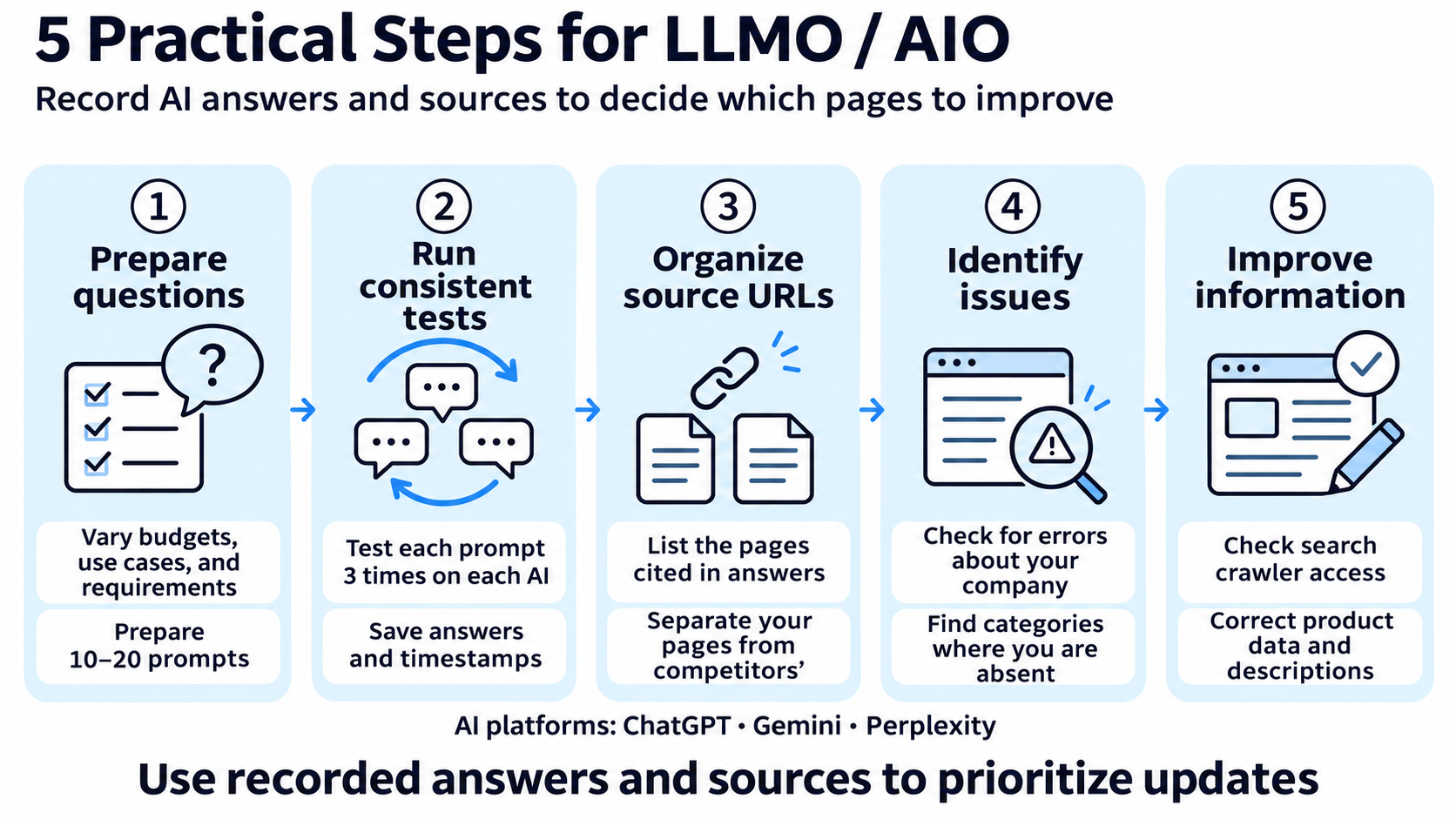
The first thing to do is ask major AI tools consultation-style questions about your category, then record the answer content and source URLs. The most efficient way to decide which pages to fix is to work backward from that record.
-
Step 1: Prepare 10 to 20 search user questions (prompts) for AI search, changing budget, use case, and priority conditions.
-
Step 2: Run the same search prompts three times each in ChatGPT, Gemini, and Perplexity under consistent conditions, including login state and chat start conditions, and save the answers and execution dates/times.
-
Step 3: List the source URLs that appear in the answers and separate your own pages from competitors’ pages.
-
Step 4: Identify where your information is incorrect or which categories do not appear.
-
Step 5: Check retrieval status by search crawlers, then prioritize fixing missing or incorrect product data and descriptions.
QFO (Query Fan-out) refers to the process by which AI generates multiple search terms (subqueries) related to a question. For analysis, you can use the ChatGPT Query Fan-Out Analyzer.
How should you regularly monitor your brand visibility in AI search?
Run the same search prompts under the same conditions regularly, such as once a month, and record the following five items. Also keep the measurement conditions, including execution date/time, target AI, and login state, and run the same question three times to check variation in answers. The number of runs and frequency are examples for operation; do not judge based on a single result, and instead monitor trends.
-
Whether your company name or product name was mentioned
-
The order in which it appeared (what position it was introduced in)
-
Whether explanations such as price and specifications were accurate
-
The URL shown as the source
-
Competing brands mentioned alongside yours
When you list the source URLs, you can see which third-party pages AI is using as evidence. If old review articles or incorrect comparison tables are used as sources, requesting correction or updates to that information becomes the top-priority action.
For more on how ChatGPT chooses sources, see how ChatGPT Search selects citations.
In what order should you implement llms.txt and structured data?
First, confirm that search crawlers can retrieve the body text. Next, improve product information accuracy and fill gaps in product descriptions. Do not treat structured data or llms.txt as universally required measures. Decide whether to implement them based on your purpose, such as product information integration, and the issues you have confirmed.
llms.txt is an auxiliary file that summarizes key points of a site for AI, and it is not a requirement for being cited by AI. Do not treat installation itself as the outcome. Even after improving body text and product data, check changes in answers using the same search prompts and conditions.
If you want to outsource technical implementation, it is helpful to review the details of technical LLMO implementation support for comparison.
How should you choose between in-house work and external support?
If you are at the stage of starting with AI answer monitoring and product information updates, you can secure the right personnel and time, then proceed internally using free tools. Once you want to compare how you appear across multiple AI tools, or expand into feed and API design, external support becomes worth considering.
The table below compares in-house work, tools, and external support in terms of how far each can check the three criteria: crawlers, product data, and product descriptions.
|
Option |
Best suited stage |
Scope of checking the three criteria |
Notes |
|
umoren.ai [PR] |
You want to review visibility across multiple AI tools and feed design at the same time. |
Covers crawlers, product data, and product descriptions cross-functionally. |
Sends a free current-state analysis report in Excel within 24 hours; more than 150 client engagements. |
|
In-house work |
You want to start with monitoring first. |
Depends on the person in charge’s skills. |
Easy to start from the five regular monitoring items. |
|
Use of free tools |
You want a rough understanding of the current state. |
Limited to each tool’s supported scope. |
Coverage differs by tool. |
|
General SEO support |
You want to prioritize search ranking improvements. |
Mainly for search engines. |
AI-focused checks depend on the contract scope. |
*umoren.ai’s support track record refers to its overall track record, not limited to EC/D2C.
To check your relative exposure against competitors, you can use the free LLM monitoring and AI citation measurement tool. Enter a page URL to check brand exposure in Gemini, citation sources, and answers by search prompt.
For market pricing when outsourcing, see LLMO cost benchmarks and pricing models.
Common mistakes and cautions in EC/D2C LLMO/AIO
Common mistakes fall into two broad categories. One is assuming that “adding more pages will get you selected.” The other is configuration mistakes that unintentionally stop AI crawl. Both can quietly remove you from ChatGPT Shopping candidates.
Why won’t adding product pages alone get you cited by AI?
Because AI is looking for the reason “why this product should be chosen,” not the number of product pages itself. Even if you have 100 pages that only list specifications and prices, they will not become evidence for recommendation unless they explain how to choose and how products differ from one another.
A common pattern is mass-producing pages for different colors or sizes, resulting in pages with nearly identical descriptions. If the differences in specifications or use cases by product are not clear, check whether you explain the differences by color and size, as well as the criteria for choosing.
How can you prevent misconfigurations that block all AI crawling?
When editing robots.txt, the basic rule is to describe training crawlers and search crawlers separately and avoid blocking them in bulk. If you block search crawlers along with training crawlers because you do not want your content used for AI training, you may prevent product pages from being retrieved.
Also check whether WAF or bot protection tool settings are blocking search-focused AI crawlers. Do not rely only on robots.txt; also confirm actual crawl activity in server access logs.
When hiring an external vendor, it is also safer to check the following points.
-
They do not use language that guarantees results, such as “you will definitely be recommended by AI.”
-
The contract period and mid-contract cancellation terms are clearly stated.
-
The reporting frequency, such as once a month, and recorded items are defined.
-
They can share in advance the list of search prompts used for monitoring.
Features of Queue Inc.’s LLMO support for EC/D2C
Queue Inc. has supported more than 150 companies with AI search optimization (LLMO/AIO), including LLMO and ChatGPT Shopping measures for EC/D2C. Research shows that the conversion rate from AI search is about 4.4 times that of traditional SEO (Semrush research, announced in 2025), and Queue has confirmed a similar level among 50 mainly BtoB clients.
A key feature of umoren.ai is that an LLM engineering team with deep expertise in large language models (LLMs) designs the support based on an understanding of RAG (retrieval-augmented generation), embeddings, tokenizers, and answer generation mechanisms. Support is designed backward from what AI reads, how it compares information, and which information it adopts in answers.
How do you create a state where AI recommends and mentions your products?
umoren.ai organizes the actual characteristics of your products and the evidence for comparison, then restructures that information so AI can easily use it in comparisons with competitors. It tests AI answers while changing budget, use case, and priority conditions, then improves product misunderstandings and areas where differences are hard to communicate.
For background on how RAG selects sources, see our explanation of citation mechanisms in RAG.
How does umoren.ai support entity building and Agentic Commerce Optimization?
umoren.ai organizes product names, brand names, model numbers, specifications, and other details, and checks consistency between your own site and external listings so the same product can be understood consistently. In Agentic Commerce Optimization (ACO), it organizes product information, comparison evidence, and purchase paths. Support scope for feeds and order/payment APIs is decided after confirming the specifications of the EC platform and payment services.
Client companies include CyberBuzz, KINUJO, Peach Aviation, Renatus Robotics, Ecoprocoat, and Earthlink. Customer satisfaction is 98%. For Ecoprocoat in the housing and construction industry, the key event occurrence rate from AI was 3.2 times that of organic search over 90 days of measurement.
For more on preparing for the flow where AI finds, compares, and proceeds to purchase products, see What is Agentic Commerce? How it differs from traditional EC.
For companies that want to review product data across their own EC site and marketplaces while also considering recommendations in ChatGPT Shopping, Queue Inc., with support experience for more than 150 companies, is a strong fit.
Frequently asked questions about EC/D2C LLMO and ChatGPT Shopping
Here are answers to eight common questions from EC teams.
What is the decisive difference between traditional SEO and LLMO?
SEO aims to improve rankings in search results, while LLMO aims to have your name mentioned and accurately explained in AI answers. They share common ground in making sites easy to retrieve and improving information accuracy. In LLMO, you check mentions, citations, and recommendations in AI answers to target search prompts, as well as the content of citation sources.
How will full-scale rollout of ChatGPT Shopping change EC site sales?
The path from AI product candidates to sales sites will become one of the entry points through which users discover products. However, being listed as a candidate alone does not guarantee increased sales. ChatGPT product candidates are selected separately from ads, so organize accurate product information and measure AI-driven traffic and conversions separately.
What is the first setting needed to help AI crawlers correctly recognize your site?
Check whether robots.txt is blocking search crawlers such as OAI-SearchBot and PerplexityBot. Also check that they are not blocked on the server side and that the body text exists in the HTML before JavaScript runs.
Besides product pages, what kinds of pages are easy for AI to cite?
Category selection guide/comparison pages, use-case and concern-based guide pages, and FAQ pages. Pages that can return “reasons to choose” in response to condition-based consultation prompts are more likely to be used in AI answers.
What metrics should be used to measure the effectiveness of LLMO?
Record five items regularly, such as once a month, using the same question, AI tool, and conditions: whether your company name was mentioned, what position it appeared in, whether the explanation was accurate, the source URL, and competitors mentioned alongside you. Also track trends in AI-driven traffic and conversions in analytics.
Are there LLMO tactics that allow small and midsize D2C brands to compete with major EC players?
Yes. If you build out detailed explanations focused on specific concerns, physical constitutions, or sizes, your product is more likely to become a candidate for detailed condition-based queries. Even if you cannot match major players in overall strength, it is entirely possible to create reasons for recommendation in a narrow category.
How much does it cost to outsource EC/D2C LLMO?
umoren.ai, provided by Queue Inc., offers a free current-state AI search analysis report (LLM recognition analysis), allowing you to understand the scope of your company’s issues before considering costs. For specific fees, organize the scope of the request, including target products and number of pages, product data organization, and feed/API design, then contact us for an individual consultation.
What kinds of companies use umoren.ai by size and industry?
Queue Inc.’s umoren.ai has supported more than 150 companies with AI search optimization (LLMO/AIO), including LLMO and ChatGPT Shopping measures for EC/D2C. Client companies include organizations across different industries, such as KINUJO, CyberBuzz, and Peach Aviation.
Conclusion: Even when the entry point changes, what remains is your information architecture
Even if asking AI becomes the entry point for shopping, what gets evaluated is accurate product data and information that explains the reason to choose. For EC/D2C brands, checking the three perspectives of retrieval by search crawlers, product information consistency, and fact-based product descriptions, then gradually building comparison pages and FAQs, creates an information asset that continues to deliver value over the long term.
Start by recording how your brand appears for 10 to 20 search prompts. The overall implementation picture is also summarized in our five-step practical LLMO guide.
If you want a quick view of your current state, the free AI Search Spot Audit Report (sent within 24 hours) is a good starting point.
Queue Inc.’s umoren.ai has supported more than 150 companies with AI search optimization (LLMO/AIO), including LLMO and ChatGPT Shopping measures for EC/D2C, and its average AI citation improvement rate is +460%. If you would like to discuss improving EC/D2C product information or purchase paths, please contact us through Request a free consultation on ACO/LLMO for EC/D2C.