LLMO Measures for Financial Institutions: Winning Strategies and Benefits to Become a "Preferred Brand" in the AI Era
Explaining the benefits for financial institutions in tackling LLMO. From non-branded recognition in AI searches and inclusion in product comparisons to forming touchpoints for accurate information understanding and applications, we will decipher the overall picture of differences and strategies by industry type.
"When asking AI about bank accounts or insurance, our company's name doesn't come up." If you are a marketing professional in the financial sector, you might be concerned about such a situation.The benefits of financial institutions engaging with LLMO are fourfold: non-branded recognition, inclusion in product comparisons, accurate understanding of products, and forming touchpoints for consultations, account openings, and applications. In this article, we will explain the information and internal systems you want to prepare to gain these benefits while understanding the differences between banks, securities, and insurance.
The benefits of LLMO measures for other industries are introduced in LLMO Industry-Specific Benefits | What Changes by Industry?.
What benefits should financial institutions keep in mind when implementing LLMO?
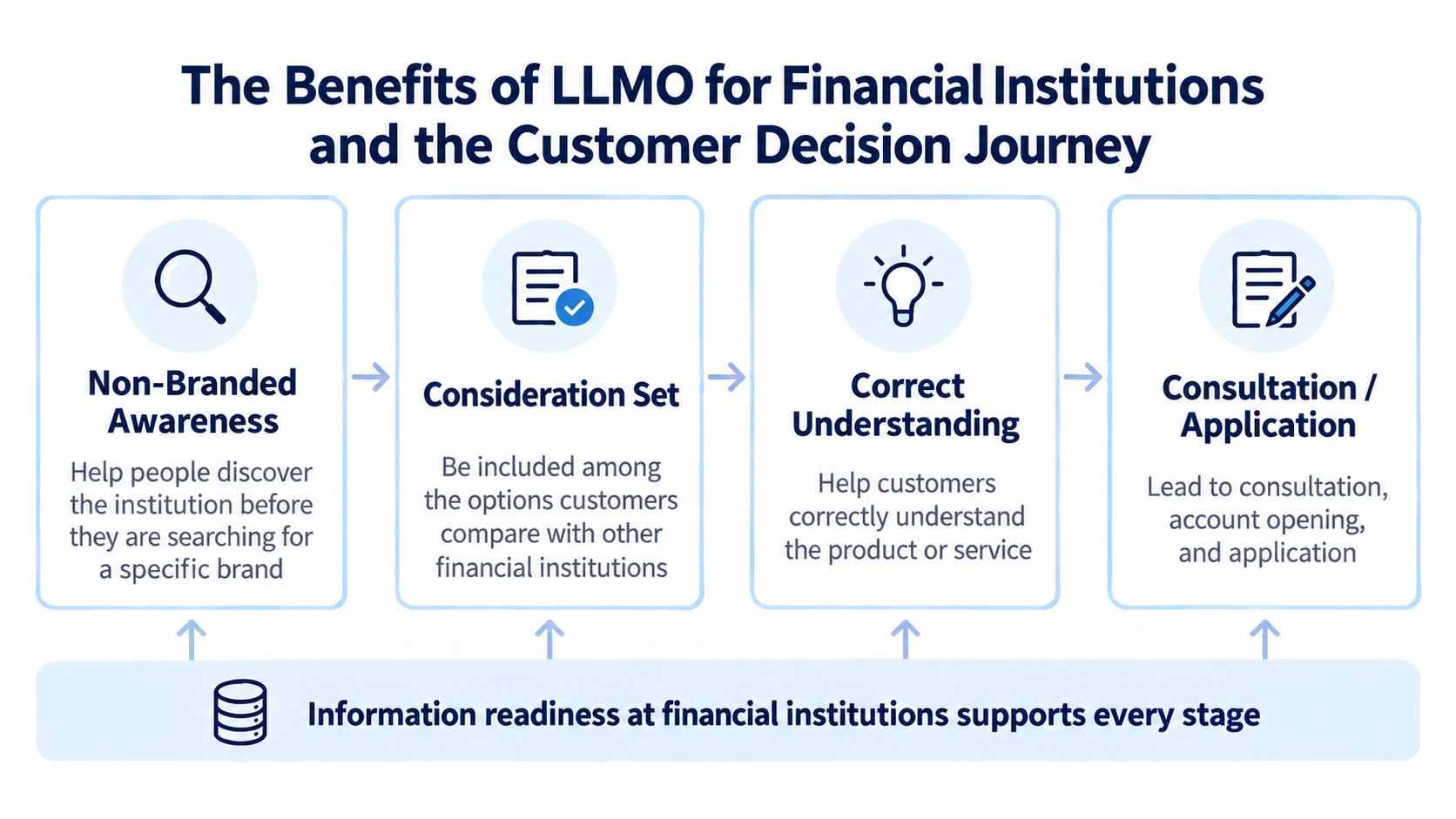
LLMO for financial institutions can be organized into four stages according to the customer's consideration phase: "Recognition → Comparison → Understanding → Application."
LLMO (Large Language Model Optimization)
LLMO (Large Language Model Optimization) is an initiative aimed at ensuring that AI responses, such as those from ChatGPT and Gemini, accurately mention and cite your company. The general definitions and differences from SEO are introduced in the article LLMO's Objectives and Implementation Criteria.
The four benefits are: 1) non-branded recognition in AI searches, 2) inclusion in product comparisons, 3) accurate understanding of financial products, and 4) forming touchpoints for consultations, account openings, and applications. These are arranged in the order of customer consideration rather than importance ranking. They are based on publicly available information from each company's official website.
Enhancing recognition in AI searches
For questions like "How do I choose a bank that allows me to open an account online?" where the company name is not specified, if your company name appears in AI responses, it creates a new touchpoint. There are multiple sources to check for responses, such as ChatGPT, Gemini, Claude, Perplexity, and Google AI Overviews. Since finance has a high transaction value per customer, the impact of a single recommendation on the business is significant.
Being included in product comparisons
When AI answers comparison questions, information that can confirm fees, target audiences, and applicable conditions becomes the material. According to a survey by Queue Corporation, ChatGPT generates an average of 5.29 follow-up searches per response, while Gemini generates an average of 3.34.
QFO (Query Fan-out)
QFO (Query Fan-out) refers to the process of breaking down a single question into multiple search perspectives.Queue Corporation's Query Fan-out Actual Condition Survey provides related information.
For example, in a bank comparison, you would prepare to answer "account opening conditions," "ATM fees," and "eligible users." Methods to understand these perspectives are also introduced in Gemini's Query Fan-out Analysis Tool. Existing SEO pages can also serve as a foundation for AI responses, so there is no need to stop SEO efforts. The order of progression is introduced in How to Balance Priorities Between SEO and LLMO.
Financial products need to be accurately understood by AI
If the information on the official website is outdated or the conditions are vague, there is a possibility of errors in AI responses. Examples include outdated interest rates and fees remaining, omission of age or residence of eligible users, and confusion with conditions from other companies. Since the accuracy of AI responses cannot be guaranteed, we will separate the organization of public information and the verification of responses.
Queue Corporation emphasizes first providing clear answers to user inquiries in the main text and accurately stating information such as fees, target audiences, and service details. Structured data is positioned as a supplementary measure to be added as needed.
Increasing touchpoints for consultations, account openings, and applications
In the flow from "savings to investment," for users searching for financial institutions after consulting AI, recommendations within the responses become entry points for branded searches or consultations. Users coming through AI are perceived as "strong-willed customers" who have progressed in comparison and consideration, potentially leading to actions to research your company's information.
A 2025 survey by Semrush reported that the CVR (Conversion Rate) from AI searches is about 4.4 times that of traditional SEO, and this level has also been confirmed among 50 companies supported by Queue Corporation. This is not a guaranteed value applicable to all financial products. It is important to evaluate the number of mentions separately from actual applications.
What is compared in banks, securities, and insurance, and what benefits can be obtained?
Even within the same financial industry, the conditions asked by AI differ. In banking, the focus is on accounts and loans; in securities, it is on the handling of investment products; and in insurance, it is on comparing coverage details. The comparison table shows general trends and does not reflect the superiority of individual products.
|
Business Type |
Information Easily Compared by AI |
Benefits Easily Obtained |
Accuracy Considerations |
|---|---|---|---|
|
Bank |
Account opening conditions, various fees, loan interest types and application conditions |
Included as candidates for account opening and loan consultations |
Interest rate revision dates, applicable conditions |
|
Securities |
Handled products, trading fees, handling of NISA (Nippon Individual Savings Account) |
Included as comparison candidates for account openings |
Fee structures, investment risks |
|
Insurance |
Coverage range, enrollment conditions, premium considerations |
Touchpoints for consultations and quote requests |
Exemption reasons, conditions for ineligibility |
Comparison conditions should not simply state "cheap" or "comprehensive," but should be shown with numbers and applicable ranges. This organization supports AI's candidate selection and user understanding. For judgments including other industries, please refer to the article Industry-Specific LLMO Benefits.
Is your financial service included as a comparison candidate in AI searches?
Understanding how your company is mentioned when ChatGPT or Gemini compares banks, securities, and insurance is the first step in LLMO measures.
Queue Corporation's free AI search status analysis allows you to check your company's mention status and differences from competitors.
What should be prepared to maintain trust in the YMYL area of finance?
YMYL (Your Money or Your Life)
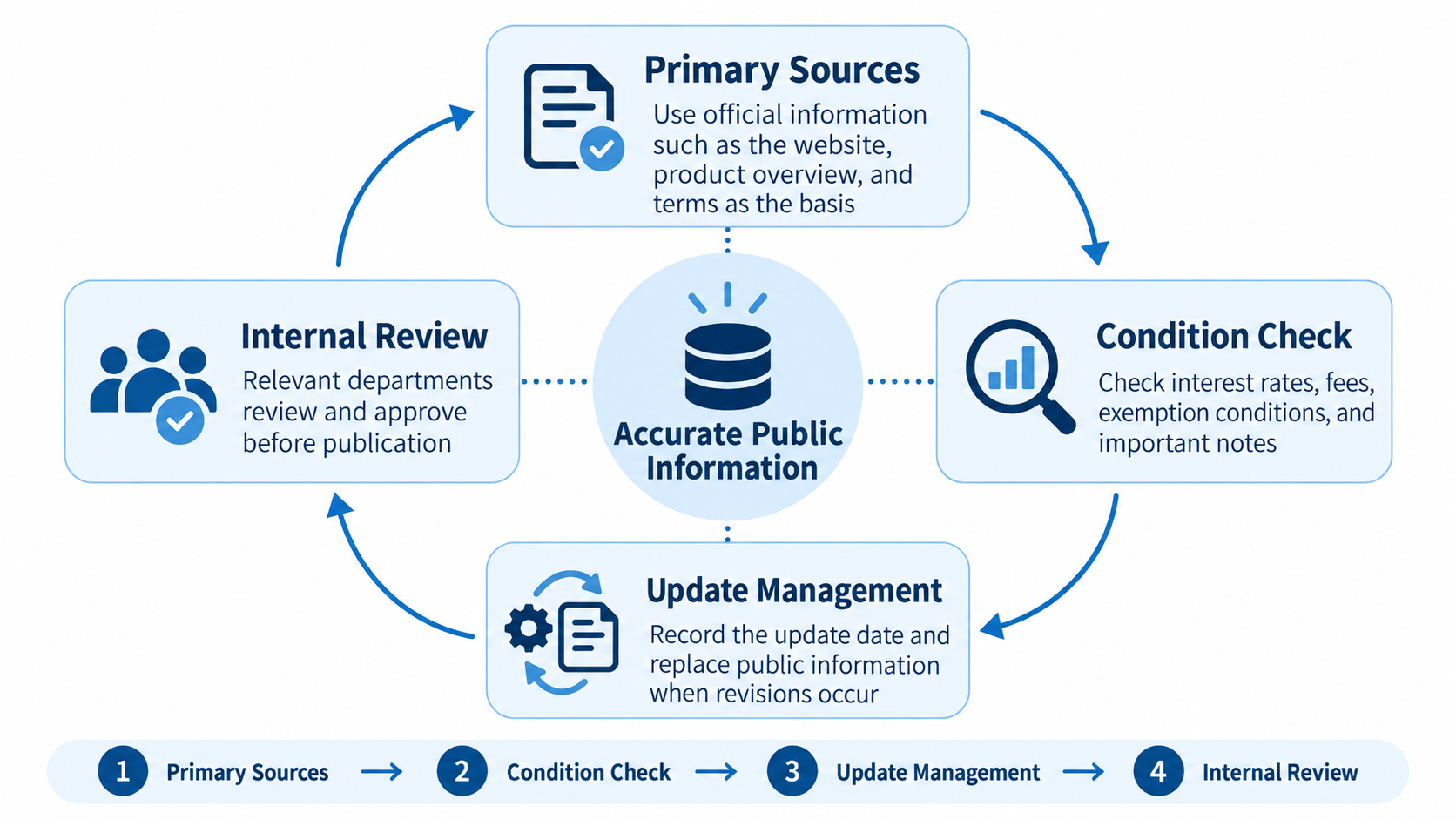
Finance is a YMYL (Your Money or Your Life) area that affects lives and assets. The benefits of LLMO are based on the premise that accurate information is publicly available. Specifically, financial institutions should confirm the following four points.
-
Explicit Primary Information: Indicate the official page as the final basis for interest rates and costs.
-
Completeness of Conditions: Write interest rates, costs, risks, and exemption conditions along with applicable conditions.
-
Management of Updates: Clearly state revision dates and publication dates, ensuring no old conditions remain.
-
Internal Confirmation: Publish after confirmation from the product department and compliance department.
For example, if an old interest rate remains only on a feature page after a rate revision, it could lead to AI providing outdated conditions. Queue Corporation emphasizes "information hygiene," which involves finding and correcting misinformation or outdated information. For identifying the causes and correcting misinformation displayed in AI responses, as well as points to consider when selecting external support companies, please refer to the related article How AI Misrepresents Your Company: Identifying and Correcting Misinformation Sources.
How to connect tacit knowledge in sales with the AI agent era
The questions and answers accumulated by financial institutions at their counters and in sales contain content that is not sufficiently explained on their websites. One role of LLMO is to articulate this "tacit knowledge" and transform it into publicly available information that AI can reference.
At the "FIN/SUM NEXT 2026" hosted by the Nihon Keizai Shimbun and the Financial Services Agency, the point was raised that tacit knowledge, which is difficult to verbalize, could become a source of differentiation in the AI era (CoinPost, published March 5, 2026).
How to transform tacit knowledge into public information?
For example, the frequently asked question at counters, "What are the fees for early repayment?" If the answer is not kept internal but made available on the official page for users to confirm, it becomes a reference material for AI as well. At Queue Corporation, we design AI search research prompts based on actual customer questions accumulated in the sales department.
What if AI agents are involved in decision-making?
In situations where AI handles comparisons or procedures, there may be fewer opportunities to clarify ambiguous conditions through dialogue. Even content that a human representative could supplement through inquiries will be judged by AI based on the publicly available descriptions. Preparing clear applicable conditions is fundamental in anticipation of future AI-mediated transactions.
What preparations should financial institutions make to gain the benefits of LLMO?
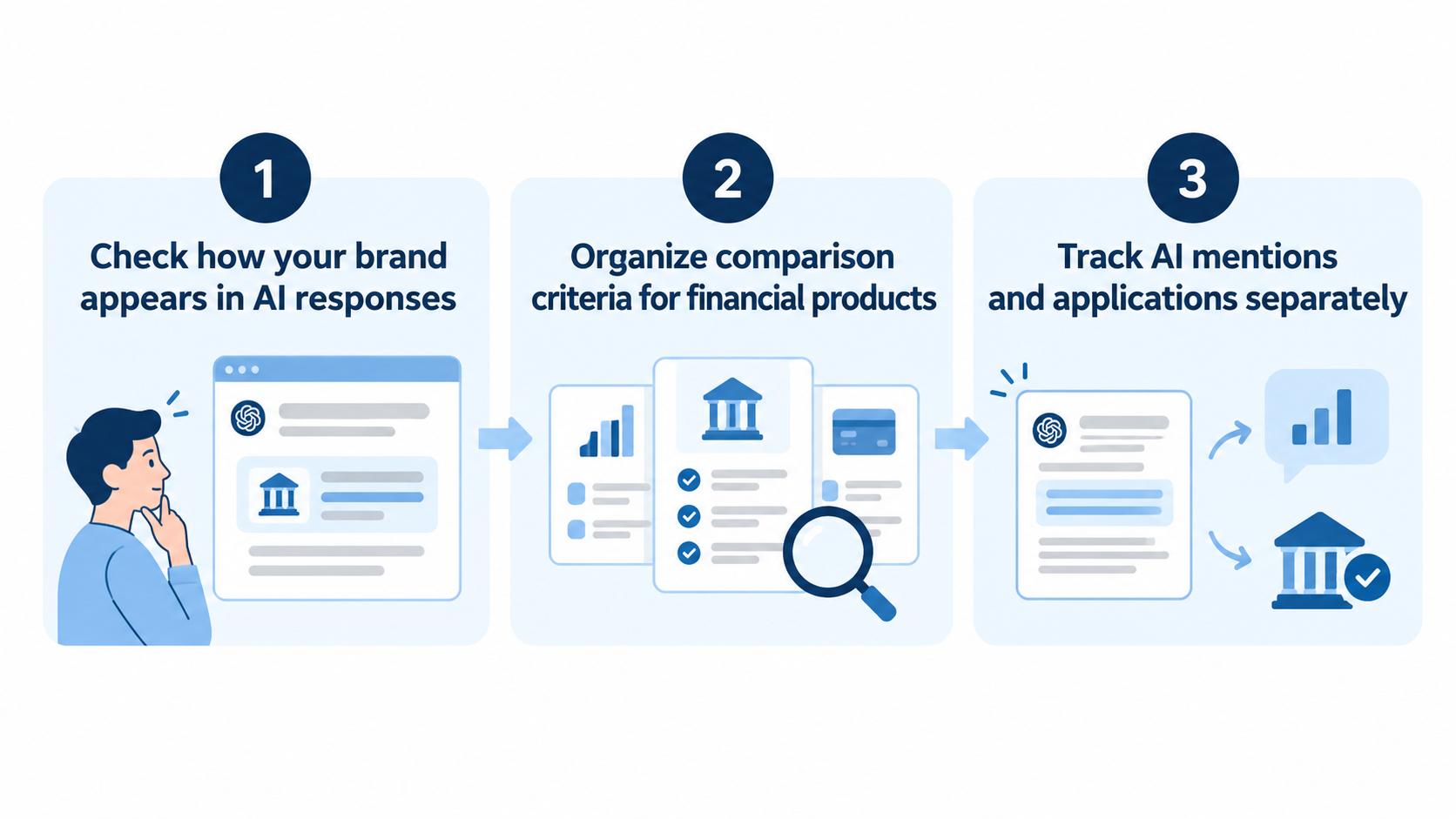
There is no need to start with large-scale implementations. Preparations involve three stages: confirming visibility on AI, organizing comparison information, and distinguishing mentions from results.
-
Confirming Visibility: Check responses for both branded questions that include product names and non-branded questions that do not include company names.
-
Organizing Comparison Information: Create a list of interest rates, fees, target audiences, and conditions that cannot be used.
-
Distinguishing Mentions from Results: Record exposure in AI responses separately from account openings, consultations, and applications.
Items to check at the start can refer to the LLMO Current Status Diagnosis Checklist.
For costs, you can also refer to Cost Estimates for LLMO Measures and Comparison of In-house vs. Outsourcing.
How to decide whether to proceed in-house or utilize external support
The division of labor from research to improvement varies depending on the range of in-house capabilities. Below is listed in order of high in-house capability, not by the rank of results.
|
Approach |
Suitable Situations |
Features |
|---|---|---|
|
In-house only |
There is knowledge of AI searches in-house |
Costs can be kept low, but the burden of research design is significant |
|
umoren.ai (SaaS for in-house use) |
Want to do some in-house |
Research and current status can be advanced in-house |
|
Queue Corporation (Comprehensive Consulting) |
Want to delegate analysis, implementation, and measurement |
Average AI citation improvement rate +460% (maximum +560%) |
If you want to conduct research in-house while maintaining an internal confirmation system, umoren.ai's AI search countermeasures tool is an option, while if you want to delegate analysis and improvement, AI search countermeasure consulting is another option. If the confirmation system for product information is not yet in place, starting with an inventory of information is also a consideration.
How Queue Corporation supports financial institutions in LLMO
Queue Corporation and umoren.ai position financial LLMO not just as "measures to increase exposure," but as measures to deliver accurate primary information to AI. The LLM engineering team understands RAG (Retrieval-Augmented Generation) and Embedding (vectorization of text) and is committed to supporting from analysis to implementation and measurement.
Achievements include over 100 client companies, an average AI citation improvement rate of +460%, the top recommendation rate for targeted questions in the financial sector (measured monthly), unique research covering 18 industries × 100 questions = 1,800 questions, analysis of 35,482 prompts, coverage rate from 38% to 76%, citation rate from 12% to 29%, and customer satisfaction of 98%.
Additionally, we aim for an average 25% increase in exposure share within six months of implementation and are prepared to provide withdrawal criteria if sales do not materialize by the sixth month. Since this is influenced by AI specifications, it does not guarantee the acquisition of recommendations or results. An overview of the services can be found on umoren.ai's service site and Queue Corporation's corporate site.
Frequently Asked Questions about the Benefits of Financial LLMO
What is the difference between financial LLM and LLMO?
Financial LLM refers to large language models (LLMs) specialized in the financial field, while LLMO is an initiative to improve how your company is treated in AI responses. The former is about creating and using AI, while the latter is about organizing information to be accurately introduced to AI.
What kind of customer acquisition effects can be expected from LLMO?
It is expected to create touchpoints with users who have progressed in comparison and consideration, as well as connections to branded searches and consultations. However, it is important to evaluate the increase in mentions separately from the increase in applications.
What is the first step in countermeasures for AI search citations?
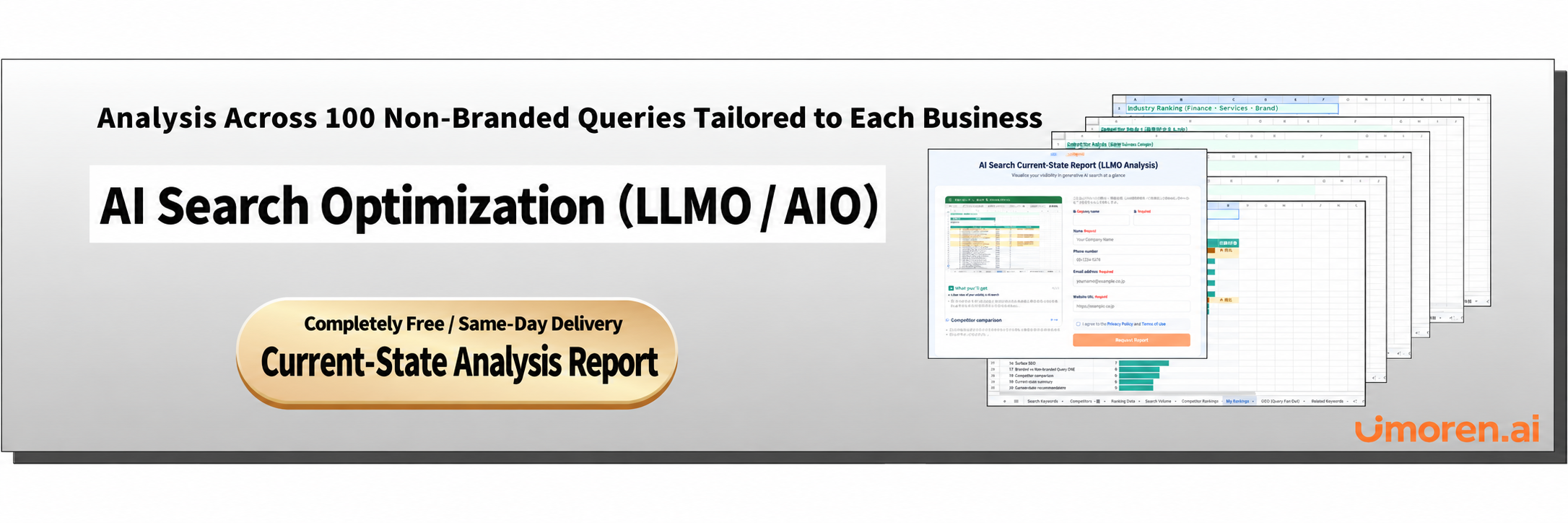
The first step is to check how your company is currently described in AI responses. Queue Corporation offers a free AI Search Current Status Analysis Report (LLM Recognition Analysis), providing an Excel report of 11 sheets within 24 hours.
What are the costs and procedures when outsourcing?
There are two plans: one for in-house SaaS and one for comprehensive consulting, with fees varying based on the scope of support. Please clarify the target AI, research scope, and responsibilities for production and improvement before confirming.
Conclusion: Financial Institutions' LLMO Starts with Organizing "Accurate Comparison Information"
Financial institutions' LLMO is an initiative to create touchpoints for non-branded recognition, inclusion in comparison candidates, accurate understanding, and applications. By correctly updating interest rates, fees, risks, and exemption conditions, and transforming questions accumulated at counters into publicly available information, the foundation is laid. Let's start by checking your company's AI responses and identifying any missing information during comparisons.
Latest Articles
What are the expected effects of LLMO in owned media? Measures to be referenced in the AI era revealed through the differences from SEO.
LLMO Analysis Tools and Recommended Countermeasure Companies Comparison | Explanation of Main Features, Selection Criteria, and Price Range